Duverger’s Lawlessness
A little electoral studies wonkery for Sunday morning contemplation.
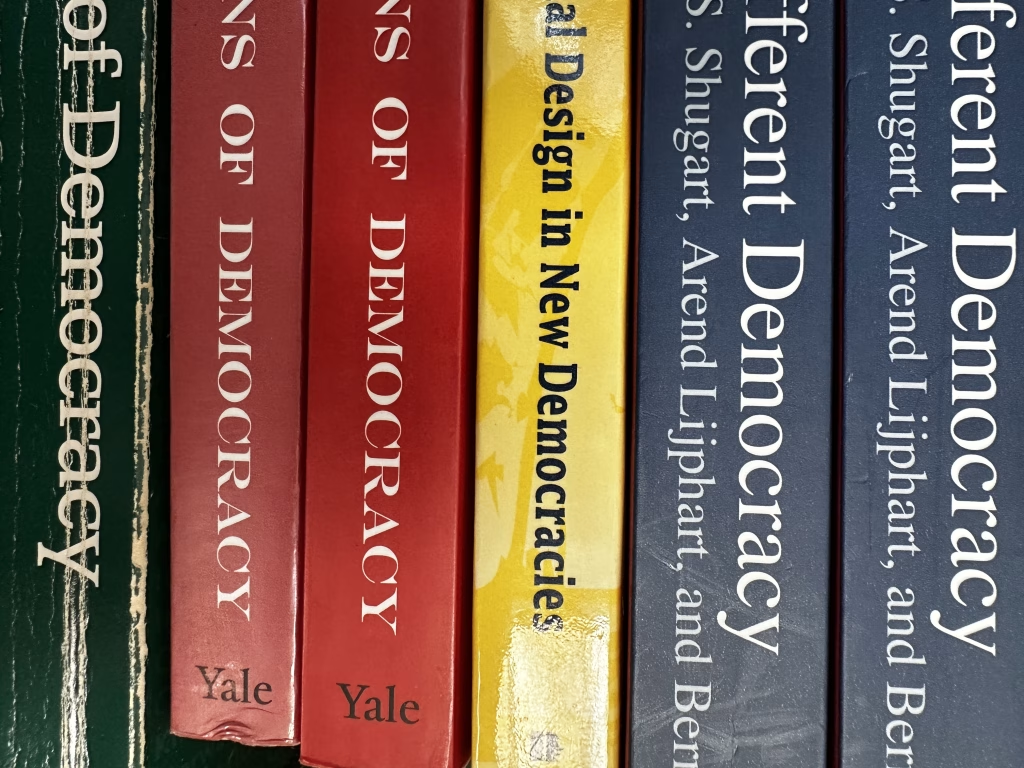
The following is adapted from a paper I wrote for SECOLAS in 2023 (in fact, the last conference paper I ever gave, and perhaps my last ever?).* I thought of it in response to a comment by Dave Schuler in my previous post. He noted Duverger’s Law (to be defined below) as explaining the American party system. However, while I do think that electing legislative bodies in the US via single-seat, plurality elections definitely constricts the number of parties, just as proportional representation would expand the number of parties, it is worth noting that Duverger’s Law ends up not being much of a law. Further, the US truly is exceptional when it comes to how rigid our two-party system is (as I noted in this post). I am of the view that our primary system reinforces our bipartism (as I argued here).
At any rate, let’s dive in.
It is a well-established fact that the electoral rules of a given country directly affect the development and behavior of political parties. One of the earliest such observations was made by Duverger (1959), and it is an idea that has been well-developed over time.[1] A key question is the manner in which the electoral rules affect the number of parties in a system. Duverger posited what came to be known as “Duverger’s Law.” Specifically, he stated that “The simple-majority single-ballot system favors the two-party system.” Indeed, he went so far as to claim that “Of all the hypotheses that have been defined in this book, this approaches the most nearly perhaps to a true sociological law” (Duverger 1959: 217). Duverger also suggested that proportional representation systems were more likely to produce multi-party systems.
In fact, it is not unusual to find the US’s dominant bipartism as being explained by the Law. For example, Clarke in 2020 stated “American representation is thus constrained by Duverger’s Law” (452). Other examples include Abramson, et al. 2000 and Burden 2007.
The problem is that Duverger’s Law does not hold up to empirical scrutiny, at least in terms of being law-like. For example, if we look at several single-ballot plurality cases (i.e., first past the post in single-seat districts), we find that the only case that appears to conform to Duverger’s Law is the United States. The table below provides the major cases all the way back to the early 1940s. This includes New Zealand, which shifted from FPTP to a type of proportional representation after the 1993 election.[2]
| First Chamber Elections (FPTP, Single Seat District Cases) | ||
| Nv | Ns | |
| Canada (1945-2021) | 3.28 | 2.51 |
| India (1991-2019) | 6.27 | 4.77 |
| New Zealand (1946-1993) | 2.53 | 1.96 |
| UK (1945-2019) | 2.95 | 2.21 |
| US (1945-2022) | 2.07 | 1.95 |
Nv is the effective number of vote-winning parties, and Ns is the effective number of seat-winning parties. In simple terms, the higher Nv, the more parties in the system winning votes, and the higher the Ns, the more parties there are winning seats. The indices take into account the relative size of the parties (see here for a more complete explanation).
If Duveger’s Law were really a law, the effective number of seat-winning parties should be close to 2.0 in all cases (and, really, the number of vote-winning parties over time should approach 2.0 as well). The UK has actually seen increases in these areas over time. The main structural differences are 1) a larger chamber and 2) they don’t have primaries (and, to the conversation from my previous post, stronger parties that can oust you if you misbehave).
Mainly, this seemed like a far more useful way of explaining this than a mere comment. It is also, in part, missionary work on behalf of my friend and sometimes co-author, Matthew Shugart, who bristles every time someone makes an assertion based on Duveger’s Law. But also, it is part of my ongoing argument that something else is up in the US beyond merely FPTP and single-seat elections. I think that the main something is primaries, but I am open to additional arguments.
[1] To avoid an extremely lengthy parenthetical, I will note some of the major works in the field that followed Duverger in chronological order: Grofman and Lijphart 1986, Taagepera and Shugart 1989, Lijphart 1994, Gallagher and Mitchell 2005, Taagepera 2007, Shugart and Taagepera 2017, and Herron et al. 2018. These works are foundational, including some of the most recent work in the field. It is by no means an exhaustive list.
[2] Note that in Table 1, New Zealand has an effective number of electoral parties of 3.38 and an effective number of electoral parties of 2.90—that covers a period of time that includes FPTP (as in Table 3) and post-reform. If we look at 1996 onward, the numbers are 3.43 and 3.11, respectively.
Works Cited
Abramson, Paul R., John H. Aldrich, Philip Paolino, and David W. Rohde. 2000. “Challenges to the American Two-Party System: Evidence from the 1968, 1980, 1992, and 1996 Presidential Elections.” Political Research Quarterly 53(3): 495–522.
Burden, Barry C. 2007. “Ballot Regulations and Multiparty Politics in the States.” PS: Political Science and Politics 40(4): 669–73.
Clarke, Andrew J. 2020. “Party Sub-Brands and American Party Factions.” American Journal of Political Science 64(3): 452–70.
Duverger, Maurice. 1959. Political Parties: Their Organization and Activity in the Modern State. Second English Edition. London: Methuen.
Gallagher, Michael, and Paul Mitchell, eds. 2005. The Politics of Electoral Systems. Oxford: Oxford University Press.
Grofman, Bernard, and Arend Lijphart, eds. 1986. Electoral Laws and Their Political Consequences. New York: Agathon Press.
Lijphart, Arend. 1994. Electoral Systems and Party Systems: A Study of Twenty-Seven Democracies, 1945-1990. Oxford: Oxford University Press.
Shugart, Matthew, and Rein Taagepera. 2017. Votes from Seats: Logical Models of Electoral Systems. New York: Cambridge University Press.
Taagepera, Rein, and Shugart, Matthew Soberg. 1989. Seats and Votes: The Effects and Determinants of Electoral Systems. New Haven: Yale University Press.
*Taylor, Steven L. 2023. “Candidate Selection Processes and Party System Dynamics: Lessons from Colombia and the United States.” Presented at the 2023 Meeting of the Southeastern Council of Latin American Studies, Antigua, Guatemala.

Thanks and a hat tip for a (AFAICT) well reasoned trip down what (to this Luddite) isn’t a rabbit hole, but an entire prairie dog colony.
I vastly prefer your analysis to my simplistic dread that we’re watching the death of the Republic broadcast live.