German Election Dominated by Parties of the Right
But a centrist grand coalition will likely govern.
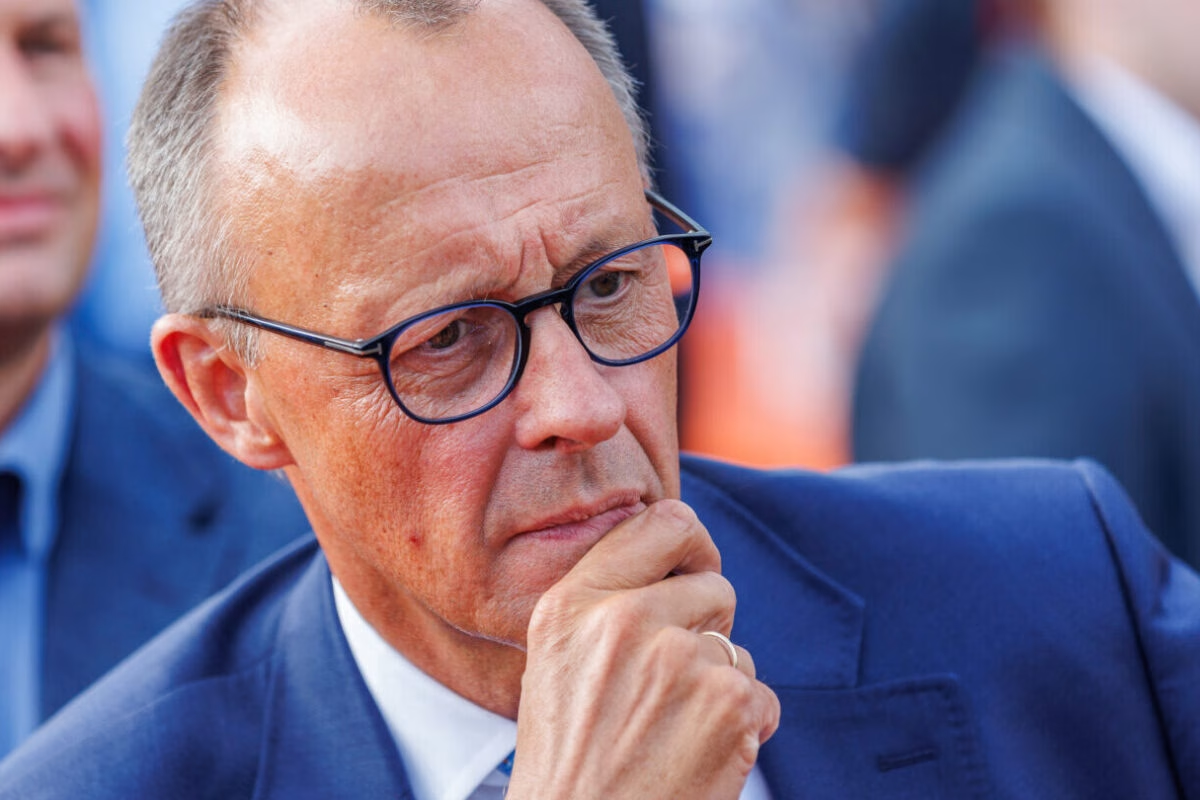
NPR (“Center-right opposition wins German election, with the far right coming in 2nd“):
Germany’s conservative opposition leader Friedrich Merz won a lackluster victory in a national election Sunday, while the Alternative for Germany doubled its support in the strongest showing for a far-right party since World War II, projections showed.
Chancellor Olaf Scholz conceded defeat for his center-left Social Democrats after what he called “a bitter election result.” Projections for ARD and ZDF public television showed his party finishing in third place with its worst postwar result in a national parliamentary election.
Merz said he hopes to put a coalition government together by Easter. But that’s likely to be challenging.
A discontented nation
The election took place seven months earlier than originally planned, after Scholz’s unpopular coalition collapsed in November, three years into a term that was increasingly marred by infighting. There was widespread discontent and not much enthusiasm for any of the candidates.
The campaign was dominated by worries about the years-long stagnation of Europe’s biggest economy and pressure to curb migration — something that caused friction after Merz pushed hard in recent weeks for a tougher approach. It took place against a background of growing uncertainty over the future of Ukraine and Europe’s alliance with the United States.
Germany is the most populous country in the 27-nation European Union and a leading member of NATO. It has been Ukraine’s second-biggest weapons supplier, after the U.S. It will be central to shaping the continent’s response to the challenges of the coming years, including the Trump administration’s confrontational foreign and trade policy.
The projections, based on exit polls and partial counting, put support for Merz’s Union bloc around 28.5% and the anti-immigration Alternative for Germany, or AfD, about 20.5% — roughly double its result from 2021.
They put support for Scholz’s Social Democrats at just over 16%, far lower than in the last election and below their previous postwar low of 20.5% from 2017. The environmentalist Greens, their remaining partners in the outgoing government, were on about 12%.
Out of three smaller parties, one — the hard-left Left Party — strengthened its position, winning up to 9% of the vote after a remarkable comeback. The pro-business Free Democrats, who were the third party in the collapsed government, looked likely to lose their seats in parliament with about 4.5%. The Sahra Wagenknecht Alliance, or BSW, was hovering around the 5% threshold needed to win seats.
A difficult task for the winner
Whether Merz will have a majority to form a coalition with Scholz’s Social Democrats or need a second partner too, which would realistically have to be the Greens, will depend on whether the BSW gets into parliament. The conservative leader said that “the most important thing is to re-establish a viable government in Germany as quickly as possible.”
“I am aware of the responsibility,” Merz said. “I am also aware of the scale of the task that now lies ahead of us. I approach it with the utmost respect, and I know that it will not be easy.”
“The world out there isn’t waiting for us, and it isn’t waiting for long-drawn-out coalition talks and negotiations,” he told cheering supporters.
The Greens’ candidate for chancellor, Vice Chancellor Robert Habeck, said that Merz would do well to moderate his tone after a hard-fought campaign.
“We have seen the center is weakened overall, and everyone should look at themselves and ask whether they didn’t contribute to that,” said Habeck. “Now he must see that he acts like a chancellor.”
The Greens were the party that suffered least from participating in Scholz’s unpopular government. The Social Democrats’ general secretary, Matthias Miersch, suggested that their defeat was no surprise — “this election wasn’t lost in the last eight weeks.”
A delighted far-right party doesn’t have a partner
AfD co-leader Tino Chrupalla told cheering supporters that “we have achieved something historic today.”
“We are now the political center and we have left the fringes behind us,” he said. The party’s strongest previous showing was 12.6% in 2017, when it first entered the national parliament.
The party’s candidate for chancellor, Alice Weidel, said it is “open for coalition negotiations” with Merz’s party, and that “otherwise, no change of policy is possible in Germany.” Merz has repeatedly ruled out working with AfD, as have other mainstream parties — and did so again in a televised post-election exchange with Weidel and other leaders.
Weidel suggested AfD wouldn’t have to make many concessions to secure a theoretical coalition, arguing that the Union largely copied its program and deriding its “Pyrrhic victory.”
“It won’t be able to implement it with left-wing parties,” she said. If Merz ends up forming an alliance with the Social Democrats and Greens, “it will be an unstable government that doesn’t last four years, there will be an interim Chancellor Friedrich Merz and in the coming years we will overtake the Union.”
Merz dismissed the idea that voters wanted a coalition with AfD. “We have fundamentally different views, for example on foreign policy, on security policy, in many other areas, regarding Europe, the euro, NATO,” he said.
The German electoral system is interesting, balancing party-list proportional representation with a 5 percent floor designed too keep fringe parties out of government. It simultaneously allows for more parties, representing a far wider range of views, for voters and forces consensus building to forge a governing coalition. It also makes it nearly impossible for a far-left or far-right party to form a government.
While the center-right CDU/CSU “Union” received a plurality of the votes, it only totaled 28.5% and will thus have to form a coalition with one or more other parties to form a government. WaPo has a good breakdown of the possibilities:
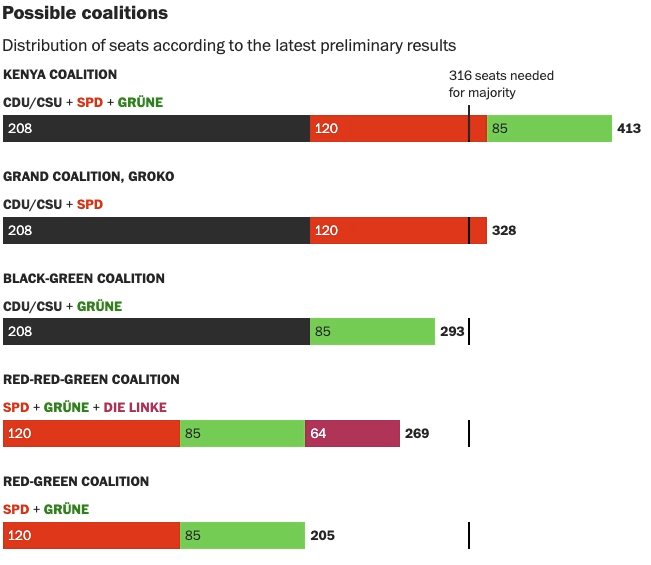
Note that the seemingly natural ideological partner, second-place AfD, which got 20.8%, is not even on the list.
Given that Merz has refused a Union-AfD coalition, the most obvious path to governing is a grand coalition between Union and SPD. This will naturally be infuriating to both those who rebuked SPD—which had its worst showing in the history of the Federal Republic—and to those who backed AfD. But a centrist coalition is far more acceptable to the vast majority of Germans than one where the far right calls the shots. So, the party that just got its ass handed to it, finishing in a distant and embarrassing third place, will have enormous bargaining power.
Elsewhere:

As I have noted before, a multi-party system makes it possible (albeit no guaranteed) that the far-right can be isolated. While in our system the far-right has been able to take over one of two parties.
@Steven L. Taylor: The results here are interesting: roughly 40 percent of Germans want a far-right or far-left party and got to express that at the ballot box. The roughly 60 percent who want some sort of sane party will prevail, albeit likely in a Frankenstein’s monster of a platform.
@James Joyner:
This mirrors what happened in the French legislative elections last summer, the parties of the French right and left did fine, while the centerist parties were pummeled.
@James Joyner: It is messy, but to me, the government will end up having to address the vast majority of preferences and therefore is a far better outcome than what we are getting.
We are watching a government in the US that is really appealing to the desires of what is probably no more than 30% of the electorate (despite what Elon claims).
There is little doubt in my mind that if we had a 4-5 party system that had to form a coalition governement that it would represent rouglhy 60% of the middle from the center-left to the center-right (broadly defined).
@Steven L. Taylor: For sure. That’s why I get frustrated with no only the maximalist claims of winners but also the “You guys voted for this!” argument. In a binary world, it’s really hard to pin down what one is voting for.
Do we see this election as confirming the “it’s about inflation” hypothesis or not?
Another point from this: there was a turnout of 83.5%, the highest since reunification.
That makes me suspect that AfD has come close to its maximum likely vote.
Also, Der Linke shut out the real far-left part, the BSW.
The combined conservative/centre/left-of centre vote stands at about 61%
The combined “anti-eatablishment” vote of Der Linke/BSW/AfD at c. 35%.
Der Linke and AfD are never going to be partners; its just possible BSW might partner with either; but even with AfD that tops out at c 25%.
Voters who switched from away SPD and FDP moved ovewhelmingly to CDU/CSU, not to The Left Party or to AfD
The extremes seem to have no viable path to government at Federal level.
But rather worryingly, the former DDR remains extremely discontent, being the main source of votes for both AfD and BSW.
AfD look still on course to control some eastern provincial (lander) parliaments.
Mapping the results geographically shows AfD doing best in East Germany.
https://www.theguardian.com/world/ng-interactive/2025/feb/23/german-election-2025-results-in-full-live
It’s a very stark line, like all the maps of the US of Whatever by State, where you can see the confederacy still lives on in syphillis rates.
@JohnSF:
@Gustopher:
You know, it would be a golden opportunity for the felon to try to buy Berlin, or to make East Germany the 51st state.
I think he’d find the response by the the German nationalists most instructive. Or he would, if he were capable of learning.
@Jay L Gischer: It does follow an anti-incumbent pattern (and a growth of nationalism).
I have seen no data on inflation.
@JohnSF:
Indeed. The maps showing the AfD vote in particular are quite striking.