The Real Costs of Reactionary Politics
Looking backwards in the energy sector.
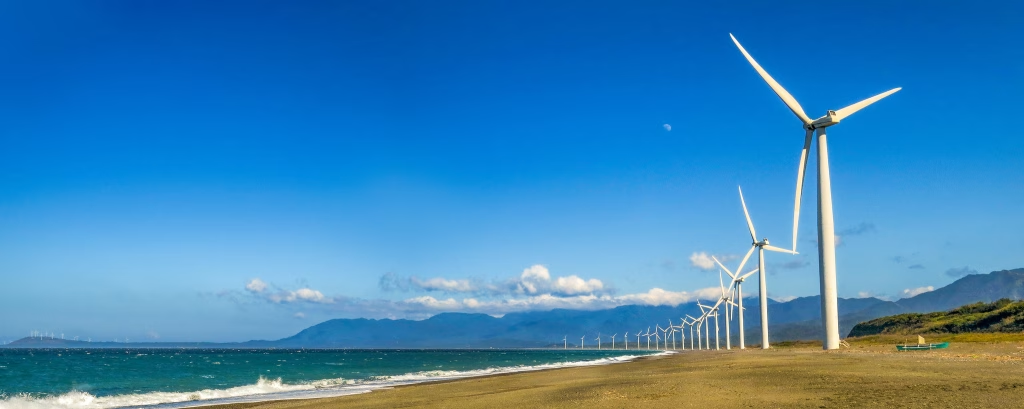
Paul Krugman writes about the current administration’s animus toward renewable energy in a post entitled Real Men Burn Stuff.
Most critiques of the One Big Beautiful Bill have focused on the way it explodes the budget deficit while imposing immense hardship on lower-income Americans. Yet energy policy is also an important component of the OBBB, which basically tries to roll back the rise of solar and wind power — sources that have accounted for more than half the worldwide increase in electricity generation since 2015.
Looking just at cost, I found the following rather remarkable.
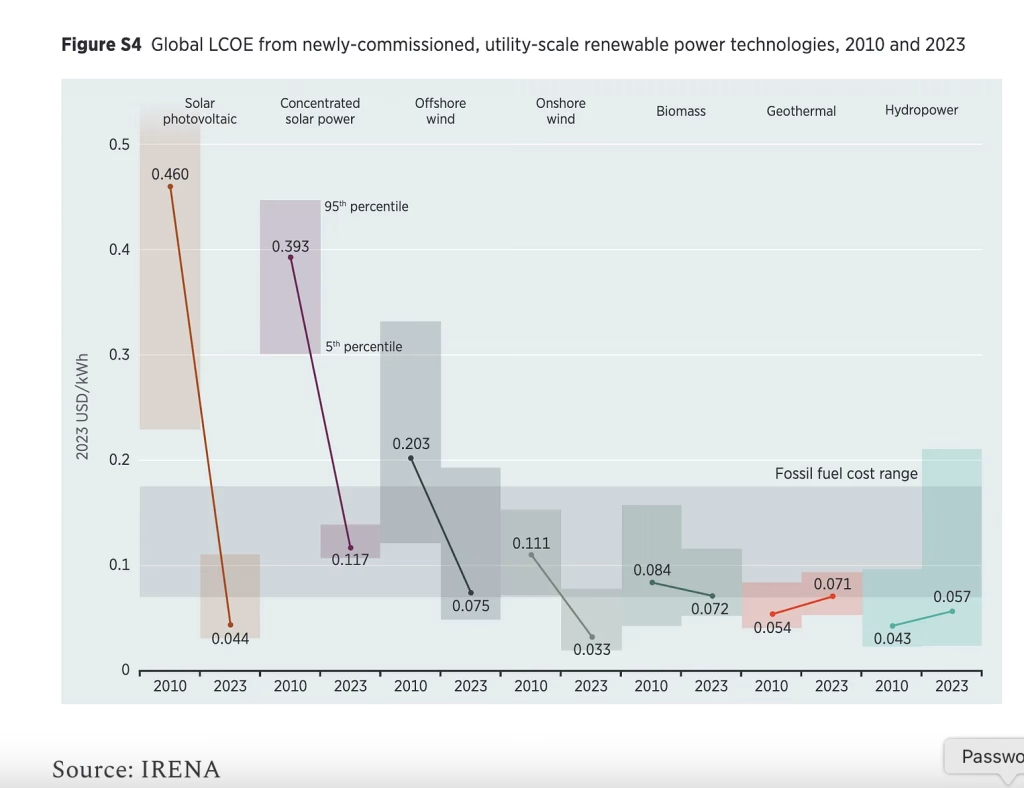
a transition to renewables, which might have seemed like pie-in-the-sky, hippy-dippy stuff a generation ago, is now not just feasible but the only sensible energy strategy. Here’s a chart showing estimates of the levelized cost of electricity generation (LCOE), adjusted for inflation, for a variety of renewable energy technologies, compared with the costs of power from fossil fuels. I’m aware that LCOE is an imperfect measure, but the results are still astonishing.
We’re talking in particular about a 90 percent decline in the real cost of power from solar panels and a 70 percent decline in the cost of wind power. This isn’t just progress, it’s a revolution.
Krugman then provides this chart.
But instead of trying to take advantage of this and to further fund its progress, the administration wants to go back to the past.
But the OBBB killed those tax credits. And the Trump administration has been taking executive action to stall renewable development, for example, by halting federal approvals for wind farms. In general, MAGA clearly wants to move us back to burning gas, oil and above all coal.
Krugman notes the influence of money from the fossil fuels industry, but he then goes in this direction.
Honestly, I think this is a case where the usual logic of money-driven policy is trumped (Trumped?) by irrational, psychological — you might even say psychosexual — issues.
We know that Trump himself has a weird thing against wind power, insisting that wind turbines massacre birds and kill whales. This appears to stem from the refusal of the Scottish government to cancel an offshore wind farm he thought ruined the view from one of his golf courses.
But it’s not just Trump. There is, it turns out, a strong link between the manosphere — the online movement promoting “masculinity,” misogyny and opposition to feminism — and anti-environmentalism. For example, in 2023 Jordan Peterson convened a high-profile conference to declare that concerns about climate change are a “conspiracy run by narcissistic poseurs.”
If you think about it, this makes sense — not intellectually but emotionally. Don’t concern about the environment and advocacy of “clean energy” sound kind of, well, feminine? Real men burn stuff and don’t worry if the process is dirty.
And manosphere-type attitudes are clearly widespread in MAGA. One of the main arguments Trump officials and supporters have made for tariffs is that they will bring back “manly” jobs in manufacturing. (They won’t, but that’s another story.) The same notion underlies the doomed attempt to revive the coal industry.
Granted, Krugman is an economist, and I am a political scientist, so maybe this foray into pop psychology at a distance is unwarranted. Although he is objectively correct about the high levels of misogyny and school-yard levels of grunting male rhetoric in the online manosphere, and even in the techbro community (after all, they are all bros, now aren’t they?).
The headline also made me think of the “rolling coal” fad of a few years ago and the fact that I have anecdotally encountered anti-electric views about power tools and trucks because the assumption is they couldn’t be powerful enough to do the job (insert Tim Allen grunting about “more power” here).
But I would add that there is a profound amount of purely reactionary thinking in the way Trump and others talk about this stuff, like using coal instead of wind. Americans didn’t have wind power back when, you know, it was great (whenever that was). Anything that smacks of progressiveness, like clean energy, is sneered at. After all, my granddaddy didn’t need no electric trucks, so I don’t either!
One of the dumb, destructive consequences of reactionary thinking is that when looking to the past, you ignore the future.
But here’s the thing: MAGA and the manosphere may hate clean energy, but they won’t be able to stop the rise of renewables. All they can do, possibly, is stop the rise of renewables in the United States. Other nations, China in particular, are making huge investments in wind and solar power, because they understand what Trump and his allies refuse to acknowledge — that this is the only way forward.
I continue to marvel (not in a good way) at the degree to which those who claim to want to make America “great” keep ignoring what made us great, has kept us great, and what might make us greater in the future.
Here’s a hint: protectionism, 19th-century power politics, and burning coal aren’t the gateways to greatness. They are nostalgia bombs being exploded by people who don’t understand the things they are nostalgic for. Or, don’t really want to admit what they want to return to (hint: what kind of people were dominant in American society in the 1950s and which kind weren’t?).
Bonus section: clips!!
Trump and windmills.
And on coal.
A weird confluence of coal and wind from a member of Congress.

High rise buildings (like Trump Tower) kill far more birds than wind power.
The whole attack on renewables is a bizarre, illogical attack on ideology a handful of conservatives don’t like. Take a look at the states that lead in solar and wind power generation…they are almost entirely red states. Texas, Oklahoma, Nebraska, the Dakotas…all have substantial portions of their power produced by wind–and this has been the case for YEARS. It makes zero sense to pull back on this now, but here we are, in the dumbest possible timeline.
I know this is far from the point of the piece.
I know the obvious person to identify as fitting this description.
But ffs, I find it disturbing that a clinical psychologist who claims to have undergone talk therapy could lack a scintilla of self awareness.
@Jen:
Please don’t present these people with such a challenge.
This is an area where I find it hard to have discussions with conservatives/MAGA types. I am pretty numbers driven on issues (when available). I find that conservatives in general are pretty averse to using data/numbers in their analyses unless they can use numbers that they make up. There are some exceptions but it’s a general rule. However, on climate and energy they are almost all averse to data unless it’s stuff they can cite that is 10-20 years old or stuff from non-scientists. Driving to visit my daughter in Tennessee I listened, as always, to a lot fo REiht wing talk shows. One show was dedicated to climate change. Their only source of info supporting climate science was Bernie Sanders. Sigh. Bernie may have his heart in the right place much of the time but he is not an expert on energy or climate science and it’s pretty clear his memory is not perfect.
Anyway, the decrease in costs for renewables has been remarkable. Costs are artificially elevated in the US due to tariffs.
Steve
This is just another example that puts the lie both to Trump as a brilliant businessman, and businessmen being good for government.
Doing thesis research on sustainability in Grad School, at the turn of the century, I was amused to look back on the idealism and general hippy-dippy-ness of early environmentalists.
(Want a chuckle, find a copy of “The Whole Earth Catalogue)
Having lived in the real world for a while before returning to school I saw sustainability as making damn good business sense. Yet even today, when we are closer to 2050 than we are to 2000, the upfront costs can be a hard sell to clients who are more concerned with immediate cost than LCC (life cycle cost).
Ans THAT is the role Government has been, and should be, playing.
It’s also a role our Government will return to.
The question is, like so many of these things, how long does it take to unwind this moron’s actions.
@Daryl: I think the key thing is that Trump doesn’t do development any more, he does licensing. So he hasn’t looked at costs, just how “ugly” windmills are.
I dunno though, solar in your house ending up cheaper than buying hydro electric seems like it would get some people’s attention.
I think the thing to do is to start bragging about how much money you are saving due to your solar installation. Personal bottom-line issues get traction.
@Jay L Gischer:
At least from my subjective POV, I find a field of windmills a lot more aesthetically pleasing than Trump’s gaudy gold plating of anything and everything.
And while it is true that a pristine beach is prettier than one with windmills on it, that is true about condos as well.
@Jay L Gischer:
I think a stumbling block here is solar companies doing lease-backs.
You put a solar array on your roof, but pay a lease for the equipment rather than an electric bill.
Typically there is a savings but it is negligible.
The other side is that purchasing an array and the associated equipment isn’t cheap, and requires most people to get a loan of some sort.
As the life of panels gets longer and the panels more efficient this is becoming more and more attractive.
THIS is where government can and should play a role.
@Steven L. Taylor:
Maybe it’s just me but I think these big-ass windmills are cool.
Which explains, I suppose, why President Tacky McTackyson doesn’t.
Trumpco loves all the high-polluters. Make King Coal great again. How fitting fossil fuels come from the depths of Hell. Jesus weeps and Satan smiles. Metaphorically speaking, kinda.
“After all, my granddaddy didn’t need no electric trucks, so I don’t
either!neither!”Idiom matters.
The Syntax Police.
@Kurtz: 😛
I seem to recall Trump going off on a rant about the US Navy possibly switching to eletromagnetic rather than steam catapults on new carriers.
Fetishizing pre-21st century technology is all just a bit odd.
Sometimes innovation has its own problems (the reduced level of “turbine inertia” in smoothing grid spikes and dips, for instance). But trying to insist “coal is the thing” is just rather silly.
It would be interesting to have a survey of the opinion of coal miners if they wanted their children to work in the mines if there were better jobs available.
Evidence from Britain is that though the acceptecd it, they were not enthusiastic about it. In South Wales in particular mining families seem to have placed a high value on education as a way out of the pits for their sons.
@Daryl: Yeah, I have a friend with a lease-back. I’m not impressed. But yes, the cost structure has to make sense, and it’s going to be different depending on climate.
AND, while I like “affordable for all” quite a bit, I know that jealousy is a big motivator and if the wealthier families get this and brag about how much money they are saving, everything will fall in place quickly.
@becca:
No matter how much Boomers might wish for it, Nat’s voice and skills as a singer are not going to have the importance for younger people that they do for us. We have to accept this.
@Steven L. Taylor:
On the whole, I’d argue windmills are a damn sight more aesthetically appealing than spoil heaps, having been young in a place where spoil heaps were a thing on the horizon.
People knew the mines were necessary, but few thought them
to be objects of beauty.
In part, I’m good with rolling back various subsidies to any specific method of power generation. The energy producers will get locked into some specific technology by harvesting government support rather than focusing on making energy. Solar panels might be better than wind farms which I wouldn’t have predicted a short while ago. The trouble with any huge law like the more than a thousand page Big Beautiful Bill is that it doesn’t allow for a real analysis of the problem. Yes, there is a role for subsidies to promote national goals. To me these national goals should include an honest look at the health costs to coal miners and the impact on people living downwind of the coal power plants. Of course, our legislators would have to do a lot of work to do this.
@Slugger:
Harvesting government support???
I urge you to investigate fossil fuel subsidies. The IMF puts global subsidies, including direct and indirect subsidies, at $7T per year.
https://www.imf.org/en/Topics/climate-change/energy-subsidies#:~:text=Subsidies%20are%20decomposed%20into%20explicit,the%20energy%20to%20the%20consumer.
@Daryl:
This is, I think, one of the inherent contradictions in conservatism. They take the Hayekian attitude that I should look after my own best interests, someone else should worry about long term, global consequences. That someone else has to be the government. But then they complain about “big government” and lobby against any long term action.
QFE.
It’s incompetence, is what is it. A plurality of voters picked this backwards-looking anti-greatness. Unwise and not smart.
@JohnSF:
IMHO, conservatives always failed to accept evolution because they cannot understand and internalize it. Of course new things have problems, they’ll get worked out. Grid inertia seems something that can be addressed now that it’s drawn attention. If nothing more high tech, a big mother motor/generator set with a monster flywheel.
I’ve kind of expected solar and wind to become as cheap as they have for decades. For one thing the “fuel” is free. It was a matter of increasing efficiency (for solar) and optimizing manufacturing costs. No small feats, true, but incremental progress eventually pays off big time unless it hits a wall.
@Daryl:
Another issue for home solar is whether the homeowner can sell excess power to the utility (net metering) and at what rate. Often this makes the difference on whether you’ll eliminate or merely reduce your monthly electric bill.
Krugman is correct that it is all vice signalling and culture grievance.
Every policy idea is filtered through sieve that sorts things into “Things That Hurt People I Hate” versus “Things That Don’t” and the position is taken accordingly.
This is why instead of “voting against their interests” Trumpist are actually very much voting for their interests, once you understand their interest is inflicting cruelty and suffering upon their hated outclass.
@just nutha: It occurred to me later that “electric” probly shoula been “‘lectric,” too. My apologies. (Or ‘pologies, as the case may be. Enforcement isn’t always cut and dry/ied.)
@JohnSF: Where my dad grew up (my grandfather was a plumber for a coal operation) spoils heaps were sometimes where people who wanted/needed to economize on energy costs got their coal from. Not particularly safe, to be sure, but needs must…
“…doesn’t allow for a real analysis of the problem.”
Feature, not bug.
@JohnSF: Indeed.
@JohnSF: Indeed.
The MAGA dictionary entry for “greatness” simply has a drawing of liberal tears. It explains 98% of the iodicy.
A few days ago I had a conversation with a good family friend, visiting from Texas, and who happens to be very Christian.
We touched on the dramatic and extreme weather events that have been visited upon all regions of the United States, Asheville, hurricanes ranging further and further north, tornados sweeping into regions where it was rare that it happened, and so forth.
She assumed that I was going to bring up Climate Change, and pre-emptively
She said, ‘climate change has happened throughout history, this is not new.’
I then said in response, ‘the difference is that we now know that human economic and industrial activity is contributing to accelerating climate chance and increasing annual temperatures.’
She then said, ‘yeah, okay.’ … and THAT ended that part of the conversation.
I don’t think my exchange is much different than those some of you may have had with some of your friends ‘across the aisle’
@al Ameda: The funny thing is that there is no reason I can think of for Christianity to interfere with accepting climate science.
@Chip Daniels:
A conservative once said conservatism is “Standing athwart history yelling STOP!!” Works sometimes, could’ve used a few back in the 30’s Germany, for instance, but we were most fortunate they didn’t carry the day when fire-making was becoming a thing and the wheel was invented.
@Steven L. Taylor:
Or the age of the universe, cosmology in general, Earth’s history, evolution…
Of course he latched onto the term “clean coal,” which never had anything to do with reduced carbon emissions, and he added the inappropriate modifier “beautiful.” Can no one tell him that makes no sense and sounds really stupid?
Although some anthracite samples do have lustrous, glassy fracture surfaces that give them an appearance similar to obsidian, even though they’re nothing like obsidian.
@Eusebio: Except, no, I can at least understand see where those views come from from certain theological views, even if I disagree with them. But climate change? Not so much.
@Steven L. Taylor: To be more specific, if a certain kind of Christian rejects evolution because of their interpretation of Genesis, I understand the religious basis of their position, even if I disagree. Likewise, I know where things like the young Earth theory come from, and so on.
But climate change? There is simply no basis for denying it from a theological POV that I am aware of.
Heck, I think it would be easier to come up with “evidence” for a flat Earth in the Bible if one were so inclined than it is to use the Bible as a basis to deny climate change.
The closest I can come is that there is a verse that talks about God giving man dominion over the Earth. Some interpret that as meaning we can do whatever we want to it, but, really, God isn’t, ultimately, down with everything humans do (He is kind of a responsibility dude). Some also say that since the End Times are coming, we don’t have to worry about the environment. But while many use Genesis to say that the cosmologists and evolutionary biologists are wrong, there is nothing I can think of that would allow the denial of climate science itself.
More likely than not, most Christians who are climate change deniers are not climate change deniers because they are Christians, but because they are the type of Christian most likely to be Republicans.
@Steven L. Taylor:
There being a number of factors to consider, such as “The Bible” isn’t the unitary monolith people assume it to be, but rather there are multiple versions and translations that have performed their own game of broken telephone over millennia. Not to mention the various books that make it up were written by unknown authors over several centuries. And that fundamentalists usually take “The Bible” to mean exclusively the King James Bible.
We then find on the book of Job: “It is he that sitteth upon the circle of the earth…”
A circle is a flat, two-dimensional shape. So yes, at least one of the translated versions of “The Bible” says the Earth is flat.
I’m sure there are passages that say the Sun goes around the Earth, too.
@Kathy: Keep in mind that I am not defending using the Bible to do anything related to these topics.
I am specifically noting the way in which a certain kind of American, conservative Christian thinks. It is not hard to know what, say, a Southern Baptist thinks is “the Bible” and how they apply it.
There is passage in the Old Testament about the sun stopping its movement, or somesuch, that the Catholic Church used against Galileo.
To the point of what I am trying to say, I understand where they got the idea, and I also know they were wrong.
@Steven L. Taylor:
Climate change is inextricably linked to Earth’s history, and by extension, the history of the Universe. But there’s certainly room for theological disagreements among Christians. What I had in mind when I typed that was the Catholic viewpoint of the Vatican Observatory, and the astronomer brothers’ view that the Universe is, as the body of science now tells us, about 14 billion years old.
@Eusebio: Indeed.
@Eusebio:
@Steven L. Taylor:
It may be Catholics are less resistant to modern cosmology, due to the fact that a Catholic priest, Georges Lemaitre, first proposed the Big Bang.