SLT Talks About a Republic v. a Democracy
Steven is a guest on Michael Bailey's podcast.
Steven L. Taylor
·
Thursday, July 24, 2025
·
13 comments
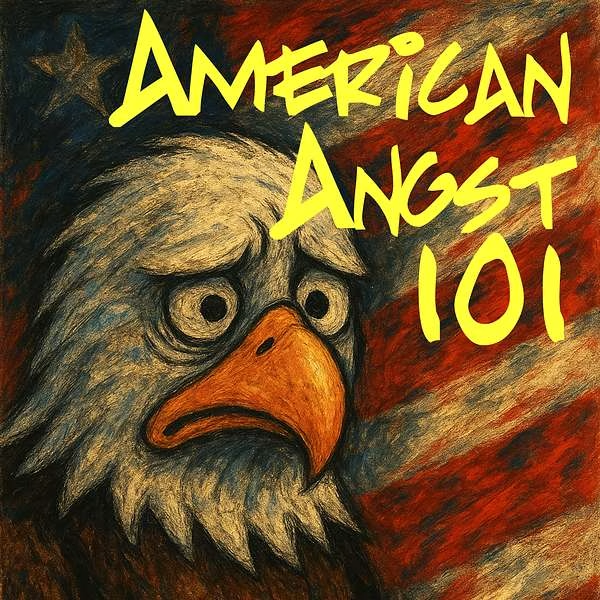
I was pleased to be a guest on Michael’s podcast, American Angst 101, where we talked about the phrase “we’re a republic, not a democracy.”

About Steven L. Taylor
Steven L. Taylor is a Professor Emeritus of Political Science and former College of Arts and Sciences Dean. His main areas of expertise include parties, elections, and the institutional design of democracies. His most recent book is the co-authored
A Different Democracy: American Government in a 31-Country Perspective. He earned his Ph.D. from the University of Texas and his BA from the University of California, Irvine. He has been blogging since 2003 (originally at the now defunct Poliblog).
Follow Steven on
Twitter and/or
BlueSky.
An hour?
Cliff notes?
This might fit in well between the short book on shareholder value I’m reading, and the next listen I haven’t picked yet.
@Daryl: An hour IS the cliff notes version of this topic!
If the UK can manage to be be both a monarchy and a democracy, I’m sure you folks can figure something out. 😉
@JohnSF:
You did figure out Charles I.
The trick would be not to have a long civil war first.
@Kathy:
See also how we dealt with James II: delete “Civil War”, sub “Dutch Invasion”.
🙂
It always amuses me that when people speak about “England was never sucessfully invaded after 1066” they always forget about the Holland Blue Guards occupying London and placing it under Martial Law in 1688.
Selective historical memory for the win. 🙂
@JohnSF:
On the other hand, thinngs worked out rather less well in Ireland.
The root of much subsequent sorrow.
Speaking of Republics, Steven made a comment in Monday’s AG podcast on Andor, to the effect that the Old Republic was made up largely of aristocrats and nobles (ie Bail Organa, Mon Mothma, Shiv Palpatine, etc).
I posted a short comment late on Monday about the Roman republic being similarly constituted. Now, we don’t know how the Old Republic worked, or for that matter the New one either, because in the SW universe it’s as simple as Empire Bad, Republic Good.
But it got me thinking. Over time there were lots of different republics and democracies, even if they took varying names. Considering the most influential, which would be the Roman Republic, the Renaissance city states like Florence, and the US, these were all constituted solely or mostly by aristocrats and nobles; that is: by the wealthy. In Rome it was the Patrician class with some aid of the Equestrian class. In the US it was the large land owners and a few prosperous merchants. Florence was the domain of the Medici family.
Curiously, all make pronouncements referencing “the people.” Most times they mean the ruling elites. This si true whether it’s on the Roman battle standard with letters representing The Senate and People of Rome, or in the preamble of the US constitution.
There are tons of parallels between Rome and the US, BTW. From slavery to territorial expansion to near constant wars to squeezing out the middle class to authoritarianism.
Of course, the story does not end with the founding of the USA. Other countries in the Americas gained independence, and many in Europe shed monarchies for a more democratic kind of rule. It would perhaps pay to delve into the histories of modern democracies, say from the mid XIX century to the present.
Let’s just cut to the chase, save some time, and recognize we were created to be a democratic-republic.
@Chris: This is true. And I used to think that explaining the terms solved the issue. It doesn’t. And the phrase has an inherent political usage that almost always supports minority rule.
@Kathy: There is a lot to unpack here, but I would agree that any real conversation of the modern democracy (or even of republicanism) needs a bright line dividing cases from, as you note, sometime in the 19th century.
There is also a lot of nuance that would need to be applied to a rigorous discussion of self-described “republics” in the past (even Madison criticized a lot of places that called themselves “republics” in the Federalist Papers).
@Steven L. Taylor:
I think I digressed from my main point, which is that the wealthy elites get involved in the struggle to reform or replace the old regime, or to achieve independence. And therefore those are the people who tend to wind up in charge of the new regime.
There are exceptions, but that’s the pattern most such developments follow.
@Chris:
That really is arguable; and where the “right has a s sorta, kinda, case, if you look at the Founders.
There were many indications they were not keen on unconstrained democracy.
See the original election system for the Senate.
And that before you start to consider that, given slavery and male only suffrage, well under half of adults actually had the vote.