The Core Problem is Single-Seat Districts
Most of the world knows that PR is a better way to elect legislatures.
I need to dig deeper into the Texas plan to attempt to squeeze five more Republican seats, but let me just note that I see a lot of pro-administration types currently discovering their distaste for the district maps in many states.
Here is an example of the genre.
Now, I am on the record as having a systematic critique of single-seat districts in the US. And I agree that it is highly problematic, from a democratic theory point of view, that Massachusetts, to pick the most egregious example from the above, has no Republican representation in the US House. While the state is heavily Democratic, there are more than enough Republicans in the state that, from a representativeness POV, it should probably have around three Republican Representatives.
It should be noted that some of those maps are blatant gerrymanders and others are not (California’s maps, for example, are drawn by a commission, and the main culprit for the lack of adequate representation is population patterns and the usage of single-seat districts).
I cannot stress enough: there is no such thing as truly fair maps that are also democratically competitive. For example, while the new maps in Alabama are fairer and more representative, they are mostly utterly uncompetitive. That is, the ratio of Rs to Ds (now 5:2 instead of 6:1) is better than it was and closer mirrors the state’s overall ratio of Rs to Ds, but almost all the seats are uncontested, or close thereto (see here for details).
Here’s the Vice President of the United States and Some Dude on Twitter.
I would note that it seems that a lot of pro-administration types have discovered that our electoral rules do not produce especially representative outcomes. This despite the fact that their favorite Chief Justice once referred to such concerns as “sociological gobbledygook.”*
Let me be clear: the solution to all of this is to elect the US House of Representatives in multi-member districts using some version of proportional representation.
More to come, no doubt.
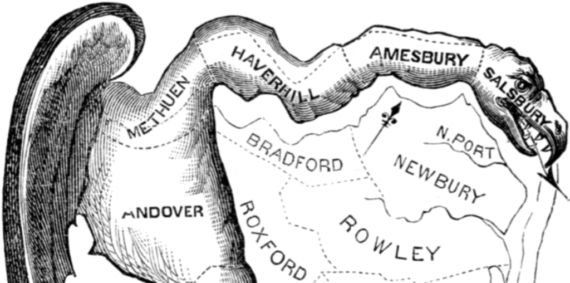
BTW, I used the original gerrymandering political cartoon because it fits, but I would stress the issue is not primarily gerrymandering (although, yes, the Texas case is blatant partisan gerrymandering), but rather it is using single-seat districts full stop. Rank choice voting does not solve this problem, by the way, as long as it is used in single-seat districts.
More reading on this topic.
- It’s the Single-Seat Districts
- Single-Seat Districts are a Huge Problem
- The Lack of Competition for House Seats
- Speaking of Reform
- More on Alabama Districts
*Roberts was referring to efficiency gap analysis, but he was really underscoring that he doesn’t have more than a rudimentary understanding of electoral studies (to the point that he doesn’t understand the difference between sociology and political science).

Yep. Agreed. And the VP has some nerve singling out California–redistricting has been the Republican raison d’être for decades. Wisconsin comes to mind as a state where Republicans have gerrymandered Democrats to near-irrelevance, despite their numbers in the state.
As an aside, it’s fascinating how brains go to the familiar first. I had to cycle through “public relations” and “Puerto Rico” before I got to PR = “proportional representation”. 😀
I’m unsure what’s so outrageous about these maps. Do people think that states are organized in Euclidean shapes? Those districts look like the opposite of gerrymandering. For example, in Massachusetts outside of something extradimensional–like maybe a wormhole district linking the North Shore to a few office parks outside Cambridge to Longmeadow and the MAGAiest parts of the Berkshires–how do you create a reliable place for Republicans to get elected? Even that would probably not end up going to the GOP.
You’re right that proportional voting would benefit everywhere. But Republicans seem to be objecting to normal geography in blue states. (EDIT: and population density.) It could be that Supreme Court will end up ruling on some nonsense theory about California and Massachusetts being subject to DOJ review while Texas will be able to gerrymander to its heart content.
I read a piece once contending that California’s districts (which don’t look crazy to me on the map), are not quite as non-partisan as it might seem, because during the first run of the commission, Democrats took nominations to the Commission seriously, and Republicans didn’t, and thus the map leaned more D.
This could be partisan garbage though, for all I know. At the same time, a dark red district surrounded by blue is noteworthy. And there are three of them on that map of CA.
However. The losses in the House that the R’s sustained in 2018 (in CA) were not due to gerrymandering, since the district lines didn’t change. Some of those Southland districts were pretty solidly red until the Republicans decided to cap mortgage interest and SALT deductions.
@Jay L. Gischer: I am not an expert on CA’s districts nor its commission process. That it is more influenced by Ds than Rs, given the state’s politics, seems likely and so might be “partisan” in that sense. That is importantly different than saying the resulting maps are partisan gerrymanders. Today, my friend, sometimes co-author, and legitimately one of the top experts on electoral systems in the world, Matthew Shugart, noted on Twitter that CA is not gerrymandered and that the distortions are due to population distribution and the general exigencies of single-seat districts.
SSDs are the core problem, and the only solution is multi-seat districts with proportional representation.
Another way of saying this is that distorted representational outcomes are not all the result of gerrymandering. Population distribution makes all single-seat maps flawed. As I noted in the OP, you cannot have both districts that are fair (meaning results for states are reasonably close to the R to D ratio in the state) and that are also competitive in any meaningful way.
@Steven L. Taylor:
Are there organizations credibly agitating for multi-seat districts?
@Steven L. Taylor: I accept your premise. I just find I don’t really have any idea of what that might look like.
@Jay L. Gischer:
Same.
I haven’t asked because 1) I don’t want to get Steven to have to do a longish explanation comment (I’m sure he has better things to do than to educate the commentariat), and 2) I suppose the more important things would go on pretty much as before. That is, a party would control the House, and the other would be in opposition.
I assume legislation would be required, probably along with increasing the number of seats in the House.
@Kathy:
I understand the inclination to remain mindful of our hosts’ time, but Steven’s primary reason for doing this is to educate.
Moreover, he recently published a white paper to contribute to moving the spotlight toward this discussion. And, futile as it may be, he tweeted at the sitting VP.
And…
Jay L. Gischer:
IIRC, several years ago, Steven wrote an entry that either linked to, or included, a basic picture of how it would look.* But it has been a while.
*I seem to remember a couple possible structures or a comparison to other options. I have a fuzzy mental images of:
a sample ballot
a mixed system with districts+at-large members
multi-member districts with PR
@Kurtz:
That would be in the link “Speaking of Reform” Steven provided above.
@gVOR10: Protect Democracy is. Fair vote may be as well.
@Jay L. Gischer: @Kathy: Please ask whatever specific questions you have. They may inspire me to write something.
@Kurtz:
It is!
Well this may be necroing a dead thread. But I’m gonna do it anyway.
Let’s take a fairly simple state: Nebraska. Three seats in the House. Probably you have a statewide election and you predefine thresholds for a party to get one, two, or three reps.
It might look like 17% to get one rep, 51 Percent to get two, and 88% to get all three. Maybe you have to fiddle a bit to account for third parties and a 1-1-1 split.
You have the election. Who gets to serve? Presumably names would be chosen from lists? If a party wins one seat, the top name gets in. If two seats, the top two are taken. If three, all three are taken.
This seems to give a lot of intermediary power to whomever makes those lists. That might be a good thing, but it is very much a different thing than what we have now.
But perhaps there’s another way to do this?
And when it comes to a big state, maybe you don’t all vote together? But that seems to get you back to the gerrymandering issue. So you do all vote together, and then you have the issue that local voters have no idea who their Rep in Congress is. Constituent services are a thing, after all.
Meh. Maybe I need to go read something. But this seems like it would be attacked as “anti-democratic” because of the power it gives to list-makers. I’m sure a scheme like this would get described as “machine politics”. Maybe I shouldn’t worry about that so much.
@Jay L. Gischer: Not a direct answer to your question, but close: starting on page 19, https://protectdemocracy.org/wp-content/uploads/2025/03/Trapped-in-a-Two-Party-System-1.pdf.
@Jay L. Gischer: I would note that the D’Hondt method is just one possible allocation rule. It might have some political juice because Thomas Jefferson developed it separately from D’Hondt (America, Fuck Yeah!), although he developed it as a possible method of apportionment, not for elections.
@Steven L. Taylor: I see. OLPR. Yeah, I think that’s a much easier sell than CLPR. At least, in the US it is.
I mean, every single Libertarian in California would love to go to PR, since they stand a decent chance of actually getting some seats.
And now I’ve read about the D’Hondt method. Not bad. My suspicion after skimming the Wikipedia article is that the US does not use D’Hondt directly to apportion Representatives to the states after a census, but some other, somewhat related method?
Ah. I see that it is Huntington-Hill, which is clearly related to D’Hondt, but kind of a strange compromise.
Also, a chart shows that the differences (from D’Hondt) aren’t that big.
The UK has single member constituencies using “first past the post” voting.
Which do have a number of problems, especially given the growing “other party” votes.
But have generally worked reasonably acceptably, largely imho because the constituency boundaries are largely seen as reasonable.
And their changes are based on the Boundary Commision reports, which are generally accepted as non-partisan.
Some constiuencies are “safe” for one party or another; but nationally it tends to average out.
I sometimes wonder if the level of partisanship in such decisions in the US may be connected to the rather unusual American tendency to have a lot of voters registered as “party supporters”.
Something no other Western democracy does, afaia.
(I think Austria used to, but dropped it)
And the related use of “primary elections” open to large scale public participation: likewise unuasaul, and perhaps unique.
In most countries, parties are private associations, even if subject to legal regulation, and their candidate selection is a private matter for party members.
@JohnSF: True. The UK, India, and Canada use them. As you know, there are distortions in the UK as a result of FPTP. But the problems are lessened because none of these states use primaries. And the UK House of Commons is not too small for its population (indeed, some argue it is too big).
FWIW, I think those the democratic quality in all these cases would be improved by a move to PR
An example of a country that moved from FPTP to PR is New Zealand.
@Steven L. Taylor:
I’m ambivalent about PR.
On the one hand, it may make for less direct representative connection to the locality.
One the other hand, it’s more democratially representative, nationally.
On the gripping hand: Israeli politics. eeek!
(I’m also ambivalent about all-out democracy: I had no personal qualms about an unelected House of Lords and Bishops. Within limits. Or even an active role in politics for the Monarch. Within limits. As leftists go, I’m an odd one, lol. Though, perhaps no more so than most of the 1945 Attlee Labour vintage?)
@Steven L. Taylor:
In re numbers in the Commons: it’s about the number necessary for a system based on more or less “organic” loclal continuencies, and to balance that out with the “safe” seats for the parties vs “contestables”.
That requires enough seats to roughly average out the “safes”.
The UK problem is going to be if the rise of “n-party” politics renders a two party assumption based system untenable, and if single member FPTP comes to be unacceptably exclusionary of major sections of democratic opinion.
If that does happen we may need to shift to a multi-member proportional mode.
Hardly a massive innovation; the UK had some multi-member constituencies up until 1948.
(Which many folks here often tend to forget)
@JohnSF: Two quick points.
1. You can have both PR and local districts via MMP as in Germany and NZ. Plus, there are still districts and reps would would represent them under most forms of PR. I can understand the concern for local reps in the UK, given the unitary nature of the British state, as opposed to federalism,
2. Israel is an extreme case of one national district. It is not the right comparative case.
@JohnSF:
Speaking as an outsider and from a theoretical POV, I would argue that there is enough of a disjuncture between the popular vote and the seat distributions in a number of Commons elections over the last several decades to say that an adjustment to the electoral rules is democratically warranted. But, of course, as with the US (which has worse representativeness problems) change is hard. Politics and whatnot, dontcha know.
@JohnSF: FWIW, I would trade the current US Senate for an unelected body that had powers more like the Lords. It would, ironically, make the US more democratic in many ways.