Trump Won’t Ask Congress for Approval
“What are they going to do? Say, ‘Gee, we don’t want to stop drugs pouring in?’”
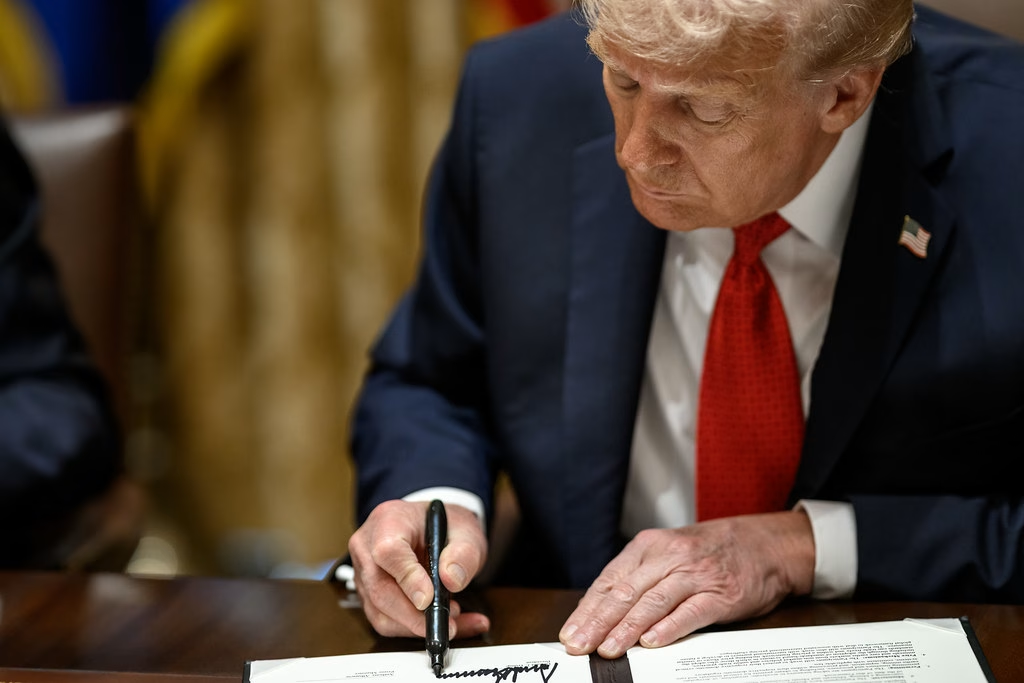
NYT (“Trump Says He Will Not Seek Authorization for Cartel Strikes“):
President Trump said on Thursday that he would bypass Congress rather than seek its approval to carry out military strikes against drug cartels that traffic narcotics to the United States, even as he vowed to expand the operation from attacks at sea to targets on land.
“I don’t think we’re going to necessarily ask for a declaration of war,” Mr. Trump told reporters of his campaign of deadly strikes against vessels in the Caribbean Sea near Colombia and Venezuela. “I think we are going to kill people that are bringing drugs into our country, OK? We are going to kill them, you know? They are going to be, like, dead.”
He made the remarks during a news conference at the White House to promote the work of agencies that Mr. Trump said were working to “arrest, prosecute and permanently remove” people who were part of an elaborate drug cartel operation inside the United States.
[…]
Though he repeatedly referred to the military operation targeting drug trafficking as a “war,” Mr. Trump said he would not seek any formal approval from lawmakers to continue striking boats or expand it to include airstrikes against countries like Venezuela, where he says the cartels originate.
“The cartels are waging war against America and just like I promised in the campaign, we are waging war against them,” he said in the White House state dining room flanked by members of his cabinet, including Secretary of Defense Pete Hegseth; Tulsi Gabbard, the director of national intelligence; and Attorney General Pam Bondi.
[…]
Mr. Trump said that he “may go to the Senate” to inform lawmakers as the campaign shifts from maritime operations to land strikes, and told Mr. Hegseth to “go to Congress, you tell them about it.”
But he appeared to be referring to a briefing rather than any formal request for approval. He appeared confident that lawmakers would support the action — or at least shy away from criticizing it.
“What are they going to do? Say, ‘Gee, we don’t want to stop drugs pouring in?’” Mr. Trump said. “They’re killing 300,000 people a year.”
In an analysis piece, Charlie Savage points to “The Peril of a White House That Flaunts Its Indifference to the Law.”
Since he returned to office nine months ago, President Trump has sought to expand executive power across numerous fronts. But his claim that he can lawfully order the military to summarily kill people accused of smuggling drugs on boats off the coast of South America stands apart.
A broad range of specialists in laws governing the use of lethal force have called Mr. Trump’s orders to the military patently illegal. They say the premeditated extrajudicial killings have been murders — regardless of whether the 43 people blown apart, burned alive or drowned in 10 strikes so far were indeed running drugs.
The administration insists that the killings are lawful, invoking legal terms like “self-defense” and “armed conflict.” But it has offered no legal argument explaining how to bridge the conceptual gap between drug trafficking and associated crimes, as serious as they are, and the kind of armed attack to which those terms can legitimately apply.
The irreversible gravity of killing, coupled with the lack of a substantive legal justification, is bringing into sharper view a structural weakness of law as a check on the American presidency.
Moving to broader issues, his colleague Carl Hulse points to “The Abdication of Congress.”
As the Trump administration shifts billions of dollars around to take care of its priorities during the shutdown with scant input from lawmakers, ignoring Congress’s clear constitutional supremacy over the power of the purse, Republicans in control have done nothing to push back. Nor have they exercised oversight of President Trump’s legally questionable military moves off the coast of Venezuela, his imposition of tariffs or anything else that has challenged the authority of their beleaguered institution.
[…]
Trump and his aides have usurped congressional power with little G.O.P. resistance. In many instances, House and Senate leaders have willingly ceded their prerogatives and cheered on the president. The Constitution gives Congress responsibility for levying tariffs, and Trump’s may hurt rural America, but the Republicans who represent it have been mainly silent.
The same goes for the administration’s operations against alleged drug runners from South America. Despite bipartisan support for sanctions on Russia, Republicans reversed course and delayed action because of mixed signals from Trump. He seemed willing to restrain Moscow, then pulled back, then finally imposed sanctions unilaterally yesterday.
[…]
There are evidently some limits to what Congress will swallow. Republicans this week pressed the White House to withdraw the nomination of Paul Ingrassia to head the Office of Special Counsel after Politico disclosed racist texts he had sent.
Senate Republicans also raised the alarm on behalf of cattle ranchers after Trump suggested that he might increase imports of Argentine beef to bolster markets there. The administration showed signs of heeding their calls.
But the funding impasse now has top Republicans talking about a yearlong extension of current federal spending, instead of a new budget. That would further undermine Congress’s authority, shifting the power to shape spending from the once formidable Appropriations Committees to the White House and its budget director, Russell Vought.
While Trump’s brazenness in flouting Congress has been unprecedented, at least in peacetime, it has been made possible by decades of erosion of legislative assertiveness.
Congress has slowly let the war power whittle down to nothing. Partly, it’s a function of a massive standing military putting Congress in reactive mode rather than being necessary to “raise an army,” putting it in reactive mode. Partly, it’s a function of partisan sorting all but ending the institutional jealousy Madison envisioned. Partly, it’s moral cowardice: they can sit on the sidelines bitching if POTUS does something unpopular, but they don’t get held accountable.
In the case of the extrajudicial killings of those identified as drug traffickers, there is also the matter of international law. But that’s largely a dead letter when it comes to major powers.

He isn’t asking for permission because he wouldn’t get it.
He won’t get impeached or arrested. So he will do whatever seems like it makes the best headlines.
It horrifies me that he thinks this makes the best headline.
Killing people when it would be so easy to halt and board these boats and look for the drugs is morally wrong. Debating the legality of it is a trap. It is simply wrong.
It also goes against every precept of justice that we have held to since the beginning of America. “Innocent until proven guilty” never was conceived to apply only to citizens, for instance.
So I ask myself, Why now? Why not during Trump 1.0? Why not 6 months ago?
I can only speculate that it’s another distraction effort. (a device that Trump has used so often that it’s almost predictable).
Epstein files jumps to mind.
@Bobert: In his first term, he had people who held him in check. They said that at the time, but it turns out that it worked.
And then he lost re-election. His reaction was, it seems, “Oh the hell with those guys. I’m not gonna let anybody who doesn’t bend the knee to me at all times get anywhere that they can slow me down.”
And so now we have the unfiltered Trump. The band of voters/political junkies who pay attention to him 24-7 and like him drink this stuff up. I’m not sure it ever gives them pause.
Most voters have never heard of most of this stuff. Trump understands this. If he does or says something outrageous but nominally in support of combatting drug trafficking, most people will only hear “Trump fights drug trafficking”. They won’t hear the rest. That’s too much detail.
Our news ecosystem is basically completely broken. However, things have kind of been this way for a long time.
For instance, in 1945 when the atomic bomb was dropped more Americans had heard about the atom bomb than could name the current president. I recall it was something like 92 to 86 percent. Those number shocked me. How could there be that many people who couldn’t name the president?
And that was without a broken news system.
@Jay L. Gischer:
“Innocent after being proven guilty” doesn’t comport with US precepts of justice either. Congressional irrelevance of POTUS’ own party was established when Republican Senators acquitted Trump of his second impeachment, then was cemented when Republican Congressmen obstructed the J6 committee. As a bonus, SCOTUS made itself irrelevant when their immunity decision made the nullification of Trump’s felony conviction after his re-election an obvious outcome.
IMO, the US constitution is too outdated and outmoded. It has been left in the dust by developments in politics, science, and social norms.
Part of the problem is that it is too hard to amend. Not just in our era, but overall. 27 or so amendments in 240 years is plain ridiculous. The average goes down, too, i one keeps in mind the first ten amendments were pretty much required for the document to be ratified, and the 19th and 21st amendments cancel each other out. Not to mention the 13th, 14th, and 15th amendments wouldn’t have passed without extraordinary pressure placed in the traitor southern states as one condition in readmittance to the union.
Causes aside, there are no ready remedies available. It’s not about passing a few amendments to fix it, which is not a likely possibility to begin with. The remedy would require replacing the constitution with something else.
This is also not possible, and in any case would require careful thought and consideration, and a good faith national debate.
It will take some kind of major crisis, like a civil war, secession by several states, maybe even an economic collapse.
Secession seems not just quaint but ridiculous in this day and age. Just the same, as the federal government relinquishes responsibilities and slashes funding, and keeps clowns like RFK Jr and Hestghe in positions of power, some Blue and not-so-Blue states are forming commissions and interstate agencies to take up some of the slack.
If such states can function without the federal government, and if they don’t even get much in the way of federal money* anyway, why stay in a country that offers them little or nothing for their allegiance, while also making their lives miserable through ICE raids and military deployments?
*And what does come in arises more from debt than tax or other revenue.
@Jay L. Gischer:
This and plus SCOTUS wrote him a get-out-of-jail card with the immunity ruling.
@Kathy:
Really only 17, since the first 10 made up the Bill of Rights and were in the immediate aftermath of ratification.
@Jay L. Gischer: In fairness, Truman had only been President since April and hadn’t campaigned for election.
@Steven L. Taylor: And two cancel each other out (Prohibition and its repeal).
Apart from the important constitutional issues that others here have touched on …
I’ve got to ask: What are the odds that Trump and Hegseth launched those deadly strikes against fishing boats, knowing full well that nobody, no legitimate media organization, was going to question, let alone verify, any of this?
@James Joyner: I did know that and considered it at the time I found that data. (It was for a term paper for a modern US history class, which I wrote on public reaction to the dropping of The Bomb. Probably the one term paper I did that left the biggest impression on me.)
It still shocked me.
This isn’t the main show. There’s a Marine Expeditionary Unit, multiple destroyers, and now the USS Ford, a single vessel that by itself is way, way, way over-powered to knock off Maduro. That’s what we’re doing, we are going to overthrow a foreign government. Which will mean what for the people of Venezuela? Civil war? Even famine?
Trump is going to knock off this government and steal the oil, which, like the tourist beaches, is mostly in the northern third of the country.
Thank God collapsed governments with desperate populations don’t result in massive numbers of refugees. Maybe that’s what the destroyers are for, to shoot refugees.
Once you teach the marines to knock off foreign governments they’ll be so much better-trained to start knocking off American State governments.
With regard to the charges of fraud with regard to the election, what the immunity decision did was run out the clock. There were several things Trump was charged with that were clearly not within the presumed duties and powers of the Executive, since they pertained to the conduct of elections, which The Executive has no role in.
BUT, SCOTUS introduced a long delay just by taking their time with the ruling, which then demanded that a bunch of things be done again in light of that ruling. Then, with Trump elected before they could finish, it was clear that he would take office before it was done, so they folded up the tent.
Seriously, I think those charges would still stick if they were pursued. I think John Roberts probably thinks that, too. Or he’s worried that they will.
That dude has sorely disappointed me. Gorsuch, too. The rest are behaving as expected.
@Jay L. Gischer:
They could have run out the clock with a far less expansive ruling. IMO the purpose was to run out the clock and get El Taco elected with such preposterous legal immunity attached. Like Mitch in 2016, they gambled their side would win. And further that if Biden won reelection, he wouldn’t abuse or even take advantage of their ruling.
For support I offer the many Taco friendly rulings in the shadow docket. They wanted him to do what he’s doing.
@Kathy: I’m not sure there was another way for SCOTUS to run out the clock. The Supreme Court only gets to rule on things before it, and for that case, that was the only thing before it.
AND, they don’t want any Democratic president to have the power to do what he’s doing. Which is why there aren’t any written opinions, or decisions on the merits. On these shadow docket things.
Meanwhile, the secret documents case got sabotaged by a ridiculous ruling from the trial judge that simply did not have enough time to get refuted by the courts. The ruling had nothing to do with the merits of that case either – it held that Special Prosecutors are illegitimate. (By the way, that would have killed all charges against Hunter Biden, too).
So that prosecution, if the ruling held, would have to start over from square one. Again, a delay tactic. Also, appealing it would take us beyond the election. If Trump had lost that election, he would have lost everything.
I’m still kind of in shock that he didn’t lose, honestly.
@Kathy:
And you underestimate the difficulty. Arguably, the only amendments that aren’t just tinkering around the edges are the Civil War amendments that did away with slavery, non-apportioned income taxes, and direct election of Senators. We had to fight a war to get the first one, the second came out of the Progressive Era and was driven by western states (which, at the state level, were rapidly adding initiatives and recalls to their own state constitutions), and were quite close to the states calling a Constitutional Convention to get the last one.
It seems to me that the US is getting very close to the effective combined executive and legislative power of the UK Prime Minister, but without the checks on that of a the potential of revolt by a cabinet of near-peers (as they are holders of Royal Warrants and Privy Coucillors in their own right, not just servants of the PM) or the intolerance of the House of Commons for a combination of arrogance and incomptence.
And the fact that the PM does not have the “prestige status” of being the legal head of state.
See the record of PM’s compelled to resign after losing the confidence of Cabinet and the House.
An “elective monarchy” is seems to be where the US is rapidly going.
Just hope you retain the “elective” bit.
@Jay L. Gischer:
I’m not a lawyer, but I know sophistry regardless of guise. The fixer court plain placed El Taco above the law.
Should he lose in 2028* and still be alive, and should he be charge and prosecuted again, for old and new crimes, I’d bet all the money on Earth the fixers would find additional absolute immunity.
@Michael Cain:
I haven’t gone through all the amendments and classified them, but yes, most deal with procedural and legal questions about the government itself.
@JohnSF:
I’m sure they will. The same way the Roman Empire retained all offices of the Roman Republic.
@Jay L. Gischer:
On occasion when I wake up suddenly, usually from a bad dream, around 2-4 am, I feel for an instant that everything since November 2016 has been an elaborate nightmare.
@Kathy:
The ironic thing being the Founders, having a background in both Classical and English history, thought their constutional mechanisms were a defence against an imperator.
Turns out, mecahnisms are without effect if no one is prepared to make them operative.
And that when it comes to procedures and conventions, they turn out to be, in the immortal words of that great political philosopher, Cap’n Barbossa, “More what you might call guidelines than actual rules.”
@JohnSF:
What the founders got wrong is astonishing, given the reverence they receive from the general population.
Granted no one can foresee all consequences, nor how the system will be gamed, nor cover all loopholes, etc., their one great big error was making the constitution too hard to amend.
Back in the 90s, when the Blue Screen of Death was Windows most popular feature*, oodles of explanations about how because the GUI was built on top of revised and patched versions of MS DOS, all Windows versions were horribly unstable. This persisted until WinXP, as I understand it, was built top-down as a graphical OS, which was far more stable**.
I think of this every time I hear how the brevity of the US constitution, and in particular the very small number of amendments, is the sign that it was oh so finely crafted and provides never ending continuity and stability.
IMO, it’s been doing its version of the Blue Screen of Death all the time. From the swift rise of political parties as soon as real presidential elections were held (Washington pretty much was acclaimed rather than elected to the presidency), to the simmering sectional conflict that ended in civil war, to the gilded age, to the New Deal, to the second gilded age, etc.
Beyond that, I recall saying during the first Taco term, maybe even here, in defense of norms that obeying the law, when one has the power not to, is a norm commonly followed.
Not any more.
* By popular I mean it appeared very often, more than most other features, not that it was liked by most users (I figure IT pros who charged or got paid per event must have loved it)
** Regardless of the reason, I think all Windows versions since XP*** have failed and crashed less often than Win95 and Win98 used to. In fact, going by personal experience, when it starts showing up now (albeit now in green with a frowny smiley for good measure), it indicates a problem with the hardware.
*** Except Windows8, which was a complete and total failure from the start and never got any better (damn, I still get angry at it).
@Kathy:
I think the “hard to amend” was rather deliberate.
They assumed they had a system that was proof against both an over-mighty executive and popular craziness or (perhaps in their view the most dangerous) the two combined.
Again, in their historical refrences they would be likely to think of not only the Roman imperator and the Stuart inclinations (and their rather mistaken notions of Goerge III) but also the wrecking of the Roman senatorial dominace by the populares, the dire consequences for Athens of the demotic assembly’s belligerence, and the Cromwellian alliance of military and people that came close to an English dictatorship.
So, they wanted a system that the executive and people could not too readily monkey about with.
Locking down the OS base from the user, to adapt your analogy.
Diggressing to OS issues:
Win3 was hilariously erratic.
But useful for forcing use of DOS quite often, perhaps?
😉
I found Win95 quite stable, assuming you did not ask too much of it, and avoided esoteric drivers and suchlike.
I currently have one PC running Win7, which still works with eminent stability, and “the beast” which is on Win11, which I built because I wanted a pretty capable gaming and music DAW machine.
As Steam no longer works on Win7, and Bitwig DAW needs 10 or 11, going fo 11Pro was the best option.
I have, though, disabled most of it’s annoying inclinations prompt use of the Microsoft Cloud, AI, Office 365, etc.
That done, it works pretty well.
Still need to see if I can run old Office 2003 on it though.
Because that was the last version where Excel VBA had a useful on-PC syntax context help, rather than a very annoying online one.
Time for a moment of sort-of-related light relief. According to the Wall St Journal, Trump is helping to design the next generation of naval warships, which he intends to call the “Golden Fleet”. I’m sure morale in the navy skyrocketed at the news.
@JohnSF:
I’m not sure they made it too hard to amend, or they miscalculated the divisions inherent in the country even at the time. It’s sometimes hard tot ell incompetence from malice.
The framers were surely high on the Dunning-Kruger scale…
@Kathy:
The Founders were neither sainted prophets, nor fools, imho.
They were reasonably sensible upper-middle class politicians trying to discover a stable polity for a country that had discarded former political assumptions.
As such, they did rather better than many others in such circumstances.The
Consider the utter failure of the French revolution to establish a viable polity.
The record of collapse into oligarchy or autocracy in Latin America.
The British failure of both a republic and of restoration until a combination of aristoctratic revolt and Dutch invasion led rather by accident to a “liberal” parliamentary monarchy.
The failure of constitutionalism in Germany.
etc
The Founders outcomes may have been sub-optimal.
But arguably less so then many other comparable instances.
@JohnSF: The US did later democracies a favor by revealing traps to avoid. Thus countries like Australia, New Zealand and Canada adopted some aspects of the US constitution but stuck (wisely) to a parliamentary system with relief valves for the kinds of developments which have caused the US Congress to become increasingly dysfunctional. I’ve often thought it was somewhat ironic that America, in virtually dictating the post-war Japanese constitution, made it very different to their own.
@Ken_L: In fairness, what really happened was the commonwealth countries mostly copied their colonial master, the UK, and then Latin America, as a means os eschewing Europe, largely copied the US.
In terms of a great example of learning lessons, it is noteworthy that the US did not try to impose presidentialism on either Germany or Japan after WWII. Nor did we on Iraq.
@JohnSF: Excellent points.
@Steven L. Taylor: While true to an extent, Australia made a crucial decision to follow the American example by adopting a written constitution, something the UK has never done to this day. We also rejected the idea of a House of Lords and created a Senate which drew heavily on the US model. Senators represent states; each state elects the same number of senators regardless of population; their terms are longer than in the lower house. Key differences however are that each state has 12 senators, six of whom retire every three years. Replacements are elected by proportional representation, which has allowed independents and minor parties to have real influence on government policy much of the time.
Among the ‘safety valves’ are prohibition on the Senate amending or rejecting ‘money bills’ (although on one infamous occasion it simply refused to vote on one, causing a true constitutional crisis. Yet that too was resolved in the end by holding an election.) Nor can the Senate initiate money bills; it can only consider money bills sent to it by the House. These provisions were indeed adopted from the British model. Another safety valve is that if the Senate twice rejects the same (non-budgetary) bill, the government can force what is known as a “double dissolution” meaning every seat in both chambers becomes vacant, to be filled at a subsequent election. As you can no doubt imagine, this gives senators considerable incentive to look for compromise and concessions rather than oppose for the sake of opposing.
@Ken_L: Without any doubt, Australian federalism and the structure of its legislature is an emulation of the US. I would still argue that the key institutional choice is presidentialism v. parliamentarism.
In regard to written constitutions, that is something that the US definitely started and has been emulated since, regardless of any other differences. There isn’t a case I can think of, apart from the UK, that doesn’t have a written constitution.
Also: I would far prefer the Australian version of the Senate to the US’s!