Atlanta Becomes Largest City Without Print Newspaper
An era slowly fades away.
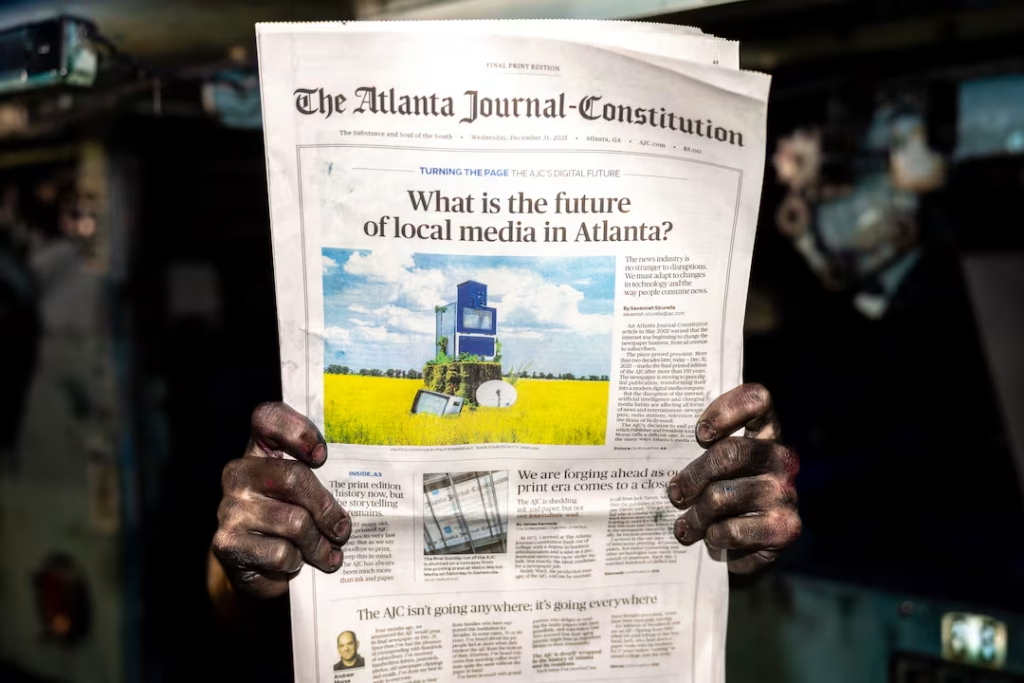
As of today, the 157-year-old Atlanta Journal-Constitution is digital only.
Kay Powell for Atlanta magazine (“An obituary for the AJC’s print edition, from its legendary obituary writer“):
The Atlanta Journal-Constitution print edition, 157, dies on December 31, 2025, succumbing to burgeoning digital news coverage. No service is planned.
The print paper’s readers are of two minds about losing their lifelong daily habit. Some say the death moves the newspaper full bore into the modern digital world. Others don’t know what they will do without it. From the Silent Generation to Gen Z, the loss is felt.
“We’ve always taken the paper even when we couldn’t buy groceries,” said Florrie Bowles, 85, of Atlanta. “I don’t think I’ll ever read it online. I like to hold it in my hand.” She and her husband, Dan, have subscribed to the paper for 67 years.
While they get most of their news digitally, Gen Z subscribers are nostalgic about the print newspapers they grew up reading. When it comes to articles younger readers want to preserve, they want a print newspaper, said Kennesaw State University student Mary Wingate.
“Part of its specialness comes from the printed newspaper,” she said. “We enjoy newspapers to commemorate things, a keepsake. The concept of it is important to people my age. Articles on paper are more permanent.”
For 157 years, the printed Atlanta Journal-Constitution has been the shared memory bank for readers. Simply mentioning a name triggers those memories: Ralph McGill, Furman Bisher, Mike Luckovich, Celestine Sibley, Lewis Grizzard, Bill Torpy, and earlier reporters Joel Chandler Harris and Margaret Mitchell before they became world famous. Copies of front-page headlines are saved, some even reprinted onto T-shirts: “It’s Atlanta!” and “CHAMPS!”
Obituaries are clipped from the paper, shared with distant friends and relatives and saved in the family Bible. Funeral homeowner Willie Watkins foresees a decline in subscriptions when the paper goes 100 percent digital. “I think it’s a sad day,” he said. “A lot of people don’t have computers. Older people, they’ll just be lost.”
The World Wide Web has been around for three decades, with online editions of most newspapers and magazines quickly following suit. At some point, it’s hard to feel sorry for people who can’t keep up. And, it turns out, AJC is still making an e-edition that mimics the layout of a standard newspaper.
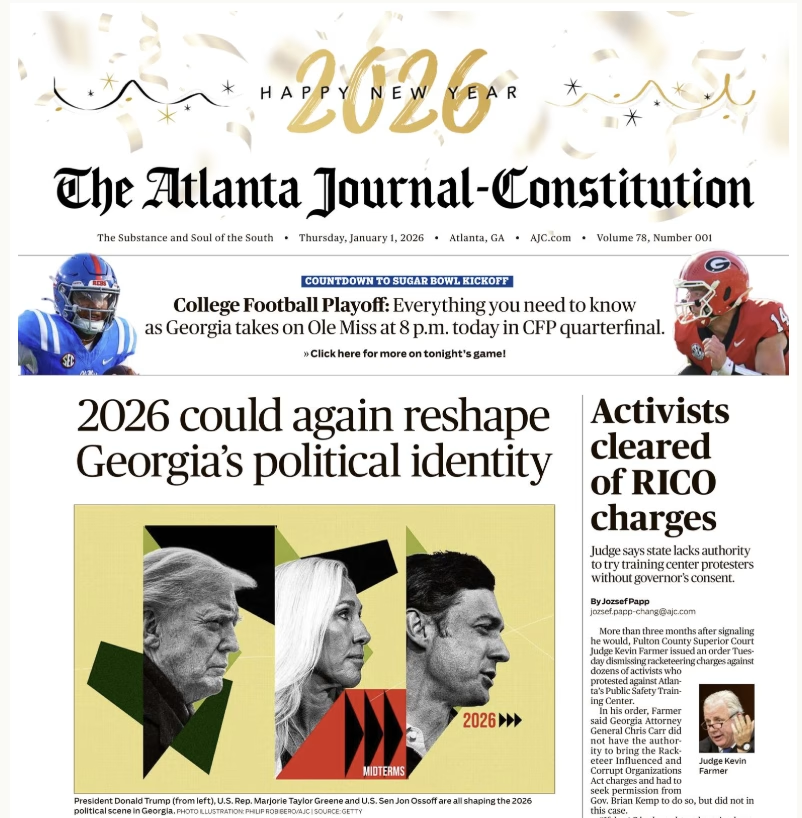
Still, the move is another milestone for the industry. As Jeff Amy reports for Fortune (“Atlanta becomes largest U.S. metro without a printed daily newspaper as Journal-Constitution goes digital”):
The decision will make Atlanta the largest U.S. metro area without a printed daily newspaper, although some smaller metro Atlanta newspapers continue printing.
Publisher Andrew Morse said in his Thursday announcement that the news organization will aim to expand its audience as it continues to report the news using online, audio and video products.
“The fact is, many more people engage with our digital platforms and products today than with our print edition, and that shift is only accelerating,” Morse wrote in a letter to subscribers posted on the Journal-Constitution’s website. The AJC has about 115,000 total subscribers, of whom 75,000 are online only; Morse has set a goal of gaining 500,000 online subscribers.
The newspaper is privately owned by descendants of the Cox family. Former Ohio Gov. James Cox bought The Atlanta Journal in 1939 and The Atlanta Constitution in 1950. The Atlanta Constitution was founded in 1868, only a few years after the Civil War left Atlanta in ruins. It became the platform of famous editors including New South booster Henry Grady and anti-segregationist Ralph McGill.
[…]
Many smaller newspapers have stopped printing, while others have cut back their days of publication. For example, The Tampa Bay Times in Florida prints only two days a week. But it’s been unusual for major metropolitan dailies to entirely abandon print. The highest profile example is The Star-Ledger of Newark, New Jersey. Once the state’s top-selling newspaper, it stopped printing in February. It’s owned by the Newhouse family, which also stopped printing other sizable newspapers in New Jersey and Alabama.
The Medill Local News Initiative at Northwestern University counted 1,033 daily newspapers in 2024, down from 1,472 in 2005, and 650 digital-only news sites.
As Rick Edmonds notes for Poynter (“The reasoning and peril behind the Atlanta Journal-Constitution going digital only“), the move is not without risk. Printing and delivery costs are massive, but publishers can charge both readers and substantially more for print subscriptions than for the online versions. And it’s tougher than ever to make money from online content.
[L]ike nearly all newspaper digital outlets and many that are digital only, AJC’s traffic from search has taken a huge hit over the last year. Facebook is phasing down news on its newsfeed, Google’s algorithms aren’t what they used to be, and even in the early days of artificial intelligence, it has clearly displaced searches that would lead to news outlets.
Getting to 500,000 paid subscribers is, alas, wildly unrealistic.
As I’m sure I’ve noted before, while I subscribed to a physical newspaper everywhere I lived, my reading habits shifted almost completely to online sources once I started this blog. That’ll be 23 years ago at the end of this month. The linking and quoting nature of the medium makes paper and broadcast news less than useful.
Still, something has doubtless been lost with the shift. I’m old enough to have clipped articles and, especially, cartoons from newspapers. While I still occasionally save PDFs of articles for reference, it’s not the same.
More importantly, the digital format—and especially as it has evolved in the age of algorithms—has drastically changed the way I consume news and information. While I still scan the home pages of WaPo and the NYT most days, I mostly deep-dive into topics that interest me. In the print era, I would scan every page of most sections of the paper, often serendipitously stumbling on stories I would not otherwise have sought out. In some ways, we were better informed because of that.
Beyond nostalgia for the olden days, the real concern is that, without a business model to sustain it, it becomes harder to do the expensive work of reporting the news, much less investigative journalism. There’s enough of a market for national political coverage that I don’t fear its disappearance. But we’re already seeing a significant decline in local news reporting. And few papers, indeed, still have international bureaus.

It will be fun to see people try to housebreak their pets with a smart phone.
@Kathy: We’ve had multiple pets since I last had a newspaper subscription. They sell training pads rather cheaply.
@Kathy: We don’t have cats anymore (allergies), but since we quit taking a dead tree paper I find I occasionally need to run to Lowes for a roll of packing paper.