The Legality of the Maduro Raid
"When the president does it, that means that it is not illegal."
The New Yorker‘s Issac Chotiner asserts “The Brazen Illegality of Trump’s Venezuela Operation,” via an interview with Yale Law professor Oona Hathaway, the president-elect of the American Society of International Law. The following are excerpts from her responses:
Unfortunately, I don’t think there is a legal basis for what we’re seeing in Venezuela. There are certainly legal arguments that the Administration is going to make, but all the arguments that I’ve heard so far don’t hold water. None of them really justify what the President seems to have ordered to take place in Venezuela.
[…]
There is a right of self-defense under the United Nations charter, which allows states to use force in self-defense against an armed attack. But it’s never been used for something like drug trafficking.
[…]
[W]hen the U.N. charter was written, eighty years ago, it included a critical prohibition on the use of force by states. States are not allowed to decide on their own that they want to use force against other states. It was meant to reinforce this relatively new idea at the time that states couldn’t just go to war whenever they wanted to.
[…]
One of the claims is that Maduro is not, in fact, the leader of Venezuela. This is something that they’ve been saying for a while now—that he’s not the legitimate leader of the country, that they don’t recognize him as the head of state. And that might justify his seizure and indictment, although using military force to do that would not be justified. I don’t know how they get from there to an argument that they can use military force in Venezuela.
[…]
As part of this military operation, at least one of the key goals seems to have been the capture of Maduro and his wife, who have been indicted for criminal charges in the Southern District of New York. The only way they can do that is if they’re claiming that he’s not a head of state, because heads of state get immunity and heads of state are not subject to criminal prosecution in the domestic courts of other states. That’s just a basic rule of international law. The United States has long recognized it.
[…]
Maduro did clearly seize power after losing the election. But, nonetheless, he’s been acting as the head of state for quite a while, and he’s been recognized by a number of other countries as a legitimate head of state. He’s been exercising the powers of head of state. He’s been directing the military. He’s been running the country.
[…]
The dangerous thing here is the idea that a President can just decide that a leader is not legitimate and then invade the country and presumably put someone in power who is favored by the Administration. If that were the case, that’s the end of international law, that’s the end of the U.N. charter, that’s the end of any kind of legal limits on the use of force. And if the President can do that, what’s to stop a Russian leader from doing it, or a Chinese leader from doing it, or anyone with the power to do so?
There’s more, but that’s the basic idea. I doubt you’d find a credible scholar of international law or the laws of armed conflict who would materially disagree.
But Harvard Law professor Jack Goldsmith (“On the Legality of the Venezuela Invasion“) offers a competing vantage point, that of U.S. precedent. It comports substantially with my initial take on the operation yesterday morning.
As I have argued before, there are few if any effective legal constraints on unilateral presidential uses of force. Everyone has an opinion about what those limits should be. Academics and politicians regularly maintain that this and that presidential use of force is unlawful, even though the legal framework for analysis, especially under domestic law, is contested.
But here is the reality. Congress has given the president a gargantuan global military force with few constraints and is AWOL in overseeing what the president does with it. Courts won’t get involved in reviewing unilateral presidential uses of force. And no country plausibly could stop the U.S. action in Venezuela.
That means that in practice the only normative legal framework for presidential war powers that matters derives from executive branch precedents and legal opinions. The Justice Department, if asked, easily could have drafted an opinion based on these precedents and opinions to justify the invasion of Venezuela.
[…]
The main precedent DOJ could cite is President George H.W. Bush’s invasion of Panama in 1989 to arrest and bring strongman General Manuel Noriega to justice in the United States, in part for drug trafficking. Some will seek to distinguish the Noriega matter from the Venezuela invasion on the grounds that Panama Defense Forces had recently killed a U.S. Marine and the Panamanian National Assembly had declared that a state of war existed between the Republic of Panama and the United States.
But the Panama precedent will nonetheless matter to the Venezuela attack due to this 1989 opinion by then-Assistant Attorney General Bill Barr, issued six months before the invasion. That opinion justified FBI arrests in foreign countries under domestic law even if doing so violated international law.
[…]
These are not the only precedents the Justice Department opinion could invoke. There is another line of precedent, summarized here, that justifies unilateral uses of presidential force in the “national interest.” Recognized national interests include the protection of U.S. persons and property, promotion of regional stability, and humanitarian concerns, all three of which could conceivably be invoked in the Venezuela context.
The DOJ opinion could also cite dozens of specific instances of past unilateral presidential uses of force stretching back at least to President Thomas Jefferson’s authorization to attack the Barbary pirates. Most on point, perhaps, are the numerous U.S. interventions in the southern hemisphere in the late nineteenth and early twentieth centuries.
[…]
These are not the only precedents the Justice Department opinion could invoke. There is another line of precedent, summarized here, that justifies unilateral uses of presidential force in the “national interest.” Recognized national interests include the protection of U.S. persons and property, promotion of regional stability, and humanitarian concerns, all three of which could conceivably be invoked in the Venezuela context.
The DOJ opinion could also cite dozens of specific instances of past unilateral presidential uses of force stretching back at least to President Thomas Jefferson’s authorization to attack the Barbary pirates. Most on point, perhaps, are the numerous U.S. interventions in the southern hemisphere in the late nineteenth and early twentieth centuries.
[…]
In sum, it would not be terribly hard for the Justice Department to write an opinion in support of the Venezuela invasion even if the military action violates the U.N. Charter.
To repeat, that does not mean that the action is in fact lawful—and it pretty clearly isn’t under the U.N. Charter. It only means that the long line of unilateral executive branch actions, supported by promiscuously generous executive branch legal opinions, support it. As I wrote in connection with the Soleimani strike: “our country has—through presidential aggrandizement accompanied by congressional authorization, delegation, and acquiescence—given one person, the president, a sprawling military and enormous discretion to use it in ways that can easily lead to a massive war. That is our system: One person decides.”
This is not the system the framers had in mind, and it is a dangerous system for all the reasons the framers worried about. But that is where we are—and indeed, it is where we have been for a while.
Goldsmith agrees with Hathaway that invading a sovereign state to arrest its leader is a gross violation of the basic principles of international law that the United States itself has championed for a century or more. But he also rightly notes that U.S. presidents have quite often acted in contravention of those principles—and the clear text of the U.S. Constitution!—when they have seen fit. We are not in anything like uncharted territory here.
Relatedly, there have been some rumblings in the comment section here about U.S. military personnel following “illegal orders” here in violation of their oath and their duty as professionals. That simply misapprehends what we expect of them. It is not their remit to substitute their legal or moral judgment for that of the duly elected commander-in-chief or the Justice Department; they are presumptively legal. As Goldsmith lays out, there is plenty of legal cover for the capture of Maduro.

As Trump is well aware from decades of shady activity, it comes down to who’s going to stop him. His own DOJ? Roberts and his accomplices? Impeachment? The UN? The Constitution police?
I’d add that while our overall record of occupation and regime change is pretty grim, the aftermath of Panama and Grenada seems to have been OK. I wouldn’t count on this being a big issue in ‘26 or ‘28.
There’s the matter of acting in a civilized fashion, and of trying all non-violent means before resorting to the use of force.
So, did the US prosecutors inform Maduro of the indictment and requested he surrender to federal authorities? Was an extradition request made to Venezuela for Maduro?
I know. But not even trying also counts. Imagine if Governor Hochul had decided to send the NY National Guard to attack Mar a Lardo so El Taco could be brought to trial in New York.
Who knows. maybe some future hardline European PM or President might raid Israel to get Bibi before the ICC.
@gVOR10:
We all know that Trump doesn’t need any evidence to assert the biggest good outcome since D-Day. The administration will claim a seasonal drop in gasoline prices or a made-up statistic for drug trafficking reduction is the result of the occupation of Venezuela and, presto change, Trump’s National Security Strategy is an unqualified success for the Trumpists and a plausible reason to support the party in power in war times.
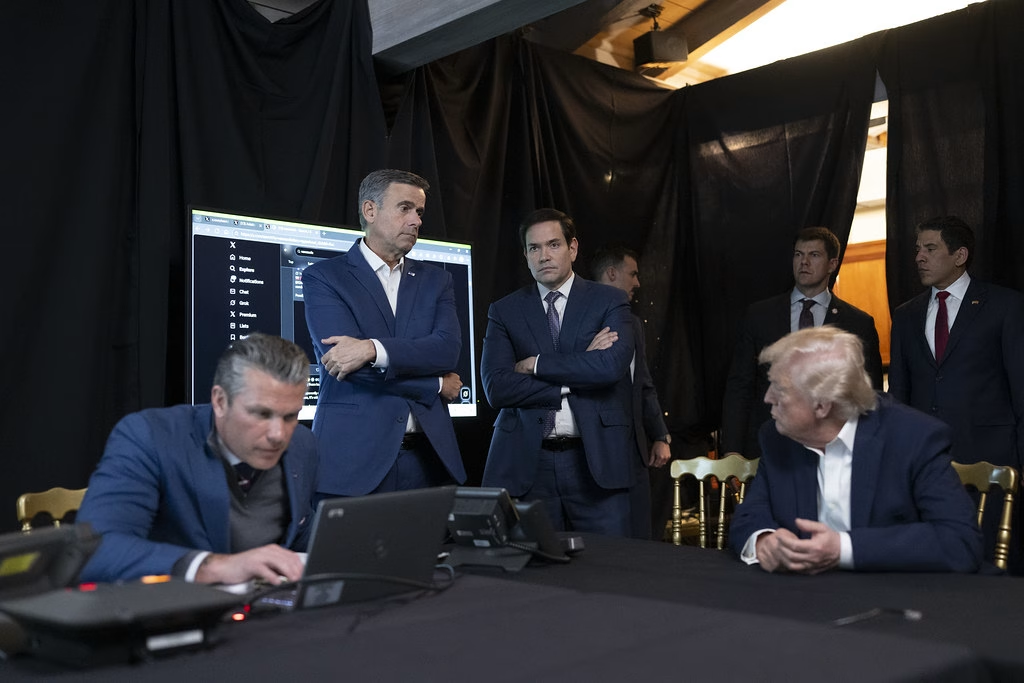
BTW: I think they are going for a Obama/Clinton in the Situation Room with Bin Laden vibe in the picture at the top of this post, but the make-shift black curtains thrown up in a ballroom at Mar-a-Lago are kind of undercutting the imagery. Nothing says Secure Military Planning like a couple of golden dining room chairs.
@Scott F.: Pete looks like he forgot his password and is trying a couple of different combinations.
I think that Trump is constantly proving that “legal” doesn’t really mean what people think it means, especially when you are the president and you control the DOJ, among other things.
Beyond that, being illegal in the abstract is not the same thing as having someone punish you for said illegality.
Worse, it has been clear for close to 80 years now that the president gets wide deference on anything foreign-policy related. While I do not defend what Trump has done, it has to be admitted that the road to acting this way was paved by all of his predecessors and a compliant Congress and nation.
This is just the final manifestation wherein action doesn’t even come with some fig leaf–and it fits my ongoing view of how the presidency has further changed under Trump and how power will be executed in the future.
As I pointed out earlier, you are completely wrong.
You are obviously wrong under international law. That doesn’t even need explaining. See, e.g., the precedents set by the Nuremberg Trials.
But let me also point you to the DoD’s Law of War Manual (which also reflects domestic law), particularly section 18.3 “Duties of individual members of the Armed Forces.”
Also:
Thus, military personnel have a positive duty to evaluate orders based on the training they have received.
The extent of this duty is obviously different for generals than for privates. But both categories of personnel have a positive obligation to not blindly follow orders.
First, it is deeply concerning that you are unaware of this.
Second, it remains an indisputable fact that at least some military commanders have failed to perform their legal duty to disobey clearly illegal orders.
@Scott F.: @Scott F.: At the time the GOPs tried to make a big deal out of Obama sitting in the corner of the situation room during the Bin Laden raid. Apparently they thought he should be in the center of the table watching the big screen and exercising minute-by-minute operational command. Many sources have noted the big screen in the Mar-a-Lago photos shows an X post.
American self-obsession with the legality of what their president can do as he flies his goons across the border to kidnap another country’s president for violating ‘laws’ is just abnormal.
It’s not legal, end of story. Any other debate about the so-called ambiguities is like people in a cult debating why it might be okay for the leader to shower with 15-year olds.
@drj: There are two broad categories in the laws of armed conflict, comporting roughly with the much older Just War tradition. The ICRC summarizes nicely:
Heads of state and other policymakers might well be held accountable for jus ad bellum violations, but military leaders and rank-and-file soldiers wouldn’t be. Putin and company have been indicted (although they’re unlikely to be prosecuted) for various war crimes in relation to their invasion of Ukraine. Soldiers who fought in the war under his orders would not be.
Jus in bello violations are trickier because there are gray areas. But that is where we expect military professionals to refuse to follow illegal orders.
For a detailed explainer on the trickiness and history of this in the U.S. case, see John Ford‘s 2017 WOTR article, “When Can a Soldier Disobey an Order?” Short answer: considerably less often than you think.
The Nuremberg principle that “I was just following orders” is not a valid excuse is not nearly as broad as one-sentence takeaways imply. I’ll write a detailed post on this soon, although likely not today.
To those who still resist any comparison to fascist regimes in general, or any (Italian or German) in particular: the current regime is awfully expansionist. Invading Venezuela, threatening Greenland, Panama, Canada, Colombia, Mexico…
@James Joyner:
Keitel and Jodl were both convicted of conspiracy to commit crimes against peace and of planning, initiating and waging wars of aggression and other crimes against peace.
There are at least a couple of four-stars who have committed crimes as part of the Donald’s wonderful Venezuela adventure.
@Kathy:
Sometime relatively recently Argentina charged Maduro with crimes against humanity, issued an arrest warrant, and sent a request to Interpol members to exercise the warrant and extradite Maduro to Argentina for trial. I don’t think they were serious, but did it in a fit of pique over something Venezuela and the US had done with some Argentinian asset.
I believe I mentioned yesterday that Noriega of Panama served his prison time in the US, and when he was released, was extradited to France to face money laundering charges there.
This bit from Fiona Hill’s deposition in 2019 is making the rounds:
Huh.
For what it’s worth, here are retired General Mark Hertling’s observations on the duty to disobey illegal orders:
https://www.thebulwark.com/p/what-americans-should-understand-about-the-military-disobeying-illegal-orders-two-oaths
@gVOR10: I don’t think anyone cares about Venezuela. It would require a concerted effort to screw up so badly that this would change any votes in 2026 or 2028.
No one likes Maduro, and it becomes an argument over process — was it legal, did we use the dessert spoon for the soup course, etc.
If Venezuela collapses into civil war and various factions start killing Americans, we might see a little movement around the edges, but unless there’s a hotel full of blonde white women on vacation getting held hostage by the Venezuelan Socialist DEI Front, no one will be deeply moved enough to change their vote or even go to the polls.
Look at Iraq. Complete fiasco. We basically created ISIS. How many of the people involved have been pushed from politics?
@James Joyner:
For one thing, losing the war is basically a precondition for even attempting to apply that principle. There have been a handful of cases otherwise, but not any broad application.
@Modulo Myself:
Understand that I am sympathetic to your situation, and viscerally agree on one level.
However, I find these discussions frustrating to a degree.
For something to be illegal, there has to be a law that is violated. Exactly what law has been violated here is rather unclear, whether we like it or not. This is made all the more true by all of the precedents set by American presidents over almost 8 decades.
Further, for illegality to be truly relevant as a practical and not abstract matter, there has to be an authority willing and able to enforce a specific law and the penalties attached thereto.
None of this is a defense of what was done. But it is to point out that is some ways, arguments over legality are unlikely to be fruitful.
All of this is kind of like arguments about constitutionality–it is all just an opinion until an entity with actual power to make a determination does so.
I will note that there is a strong case that the action violated international law. But who is going to enforce international law on the United States?
The Nuremberg Trials example has to be remembered as being something that was initiated by a victorious power in an all-out war.
@gVOR10:
Perhaps not as a discrete issue, but there’s a contingent on the right right now loudly complaining that Trump occupying Venezuela for oil is the stuff of Bush 3.0, not “America First.” Continued piling up of these “this is not what I voted for” disappointments might have an electoral impact. It did in 2025’s elections.
@Gustopher:
More to the point of this discussion: how many faced any legal repercussions?
@Gustopher:
A succinct way to put what I was trying to say above.
@Gustopher:
Iraq had electoral impact for years. In 2004, when we were only a couple of years in, Bush used Kerry’s mild antiwar stances to portray him as Soft on Terror. “Don’t change captains midstream” was a theme. That contributed to Bush’s re-election.
Then increasing war weariness contributed to the 2006 and 2008 Blue Wave elections. Obama would not have won the 2008 Dem primary if he hadn’t been been able to use a speech (that there was conveniently no recording of) to pretend to be a peacenik and thus bludgeon Hillary for her Iraq War vote.
And part of the reason Trump was Republicans’ 2016 nominee is because he pretended to oppose the right’s hawkish orthodoxy. Hence why some conservatives and indies who fell for it are not happy with him now pledging to occupy Venezuela and take its oil. Change a vote? Maybe, maybe not? Make some “Kamala will take us to war with Russia!” 2024 Trump voters less likely to turn out in 2026 or 2028? Very possible.
@Kingdaddy:
The unique aspect, at least for the last hundred years or so of US history, is the open declaration we are doing this to take Venezuela’s oil. Trump is making no bones about that, and he is even saying it has been the US’s property all along. Legal? An interesting academic question of US law worth exploring, but in this context it almost qualifies as whataboutery.
We have become (once again) imperialist thieves, pure and simple.
@Steven L. Taylor:
It’s not unclear at all.
The attack on Venezuela violated the Hague Conventions of 1899 and 1907.
These conventions were ratified by Congress and thus became part of domestic law.
I would say it is very relevant that the US government is willing to violate rules that the legislature has decided are to be the law of the land.
It’s a big deal if the government willfully disregards legislation adopted by Congress, no? (Even if the adoption happened quite some time ago.)
Would you react the same way if the government suddenly decided it is no longer bound by, e.g., the Fair Labor Standards Act? Or could that conceivably be something “abstract,” too?
@drj: So, what is the practical way forward here? How do you see this as a concrete process?
@drj: Where I am wrong here?
Please be specific.
@dazedandconfused:
+1. Yes it’s illegal. So now what? It’s illegal most times I jaywalk or torrent a pirated app or use some controlled substance at some gay sex party. But law enforcement doesn’t care, so it’s not interesting.
There’s historical value in documenting Trump’s crime spree, yes. But since our corrupt Supreme Court says he can, I agree with Dr. Taylor, an abstract legality debate has little utility. The rapist pedo felon is breaking the law. Well duh. He was a known criminal when 49.8% of those who bothered to vote in 2024 picked him, over the objection of 85% of black and LGBT voters. Of course this career criminal is still criming.
I’m not as down on Sen. Schumer as the “Do Something!!11!!” ninnies, but he and other anti-Trump citing illegality are mostly wasting breath. Fortunately, other Dems (and, once again, MAGA’s Marjorie Taylor-Greene faction) have a more salient focus: the same incompetent Republican regime depressing the Main Street economy with mass deportation and tariff inflation while insisting we have no money for healthcare, food assistance, debt relief, clean energy, high-speed rail, aid to allies actually being attacked etc…
…happily waste time and money on uselessness — a gold ballroom, dumb renaming, welfare for billionaires, an Argentine bailout, golf trips, and a now an unconstitutional oil war. Nobody voted for Venezuela First.
Trump-Vance center everything but their main campaign rationale: the majority of Americans who are financially distressed in this, our Second Gilded Age. That’s how Trump’s war crimes impact 2026 and 2028.
@Steven L. Taylor:
I seem to recall that you have written quite a few posts about the design flaws in US governing institutions over the years. And every time someone remarked in the comments that practical reform was practically impossible, you countered with a variant of “but it is important to correctly diagnose the problem regardless.”
To me, the fact that international law (and in this case domestic law as well) gets violated seems important by itself. Because no government should violate the law – international or otherwise. If for no other reason that a government that does such a thing will almost certainly direct its lawlessness toward its own citizens at one point or another. (Which, in this case, it already has.)
Having said all that (and noting your own predilection for diagnosing problems without necessarily offering concrete solutions), this:
and this:
seems rather cheap.
I’m pretty sure it’s illegal under international law for one country to invade another in order to kidnap one of its citizens. That seems like a basic tenet of sovereignty which every country has mutually agreed upon. Imagine the same logic being applied to money and banking, and not a guy in South America.
The American position is that it’s okay for America to violate this law if the country’s leadership feels like it. That’s not a legal position. That’s just power talking. There’s an entire cottage industry of people earning their keep by making this an ‘interesting’ legal issue, but it’s not.
Reports are now emerging that the whole Venezuela deal was a dirty domestic coup with America being co-opted to depose the incumbent.
Finally got around to watching Meet the Press 1/4/26.
We’ve been told that Maduro was captured (kidnapped) from Caracas as a law enforcement action – he was wanted on a SDNY indictment.
However today on Meet the Press, Rubio said:
“He [Maduro] could have left Venezuela as recently as, you know, a week and a half ago. There were opportunities available for him to avoid all of this”
That sure sounds like: Had Maduro vacated Venezuela, he would NOT have been taken by force and returned to stand trial.
Rubio’s assertion makes it crystal clear that the kidnapping of Maduro was NOT a law enforcement action.
@drj: You are both being unkind and missing my point.
By definition a legal argument when no legal authority is willing to act is an abstract argument. Worse, there is some level of political cover for the legality of the action whether we like that fact or not.
It will be more fruitful to attack all of this on moral and consequentialist/practical grounds than to get caught up in what I think is a legalistic distraction that is more side trip than anything else.
Again, the issue you are ignoring is that there is authority here of relevance to even push a legal argument forward. That is unfortunate or even wholly unjust, but it is nonetheless true.
How about this: this action, a long with a host of others, are raising the fundamental question of whether we had an operative and binding legal and constitutional order. After all, the core issue is the long term evolution of Congress being hands off on anything to do with military and foreign policy.
I think you are interpreting my position as somehow downplaying the situation. Quite the contrary, I think this is all just a deepening example of how authoritarian the presidency has become.
In that context legality arguments are a quaintly normal thing to be doing.
But while there is a lot to lay at Trump’s feet on this general topic, I think the specifics of the Maduro arrest/removal/whatever we want to call it has been build on the foundation of at least 8 decades of prior presidencies. And it has developed in a way that makes appeal to lethality and unlikely solution.
@Steven L. Taylor:
Some of the things you wrote sound like you are arguing that the legality of an action is some near-trivial technicality.
But I also see the law as something that both imposes a moral floor on a society and enshrines the eights of the people who make up that society. In other words, law (or perhaps even “the law”) is rather more than words in a book that can be opportunistically bent or twisted.
Which means that it is not at all a trivial thing when a government decides to violate the law. It is both a threat and a breach of the social contract.
Sort of what A Man for All Seasons has Thomas More say:
So, I don’t see much distinction between legality on the one hand and “moral and consequentialist/practical grounds” on the other – most certainly not when we are talking about the Hague and Geneva Conventions. The provisions of these treaties are, IMO, very much not “legalistic distractions.”
Thus, I completely agree with this:
If that is indeed the issue to be discussed, questions about legality seem rather unavoidable, IMO.
Rather than debate whether this was legal (it wasn’t), strategically valuable (it isn’t), or prudent (no), I would ask the question, how does this make America better off?
Seriously, I do not expect my life to be improved by this. There is literally no upside to it for me.
Who does have an upside? Are there even a thousand people in the US who will have a better life because of this?
Michael Wolff says what I suspected, that Trump was off-script and the ‘running’ of Venezuela was not the plan.
Maduro is gone, his regime is not. You can’t replace something with nothing and as under-powered as were in Iraq, this is much worse. We have no control of anything in Venezuela, it remains in the hands of the Maduro regime.
And the reality is that we aren’t going to do anything, because the ‘anything’ would involve a huge commitment of soldiers, bureaucrats and money. The oil companies are not going to invest. Venezuelan expats partying in Miami are not going to return in serious numbers.
The people who might help will be the Columbians, and/or the Cubans. The Cubans, with financial support from China, since Russia is broke. The Mad King and his ever-s0-manly bootlicks will have made South America even more fertile ground for the Chinese, while reviving historically justified Hispanic paranoia about Yankee imperialism. This is an own-goal of epic proportions.
I will not be in the least surprised if these fools actually seize Greenland. They are that unhinged.
@Michael Reynolds:
Yep, it’s in plain sight !
@drj: How about this.
I agree that the topic of legality is relevant to the broader conversation, but will continue to insist it is largely an abstract one, save at it pertains to whatever defense Maduro puts up in court.
I also think that, in terms of the legality of the action of grabbing Maduro itself, as it pertains to US law, it is going to be a non-starter. There is too much precedence combined with too much deference to presidents in such matters (I am not saying this is a good thing).
And I don’t think Trump can be damaged by legal arguments in this matter.
And to be clear: I find it all to be hugely problematic, if not outrageous.
@Steven L. Taylor:
You do you.
But if you want to couch this in moral terms rather than legalities, the easy counter (channeling my inner Fox News anchor) is that Maduro “was no angel.”
We have seen this many times before, albeit on a somewhat smaller stage.
Personally, I feel more comfortable starting from the position that the law should not be violated by the government because it also anchors and guarantees our rights against said government (which is necessarily more powerful than we as individuals).
Perhaps you are right that this isn’t a particularly effective approach, but I have a hard time seeing that moral arguments will be more effective.
But I am also not arguing that we defer to SCOTUS (or some equally corrupt court) to state what the law is.
The Hague/Geneva Conventions (or the Constitution for that matter) are not particularly difficult texts to understand. We are not talking about something highly technical like contract law here.
If the courts are a joke, why not say so? The Right has done so for decades – without even having the benefit of being correct about it.
In short, “a government that violates the law abroad will violate your rights at home” sounds like a pretty decent slogan to me.
More so than “it’s bad that the government kidnaps foreign dictators.”
YMMV, though.
But even if the legal approach would not be productive, saying that Trump’s actions versus Venezuela are illegal still happens to be true.
I don’t see why that shouldn’t be said in the comment section of a blog like this.
@drj:
Who said you shouldn’t say it?