Refreshing the Tree of Liberty
Standing up to armed tyrants is considerably harder than sloganeering.
Ken White is not an intemperate man. After graduating Harvard Law in 1994, he spent six years as an Assistant United States Attorney prosecuting Government Fraud and Public Corruption. He has spent the last quarter-century in private practice, defending those charged with white-collar crimes and whose First Amendment rights he believes to have been violated.
He is best known in Internet circles as the proprietor of the Popehat blog and its various spinoffs. His most recent post, “We Should Talk About The Morality of Political Violence,” is especially sobering coming from him. I recommend you read it in its entirety.
After a long bullet list of “circumstances discouraging political violence” that “America has enjoyed,” he asks you to “imagine a very different set of circumstances in America.” After significant further analysis of ostensible hypotheticals, he concludes,
[F]or the benefit of people easily offended by implication over bluntness, I think there is a plausible argument that it is morally permissible, and even morally necessary, to use political violence against the Trump Administration and its agents and supporters under the current circumstances in America. The arguments in favor are likely to grow.
Of course, the moral case does not stand alone.
I’m not asking for practical arguments, like “because they’ll kill you.” I think there is a very good moral argument that is intertwined with practicality: if you try, the ruling party and its supporters will likely use even more unrestrained violence against not just you, but also innocent Americans who have not themselves made the moral choice to join you. In other words, your choice to use violence will likely result in more violence to others. A good criticism of people historically willing to use political violence is that they have been indifferent to that.
Then again, the fact that government forces stand ready to kill citizens strengthens the moral case.
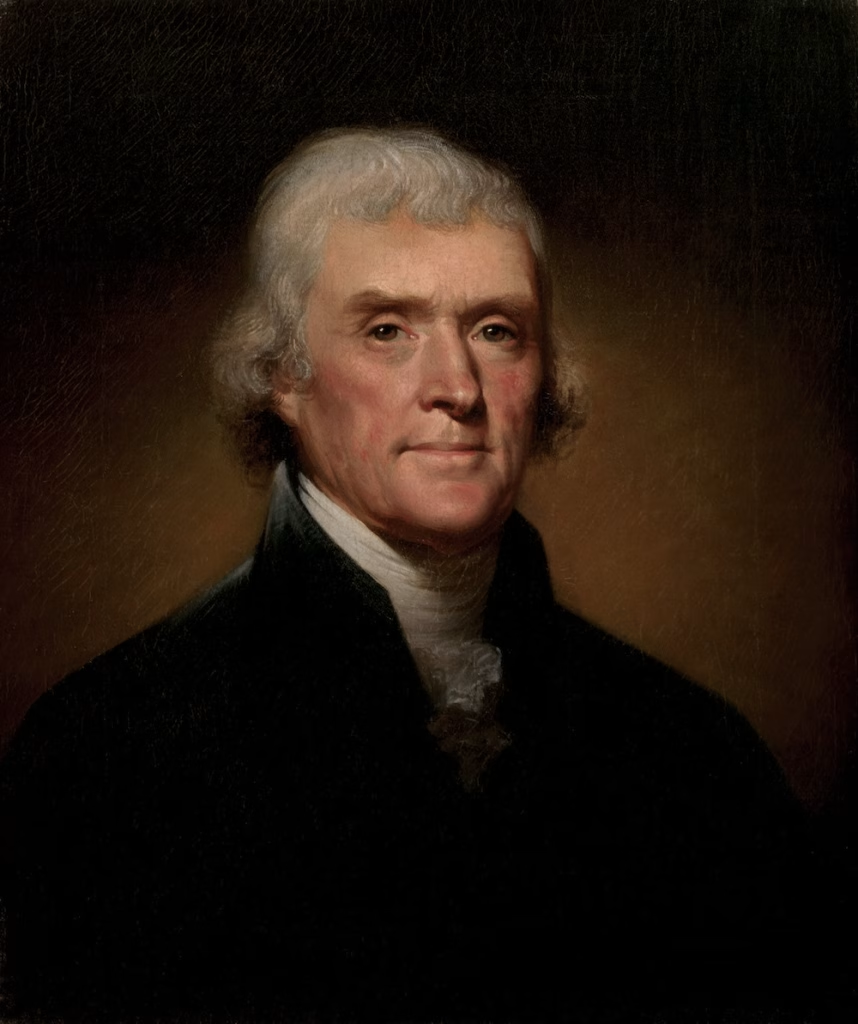
I am reminded of Thomas Jefferson’s famous declaration, “the tree of liberty must be refreshed from time to time with the blood of patriots.” It can be seen festooned on t-shirts and bumper stickers across the land by the very type of citizen most apt to have voted for the current administration.
Jefferson feared a too-powerful central government that would trample the inherent rights of the citizenry. White lays out a compelling argument that this is happening and likely to expand in scope.
Alas, the practical and moral arguments are in tension. The reality is that the blood of protestors, not tyrants, is getting spilled. A significant majority of Americans (61% in the latest NYT poll, taken after the Renee Good shooting but before yesterday’s tragedy) think ICE has gone too far. Alas, while there is increasing unease among Trump voters, the MAGA wing overwhelmingly supports the crackdown, with a whopping 21% saying it hasn’t gone far enough.
Further, as Christine Zhang and Ruth Igielnik note, gauging public opinion is challenging:
- Questions such as whether the shooting was justified are difficult to ask in a balanced way, with subtle differences in wording producing considerably different results.
- Even the best polls tend to overrepresent people who are politically engaged and who consume a lot of news. While videos of the [Good] shooting dominated media coverage in the days that followed, most Americans do not pay particularly close attention to the news.
- People sometimes answer poll questions with what feels like the “right” thing to say, an effect known as social desirability bias. In those situations, the fact that people are being asked about an event or a subject can make them feel as if they are supposed to know about or have an opinion on it.
- It is normal, even expected, for Democrats or Republicans to offer responses that align closely with their partisan beliefs. But the team mentality that some voters adopt can result in answers that reflect the way they think they should respond rather than what they might actually believe — a phenomenon known to polling researchers as expressive responding or partisan responding. This is a particular concern in instances where respondents are presented with two extreme options, neither of which exactly represents their views.
One would think constant news of ordinary citizens being killed, legal residents and citizens being terrorized, children and the elderly being frightened, and all the rest would have generated much more backlash that it has. But it’s much easier to ignore the news—or to get news filtered to one’s preexisting biases—than it used to be. And having an opinion and being motivated enough to do anything about it are very different things.
Despite the rhetoric of shedding the blood of tyrants and “Second Amendment Solutions,” there’s simply a massive collective action problem at work here. It’s just incredibly hard to get people to risk everything for a political stance. It’s why what’s happening in Iran—with citizens still in the streets after the government has murdered tens of thousands of protestors—is so remarkable.

I have said this before: at some point, it’s no longer about “political differences” but about an outright attack on both basic morality and your political rights.
Tell your family, neighbors, and co-workers (as far as feasible) that everyone who is pro-murder is dead to you.
No more pretending (not even implicitly) that things can just go back to normal.
Yesterday Jamelle Bouie wrote The Cruelty Is the Point for ICE (gift link).
Bouie goes on to note that at least 32 people died in ICE custody last year.
Republicans need an enemy, an “other”. Immigrants are playing the role Jews once played. As Rupert/Lachlan Murdoch is playing Goebbels, Noem Himmler, Bovino Rohm, etc.
Obviously Mr. White is another traitor, and needs to be immediately detained and renditioned. /S/
Why the backlash isn’t greater is the most pertinent question to answer for those us appalled by what is happening right now.
Here is another piece on violence, violence by the state though:
“Lucid”
The violence coming from ICE seems mostly the result of incompetence, albeit a somewhat encouraged incompetence from the likes of Miller and Noem*. They are screwing themselves because with each killing the people become all the more ginned up and active. There will be crowds waiting for them to show up now. Gandhi used this brilliantly against the British in India and non-violent resistance was and still can be a very effective tactic.
*An old quote of Bertrand Russell’s:
“Nothing can be more hopeless than a nation of disillusioned bigots, who have lost the capacity to be rational, and have no longer any outlet but despair for their irrationality. Such a population has no power of self-direction, and little willingness to accept again the kind of direction from without which has been found to lead astray. The springs of action are dried up, and nothing remains but listless drifting. This is part of the price that has to be paid for indulgence in collective hysteria.”
― Bertrand Russell, Why Fanaticism Brings Defeat, BBC broadcast transcript (23 September 1948).
Well, that and the fact that no court in this country is ever going to rule in favor of “violence due to tyranny.”
The regime has yet to outright defy a court order, although it’s gone close several times. But Trump’s rhetoric is painting it into a corner from which it might be unavoidable.
The first instances arose early, in connection with the despatch of Venezuelan men to an El Salvador prison. At the start it was “too late” to comply with a court order to turn the plane around; days later the regime claimed it had no authority to bring them back. On my understanding potential contempt of court orders remain under consideration from that matter.
Then we have had Trump’s frequent threats about tariffs: trying to reimburse them would be impossible, ruling them unlawful would destroy the country (which he is sworn to protect). Today he’s at it again. It’s “too late” to stop work on his stupid ballroom.
Either the Supreme Court will keep ruling in his favour, wrecking confidence in its independence even further, or it will eventually issue a decision despite his warnings that it will have terrible consequences. Even with his reputation for always chickening out, it’s likely he would choose in the latter scenario to defy the court knowing how inept it would be at making an effective response. That development would surely force some Americans to get off the fence and take a stand, although I don’t pretend to know whether it would be a stand for the constitution or for autocracy.
@Daryl: I can’t imagine any government, anywhere, that allows violence against itself. Revolutionaries who lose tend to be hanged as traitors.
@Ken_L: The administration has been pretty strategic in which rulings it appeals and which it doesn’t. But, yes, SCOTUS will have to issue rulings on several cases this term.