Take off the Masks
There is no reason for ICE operatives to wear masks save they don't want to be held accountable.
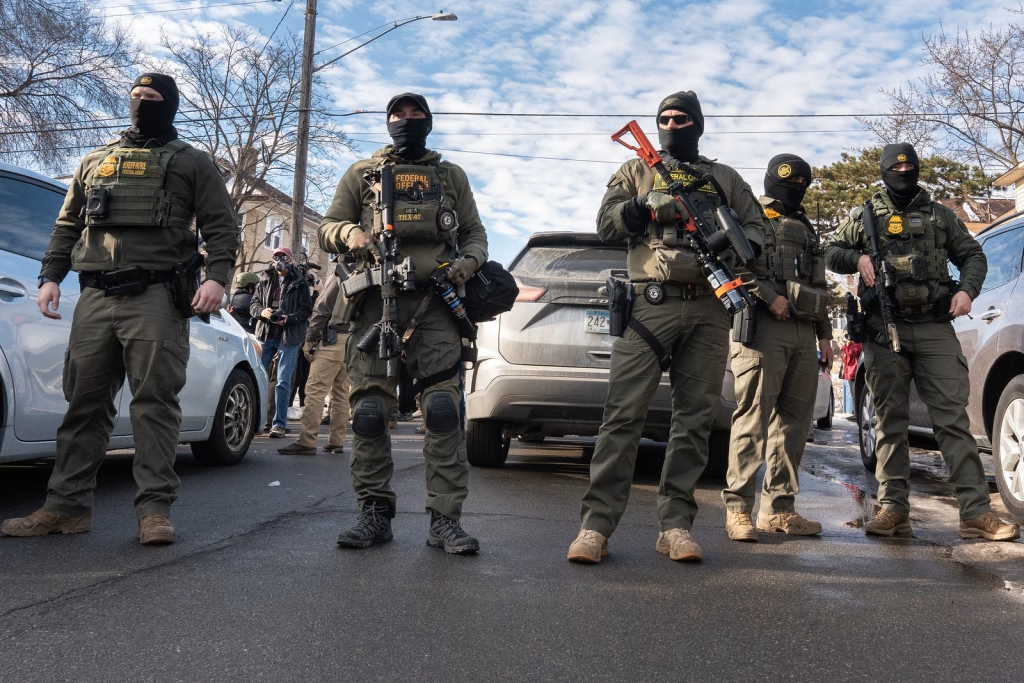
It has been obvious to me from the beginning that ICE and other federal forces deployed in the streets of the United States should not be wearing masks. This is a conviction that has only grown over time as I have watched videos of masked men acting with impunity, even while knowing that they are being filmed because their covered faces make them feel invisible.
I would argue that in a democratic society, the public has a right to know who is exercising power over them. This is especially true if those public employees have been issued guns and other implements of violence that they are authorized to use against the citizenry.
As such, I endorse Adam Serwer’s piece in The Atlantic: The Real Reason ICE Agents Wear Masks.
Masked men with guns are swarming through American cities. They are doing so in the name of enforcing immigration law. There is no justification, however, for federal agents to hide their identity from the public that pays for their weapons.
[…]
Police officers are civilians; they are public servants, not above the public. It is part of the job of police—and, for that matter, politicians—to be identifiable, because of the profound authority bestowed upon them. The ability to use force is a weighty responsibility, requiring high standards of conduct, and it can and should be revoked when abused. It is not “doxxing” federal agents for the public to know who they are. We are supposed to know who they are, because that is how we hold them accountable. This is why police officers wear visible badge numbers and name tags. The responsibilities they are given are not compatible with anonymity.
[…]
The Trump administration took the most corrupt, poorly trained, and impulsive law-enforcement agencies in the country, gave them masks, and turned them against American cities.
[…]
The public has a right to know the identity of the people who wield power in their name, so that they can withdraw that power from those who abuse or misuse it. If people can wield power over life and death without showing their face, we have a gang of criminals—not a police force.
[…]
Trump officials have loudly announced that federal agents have “absolute immunity” in the execution of their duties. Legal immunity plus anonymity equals impunity. It would be logical to think that in that situation, agents could literally get away with murder.
I recommend the entire piece, as he makes several additional salient points that I do not address here.
Let’s think about anonymity for a moment by considering some examples.
First is the internet commenter. There is little doubt that it is easier to say intemperate things if one is anonymous. It has been argued that one of the reasons LinkedIn is a less hostile environment than, say, Facebook is that not only is everyone there using their own names, one is commenting in the context of a professional community wherein people not only know your name, but they also know who you are, either in person or by reputation. This is not true of BombThrower42069 on Twitter.
Second, writers who write anonymously, especially those who claim expertise, are harder to take seriously than if I can actually see their credentials and a known body of work. And speaking as someone who has written for decades in a way that is supposed to cultivate some kind of reputation so as to generate credibility, I have to be conscious of how intemperate I am willing to let myself be in public.
Third, and to get much, much more serious, I think back to a practice in Colombia during the height of the drug war (in the 1990s), where there was a very real problem of violent retribution against judges, prosecutors, witnesses, and their families if cartel members were convicted. This was not doxxing, but assassinations, as well as bribery issues. This led to using jueces sin rostro, or faceless judges, where the identity of judges, prosecutors, and witnesses was unknown. Such a system denies a defendant the ability to challenge the fitness or potential bias of a judge overseeing a case, as well as not allowing the accused to face their accusers. It is not hard to see how such a system would make effective appeals nearly impossible. This system was eventually repealed.
If it was deemed problematic for justice to be faceless, even given the extreme violence in the context of Colombia’s internal drug war, it is hard to see how ICE’s anonymity is justifiable over theoretical doxxing.
Fourth, it was suggested in a comment thread yesterday that a good comparison for ICE is the Klan. On the one hand, I find the analogy wanting because ICE is an instrument of state power, and the Klan, though often aligned with the state, was not a legal entity. But I will agree with this: the Klan wore masks to both instill fear and to hide the identity of men doing violence so as to avoid accountability. In that way, the comparison is more than apt.
If I call customer service for just about any reason, one of the first things that they tell me is their name. I almost always write it down so that if I have a problem with the interaction and I have to elevate up the management chain, I know who to hold accountable for problems down the chain (or to simply identify at what level in the process there was a problem so that the manager knows whom to ask about the issue). If it is helpful to know who it was who was involved in handling a screw-up of my cell phone bill, I sure as hell want to know the name, badge number, and face of someone who violated my basic constitutional rights in a confrontation with ICE.
To be clear, I do not support doxxing, nor am I advocating for mob justice. But I would note that Adam Serwer, or anyone else who criticizes the administration in public, myself included, runs the risk of being doxxed (trust me: the thought has occurred well before now).
Should we all be anonymous as well?
Should we all be?
Would that be good for society?
I see no justification whatsoever for ICE or any other agency to be masked.
None.
What’s next? Masked IRS auditors?
It may be necessary to provide extra security for the individuals who have been identified as shooting Pretti. But I will say this: if fear of being doxxed or harassed would diminish the incentive to shoot protestors in the back, then maybe we need a little healthy concern about having identities linked to public actions.

Take off the masks, take off the militia cosplay gear, take off the assault rifles, wear name tags, wear badges (with serial numbers), wear body cameras.
Doxxing means revealing private details like address, work place, phone number, names of spouse and children, etc. Not seeing someone’s face and knowing their name.
@Kathy:
Indeed. It’s all intimidation. None of this shit is necessary.
It’s about as useful as pictures of Noem in CECOT.
This immediately brought to mind Reagan’s “I paid for this microphone” quote. The fact that Renee Good and Alex Pretti did, in some small way as taxpayers, pay for the weapons that ended their lives is pretty poignant.
In my “know your enemy” reading I came across Brendan Dougherty at NRO Corner under the title We Are What We Pretend to Be, arguing against ICE and other cops “getting dressed up like military forces”.
Judging by comments, Dougherty’s view is not popular with the NRO audience of supposed libertarians. One could argue they are dressed up like that as an extension of the will of Trump and MAGA who consent for the law to be enforced good and hard on people not like themselves.
They appear unrestrained by the need to document their actions, including violent encounters with members of the public. The absence of names and/or badge numbers no doubt emboldens them to take Kavanaugh stops well beyond the original ill-conceived purpose, creating a framework for mass intimidation and harassment, resulting in DHS-manufactured reasonable suspicion and the warrantless searches, break-ins, assaults, and detainments that follow.
The saying, “if you point a gun at someone, you’d better be ready to […]” should end with, at a minimum, “file a written report for organizational oversight and public accountability.”
Alas, I don’t think Trump, his lackeys, his enablers, and his voters would define “good” or “society” the way you and I would.
@Scott F.: True.
And those are, of course, rhetorical questions.
But if you did that, how could they get their “special forces stylee” cosplay on?
@JohnSF:
Paintball.
@JohnSF:
That’s an easy question, google “US paint ball parks”. Probably where Miller recruited a lot of these clowns to begin with.
ETA: Kathy beat me to it