The Slow Death of the Washington Post
A great newspaper is suffering another round of cutbacks.
The veteran journalist Ruth Marcus details “How Jeff Bezos Brought Down the Washington Post.”
On September 4, 2013, the Amazon founder Jeff Bezos held his first meeting with the staff of the Washington Post, the newspaper he had agreed to purchase a month earlier from the Graham family, for two hundred and fifty million dollars. It had been a long and unsettling stretch for the paper’s staff. We—I was a deputy editor of the editorial page at the time—had suffered through years of retrenchment. We trusted that Don Graham would place us in capable hands, but we did not know this new owner, and he did not know or love our business in the way that the Graham family had. Bezos’s words at that meeting, about “a new golden era for the Washington Post,” were reassuring. Bob Woodward asked why he had purchased the paper, and Bezos was clear about the commitment he was prepared to make. “I finally concluded that I could provide runway—financial runway—because I don’t think you can keep shrinking the business,” he said. “You can be profitable and shrinking. And that’s a survival strategy, but it ultimately leads to irrelevance, at best. And, at worst, it leads to extinction.”
To look back on that moment is to wonder: How could it have come to this? The paper had some profitable years under Bezos, sparked by the 2016 election and the first Trump term. But it began losing enormous sums: seventy-seven million dollars in 2023, another hundred million in 2024. The owner who once offered runway was unwilling to tolerate losses of that magnitude. And so, after years of Bezos-fuelled growth, the Post endured two punishing rounds of voluntary buyouts, in 2023 and 2025, that reduced its newsroom from more than a thousand staffers to under eight hundred, and cost the Post some of its best writers and editors. Then, early Wednesday morning, newsroom employees received an e-mail announcing “some significant actions.” They were instructed to stay home and attend a “Zoom webinar at 8:30 a.m.” Everyone knew what was coming—mass layoffs.
The scale of the demolition, though, was staggering—reportedly more than three hundred newsroom staffers. The announcement was left to the executive editor, Matt Murray, and human-relations chief Wayne Connell; the newspaper’s publisher, Will Lewis, was nowhere to be seen as the grim news was unveiled. In what Murray termed a “broad strategic reset,” the Post’s storied sports department was shuttered “in its current form”; several reporters will now cover sports as a “cultural and societal phenomenon.” The metro staff, already cut to about forty staffers during the past five years, has been shrunk to about twelve; the foreign desks will be reduced to approximately twelve locations from more than twenty; Peter Finn, the international editor, told me that he asked to be laid off. The books section and the flagship podcast, “Post Reports,” will end. Shortly after the meeting, staffers received individualized e-mails letting them know whether they would stay or go. Murray said the retrenched Post would “concentrate on areas that demonstrate authority, distinctiveness, and impact,” focussing on areas such as politics and national security. This strategy, a kind of Politico-lite, would be more convincing if so many of the most talented players were not already gone.
Newspapers have been struggling to find a viable business model since the Internet became the hub of the information space over a quarter-century ago. The end of local monopolies on information crushed the old advertising-supported model. And, ironically, the papers themselves helped fuel the expectation that news coverage should be free when they started publishing online.
People are understandably frustrated with Bezos:
What happened to the Bezos of 2013, a self-proclaimed optimist who seemed to have absorbed the importance of the Post in the nation’s journalistic ecosystem? In 2016, dedicating the paper’s new headquarters, he boasted that it had become “a little more swashbuckling” and had a “little more swagger.” As recently as December, 2024, at the New York Times’ DealBook Summit, Bezos expressed his commitment to nurturing the paper: “The advantage I bring to the Post is when they need financial resources, I’m available. I’m like that. I’m the doting parent in that regard.” Not long ago, he envisioned attracting as many as a hundred million paying subscribers to the Post. With these brutal cuts, he seems content to let the paper limp along, diminished in size and ambition.
“In the beginning, he was wonderful,” Sally Quinn, the veteran Post contributor and wife of its legendary executive editor, Ben Bradlee, told me of Bezos. “He was smart and funny and kind and interested. He was joyful. He was a person of integrity and conscience. He really meant it when he said this was a sacred trust, to buy the Post. And now I don’t know who this person is.”
The Post is reportedly hemorrhaging some $100 million a year. If it were an ordinary business, these cuts wouldn’t be a surprise. But it’s a vanity side project for one of the wealthiest men on the planet. $100 million is pocket change to him. Hell, his ex-wife has given away some $60 billion since their divorce.
A retired journalist speculated on Facebook yesterday that this was about managing the estate. While Bezos may be passionate about the enterprise, he may not want to saddle his wife, four children, and three stepchildren with an asset that’s losing so much money. But he’s only 62 years old; it’s a little early to be getting his affairs in order. And he could endow a charitable trust that could sustain a $100 million annual loss indefinitely for $2 billion. His net worth has fluctuated more than that in the time it took me to type this paragraph.
But, of course, it’s his money. And, despite the headline assertion that Bezos “brought down” the paper, it’s quite likely he kept it afloat for 13 years longer than it otherwise would. It’s not like there was a long line of people willing to put that kind of cash into a failing enterprise. Indeed, Marcos acknowledges, “I am grateful for the resources, financial and technological, that he devoted to the paper in his early years as owner.
Then again, longtime Post sportswriter Sally Jenkins, now with the NYT-owned Athletic, isn’t wrong here:
Bezos, she said, had been generous with his money and laudable for never interfering in the work of the newsroom. But, she added, “making money at journalism, you have to break rocks with a shovel. You have to love thinking about journalism to the point that it wakes you up at night with an idea, and then you have to be willing to try it. And I don’t see a sense that he loves the business enough to think about it at night. It’s almost like he’s treated it like Pets.com—an interesting experiment that he’s willing to lose some money on until he’s not. But the difference with this business is it’s not Pets.com. It’s not a business that just disappears into the muck of venture capitalism. It’s a business that is essential to the survival of the Republic, for Christ’s sake. So you don’t fuck around with it like that.”
From a business standpoint, the cuts make some short-term sense. But, at some point, it’s no longer a major newspaper. We’re dangerously close to that point, if it hasn’t already happened.
One could argue, for example, that a prestige Sports section is a vestige of a bygone era. Fans can gets scores in real time on their phones nowadays and there are so many niche outlets out there doing deep dives on particular teams and niches. Still, for a paper that until recently employed the likes of Tony Kornheiser, Michael Wilbon, and John Feinstein, it’s quite a shock to essentially close shop.
The World desk is another matter entirely. One can’t be truly informed without having some sense of what’s happening in other countries. But maintaining foreign bureaus is expensive and, alas, most Americans just aren’t interested.
UPDATE: Regular commenter @Moosebreath observes,
Missing in this analysis is the recent coziness between Bezos and Trump, as well as the strong rightward turn the paper has taken in recent years, causing many of its subscribers (myself included) to flee. The monetary losses, after years of stability, may have been a result.
Middle East scholar Monica Marks thinks the same, and offers this graph by way of evidence:
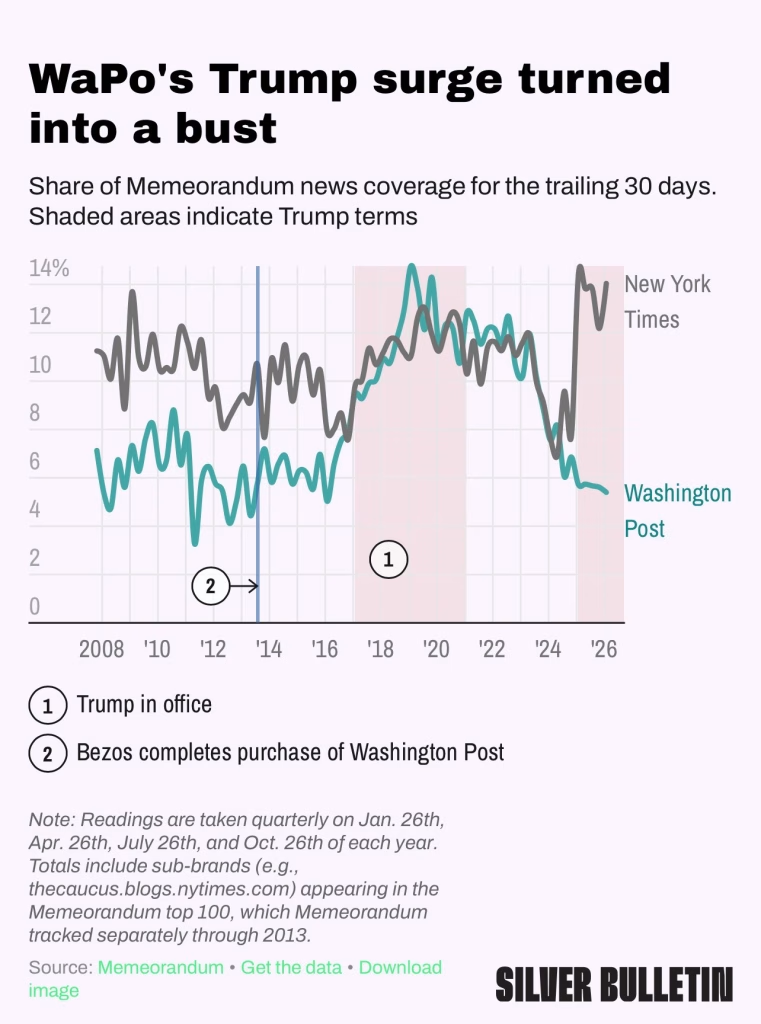
Whatever the cause or rationale for that change in editorial policy, which no doubt offended a core group of the Post‘s subscribers, the paper’s financial woes long predate the change or, indeed, Bezos’s acquisition. Aside from a short period fueled by the Trump phenomenon, the paper has been losing massive amounts of money for at least two decades.
The retired reporter referenced above puts it this way:
Subscriptions began diving after Biden was elected. The rage that fueled circulation disappeared alongside Trump. You see the same effect not only at the NYT but at most left-leaning periodicals, many of which went bust.
So, why did NYT succeed and they fizzled? Bundling! Reporters never like to hear this, but Wordle, the Athletic, Wirecutter, etc., keep the hard newshounds employed. NYT sells them as packages, giving subscribers an affirmative reason to spend their money.
Which, ironically, is what newspapers always did. Yes, advertising, not subscriptions, paid most of the freight. But it offered news, sports, lifestyle features, crosswords, comics, obituaries, weather, television listings, etc. You pretty much had to take the local paper. That’s no longer the case and yet publishers have to figure out how to make it with subscription fees alone.

This may be unfair, but it will be a cold, cold day in the Sun’s core before I feel I owe Lex Bezos fairness.
Missing in this analysis is the recent coziness between Bezos and Trump, as well as the strong rightward turn the paper has taken in recent years, causing many of its subscribers (myself included) to flee. The monetary losses, after years of stability, may have been a result.
@Moosebreath: I was going to answer here but updated the post instead.
@Moosebreath: indeed. The post with quotes only mentions Trump once, as a time marker. But this is all obviously about Trump.
Somewhere in there is a good story about late stage capitalism, excess wealth, and oligarchs. Maybe one of the ex-staffers will write it.
ETA: James types faster than I do. yes, they should have done what NYT did. But Bezos seems to have preferred that it quietly die.
Maybe CBS News needs to learn a lesson from this (they won’t). The New Yorker pointed out that in the movie Citizen Cain the newspaper owner was concerned about losing $1million per year, rendering him broke in 60 years. The WP could lose $17 million per year and Bezos would go broke in like 1272 years.
Also, I agree that newspapers haven’t found a model that works since the inception of the internet. I don;t understand what is so hard about this. If there was a service where I could pay $10, $20, maybe $30 per month to unlock articles and journalists / newspapers get paid like artists on Spotify then I would do it. I’m not going to pay for a subscription to 10 different news outlets so I can read the 3 or 4 articles per month that I am interested in.
All true, and certainly the digital age plays large into this sad transitioning for WAPO. But bringing in Lewis was not a good sign or good turn for the paper. The media marketplace is over-saturated with right leaning media outlets now. Way over-saturated. Bezos began chasing after a demographic already hounded by sound-a-likes, on a long read platform losing favor with the general public anyway. A perfect storm.
There are so many media sources out there of which I would like to partake, but for the cost of subscribing to them all. I would like to see a “news media passport” (does one exist?) that entitles the subscriber to sample reads from all offerings for one monthly fee. For example, if one were to pay x-per month, they would get x-number reads from the entire bundle. There could be different size bundles. A Netflix for news, so to speak.
I left WAPO last year. WAPO’s rising hypocrisy rendered it a waste of time.
I think there is another angle worth sussing out, please bear with me a second I’m in bad (mental) shape today.
I think there are a couple of things that are starting to fuse together: 1. People of unimaginable wealth have come to believe that they are entitled to EVERYTHING + impunity to do what they want when they want it + a demand that we not only accept this as normal, but that we LOVE them for it, 2. a 50ish year Right Wing project to render any Left wing use of power, no matter how milquetoast, completely and totally illegitimate, and 3. an almost explicit return of the Confederacy (hierarchical, misogynistic, racist, white supremacist, Christian nationalist).
As an aside, I’m still trying to figure out the contours of #2 above. I don’t mean this in a conspiracy sort of way, but it really seems like Regan & Thatcher looked at the New Deal & what happened to Nixon and decided to undue the first and ensure the second never happened again. They inspired people like Roberts, Alito, & Gorsuch to bring that into effect for them.
I know Dr. Taylor disagrees with me about the comparison of ICE to the KKK because of the state action issue. He’s probably right. However, we know the Nazis were inspired by the Confederacy and Jim Crow, what if our neo-Confederates have been inspired by the Nazis in turn? The Confederacy used state power to enforce to Fugitive Slave Act against the North. The aristocracy of the Confederacy went ape shit, when even after getting their way, they weren’t beloved as well.
I think that’s what we’re moving into. It suits people like Bezos to let something like WaPo die. It’s a rounding error to him. How much, in 2026 dollars, did Rockefeller and Carnegie spend on public works? Bezo’s entire wealth is because he’s destroyed small and medium businesses while also paying his employees as little as possible. It benefits him and his oligarch friends to destroy national news like WaPo.
Another part of this is: there is always enough money for right wing things. You don’t hear the Murdochs complaining about costs. There’s plenty of money to bribe people like Clarence Thomas. Plenty of money to bring people together and bring them up in the right wing machine.
Everything outside of that, Unions, community organizations, broad national news, I’m sure other things, have just been systematically starved of resources. We notice when they are outright murdered, but we don’t notice as they are just suffocated. Everything outside the right wing machine is subjected to “economics”, while everything inside is nurtured and propped up. Sometimes with our money.
Hopefully any of this makes sense and is coherent enough.
Today’s NYT “The Daily” podcast is also covering the WP story.
https://www.nytimes.com/2026/02/05/podcasts/the-daily/jeff-bezos-the-washington-post.html
@Beth: What’s weird is that the Bezos-funded Post clearly had a Progressive/Resistance vibe before pivoting just before the 2024 election. It’s really bizarre.
As to “there is always enough money for right wing things. You don’t hear the Murdochs complaining about costs,” it’s worth noting that Fox News is hugely profitable. It’s infotainment, not news, but it had profits of something like $2.5 billion last year.
@Beth: Coherent and true and needing annunciation.
@Beth:
Thomas Franks “The Wrecking Crew” chronicles a part of that 50ish year period. He brings the goods – footnotes, references. The game was already in play forty years ago.
I think that the newspaper model isn’t really viable anymore in the US. We will have a few survive for a while and many of those will be similar to the WAPO ie a vanity project of some rich person.
Steve
@Beth:
I think you’ve put your finger on something really important here. As @gVOR10 notes excess wealth and oligarchs lurk at the heart of so much of the dysfunction of this new Gilded Age and I believe we aren’t giving that the focus it needs.
An obscenely rich man OWNS a business that journalist Sally Jenkins rightfully points out as “essential to the survival of the Republic, for Christ’s sake.” I can’t conceive a societal benefit to having that kind of power in the hands of an unimaginably wealthy man accountable only to his own bottom line.
BTW, I think the numbers 2 and 3 in your fusion above are derivatives of number 1. Leftism is the mortal enemy of unbridled wealth accumulation, so it must be killed. At the same time, the rise of a new Confederacy is about getting the 99% to fight amongst themselves, so the 1% can have their way without being hated for it.
@James Joyner:
I don’t think it’s that bizarre, but I do think the reality of the situation sounds crazy enough to get rejected as a tv show.
I think this bit from The Bulwark nails a good chunk of it:
Snip
I think the other part is the Epstein of it all. Not that Bezos is a kid diddler, but he runs in those circles. It’s all impunity all the way down. Maybe another way of putting it is that people like Bezos understand and have intense class solidarity.
Yes, but I don’t think this disproves my point. Fox News is profitable, but how much of that is because it’s the beneficiary of right wing socialism? Also, as you note, it’s not journalism in the way that WaPo is. If it was held to actual standards, would it be profitable?
Another bit, I checked NY Post was unprofitable for years. I’m guessing that Fox News is the exception that funds a lot of other things, directly and indirectly.
@Rob1:
You and me both, along with a whole lot of other people. I’d have stayed if I thought there was a chance I’d be supporting reality based journalism. But it was obvious Ann Telnaes had it right in the cartoon WAPO refused to publish, driving her resignation.
@James Joyner:
Not bizarre at all. There’s a budding movement to regulate social media and tech companies, and to hold them accountable for their negative effects on society. Biden and Harris seemed amenable to this.
In addition, Biden had moved parts of the economy to work more for the middle class and the poor than for the oligarchs. Not much, not very fast, but it was clear what direction the Democrats were taking.
To end, removing the Harris endorsement might have helped Lex in his dealings with El Taco. Leaving the endorsement would have impeded this, and probably got him hostility if not outright retaliation. Whereas if Harris had won, she wouldn’t have made Lex pay for his insolence.
What’s bizarre is that a net worth over a quarter trillion dollars, plus a huge yacht, a space toys company, domination of online retail, a large role on streaming, the ability to rent Venice for a part, and lots of other things, are not enough for this particular oligarch, nor for his bros in the rarefied levels of wealth they move around.
@Beth: @I haven’t read The Wrecking Crew that Rob1: mentions. Sounds promising. I’d recommend Jane Mayer’s Dark Money. Thomas Piketty, Peter Turchin, and others see recurring cycles of revolution or reform followed by the ascendance of wealth in politics again until things break down again.
I take this back to two things. First, Kennedy cut the top marginal personal income tax rate from 90% to around 70. He did it because mainstream econ estimated peak revenue would come at about 70%. And it was a successful supply side tax cut, I think the only one. But the 90% rate ciut down on the number and wealth of people who could afford to ratfrack with politics. And subsequent Republican cuts to 37% have been suicidal.
Second, and around the same time, Goldwater’s backers realized they could sell a prez candidate the way they sold cars and laundry soap. They failed with Goldwater, but they didn’t have a credible product, especially against the Veep of the martyred prez.. Not long after that David Koch lost his VP bid as a Libertarian, he and his brother realized there was no way for an avowed libertarian to win a fair election, so they and their fellow travelers set out to simply buy the government. It’s been a long campaign, but it’s working, for them.
@HelloWorld:
I’ve long said something similar, but in order for this to push enough revenue to publications that it would pay salaries, it would likely have to be a fixed set of publications. Like, the political pack would be NYT, WaPo, Politico Pro, WSJ. You pay $40 a month and each of those publications gets $10, and they decide how many articles that unlocks, rather than paying $40/mo. for 30 articles. You could design a sports pack, a cooking section pack, and so on. The difference between musical artists on Spotify is that music is just one funding stream for them, there are multiple outlets where they can sell music, they also have concerts, merchandise, etc.
@HelloWorld:
@steve222:
This doesn’t mean that print legacy outlets are destined for death tho. The newspaper business will never be as big as it was in the William Randolph Hearst or Katharine Graham/Ben Bradlee days, of course not. But survival and even growth are not impossible. To wit:
New York Times reports strong 2025 growth as Washington Post cuts staff (Yahoo Finance)
And it’s not because the Clintonphobic, Bannon-friendly, anti-trans, pro-Iraq, Mamdani-skeptical New York Slimes is an avatar of resistance liberalism — like The Guardian, another thriving paper of record. The Wall Street Journal also does well in its traditionalist conservativism.
Yes, these are big, esteemed outlets with international reach, and thus somewhat sui generis — but so is/was the Post. There are smaller, more local papers not shedding huge chunks of readership or laying off a third of staff.
WaPo was better leveraged than most to survive better against digital disruption. But it’s been poorly run for a while, from amplifying clueless contributors like Megan McArdle and the odious Marc Thieesen to the unethical decisions that alienated liberals and ran away smart journalists, leaving its Thieesens to write half-baked editorials simping for a pedophile president.
I doubt Bezos wanted to kill the Post. Having bought into the antiwoke vibe shift bs, Bezos wanted to burnish his image as a benevolent, above-the-fray, “there’s no red or blue America, only purple America” benefactor. He envisioned WaPo as a journalistic Switzerland, the go-to for prestige centrism. Like Citizen Kane, he thought it would be fun to run a newspaper.
Bezos failed to recognize the 2020s as what Reagan called “A Time for Choosing,” when moral clarity is required. In 2026, milquetoast neutrality reads as moral corruption.
I think Bezos would rather people think he doesn’t care about his personal reputation and is acting affirmatively to either save or kill the Post, when the blame lies in incompetence, weakness, and betting on the wrong horse. He’s just not good at owning a newspaper. Too bad WaPo employees have to suffer the financial consequences.