No Kings Rallies March On
Sounding a barbaric yawp over the streets of the world.
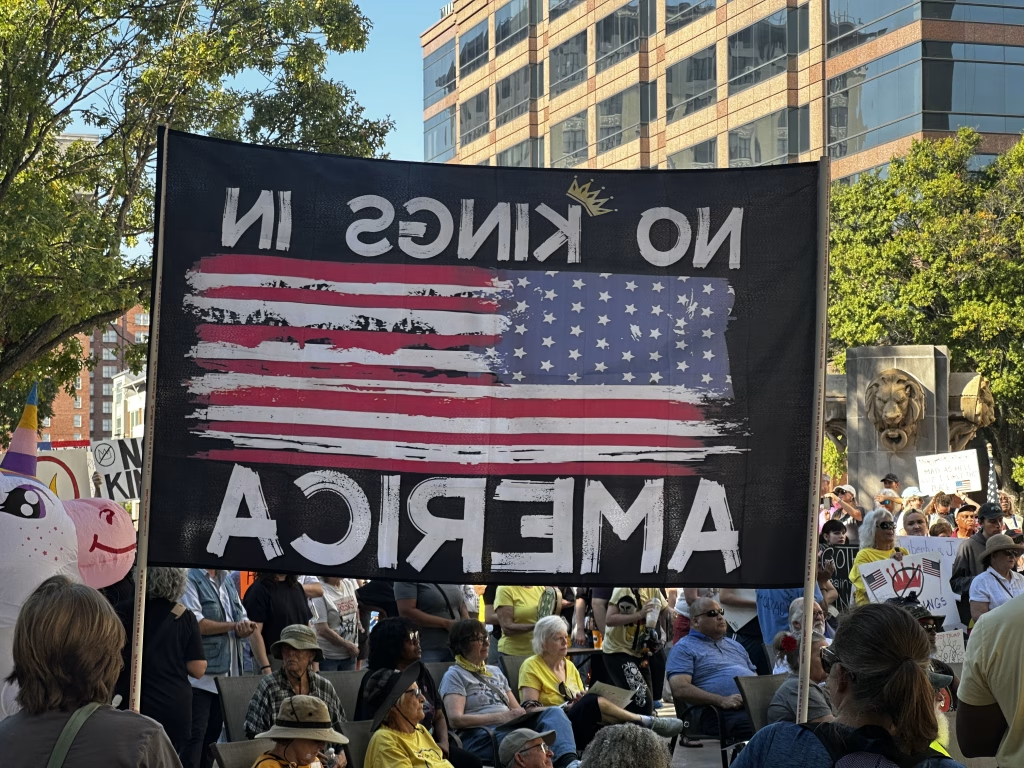
Reporting for NYT, (“A Challenge for ‘No Kings’ Protests, the Third Time Around” in the online edition, “Will Primal Scream of ‘No Kings’ Echo in Voting Booths?” on today’s front page), Jeremy W. Peters explores the challenges of a leaderless prtest movement.
Deflated by their electoral losses and demoralized by President Trump’s return to power, millions of his most ardent opponents turned out at two nationwide protests last year and found an outlet for their discontent.
They hit the pavement again on Saturday for the third “No Kings” demonstrations, a boisterous show of force that filled television screens, social media feeds, and cities and towns in all 50 states.
[…]
Organizers hoped Saturday’s protests would turn out to be the largest yet. But as the marchers tried to fulfill that promise, it remained an open question whether another big turnout would be enough to influence the course of the nation’s politics. Can the protests harness that energy and turn it into victories in the November midterm elections? How can they avoid a primal scream that fades into a whimper?
The phrase “No Kings” is a nod to the anti-authoritarian, democratic principles the country was founded on — which the protesters say Mr. Trump has ignored.
Otherwise, organizers said, “No Kings” protests intentionally lack a single, specific demand, reflecting the diffuse nature of the anti-Trump effort. The signs protesters carried on Saturday highlighted a wide range of issues, including immigration patrols (“ICE Needs to Melt”), democracy, diversity and the war against Iran. “We Can’t Afford the War or the Gas,” read one sign in Atlanta.
Nor has a high-profile leader or public face emerged, in the way that Tom Hayden did during the 1960s antiwar protests or Jerry Falwell in the 1980s for Christian evangelicals. Luminaries of today’s left like Bernie Sanders and Alexandria Ocasio-Cortez act as champions of progressive causes rather than only as foils to Mr. Trump.
Organizers say the idea is to attract as many opponents of the administration as possible — especially the disaffected.
[…]
Protesters held events in thousands of locations from Alaska to Florida, in liberal big cities and Republican strongholds, in addition to cities overseas. And beyond urging the faithful to turn out in big numbers and remain nonviolent, organizers were hands-off about what they expected from attendees.
[…]
Videos of the peaceful demonstrations, whether taking up several city blocks or a small-town street corner, are meant to rev up the politically weary, organizers said. So are the whimsical costumes and homemade placards, with cheeky sayings like “Make Orwell Fiction Again.”
But skeptics of such events say that during Mr. Trump’s first term, progressives mistakenly thought that mass protests were a sign of the movement’s widespread popular support, without mastering the harder work of organizing.
“These large-scale protest events make people feel like they’re not alone — it’s like collective therapy,” said Dana R. Fisher, a professor at American University who studies civic engagement.
She has surveyed “No Kings” participants in her research and supports their work. But, she added, collective catharsis and hitting what she called “a magical number” of participants is not enough to sustain an effective political movement. “What we really need to do is the work of defending democracy in our communities,” she said. “It’s not about inflatable costumes. It’s not about clever signs.”
[…]
Mr. Trump’s approval rating has fallen to 36 percent as of March 23, from 45 percent around the time he took office last year, according to Reuters/Ipsos.
That kind of drop should help activists, but the “No Kings” rallies have forced progressives to assess whether their messaging is simple and direct enough to reach most voters.
Ms. Fisher of American University and a team of researchers surveyed participants at more than 300 “No Kings” events last summer and found them to be predominantly female, college educated and middle-aged. Close to 90 percent were white, the surveys found.
They were also deeply engaged politically, with more than two-thirds saying they had participated in a political boycott in the last year.
The organized opposition to Mr. Trump has had little difficulty summoning the nation’s outrage at opportune moments. Quantifying the impact of those protests is much harder.
Lara Putnam, a history professor at the University of Pittsburgh who studies political protest movements, said the recent level of activity inside the Trump opposition has been striking. In Pennsylvania, for instance, she said that she had found 80 different “No Kings” events across the state last October. That compared with 27 events on the day of the Women’s March in 2017, a mass demonstration against President Trump during his first term.
Because of social media, “it is much easier to get people in the same place,” Ms. Putnam said. “But it doesn’t necessarily make the other pieces needed for building a political movement.”
As regular readers know, I’m a longtime skeptic of protest movements. They can certainly be effective, with the Civil Rights and anti-Vietnam War protests as modern exemplars. Even the Tea Party movement generated real results, as noted in Peters’ piece. But most — Occupy Wall Street, the first-term anti-Trump Resistance, and seemingly this one — simply lack focus. The participants have some modestly overlapping — often quite legitimate — grievances, but don’t have a common programmatic goal.
But I’ve also come to be less dismissive of “collective catharsis,” “collective therapy,” or however else one might characterize millions of people with no other recourse venting their displeasure with the current state of affairs.
Sure, a significant number of the participants are the usual suspects, for whom protesting is something of a hobby. Others are simply mad that their preferred candidate lost the election. But there’s also genuine fear and outrage over a whole host of actual policy actions taken by this President, quite often in contravention of basic Constitutional norms. And, as outrages mount, the specific ones animating those assembled have shifted.
Renee Good had not been murdered when the first protest took place. We had not started a war with Iran solely on a presidential whim when the previous iteration took place.
Given that Trump was elected to a four-year term in November 2024, he’s likely to be in office until noon on January 20, 2029. Given that his party has slim control of both the House and the Senate — and that they’ve shown incredible deference to him — there’s very little folks can do to vent their outrage and fear.
Sure, they can work to elect Democrats to the House and Senate in November. But that’s months away even now and interminably long when the first* of these protests took place last President’s Day. And, of course, many of the protestors live in states and districts that are solidly red, making that task next to impossible in their locality. (Or, for that matter, live in states and districts that are deep blue, making the outcome assured locally.) And that’s to say nothing of those affected by these policies who live in other countries.
Four years is a long time to live in fear and anger. Spending a Saturday communing with hundreds or thousands of others who are frustrated is, if nothing else, a coping mechanism.
*Peters seems not to be counting the “No Kings On Presidents’ Day” rally for whatever reason. NPR does the same. ¯\_(ツ)_/¯

Odd take by Peters. It’s not just progressives protesting Trumpism. And after his first term Trump was booted from office.
At any rate, not sure why skeptics of No Kings are so vocal about it. It’s a nominally free county: ergo, like-minded people can gather if they want, for no reason at all or just to commiserate, if they choose. They don’t need to justify that to anyone.
Skeptics can instead do what I did yesterday: housekeeping, gardening, gym/cardio, and laundry.
I don’t see why we should cheer Iranians protesting their Islamofascist government but sneer at Americans protesting our Christofascist government.
These protests are a way to hold on to normalcy, sanity, in the midst of the Trump Cult’s efforts to erase reality and replace it with lies and fantasies. When the world has gone crazy it can be reassuring to realize that not everyone has lost their fucking minds. We cannot allow corruption, lies, hate speech and government violence to be seen as the norm going forward. It’s a powerful reminder to MAGA that no, assholes, you have not won because we have not surrendered.
And it is an intimidation tactic as well: we are here, there are a lot of us, and we fucking hate what you MAGAts are doing to our country, and we will take you down.
I’d also argue that the anti-ICE protests have been effective to a significant degree – we are not seeing the kinds of overt thuggishness we watched in Minneapolis. ICE has been warned, whether they would admit it or not, that they cannot just storm into an American city and start murdering people.
Imagine if there were no mass protests of Trump. I’m sure the NYT would run articles saying how it shows 1. Trump won the argument, 2. Dems are in disarray, 3. kids these days.
If there are protests, NYT says it shows how Dems are in disarray and unable to project unity. If there are no protest, NYT would say it shows how Dems are in disarray and unable to inspire even their own base.
The unstated editorial line is, I think, to keep the Dem base in line and mold the party into something center-left-but-no-further.
@DK:
Speculation and nothing more, I think JJ lives in a world where he interacts with, works with, likes at least some people who are MAGA, and because they are in uniform or wearing suit and tie he can see them as ‘wrong’ but not as ‘evil.’
Hannah Arendt on the banality of evil: “The sad truth is that most evil is done by people who never make up their minds to be good or evil.” Evil isn’t just SS officers in spiffy Hugo Boss uniforms or mustache-twirling villains, it’s ordinary, boring people ignoring evil, refusing to see it, shrugging it off. A MAGA Army colonel, chest all covered with ribbons, backslapping and buying drinks and seeming to all outward appearances to be normal is, nevertheless, a servant of evil, just as surely as the professional Prussian officer in 1940 served evil.
That has to be uncomfortable for people who are required to be part of a hierarchy much of which is MAGA.