A Very Good Week For Putin
The Russian autocrat may be on the verge of getting what he wants.
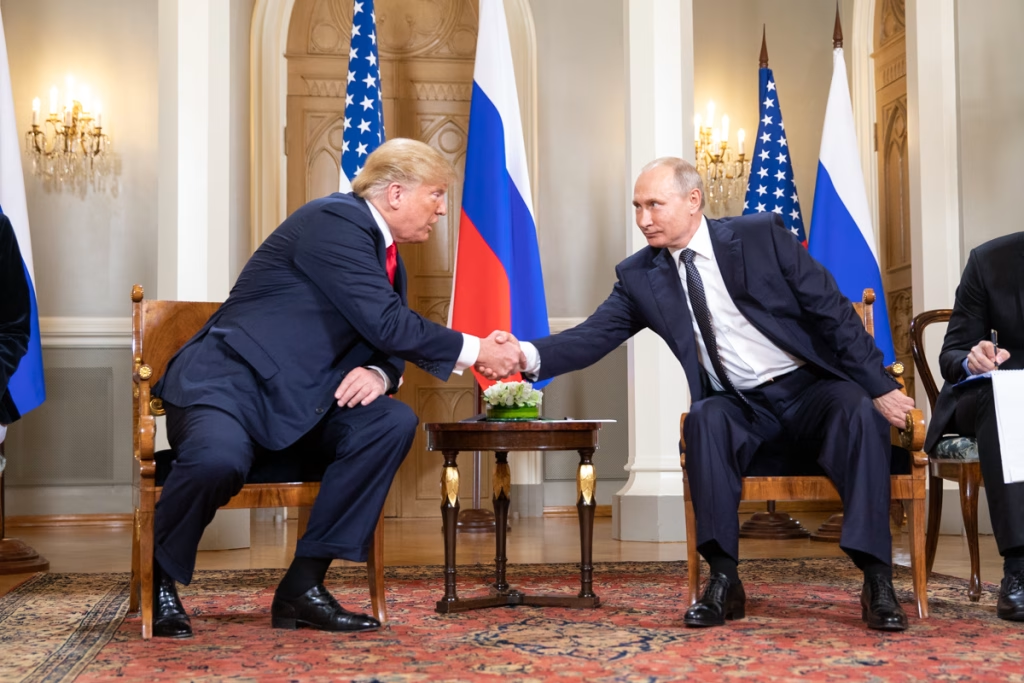
NYT international correspondent Paul Sonne (“After Almost Losing Trump, Putin Gets His Ideal Summit“):
Late last month, President Vladimir V. Putin of Russia was facing a stark reality: He was on the verge of losing President Trump, the one Western leader possibly willing to help him get his way in Ukraine and achieve his long-held goal of rupturing the European security order.
After months of trying to get Mr. Putin to end the war, Mr. Trump had grown tired of ineffectual phone calls and talks, and had begun issuing ultimatums. Even worse for Mr. Putin, Mr. Trump appeared to have patched up his relationship with President Volodymyr Zelensky of Ukraine, despite an Oval Office blowup earlier this year that delighted Moscow.
[…]
Despite previous refusals by Russian officials to negotiate over territory in the Russia-Ukraine war, the Russian leader, during a meeting at the Kremlin last week, left Mr. Trump’s special envoy, Steve Witkoff, with the impression that Russia was now willing to engage in some deal-making on the question of land.
“We’re going to get some back, and we’re going to get some switched,” Mr. Trump said Friday. “There’ll be some swapping of territories to the betterment of both.”
By speaking a language Mr. Trump understands — the language of real estate — Mr. Putin secured something he had been seeking ever since January: a one-on-one meeting with the U.S. leader, without Mr. Zelensky present, to make his case and cut a deal.
“It has been a very good week for Putin,” said Sam Greene, a professor of Russian politics at Kings College London. “He has taken himself out of a position of significant vulnerability. He has maneuvered this entire process into something that is more or less exactly what he needed it to be.”
At the same time, tensions between Washington and Kyiv have reappeared.
Mr. Zelensky said on Saturday that the Ukrainian Constitution does not allow Kyiv to negotiate away the country’s land. Mr. Trump initially told European officials that the meeting with Mr. Putin would be followed by a three-way summit with both Mr. Putin and Mr. Zelensky. But the Kremlin quickly said no such promise had been made. The White House proceeded anyway.
The fundamental problem remains the same as it has been since it became clear, very early in the war, that Russia could not achieve its maximalist aim of complete conquest of Ukraine: there is no obvious endstate that both parties can accept and no realistic way for either party to achieve their war aims.
For Zelensky, anything short of the status quo ante is a non-starter. And, yet, Ukraine simply doesn’t have the manpower to achieve that aim absent a much greater commitment from NATO countries than any are likely to make. Putin is willing to wage an indefinite war of attrition and he has a population three and a half times Ukraine’s.
Despite hopes—which, admittedly, I shared—that the disastrous war would lead to the military or oligarchs turning against Putin, there’s simply no sign that’s going to happen. But his ego and ideology won’t allow him to end this war without gaining a substantial chunk of Ukrainian territory.
Mr. Putin has made it clear that, among other things, he wants a formal promise that Ukraine will not enter NATO or any other Western military alliances, host Western troops on its territory or be allowed to build up a military that threatens Russia — making Kyiv perpetually vulnerable.
“The fundamental thing for Russia is domination,” Mr. Greene said.
Alexander Gabuev, director of the Carnegie Russia Eurasia Center in Berlin, said Mr. Putin would come into the summit Friday in Alaska pursuing various scenarios.
Those include a favorable deal with Mr. Trump that the U.S. president successfully forces upon Ukraine or a favorable deal with Mr. Trump that Mr. Zelensky refuses, causing the United States to walk away from Ukraine, Mr. Gabuev said.
The third option, he noted, is that the Russian leader continues his current path for another 12 to 18 months, with the expectation that Ukraine will run out of soldiers faster than the Russian war economy runs out of steam.
A promise that Ukraine will not join NATO would be a bitter pill to swallow but, realistically, Germany and France at a very minimum will never allow it to happen. The pledge at the 2008 Bucharest Summit that Ukraine and Georgia would eventually become members was a feckless one, soon followed by Russia’s invasion of Georgia. While NATO’s response in the wake of the 2014 invasion of Crimea and, especially, the 2022 invasion, was heartening, there’s clearly no stomach to take on Russia directly.
President Trump has demonstrated more affinity for Putin and other great power leaders than he has for those they threaten. He lacks the instincts of his predecessor, forged during the Cold War, to stand up to Russian aggression in the region. At the same time, he responds to personal slights, so Putin can’t overplay his hand here.
Mr. Putin understands that Mr. Trump is willing to offer things few other American leaders would ever consider, which could help Russia fracture Ukraine and divide the Western alliance.
“If you could get Trump to recognize Russia’s claim to the lion’s share of the territory that it has taken, understanding that the Ukrainians and the Europeans might not come along for the ride on that, you drive a long-term wedge between the U.S. and Europe,” Mr. Greene, of Kings College London, said.
I simply have no basis for prediction on that front. Trump is, if anything, wildly inconsistent and completely lacking in ideology. He likes making deals, so long as he can spin them as wins. What that means, I haven’t a clue.
But despite wanting those things, Mr. Putin won’t stop the war for them, if getting them means agreeing to a sovereign Ukraine with a strong military, aligned with the West, that is able to make its own arms, Mr. Gabuev said.
“Trump is a big opportunity for him,” Mr. Gabuev said. “I think that he understands that. But at the same time, he is not ready to pay the price of Ukraine slipping away forever.”
Again, given that Zelensky knows full well he’s not going to get NATO membership, he’s likely to be willing to commit to staying outside the alliance. He can’t and shouldn’t commit to what amounts to disarmament.
CNN chief international correspondent Nick Paton Walsh (“Trump-Putin summit in Alaska resembles a slow defeat for Ukraine“):
The conditions around Friday’s summit so wildly favor Moscow, it is obvious why Putin leapt at the chance, after months of fake negotiation, and it is hard to see how a deal emerges from the bilateral that does not eviscerate Ukraine. Kyiv and its European allies have reacted with understandable horror at the early ideas of Trump’s envoy, Steve Witkoff, that Ukraine cede the remainders of the Donetsk and Luhansk regions in exchange for a ceasefire.
Naturally, the Kremlin head has promoted the idea of taking ground without a fight, and found a willing recipient in the form of Witkoff, who has in the past exhibited a relaxed grasp of Ukrainian sovereignty and the complexity of asking a country, in the fourth year of its invasion, to simply walk out of towns it’s lost thousands of men defending.
It is worth pausing and reflecting on what Witkoff’s proposal would look like. Russia is close to encircling two key Donetsk towns, Pokrovsk and Kostiantynivka, and may effectively put Ukrainian troops defending these two hubs under siege in the coming weeks. Ceding these two towns might be something Kyiv does anyway to conserve manpower in the months ahead.
The rest of Donetsk – principally the towns of Kramatorsk and Sloviansk – is a much nastier prospect. Thousands of civilians live there now, and Moscow would delight at scenes where the towns evacuate, and Russian troops walk in without a shot fired.
Ukrainian President Volodymyr Zelensky’s rejection of ceding land early Saturday reflects the real dilemma of a commander in chief trying to manage the anger of his military and the deep-seated distrust of the Ukrainian people towards their neighbor, who continues to bombard their cities nightly.
What could Ukraine get back in the “swapping” Trump referred to? Perhaps the tiny slivers of border areas occupied by Russia in Sumy and Kharkiv regions – part of Putin’s purported “buffer zone” – but not much else, realistically.
The question in any such negotiation is What’s the alternative? If the answer is the same or worse territorial situation two years from now, but with tens of thousands more Ukrainians dead, it might well be the best bad option.
My instinct remains what it has been: if the Ukrainians are willing to keep fighting what may well be an unwinnable fight, that’s for them, not us, to decide. But, of course, their ability to do so is at least partly predicated on our continued material and intelligence support.
Regardless, I fully agree with Sam Greene that, “It has been a very good week for Putin.” He’s an international pariah who should not be able to travel to a civilized country without being arrested for war crimes. Instead, for the first time in a decade, he’s been invited to the United States to meet with the ostensible leader of the free world.

I agree that he lacks a well-articulated ideology. But he does believe in power and favors the notion of strength and strong leaders. This is a worldview that guides action, if you would prefer not to use the word “ideology.” This worldview about strength and strongmen is why we are in the place that we are with him in this war. He favors Russia and Putin because of it.
That doesn’t make him predictable. Having said that, the odds that he does something that favors Russia over Ukraine would be less surprising than the opposite.
I’m getting sick of saying this, but Trump has for years now stated that the way to end this war is to “give Russia what it wants.”
His words.
Give Russia what it wants.
When it comes to Russia Trump is entirely predictable. He’ll spout some empty threats and meaningless deadlines but he always, always ends up on his knees before his master.
BTW, the US has no strategic interest in ending this war. This war has dramatically weakened our second most dangerous adversary, it has dramatically strengthened Europe, and it has cost us not a single life and not that much money, either. In addition it’s been a tutorial for the US military which has learned a great deal without having to take any risks.
Our idiot president seems to think he’s getting a Nobel some day, and he apparently imagined that his master would reward him for his subservience by handing him a cheap and easy ‘deal,’ regardless of whether it’s good for the US or our allies. Oops. Guess not.
When dictators get together
Even if Trump were to get Zelensky to agree to some land swap deal (which is a planet sized “if”,) I don’t see the Ukrainian military or general citizenry going along quietly. Consideration of tens of thousands more Ukrainian dead will pale in consideration of the tens of thousands already dead since Russian invaded. Occupied Ukrainian territories will smolder until long after Putin and Trump have escaped their earthly bounds.
A transactional simpleton like Trump will never understand the human stakes here.
It’s not just the soldiers and civilians who have died. Just like the 30s and 40s Russia has also kidnapped and deported to Russia a number of Ukrainians, especially children. People tend not to forget or forgive that.
Steve
And, Putin will consider concessions as just a down payment on tomorrow’s concessions.
And, Putin will consider concessions as just a down payment on tomorrow’s concessions.
@Scott F.:
War eventually tires everybody out. The Ukrainian public opinion polls of late have shown an increasing willingness to accept a ceding of the occupied, or at least some occupied, areas if it brings an end to the conflict.
It’s worth re-emphasisng a key point: Putin is not, and never has been, interested in just annexing a devastated and largely depopulated Donbas.
His goal is the subordination of all Ukraine to effective Russian control.
This has been the driver of all his policy to Ukraine since 2012.
– The refusal to allow Yanukovych to pursue a compromise course of both limited association with the EU and a deal with Russia.
– The invasion of 2014, and the subsequent “Minsk” process which aimed at giving Russian controlled “federalized” DNR/LNR puppets veto powers over economic and security policy in Kyiv.
– And the consistent, and still explicit, demands that any peace agreement must include the “denazification” and “demilitarization” of Ukraine, to the satisfaction of Russia. That is, de facto Russian control of Ukrainian politics, and the destruction of Ukraines capacity for military resistance.
It seems Putin continues to belive that grinding offensives will eventually force Ukraine to capitulate on such terms, and that Western politics, and the influence within it of his allies, witting or unwitting, can prevent Ukraine being armed to the extent that the Russian offensives collapse.
If he does accept some sort of “truce” short of this, it will only be on terms that permit a resumption of operations if full capitulation does not follow.
In my opinion, this is a miscalculation by Putin.
It is true that Russia has a population about 3.5 times the size of Ukraine.
However, the overall Russian military loss ratio seems to be even higher than that.
So if a war of attrition on current patterns continues, Russia could well run out of military manpower first.
Increased Western military support could accelerate that.
But on current political positions, that requires European re-armament programmes to be completed, which is a annoyingly slow thing, given “non-war” domestic politics.
Though Trump is, almost certainly entirely unconscously, continuing to be an effective driver of that process.
@dazedandconfused:
I’d want to see the polling results from within one of the occupied areas before I’d put too much stock in them. Yes, war tires everyone. But, I suspect Ukrainians not being bombed directly would be more conciliatory than those who are.
@Scott F.:
Can’t imagine how one could expect straight polling from the Ukrainians in the occupied areas. They are under Russian control and we all know what that means in terms of honest polling results. Bitching against Russia is a very risky thing to do and they know it.
Moreover, it will be the Ukrainians represented in the Rada that make the call, a body in which those in the occupied areas have no voice. It’s safe to assume the free Ukrainians who were polled are aware they would be abandoning those in the occupied areas, is it not?
@dazedandconfused:
I think we are talking past each other, as my comment about specific polling was mostly rhetorical.
My point is that a significant percentage of the Ukrainians of Donetsk aren’t going transition into being proud citizens of Russia – no matter what the Rada or Zelenskyy say – because Trump and Putin knock out a deal in Alaska.
Witkoff has been such an unmitigated disaster, not only in talks with Moscow but in his missions to get a “deal” with Iran and peace in Gaza, that it’s hard not to believe that was the intention. His bungling has allowed Trump to claim he worked tirelessly for peace, but Ukraine/Iran/Hamas refused to see reason.
@dazedandconfused:
In fact the occupied areas are represented in parliament.
The members elected from those areas in 2019 continue to sit, and will almost certainly continue to be seated if elections are held elsewhere in Ukraine and not possible in the occupied areas.
@Scott F.:
There have been too many recent polls conducted on this topic within Ukraine to dismiss, IMO.