Ace Frehley, 1951-2025
The original KISS lead guitarist is gone at 74.
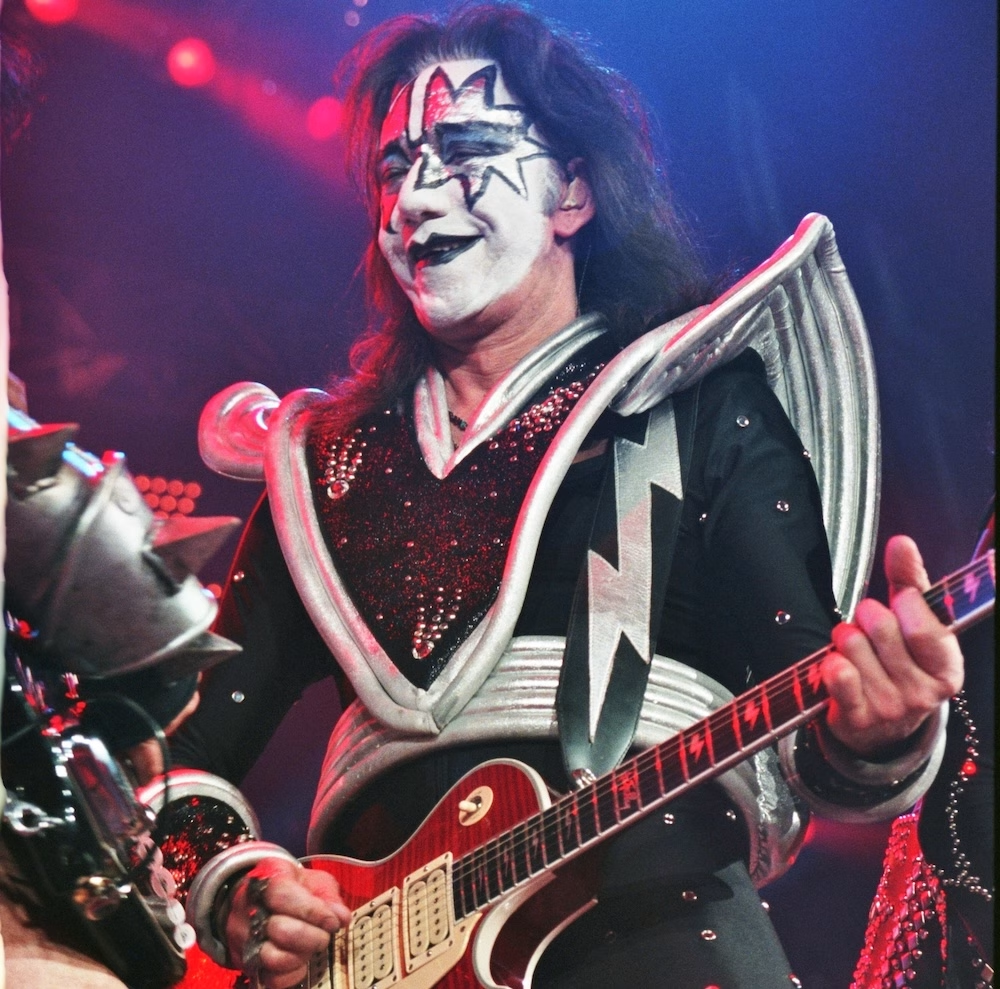
NPR, “Ace Frehley, lead guitarist in Kiss, dies at 74“
Ace Frehley, a founding member of KISS who played fiery lead guitar during the band’s 1970s heyday, has died. He was 74.
Frehley died Thursday surrounded by family in Morristown, N.J., following a recent fall at his home. Citing “ongoing medical issues,” Frehley had recently canceled all of his 2025 tour dates.
“We are completely devastated and heartbroken,” his family said in a statement. “In his last moments, we were fortunate enough to have been able to surround him with loving, caring, peaceful words, thoughts, prayers and intentions as he left this earth. We cherish all of his finest memories, his laughter, and celebrate his strengths and kindness that he bestowed upon others.”
Known as the Spaceman or Space Ace, the Bronx-born musician wrote the KISS classics “Cold Gin” and “Shock Me” and had a top 40 hit as a solo artist with 1978’s “New York Groove.”
He became known for virtuosic solos infused with bluesy grit and hard rock bite, inspiring future stars such as Slash, Tom Morello, John 5, and Pearl Jam’s Mike McCready.
“My style is unorthodox because I never took guitar lessons,” he once told Classic Rock. “I play differently to how a schooled musician would. If it sounds good, do it. That’s always been my motto. That’s rock ‘n’ roll.”
[…]
Frehley recorded a demo for RCA Records in 1971 with the group Molimo, but helped start KISS in 1973 and immediately found his place. As a guitarist, his blues-rooted approach complemented Paul Stanley’s glammy rhythmic boogie, creating electric friction that propelled the band. His guitar solos on 1975’s Alive!, particularly the thunderous fan-favorite “She,” helped make the album a classic.
Although he was never the band’s primary songwriter, Frehley did have songwriting credits on the beloved records that helped KISS become superstars, notably 1974’s Hotter Than Hell (“Parasite”) and 1975’s Dressed to Kill (“Getaway”). Later, he took lead vocals on a 1979 cover of the Rolling Stones’ “2000 Man” and 1980’s “Talk To Me”; the latter was a hit outside of the U.S.
Frehley last appeared on a KISS album as a full-fledged member on 1982’s Creatures of the Night, but rejoined the band for a well-received 1996 reunion tour and stayed with the group through a performance at the 2002 Winter Olympics.
In addition to “New York Groove,” which appeared on his 1978 self-titled solo debut, Frehley enjoyed plenty of success outside of KISS. After fronting the band Frehley’s Comet during the 1980s, he began releasing a string of well-received solo albums throughout the 2010s. In fact, he became the first member of KISS to reach the top 10 of the Billboard 200 as a solo artist with 2014’s Space Invader.
These albums revealed remarkable consistency: Although Frehley dabbled in stoner rock and grungier fare, bluesy hard rock was always his north star.
“I’m 72 years old and still sound like I did in the ’70s,” he told Guitar World in early 2024. “I get a kick out of the fact that I can do this like I did then. Some will say the fact that my playing hasn’t evolved is a problem, but I’d say that’s bulls***.”
New York Times, “Ace Frehley, a Founding Member of Kiss, Is Dead at 74“
Ace Frehley, the original lead guitarist of the hard-rock band Kiss, who often performed in white-and-silver face makeup as the group sold millions of records during his two tenures with it, from 1973 to 1982 and then from 1996 to 2002, died on Thursday in Morristown, N.J. He was 74.
[…]
A consummate showman, like all the members of Kiss, Mr. Frehley was known for playing guitars rigged with pyrotechnic effects and for his distinctive stage persona: He was known as “the Spaceman” or “Space Ace” because of the silver stars on his face. He designed the band’s logo, with its lightning-bolt letters.
The other founding members of Kiss were the guitarist Paul Stanley, the drummer Peter Criss and the bassist Gene Simmons, who was hospitalized this month after a car crash in Malibu, Calif. All four are slated to receive Kennedy Center Honors in December.
Many rock fans initially dismissed Kiss as gimmicky charlatans. Its members weren’t photographed without their stage makeup until 1983. But the band’s energetic and theatrical live shows built a following of teenagers, known as the Kiss Army. The band placed eight singles in the Top 40 during Mr. Frehley’s tenure, and he played on seven of them, including “Love Gun,” “Christine Sixteen” and “I Was Made for Loving You.” (He was absent from the band’s biggest chart hit, “Beth,” a ballad with orchestral backing that reached No. 7 on the Billboard chart in 1976.)
During Mr. Frehley’s time with Kiss, the band released 11 albums, both studio and live, that went gold or platinum in the United States. (Kiss ultimately sold more than 100 million albums.) With the passage of time and the enduring popularity of its party anthem “Rock and Roll All Nite,” the band saw its critical reputation improve. Kiss was inducted into the Rock & Roll Hall of Fame in 2014.
The guitarist Tom Morello of Rage Against the Machine inducted the band, making the case for Kiss’s influence on everyone from Metallica to Lady Gaga. Mr. Frehley, he said, “blazed unforgettable, timeless licks across their greatest records.”
[…]
Inspired by the Beatles and the Rolling Stones, Paul began playing guitar at age 13; his parents gave him his first electric guitar as a Christmas present, hoping (unsuccessfully) that it would keep him out of trouble. He was given the nickname Ace when he was 16 by the drummer in one of his early bands, who admired Mr. Frehley’s ability to set him up with attractive dates.
In 1972, when he was 21 and still living at home, he spotted an ad in The Village Voice that read, “Lead guitarist wanted with flash and ability.” Reasoning that he fit the description, he auditioned for the band that would become known as Kiss. (His mother drove him to the audition.) When he got the gig, Mr. Frehley started using the name Ace full time to avoid confusion with Mr. Stanley.
[…]
He was the band’s most enthusiastic user of drugs and alcohol; Mr. Simmons, in contrast, was a lifelong teetotaler. In the 2003 book “Kiss: Behind the Mask,” an authorized biography by David Leaf and Ken Sharp, Mr. Stanley was quoted as saying that at times, “I don’t know if Ace knew the back side of his guitar to the front and it was probably due to ingesting certain liquids.”
Mr. Simmons added, “Ace’s judgments have been clouded since the beginning, and that’s being kind.”
In his 2011 memoir, “No Regrets” (written with Joe Layden and John Ostrosky), Mr. Frehley said that he became alienated from the band because of its increasing commercialism: “There were Kiss lunchboxes, Kiss action figures, Kiss makeup kits, Kiss dolls. You name it, we sold it.” He allowed that he did enjoy the money the group brought in — $100 million per year in the late 1970s, according to Mr. Frehley.
Rolling Stone, “Kiss Guitarist Ace Frehley Dead at 74“
Ace Frehley, the wild Spaceman of Kiss who played guitar in the band throughout their Seventies heyday and again during the reunion period in the Nineties, inspiring an entire generation of musicians to pick up the instrument along the way, died on Thursday in Morristown, New Jersey. He was 74.
[…]
Gene Simmons and Paul Stanley were the primary songwriters in Kiss, but Frehley’s guitar chops and rock star attitude were key components of the band’s success. As a songwriter, Frehley wrote “Cold Gin,” “Parasite,” “Shock Me,” “Talk to Me,” and other fan favorites. Simmons, Stanley, Frehley and drummer Peter Criss were inducted into the Rock & Roll Hall of Fame in 2014.
“We are devastated by the passing of Ace Frehley,” Simmons and Stanley said in a joint statement. “He was an essential and irreplaceable rock soldier during some of the most formative foundational chapters of the band and its history. He is and will always be a part of KISS’s legacy. Our thoughts are with [Frehley’s wife] Jeanette, [his daughter] Monique and all those who loved him, including our fans around the world.”
[…]
The band’s distinct stage makeup and bombastic show generated instant attention when they started gigging around New York City in 1973. But they didn’t find mainstream success until their 1975 concert album Alive! took off. To an outspoken segment of young fans, Frehley was the coolest member of the band. “When I play guitar onstage it’s like making love,” he told Rolling Stone in 1976. “If you’re good, you get off every time.”
But it didn’t take long for hard drugs to enter the picture. “There was so much cocaine in the studio with [producer] Bob Ezrin, it was insane,” Frehley recalled to Rolling Stone in 2015. “And I hadn’t even done coke before that. I liked to drink. But once I started doing coke, I really liked to drink more, and longer, without passing out. So I was really off to the races. I made my life difficult because there were so many times I’d walk in with a hangover, or sometimes I wouldn’t even show up.”
[…]
And as the group grew more successful in the late Seventies and the band’s audience started skewing younger, Frehley grew uneasy. “We were this heavy rock group,” he told Rolling Stone in 2015, “and now we had little kids with lunchboxes and dolls in the front row, and I had to worry about cursing in the microphone. It became a circus.”
That circus also featured a lot behind-the-scenes battles stemming from Frehley’s drug use, alcohol consumption, and the band’s decision to use session guitarists on some tracks. By 1982, Frehley simply had enough. “I was mixed up,” he later recalled. “I believed that if I stayed in that group I would have committed suicide. I’d be driving home from the studio, and I’d want to drive my car into a tree. I mean, I walked out on a $15 million contract. That would be like $100 million today. And my attorney was looking at me like, ‘What are you, crazy?’”
I was a bit young during the initial KISS craze of the mid-1970s, but I did buy the infamous 1977 Marvel Comics Super Special printed in real KISS blood!
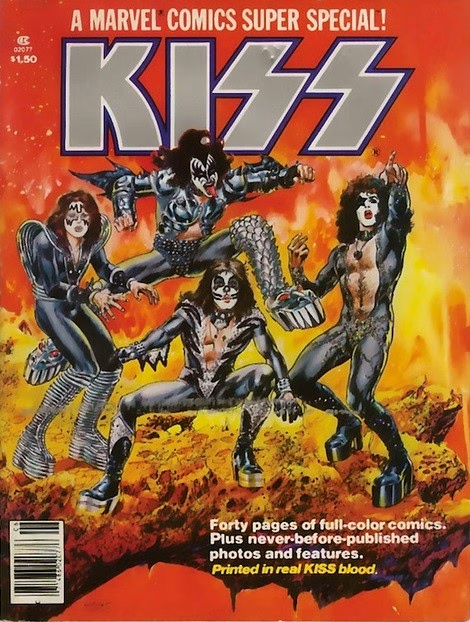
I came to appreciate their music when I was in college, but they were never one of my very favorites. But they really redefined the concert space, making fans expect a show rather than just performing songs.
Like just about all bands that survive for decades, a leader or leaders emerge who take the business side seriously. They invariably clash with those whose emphasis is on the sex and drugs part of the sex, drugs, and rock and roll mantra.
While Frehley was easily the most successful solo act among the KISS gang, that’s a pretty low bar. Still, he managed to maintain a loyal fan base and continue making a living at his craft until the end.
While not generally regarded by music critics as a great guitar player, he clearly inspired a lot of great rock guitar players. And his playing on the 1977 hit “Shock Me” was ranked the 43rd Greatest Guitar Solo of All Time by Guitar World.
Not so much a solo as a greatest hits compilation for the pentatonic scale, Shock Me sees Ace Frehley wheeling out his entire lick arsenal. He neatly distils the first 25 years of American rock guitar into 50 seconds, ready to be plagiarised for the next 25 years.
Just when you think it’s winding down at 2:29, it instead changes key and keeps on rolling. Ace’s signature strictly rhythmic vibrato is ever present, and he combines major and minor pentatonic lines seamlessly. His licks are mostly not hard to play, and that’s a major reason they’ve been so influential. There aren’t many things that unite hair metal and grunge guitarists, but this solo is one of them.
The flurries of pull‑offs at 2:06 are played by pulling off 8‑7‑5 on the E string and then repeating on the B string (Ace is tuned down a semitone). The wild blues scale lick at 2:14 is worth stealing, too; the timing of those massive three‑fret bends (played at fret 12 on the E string) feels like whiplash.
I’m old enough now that 74 seems young to die. But he certainly lived the hell out of those 74 years.


I never would have pegged you as a Kiss fan (or listener). So that’s my surprising thing for the day.
Kiss Meets the Phantom of the Park
Teenage Bottlerocket’s diss of KISS offers at least some praise for Frehley.
They were never one of my bands.
@Rob1: Agreed.
I always thought Kiss was like the Harlem Globetrotters or Spinal Tap more than a real band. Or the Monkeys.
However Ace did give us this interview.
https://www.logodesignlove.com/kiss-logo
That attitude is valuable in an artist. Any artist. Renowned bass player Ron Carter has said he didn’t much listen to other bass players, because he didn’t want to sound like them. Ron Carter went to Eastman and then got a Masters from Manhattan School of Music.
AND, even though you will see this idea commonly expressed by people with no formal training, formal training has nothing to do with it. Listening is vital to musicians, but learning to read music doesn’t hurt your ability to listen and reproduce what you’ve heard. Not at all.
This is more a rejection of anything highbrow. A kind of punk thing. (Though I don’t think anyone would call Kiss punk.) It’s a fair thing to do artistically. I just want the dumb mythology about how learning things ruins you to be destroyed.
@Jay L. Gischer:
I am an uneducated ‘artist’ and I think my complete ignorance has been extremely helpful. No one has ever suggested I was derivative or even influenced by another writer. But as I tell the kids, just because one guy jumped off the Golden Gate bridge and survived does not make it a good idea.
Not relevant, but I don’t know if I’d recognize a single Kiss song if I heard one (please don’t start listing them).
They were very popular in the late 70s, before I developed any interest in music of any kind.
TBH, I was never even remotely intersted in Kiss.
They never were that much of thing in England.
I think it was just how they dressed, lol.
It was like glam-rock of Bowie taken to the extreme.
Not so much Kiss as Kitsch.
Like “hair metal”: more US than UK.
AC/DC were in someways similar musically, but more cool, in the UK perspective.
As was punk (for arbitrary values of “punk”)
All that said: it’s the passing of a time.
Farewell, Ace Frehley.
As Barclay James Harvest sang:
“Oh, what it is to be young.”
@Michael Reynolds:
What?
Detroit can’t rock?
Has he never heard of MC5?
The Stooges?
Dear me.