NYT (“How Amy Coney Barrett Is Confounding the Right and the Left“):
As President Trump was leaning toward appointing Amy Coney Barrett to the Supreme Court five years ago, some advisers shared doubts about whether she was conservative enough. But he waved them away, according to someone familiar with the discussions. He wanted a nominee religious conservatives would applaud, and with an election approaching, he was up against the clock.
Soon after Justice Barrett arrived at the court she began surprising her colleagues. Chief Justice John G. Roberts Jr. assigned her to write a majority opinion — among her first — allowing the seizure of state property in a pipeline case, according to several people aware of the process. But she then changed her mind and took the opposite stance, a bold move that risked irritating the chief justice.
In another early case, as Justice Samuel A. Alito Jr. tried to further his decades-long quest to expand the role of religion in public life, she preferred a more restrained route, setting off a clash in their approaches that continues. And in a key internal vote, she opposed even taking up the case that overturned Roe v. Wade and the federal right to abortion, though she ultimately joined the ruling.
Anecdotal, yes? But the plural of anecdote is data, and it’s mounting.
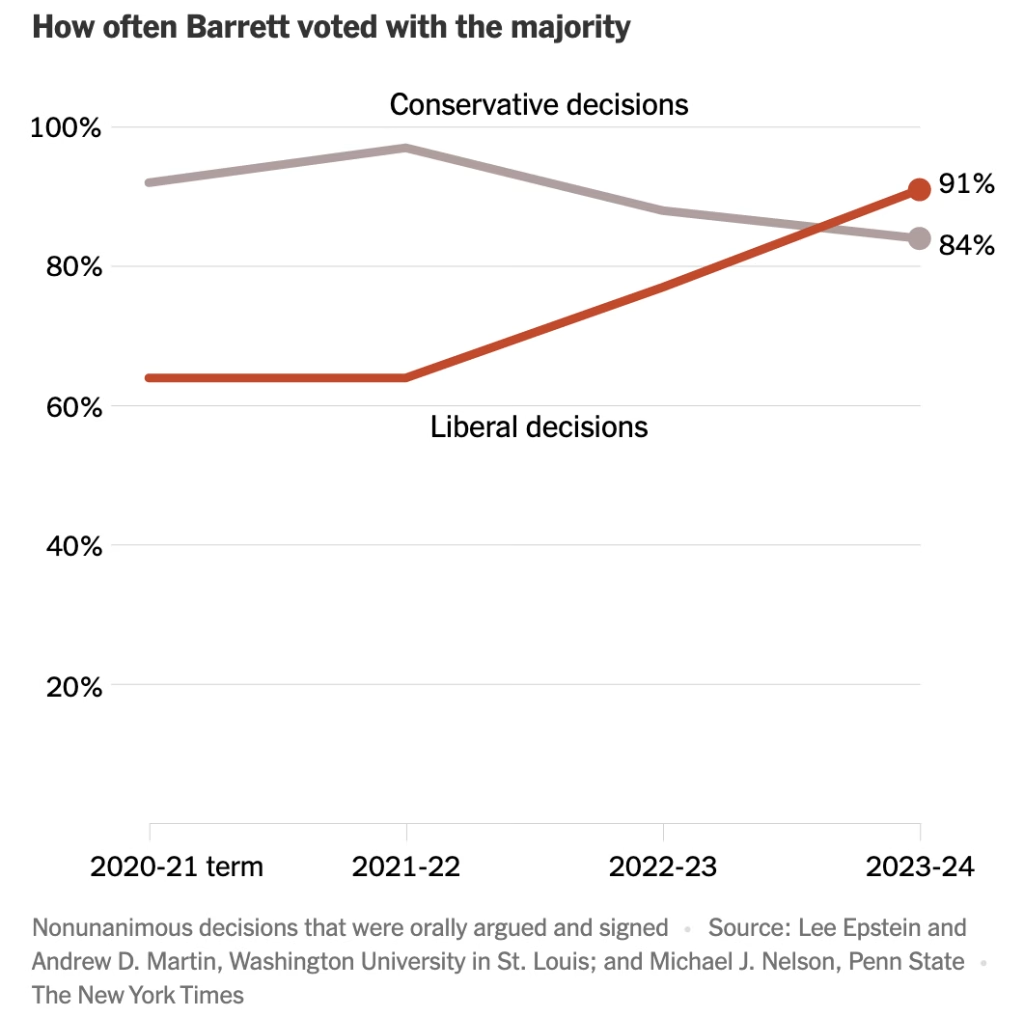
She has become the Republican-appointed justice most likely to be in the majority in decisions that reach a liberal outcome, according to a new analysis of her record prepared for The New York Times. Her influence — measured by how often she is on the winning side — is rising. Along with the chief justice, a frequent voting partner, Justice Barrett could be one of the few people in the country to check the actions of the president.
Now, of course, this could be misleading. Some cases are more impactful than others and the chart doesn’t break down her votes in a way to analyze that. Still, it’s interesting. And there’s this:
Overall, her assumption of the seat once held by Justice Ruth Bader Ginsburg has moved the court’s outcomes dramatically to the right and locked in conservative victories on gun rights, affirmative action and the power of federal agencies. But in Trump-related disputes, she is the member of the supermajority who has sided with him the least.
That position is making her the focus of animus, hope and debate.
In interviews, some liberals who considered the court lost when she was appointed have used phrases like, “It’s all on Amy.” When Justices Sonia Sotomayor and Elena Kagan agreed on nonunanimous decisions this term, Justice Barrett joined them 82 percent of the time — up from 39 percent of the time in her first term.
Some of Mr. Trump’s allies have turned on her, accusing the justice of being a turncoat and calling her — a mother of seven, with two Black children adopted from Haiti — a “D.E.I. hire.” Her young son asked why she had a bulletproof vest, she said in a speech last year, and her extended family has been threatened, including with pizza deliveries that convey a warning: We know where you live.
We had too much hope for her,” Mike Davis, a right-wing legal activist with close ties to the Trump administration, said in a recent interview. “She doesn’t have enough courage.”
This spring, on Stephen K. Bannon’s podcast, he tore into her in such crude terms, even mocking the size of her family, that Justice Neil M. Gorsuch, for whom Mr. Davis had once clerked, phoned him to express disapproval of his comments, according to people aware of the exchange. Mr. Trump has privately complained about her too, according to two people familiar with his thinking.
Certainly, in this environment, ruling in ways that displease the MAGA crowd comes with substantial risk. But, by all appearances, she’s ruling pretty much in the way we’d have expected someone of her background to rule in these cases.
But she rarely abandons the other Republican appointees in the most significant cases. “It’s a mistake by ignorant conservatives and wishful liberals to believe she’s moderating,” said Noah Feldman, a Harvard law professor who befriended her when they clerked at the court. Like others who know her, he said that both the right and the left had misread her. “She’s exactly the person I met 25 years ago: principled, absolutely conservative, not interested in shifting.”
Friends, former colleagues and people from the court describe the justice as more of a methodical problem solver than an architect with grand plans for the law. “A law professor to my bones,” she said in a 2022 talk, referring to her years teaching at Notre Dame Law School. When others tried to draft her for the bench, she was uncertain about becoming a judge, according to those who know her well. She still maintains a tucked-away office at Notre Dame.
Some on the right are turning her scholarly background against her, complaining that she is too fussy about the fine points of the law and sounding a rallying cry of “no more academics” for future appointments.
That she has deeply conservative views and rules accordingly should not be surprising. But much of what MAGA stands for is not conservative in any meaningful sense.
Her apartness shows in her votes and her signature move of joining only slices of her colleagues’ opinions. She agrees with most of the supermajority’s outcomes, but sometimes writes to say they took the wrong route to their conclusion. (One person from the court called her the Hermione Granger of the conservatives, telling the men they’re doing it wrong.) Or she joins the liberal justices but stipulates that she can’t fully buy in.
“She hasn’t found a team,” said Sarah Isgur, a legal podcast host, pointing to her habit of marking where she departs from conservative colleagues, and to a recent death penalty ruling in which she was sitting “in the middle of that decision.”
But the Trump administration’s conflict with the courts and pushing of constitutional boundaries may force her to take a more decisive stance. Of the three justices at the center of the court, where the most influence lies, she is the only one without a long trail of views on how much power a president should have — the issue at the heart of nearly all these cases.
“She doesn’t have 10 years to mellow into it,” Mr. Feldman said. “Now is the crisis.”
If her voting record exactly matched that of Ketanji Brown Jackson, that would still be only four votes. But I don’t judge Supreme Court justices on policy outcomes but rather on whether they’re intellectually consistent and independent. I disagree with the three Democratic appointees’ votes more than I agree; none of them strike me as hacks. I can’t say the same for a couple of the Republican appointees.
Another anecdote:
One morning in April, the justices formed a nine-person frieze of contrasts as they heard oral arguments in Mahmoud v. Taylor, over whether parents of public elementary school students are entitled to religious exemptions from lessons involving books about gay and transgender people. Justice Alito, quick to favor exemptions, clashed with Justice Sotomayor, who was skeptical. As she spoke, Justice Alito shut his eyes and leaned far back in his chair.
Justice Barrett composed herself into a portrait of someone in listening mode, eyes trained, chin resting on hands. She asked open-ended, just-trying-to-understand questions, then sharper ones, moving in on a factual hole in the school’s argument and politely forcing the lawyer to admit it. By the time the justices rose, American parents seemed likely to gain more control over the ideas their children encounter in public school.
Her queries made a similar impression when she arrived as a student at Notre Dame Law three decades ago: She was so incisive that several instructors said they were learning from her. She won a clerkship with Justice Antonin Scalia but then chose the quiet work of a law professor.
Not the hotshot kind: “She wasn’t trying to break big new ground,” recalled Joseph P. Bauer, her civil procedure teacher and, later, fellow faculty member. “She is not going to present an argument that shifts the paradigm, or reconceives ways of looking at things, or makes big moves.”
The courses she taught were about the rules of the road — evidence, procedure, the fine-grained reading of laws. In her own scholarship, she delved into questions that even some academics considered too nerdy to answer. Mark McKenna, a former faculty member, said, “I remember people pushing her, Does anyone care about these things?”
Unfortunately, it seems that some on the Supreme Court do not, concerning themselves only with partisan and political outcomes. For the courts to have any legitimacy, the people have to believe that Justices are making a good-faith interpretation of the Constitution and statutes on which rulings are based. Process and procedure are everything.
There’s a whole lot more to the feature, which is worth a read.
James Joyner is a Professor of Security Studies. He's a former Army officer and Desert Storm veteran. Views expressed here are his own. Follow James on Twitter @DrJJoyner.
The difficulty that Barrett provides the right, isn’t that she’s not a conservative, it’s that she’s not a trumpist. Where the position/policy of the felonious TACO’s admin aligns with conservative constitutional theory, she’ll support them, it is the trumpian overreach that she opposes. Liberals are deluding themselves if they believe that she’ll somehow turn into a lib. At best, she’ll continue to join the court’s libs selectively and also will continue to moderate decisions.
In truth, other than Alito and Thomas, none of the conservatives are trumpists, all have demonstrated independence on particular issues before the court. Alas, from my POV, not frequently, nor strongly enough.
@Sleeping Dog: That’s pretty much where I am. Roberts, Gorsuch, Kavanaugh, and Barrett are staunch conservatives, but also Constitutionalists and institutionalists. Thomas is a Constitutionalist but, alas, also, as the late Justice Scalia put it, “a nut” willing to overthrow decades or even centuries of precedent in service of his ideology. He also seems to have some serious chips on his shoulder and conflicts of interest. Alito seems at this point to just be a pure party hack.
The whine that ACB “doesn’t have the courage” harkens to Trump’s stated desire to have lawyers – and judges – willing to break the law to enable his unquenchable thirst for power. Recall that he said Mike Pence “didn’t have the courage” to throw out millions of votes under the theory that got John Eastman (properly) disbarred. There is nothing courageous about deliberately misinterpreting the constitution to suit a particular cause or ideology, especially when done in service to the whims of an ignorant, likely mentally ill, wannabe dictator. Kudos to Amy for being more faithful to the law than to MAGA.
In truth, other than Alito and Thomas, none of the conservatives are trumpists
If I recall the history correctly, Alito and Thomas, and Roberts, predate the Leonard Leo/Federalist takeover of selecting SCOTUS nominees. However, Alito and Thomas seem to have been bought by the Federalists.
A wannabe dictator has to take over the courts, it’s in the handbook. We have a situation in which the Court was taken over by somewhat reluctant and conflicted supporters of the wannabe. It’s going to lead to some entertaining dynamics, as with Barrett.
Somewhat ironically, the Trumpiest judges currently on the Court are Thomas and Alito, neither of whom were appointed by Trump.
In his first term, he was giving a lot of deference to Mitch McConnell and the Federalist Society in his picks. There’s nuance to that, though. In 2018, ACB was the favorite choice among conservatives, but he picked Kavanagh. An article I read at the time suggested it was because of Kavanagh’s expansive views on executive authority.
When and if Trump gets another vacancy (I’m expecting at least Thomas to retire before the end of 2026), it’s a near-certainty he’ll appoint a hardcore MAGA loyalist–Aileen Cannon or someone similar.
@James Joyner:
I also believe that Thomas has always been quite bitter about his confirmation hearing, and like Trump, he’s been determined to stick it to liberal Americans ever since. The shift in the ideological balance of the Court blew the doors off and Thomas and Alito are tearing down liberal culture whenever they can now.
“Her influence — measured by how often she is on the winning side”
I suppose one could see it that way. Or one could read it as her liking to join a winning side. She didn’t strike me as an intellectual leader in her confirmation – quite the opposite.
I wonder if she regrets signing on to the presidential immunity opinion. She actually dissented on two of the key parts–that “the jury must be allowed to hear about both the quid and the quo,” and that the case should have been decided by the SC at that time instead of delaying judgment by sending it back to the lower court. It would have been a stand on principle, as she only could have changed the outcome from 6-3 to 5-4.
Thomas is a Constitutionalist but, alas, also, as the late Justice Scalia put it, “a nut” willing to overthrow decades or even centuries of precedent in service of his ideology. He also seems to have some serious chips on his shoulder and conflicts of interest.
He might have started as a constitutionalist, but for the reasons you hint at and @al Ameda mentioned, I think he’s a “Constitutionalist” when it serves “his side” on most issues and then forgets about those values when it’s going to significantly empower the left.
Yes, he has sided against Trump from time to time, but the amount of times he and Alito have decided to be naked partisans (including in their approach to the shadow docket) is noteworthy. To some degree that also feels like the influence of Ginny Thomas who is also a nut.
But much of what MAGA stands for is not conservative in any meaningful sense.
I woud amend your statement to “not conservative in any non-political sense.” Corey Robin wrote a whole book, The Reactionary Mind, making a good case that “conservatives” throughout history have never been conservative, just reactionary.
My own take is that as it was in the beginning, is now, and ever shall be, conservatism is about protecting the wealth and power of the currently wealthy and powerful. Current Republicans are hardly doing anything novel, faux populism is a common ploy to maintain power. If you’ve got nothing real to sell, blood and soil populism is the easiest con.
I read this piece in NYT. I thought it rather short on substance and not worth publishing. Then I realized I should be more charitable, any Republican displaying even the slightest trace of integrity is news worthy.


The difficulty that Barrett provides the right, isn’t that she’s not a conservative, it’s that she’s not a trumpist. Where the position/policy of the felonious TACO’s admin aligns with conservative constitutional theory, she’ll support them, it is the trumpian overreach that she opposes. Liberals are deluding themselves if they believe that she’ll somehow turn into a lib. At best, she’ll continue to join the court’s libs selectively and also will continue to moderate decisions.
In truth, other than Alito and Thomas, none of the conservatives are trumpists, all have demonstrated independence on particular issues before the court. Alas, from my POV, not frequently, nor strongly enough.
@Sleeping Dog: That’s pretty much where I am. Roberts, Gorsuch, Kavanaugh, and Barrett are staunch conservatives, but also Constitutionalists and institutionalists. Thomas is a Constitutionalist but, alas, also, as the late Justice Scalia put it, “a nut” willing to overthrow decades or even centuries of precedent in service of his ideology. He also seems to have some serious chips on his shoulder and conflicts of interest. Alito seems at this point to just be a pure party hack.
The whine that ACB “doesn’t have the courage” harkens to Trump’s stated desire to have lawyers – and judges – willing to break the law to enable his unquenchable thirst for power. Recall that he said Mike Pence “didn’t have the courage” to throw out millions of votes under the theory that got John Eastman (properly) disbarred. There is nothing courageous about deliberately misinterpreting the constitution to suit a particular cause or ideology, especially when done in service to the whims of an ignorant, likely mentally ill, wannabe dictator. Kudos to Amy for being more faithful to the law than to MAGA.
@James Joyner:
Alito got appointed to the court after the Harriet Miers debacle. James, I can still still remember you writing about it.
@Sleeping Dog:
If I recall the history correctly, Alito and Thomas, and Roberts, predate the Leonard Leo/Federalist takeover of selecting SCOTUS nominees. However, Alito and Thomas seem to have been bought by the Federalists.
A wannabe dictator has to take over the courts, it’s in the handbook. We have a situation in which the Court was taken over by somewhat reluctant and conflicted supporters of the wannabe. It’s going to lead to some entertaining dynamics, as with Barrett.
Somewhat ironically, the Trumpiest judges currently on the Court are Thomas and Alito, neither of whom were appointed by Trump.
In his first term, he was giving a lot of deference to Mitch McConnell and the Federalist Society in his picks. There’s nuance to that, though. In 2018, ACB was the favorite choice among conservatives, but he picked Kavanagh. An article I read at the time suggested it was because of Kavanagh’s expansive views on executive authority.
When and if Trump gets another vacancy (I’m expecting at least Thomas to retire before the end of 2026), it’s a near-certainty he’ll appoint a hardcore MAGA loyalist–Aileen Cannon or someone similar.
@James Joyner:
I also believe that Thomas has always been quite bitter about his confirmation hearing, and like Trump, he’s been determined to stick it to liberal Americans ever since. The shift in the ideological balance of the Court blew the doors off and Thomas and Alito are tearing down liberal culture whenever they can now.
“Her influence — measured by how often she is on the winning side”
I suppose one could see it that way. Or one could read it as her liking to join a winning side. She didn’t strike me as an intellectual leader in her confirmation – quite the opposite.
Spoken like a true leftist. Mask off, huh?
I wonder if she regrets signing on to the presidential immunity opinion. She actually dissented on two of the key parts–that “the jury must be allowed to hear about both the quid and the quo,” and that the case should have been decided by the SC at that time instead of delaying judgment by sending it back to the lower court. It would have been a stand on principle, as she only could have changed the outcome from 6-3 to 5-4.
@James Joyner:
He might have started as a constitutionalist, but for the reasons you hint at and @al Ameda mentioned, I think he’s a “Constitutionalist” when it serves “his side” on most issues and then forgets about those values when it’s going to significantly empower the left.
Yes, he has sided against Trump from time to time, but the amount of times he and Alito have decided to be naked partisans (including in their approach to the shadow docket) is noteworthy. To some degree that also feels like the influence of Ginny Thomas who is also a nut.
I woud amend your statement to “not conservative in any non-political sense.” Corey Robin wrote a whole book, The Reactionary Mind, making a good case that “conservatives” throughout history have never been conservative, just reactionary.
My own take is that as it was in the beginning, is now, and ever shall be, conservatism is about protecting the wealth and power of the currently wealthy and powerful. Current Republicans are hardly doing anything novel, faux populism is a common ploy to maintain power. If you’ve got nothing real to sell, blood and soil populism is the easiest con.
I read this piece in NYT. I thought it rather short on substance and not worth publishing. Then I realized I should be more charitable, any Republican displaying even the slightest trace of integrity is news worthy.