Another Wave of Anti-Government Protests in Iran
The economy sparked this particular uprising.
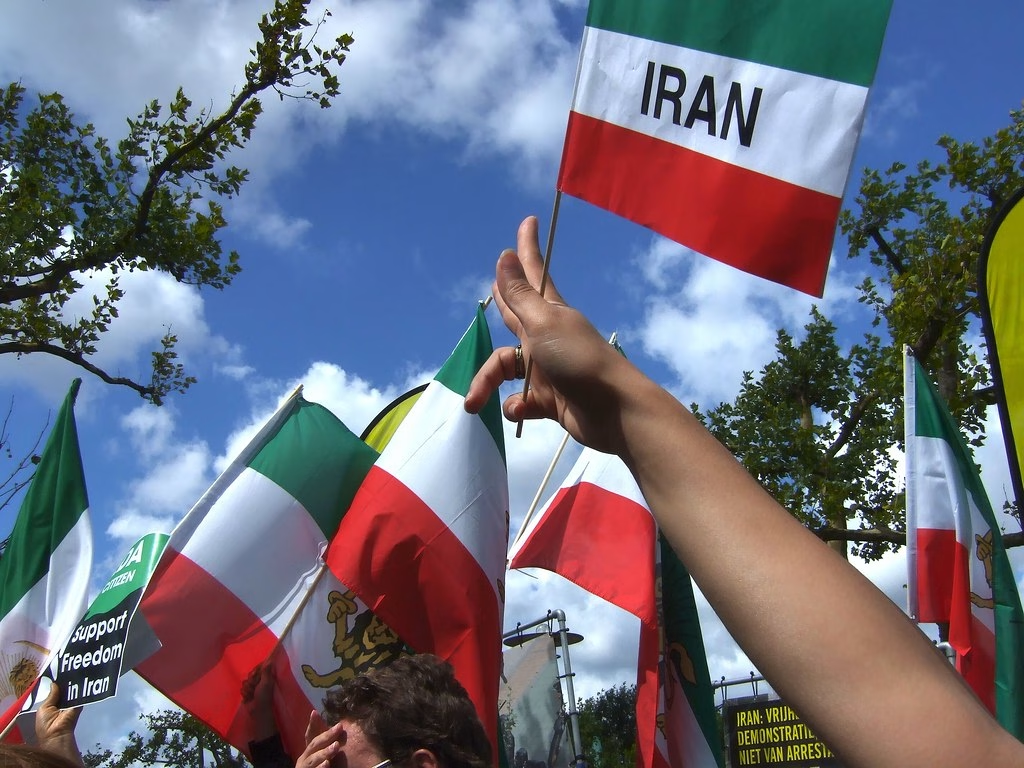
NYT (“Most of Iran Shuts Down as Government Grapples With Protests and Economy“):
Businesses, universities and government offices stayed closed on Wednesday across most of Iran under a government-ordered shutdown, as the president struggled to address public frustration that has fueled mounting protests over the faltering economy and the government.
The one-day shutdown in 21 of Iran’s 31 provinces, including Tehran, the capital, came as President Masoud Pezeshkian on Wednesday appointed a new central bank chief, the former economy minister Abdolnaser Hemmati. The president acknowledged that it was an “extremely difficult and complex” role that would subject the new bank head to intense pressure and criticism, according to state news media.
Iran’s inflation rate has spiked, driving frustrated merchants to the streets in Tehran and other cities, and prompting the abrupt resignation of the former central bank head, Mohammad Reza Farzin, on Monday.
The disruptions caused by the days of protests came as footage circulating on social media on Wednesday and verified by The New York Times showed demonstrators throwing objects at the gates of a government building complex in Fasa, in south-central Iran, and then shaking them until they opened.
The protests have spread and drawn in demonstrators from across sectors and society, with the demonstrators increasingly also expressing frustration and anger at the regime over not only the economy but severe water shortages and more. “Death to the dictator,” protesters shouted at a demonstration in Hamedan in west-central Iran, according to a video posted by BBC Persian.
Jerusalem Post (“Iran president says Tehran must address people’s issues or ‘we will end up in hell’“):
Shopkeepers, students, and Iranians from all segments of society have taken to the streets as Iran’s rial has lost nearly half its value against the dollar in 2025.
As protests continue in Iran over soaring costs and a plummeting currency, Iran’s President Masoud Pezeshkian said in an interview on Thursday morning that the government must be willing to address the people’s concerns.
“If we do not solve the problem of people’s livelihood, we will end up in hell,” he said.
[…]
Shopkeepers, students, and Iranians from all segments of society have taken to the streets as Iran’s rial has lost nearly half its value against the dollar in 2025. Inflation reached 42.5 percent in December, and the country’s economy is reeling from the effects of sanctions.
The Iranian government said it “recognizes the protests” and would listen “with patience, even if it is confronted with harsh voices”.
Government spokesperson Fatemeh Mohajerani said on state media, “We officially recognize the protests … We hear their voices, and we know that this originates from natural pressure arising from the pressure on people’s livelihoods.”
[…]
The BBC has verified videos showing demonstrations in the cities of Karaj, Hamadan, Qeshm, Malard, Isfahan, Kermanshah, Shiraz, and Yazd. In most cases, police were seen using tear gas to disperse the protesters.
CBS News (“Iran protests draw swift crackdown as U.S. calls on Tehran to respect “rights of the Iranian people“):
Iran’s prosecutor general said Wednesday that economic protests that have gripped the country were legitimate, but he warned that any attempt to create insecurity would be met with a “decisive response,” as the Islamic Republic’s rulers tried to clamp down on a fourth day of unrest.
“Peaceful livelihood protests are part of social and understandable realities,” Mohammad Movahedi-Azad told state media after protests started by shopkeepers in the capital city Tehran, which were joined by students and others in several cities across the country.
“Any attempt to turn economic protests into a tool of insecurity, destruction of public property, or implementation of externally designed scenarios will inevitably be met with a legal, proportionate and decisive response,” warned Movahedi-Azad.
His comments came days after the Mossad intelligence agency of Iran‘s arch-foe Israel posted on social media that it was “with you on the ground,” in a message to Iranian protesters. Posting on its Persian-language X account, the spy agency encouraged Iranians to “go out into the streets together.”
[…]
The protests, driven by dissatisfaction at Iran’s economic stagnation and galloping hyperinflation, began Sunday in Tehran’s largest mobile phone market, where shopkeepers shuttered their businesses. They gained momentum through Tuesday, with students at 10 universities in the capital and in other cities, including Iran’s most prestigious institutions, joining in.
Nevertheless, the protests remain limited in number and concentrated in central Tehran, with shops elsewhere in the sprawling metropolis of 10 million people unaffected. And the government appeared to be cracking down on the unrest, both on the streets with a heavy security presence, and by declaring a last-minute holiday to prompt the closure of schools and businesses.
Iran’s economy has been in the doldrums for years, with heavy U.S. and international sanctions over Tehran’s nuclear program weighing heavily on it. The currency, the rial, has also plunged in recent months, losing more than a third of its value against the U.S. dollar since last year.
Aljazeera (“Iran’s Pezeshkian urges unity as protests over economic woes turn deadly“):
Iran’s President Masoud Pezeshkian has appealed for unity in the face of economic pressure from Tehran’s “enemies”, as protests over soaring living costs spread across the country, with at least one paramilitary officer killed in the western province of Lorestan.
Pezeshkian’s appeal on Wednesday came as security forces in the southern Fars province also opened fire on protesters who tried to break into a local government building there.
[…]
Speaking at a business forum in Tehran, Pezeshkian suggested foreign interference was to blame for the unrest.
“We are in a situation where external pressures are being exerted by the country’s enemies and, unfortunately, within the country as well,” he said.
[…]
“Right now, the enemy has placed most of its hopes on knocking us down through economic pressure. You cannot conquer a nation with bombs, fighter jets, or missiles,” he said.
“And if they were to confront this nation on the ground, if we remain determined, united, and committed to working together to make our country proud, it would be impossible for them to bring Iran to its knees,” he added.
[…]
Iranian authorities have responded to previous protests over issues ranging from prices, drought, women’s rights and political freedoms with forceful security measures and extensive arrests.
This time, the government said it would set up a “dialogue mechanism” with leaders of the demonstrations, though it has not said how the process would work.
“The government will listen patiently even if there are harsh voices because we believe our people are patient enough, and when their voices are raised, the pressure that is being put on them is high,” Fatemeh Mohajerani said at a news conference in Tehran.
[…]
Al Jazeera’s Tohid Asadi, reporting from Tehran, said the government is sending mixed messages over the protesters’ concerns.
On the one hand, he said, Pezeshkian has expressed his sympathy for the economic hardships faced by many, while the government had already taken action in replacing the head of the central bank on Monday.
On the other hand, he said, there are serious concerns for the state about the possibility of “escalation” by the protesters.
The totalitarian regime, which has been in power since the 1979 Revolution, is corrupt and inefficient. But I would be cautious about getting too excited about the prospect of these protests toppling it and replacing it with something more legitimate.
There have been extended mass protests before. The most recent before this were the so-called “Woman, Life, Freedom” movement after regime forces killed Mahsa Amini in 2022. It lasted two years before it was brutally suppressed. The photo atop the post is from the Green Movement way back in 2009. The regime has a massive “security” apparatus and has been brutally effective in cracking down on dissent.
Of course, that was all true of the shah’s regime as well. Repression works until it doesn’t.
Regardless of the eventual outcome—and, indeed, because it is unknowable—the sheer courage of these protestors must be acknowledged. Iran is not, to say the least, a free country. These people are risking their lives and future livelihood in standing up to a government that it failing to meet its basic responsibilities.

It is sad that I read a headline like this, “Iran protests draw swift crackdown as U.S. calls on Tehran to respect “rights of the Iranian people“ and it just rings hollow.
I wonder if riots alone are enough to force change. Iran doesn’t have the ability to produce drinking water, it can’t do anything real about the value of its currency, and under sanctions I doubt they can do much about the economy more broadly. Will the protesters go for the usual empty promises the regime has offered in the past? The rioters don’t seem to have a leadership.
The only way Iran can effect change is probably getting out from under sanctions which would mean a huge ideological shift. This would go well beyond agreeing to let go of the hijab.
The thing to watch is whether parts of the army support the protests. Rocks and Molotov cocktails are unlikely to get the job done.
@Michael Reynolds: The problem is that, in Iran, the regular army is considerably less important than the IRGC (Islamic Revolutionary Guard Corps), which answers directly to the Supreme Leader and is combination secret police and enforcer of ideological purity. I can’t imagine they won’t do whatever the mullahs direct.
@James Joyner:
The more important cleavage, perhaps is between the mullahs, many of whom are “conservative moserates”, and the Pasdaran/IRGC leadership, who combine a fair bit of radical ideology, control of the main security forces, and self -interest in a close economy, as they also control the smuggling operations, as well as large other areas of economic activity.
I suspect if the mullahs, post-Khamenei, attempted to assert control, the Pasadarn would quite rapidly educate them in the error of their ways, and install a Pasdaran-aligned ayatollah as leader.
There is a possibility of a multi-sided catfight if the army plus conservative mullahs plus some civilian politicians get pushed to the point of open intra-regime conflict with the Pasadran.
As of now the main driver of the protest seems to be massive pressure on living standards from a collapsing currency.
The govt may be able to put a lid on it again, and wait for protests to fade away.
But nothing can obscure the fundamental problem that the Iranian economy is in a very bad place, due to sanctions, government incomptence, and (often Pasdaran related) exploitation and corruption.
There is a serious possibility of a general economic collapse.
WShich greatly add to pressure on the govt. to reach a deal with the US.
But that in turn incites the Pasadaran to just act even more mulish, and fantasise about a “revolutionary solution”.
@JohnSF:
And also requires the US to be capable of crafting a realistic deal that both satisfies the main actors in Iran (at least temporarily) and meets basic US requirements (ditto).
Given the incoherent nature of the Trump administration, I shall be putting my optimism on hold.
@JohnSF:
What I find surprising is that all the riots seem to be in the West of the country. I don’t see anything happening in Baluchistan.