NPR (“The cultural works becoming public domain in 2026, from Betty Boop to Nancy Drew“):
A new year means a new parade of classic characters and works entering the public domain.
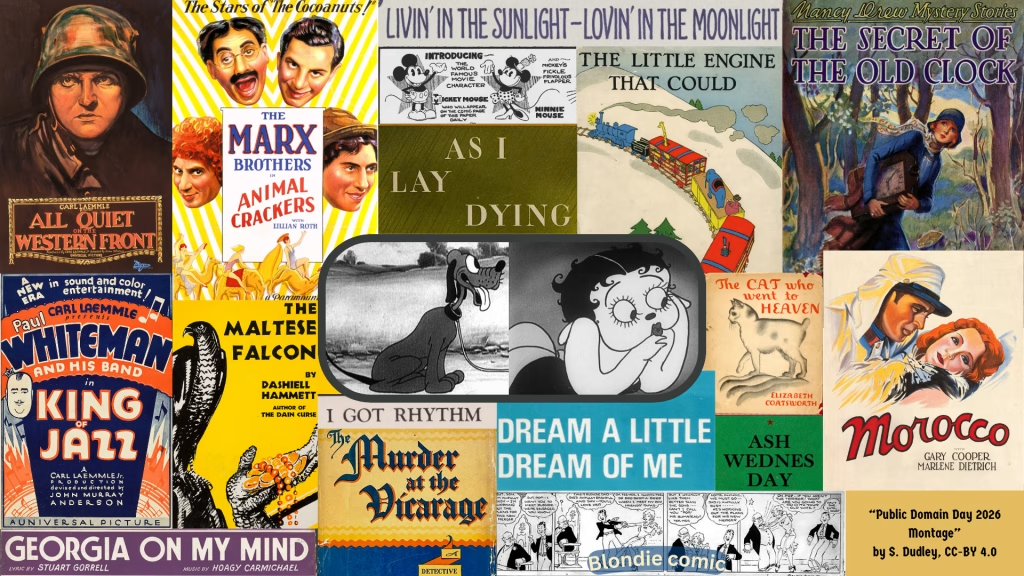
Under U.S. law, the copyright on thousands of creations from 1930 — including films, books, musical compositions and more — will expire at the stroke of midnight on Jan. 1, 2026, meaning they will be free to use, share and adapt after nearly a century.
“I think this is my favorite crop of works yet, which is saying a lot,” says Jennifer Jenkins, the director of Duke University Law School’s Center for the Study of the Public Domain, who has compiled an annual list of public domain entrants for over a decade.
This year’s treasure trove features famous faces like the original Betty Boop — whose iconic hoop earrings originally took the form of floppy dog ears — and the initial version of Disney’s Pluto, who first went by the name Rover.
“That’s not only exciting in itself, but it’s really an opportunity to look back at the history of these two incredible animation studios, Fleischer and Disney, and how their styles are imprinted in the DNA of today’s cartoons,” Jenkins says. “That’s just a fun rabbit hole.”
Literary highlights include William Faulkner’s As I Lay Dying, the full version of Dashiell Hammett’s The Maltese Falcon, Watty Piper’s The Little Engine that Could, the first four books of the Nancy Drew detective series and The Murder at the Vicarage, Agatha Christie’s first Miss Marple mystery.
The movie selection spans war stories, musicals, thrillers, Westerns, comedies and more, coming from directors including Alfred Hitchcock, Howard Hughes and Salvador Dalí. Among them are All Quiet on the Western Front, Animal Crackers starring the Marx Brothers, 1931 best picture winner Cimarron, and two Marlene Dietrich films, Morocco and The Blue Angel.
Several movies on the list feature future stars in their early days: Bing Crosby’s first feature-film appearance in King of Jazz, Greta Garbo’s first talkie Anna Christie and The Big Trail, John Wayne’s first leading role.
The implications are manifold:
[A] Betty Boop horror movie is already in the works, following a string of 2025 scary movies starring villainous versions of the freshly non-copyrighted Peter Pan, Bambi and Popeye. Also, a Minnie Mouse slasher is due for release in 2026.
Not all adaptations have to be dark: Think West Side Story drawn from Shakespeare’s Romeo & Juliet, Percival Everett’s reimagining of Huckleberry Finn in the 2024 book James and, of course, the Wizard of Oz-inspired Wicked movies.
And public domain isn’t just good news for those who want to create art, but also for those who simply want to consume it.
“It goes well beyond creativity to availability, to preservation, to being able to use things freely in school,” Jenkins explains.
For example, Jenkins says, books tend to become cheaper — and available in more editions — once they enter the public domain.
A lot of creative works from the 1930s haven’t been in print for decades, and ownership questions have kept many from being available online at all — at least while they were under copyright.
“Publishing houses go out of business, people die, ownership changes hands,” Jenkins adds. “I mean, who on Earth owns the copyright to those random works from … almost a century ago? And when they go into the public domain, you don’t have to worry about that.”
Another benefit is that third parties can now digitize old films and sound recordings that have physically deteriorated over the decades — allowing for their preservation and wider distribution.
Alas, it’s not quite so simple as these works being completely free to use. As Jenkins and Boyle document extensively,
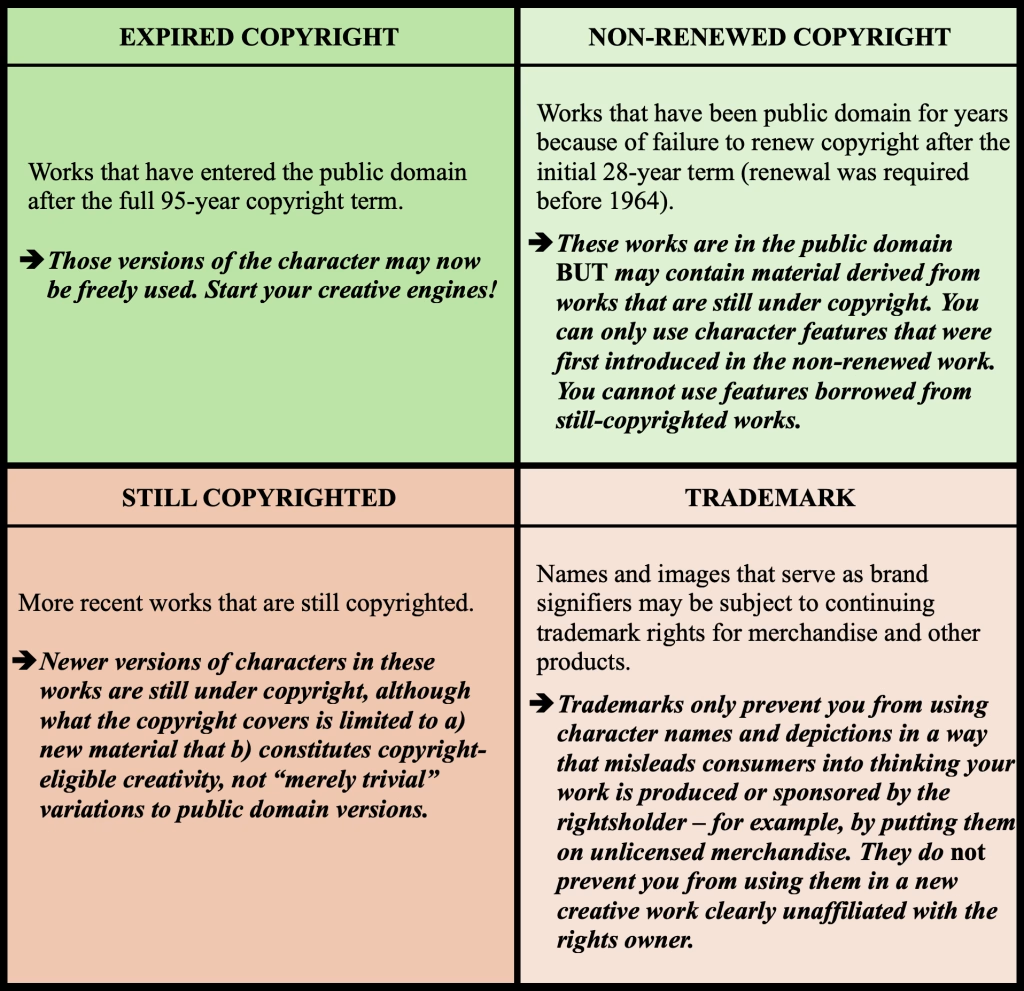
Long-running characters such as Betty Boop and Mickey Mouse are subject to both expired and enduring rights. This creates a fascinating checkerboard of material that is free and still owned. The overall result is a layered mosaic of public domain and copyrighted character attributes. Here is a summary, with the legal rules spelled out in more detail afterward and applied to Betty Boop.
[…]
As Betty Boop 1.0 enters the public domain, this is an opportunity to celebrate and appreciate Max and Dave Fleischers’ unparalleled artistry and pioneering animation. While Fleischer Studios may not be as well-known to the general public as Disney, perhaps they should be.
We know that Boop’s initial appearances from 1930 are public domain in 2026. There are also dozens of post-1930 Betty Boop cartoons that have long been public domain due to non-renewal. And there are many still-copyrighted works featuring Boop, plus trademark rights over her name and depiction for certain products.
Fleischer Studios has posted a statement called “Fact Check 2026: Is Betty Boop in the Public Domain?”. It begins with “this year Betty Boop appeared on a number of [public domain] lists, claiming that she will enter the public domain on January 1, 2026, which is actually not true” and elaborates:
While the copyright in the ‘Dizzy Dishes’ cartoon may fall into the public domain in 2026, this does not affect Fleischer Studios’ copyright in the fully developed BETTY BOOP character Fleischer Studios created in subsequent cartoons and other uses and continues to use today. Fleischer Studios’ copyright in that character will therefore remain in force for some years to come, as will Fleischer Studios’ copyrights in the many subsequently revised and modern versions of the BETTY BOOP character and related elements. Equally important, the BETTY BOOP name and various related character designs are well-known and valuable Fleischer Studios trademarks.
This is interesting because while Fleischer Studios does own continuing trademark rights over Betty Boop (discussed below), its claim to copyright over the fully developed character is less clear. In fact, in 2011, an appeals court definitively held that Fleischer did not own the copyright in the Boop character.[14] The original Fleischer Studios had gone out of business and sold off its rights in the 1940s. The current Fleischer Studios, “a distinct and separate entity,” had later tried to buy back those rights. The only issue before the court was whether Fleischer owned the familiar Boop character. The court ruled that, because “the chain of title is broken,” it did not. (Beside the text you can see, from the court exhibits, two versions of Boop that Fleischer did not then own. As you can see, they are more “modern” than the 1930 Boop with her subtle dog ears.) Perhaps Fleischer has since reacquired some of those rights, or perhaps they only have the rights over newly added features from the “subsequent cartoons and other uses” they mention. In the latter case, those rights would be narrow and would not extend to the underlying Boop character at issue in the 2011 decision. One thing is clear: regardless of who owns the later versions of the character, the original Betty Boop character from 1930 is in the public domain.
If your head is spinning from all the complexities involved here, congratulations! You are in good company. This is another reason why copyright expiration is so important: It brings clarity. There can be multiple separate copyrights implicated in a single creative work – over characters, audiovisual content, music, and so on. During a copyright term that lasts almost 100 years, those multiple rights may have changed hands many times and may no longer be owned by a single entity, or indeed by any entity we can identify. It can be incredibly difficult to figure out who owns what. When entire works become public domain, they are free for reuse without having to untangle this web of ownership.
Thankfully, now that Betty Boop 1.0 is public domain, the ownership and chain of title questions are immaterial. She, at least, is copyright-free. That brings us to another set of questions: What features of the newer, copyrighted Boop characters are still subject to exclusive ownership, and what is free to the public? Expanding on the checkerboard above, here are more specifics about the legal rules, and how they apply to Betty Boop.
EXPIRED AND SUBSISTING COPYRIGHTS
We begin with the left column on the checkboard above. When the copyright expires over a creative work, the characters within that work enter the public domain, and you can use them in new works without permission or fee. What if those characters also appear in more recent works that remain copyrighted?
First, under US copyright law, anyone is free to use characters as they appeared in public domain works. If those characters recur in later works that are still under copyright, the rights only extend to the newly added material in those works, not the underlying material from the public domain works—that content remains freely available.
Second, with newer versions of characters, copyright only extends to those new features that qualify for such protection. The features must be “original, creative expression,” meaning that they were independently created (as opposed to copied from somewhere else) and possess at least a modicum of creativity. Mere “ideas” such as generic character traits are not copyrightable. Nor are “merely trivial” or “minuscule” variations added to the original characters. It is not enough for the new material to be different; it has to meet copyright’s threshold requirements for protectability. In addition, using commonplace elements that have become standard or indispensable (copyright law calls these “scènes à faire”) is not infringement.[15] Finally, if your use qualifies as “fair use,” for example if you make a scathing parody that significantly transforms the original work, the copyright owner has no right to stop you.
[…]
How do these legal rules apply to Betty Boop? BOOP! the Musical was made when the character was still under copyright. Permission needed to be obtained. What if you wanted to make your own different Betty Boop musical in 2026, now that Boop 1.0 is in the public domain?
All of Boop’s features from the 1930 cartoons are public domain in 2026. In her first appearance in Dizzy Dishes, she has the familiar flapper girl appearance and dance moves, and sings variations of “Boop Oop a Doop” to the besotted Bimbo character.
That Betty Boop is in the public domain, along with the lyrics, plot, and incredible animation. So are the Boops from other 1930 cartoons (to the left, Barnacle Bill and Mysterious Mose). However, those are not the only parts of the character in the public domain. Some of her features were not copyrightable from the beginning, because they were copied from elsewhere. Her general appearance and “Boop Oop A Doop” catchphrase were inspired by the Jazz Age flapper girl archetype, as embodied by celebrities such as Helen Kane.[16] It was the way those came together into a captivating new character that was copyrighted and is now entering the public domain.
[…]
What features of newer Betty Boops are copyrightable? While copyright still covers the overall post-1930 depictions of Boop, it does not extend to unoriginal, “merely trivial,” or stereotypical modifications of Boop 1.0, such as replacing the dog ears with human ones, dressing her in standard attire for a cabaret performer or homemaker, adding a Rosie the Riveter bandana, or modulating her voice to reflect newer singing styles.
We went through this same process two years ago with Mickey Mouse. Mickey 1.0 did not have red shorts or speak in a high-pitched voice; those traits were added in later, still-copyrighted works. When the original Mickey became public domain, we were asked by many reporters whether creators could color his shorts red or have him talk in a falsetto. Are those variations, standing alone, copyrightable? Does choosing a single, bright, primary color for an article of clothing, or giving an animated mouse a squeaky voice (given that mice actually squeak), meet the copyrightability threshold? We would say no, but reasonable people could disagree on exactly where the line is to be drawn.
[…]
WHAT IF THE CHARACTER IS NO LONGER COPYRIGHTED, BUT ITS NAME OR IMAGE IS STILL SUBJECT TO TRADEMARK RIGHTS?
We finish with the bottom right quadrant: trademarks. You may encounter claims that even though Betty Boop 1.0 is copyright-free in 2026, you still cannot use the character in new creative works because it is trademarked by Fleischer Studios. But this is not what the law actually says. While Fleischer’s trademark rights over Betty Boop are unaffected by her entry into the copyright public domain, those rights are limited. Trademark law only prohibits the use of a trademarked character if doing so “is likely to cause confusion, or to cause mistake, or to deceive” consumers about the source or sponsorship of a new product.[19] Here is a brief summary of the relevant law.
[…]
Unlike copyrights, trademarks do not automatically expire. They can last as long as a mark is still being “used in commerce.” While trademarks can outlast copyrights, however, the rights themselves are more circumscribed. It is only trademark infringement if an unauthorized use is likely to create consumer confusion about a product’s source or sponsorship. Non-confusing uses are not prohibited, and there are a variety of legal safeguards for uses of trademarks in connection with expressive works such as films, books, and songs.
Sometimes copyrights and trademarks overlap. A character such as Betty Boop might be covered both by copyright law (as a creative work) and trademark law (as an indicator of product-source). What happens when the copyright expires and the trademark is ongoing? In a unanimous opinion, the Supreme Court made clear that trademarks cannot be used to make an end run around copyright law because this would “create a species of mutant copyright law that limits the public’s federal right to copy and to use expired copyrights.”
[…]
If courts have delineated the line between copyright and trademark, why is there so little clarity in this area? Sadly, companies sometimes claim to have more expansive rights than they actually do, capitalizing on fear, uncertainty, and doubt to collect royalties and licensing fees to which they are not legally entitled. This is deeply regrettable. It interferes with the rights of everyone from the small community theater trying to screen a public domain movie, and being told they still have to pay licensing fees, to new creators trying to make a new work from a public domain character but facing baseless threats that they are infringing. In the process, it fundamentally misstates the law in a way that confuses the public.
There’s a whole lot more at the link, but you get the idea: for all intents and purposes, unless you can afford massive litigation costs, it’s likely not worth the risk of treating Betty Boop as a public domain property, as you’ll likely get sued. Fleischer will likely claim that the work uses features of the character not present in the 1930 version. And they have trademark rights on all manner of Boop-related merchandise.
Still, this is mostly a boon. Most of these works are not being licensed or controlled by anyone. Some may be next to impossible to find, as they’ve been out of print for decades.
James Joyner is a Professor of Security Studies. He's a former Army officer and Desert Storm veteran. Views expressed here are his own. Follow James on Twitter @DrJJoyner.
Some may be next to impossible to find, as they’ve been out of print for decades.
One of the things that used to be noted when material passed out of copyright were well-known movies whose copyright controllers couldn’t be accurately identified and there were only one or two known prints. Digitizing century-old cellulose runs a significant risk of serious damage — that is, you may only get one shot at it. Wonder if anything of importance becomes available to the preservation people this year?

One of the things that used to be noted when material passed out of copyright were well-known movies whose copyright controllers couldn’t be accurately identified and there were only one or two known prints. Digitizing century-old cellulose runs a significant risk of serious damage — that is, you may only get one shot at it. Wonder if anything of importance becomes available to the preservation people this year?