Concentration Camps Redux
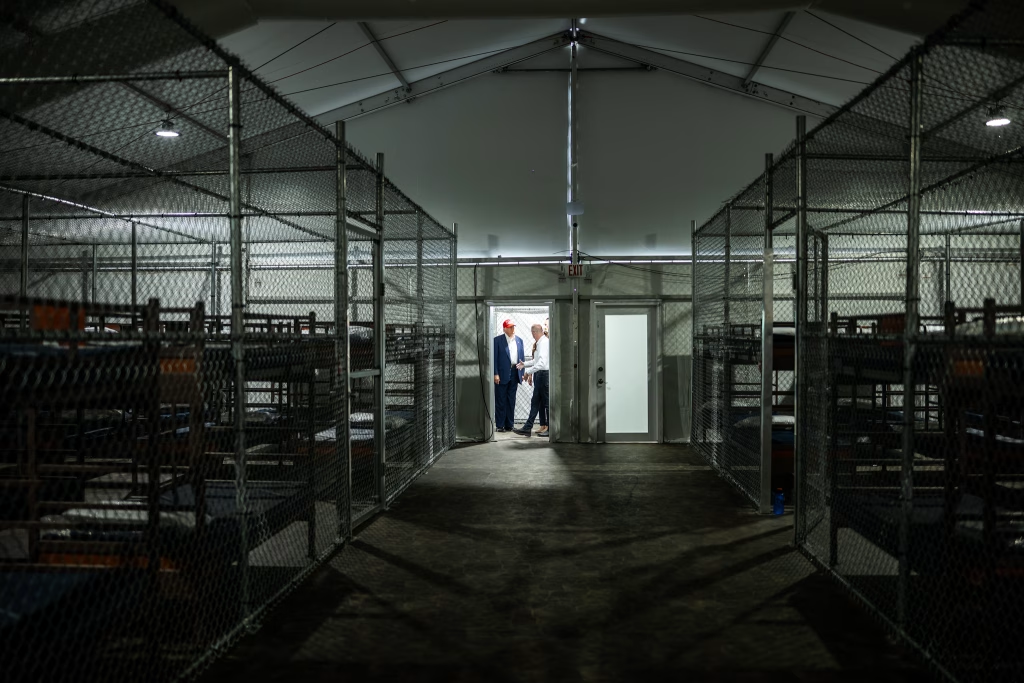
A few weeks ago, I noted an essay by author Andrea Pitzer about her book on the history of concentration camps and the applicability of her work on contemporary US politics. Let me add the following Will Bunch column to the discussion, which includes more from Pitzer: This column on U.S. concentration camps is the one I hoped I’d never write.
Given the ongoing debate about words and their meanings, let me start here.
One of Pitzer’s goals in writing One Long Night and her follow-up works has been to define what exactly a concentration camp is.
She called it “the mass detention of civilians without any real trial. So if there’s a trial, it’s a show trial.” Detainees are held “on the basis of race, ethnicity, religion, political affiliation, or some aspect of identity instead of as a consequence of a specific crime that they’ve done and been convicted of. And it was almost always done for political gain. And what I saw all over, but also in the U.S., was the way, particularly after 9/11 in ‘the war on terror,’ that it was used to sort of consolidate political power.”
By the way, the reference to 9/11 reminds me of Michelle Malkin’s book, In Defense of Internment, which was both a defense of Japanese internment and also argued for Muslim internment in the wake of 9/11.
But back to the discussion at hand.
Bunch addresses the “concentration camp” v. “death camp” issues as follows.
The most famous case study, in Nazi Germany, is also the source of many current misconceptions, since the “final solution” death camps, such as Auschwitz in Poland, where some of the six million Jews murdered in the Holocaust died in gas chambers, have often been what people think of. But the first well-known German concentration camp, Dachau, opened less than two months after Hitler took power in early 1933, and was used to detain — not slaughter — the Nazis’ political opponents.
The following from Pitzer is especially noteworthy given the reports that James Joyner noted about the Trump administration’s approach to homelessness.
“It was used in a kind of social engineering way,” Pitzer said of Hitler’s early camps. “There were a lot of homeless people, there were a lot of career criminals that they put in the camps to kind of dilute the percentage of political prisoners. So it would be more of a PR thing. People would support it more. You saw detention, particularly, of gay men.”
She also has a warning, based on her research.
Pitzer said her research has shown these camps “almost always transcend whatever were the original goals of even the very bad actors that imposed the camps in the first place. And so what we are looking at potentially happening here is not just sort of Stephen Miller’s visions being fulfilled. We could be looking at something much worse over time that we aren’t even imagining yet.”
To me, all of this raises the question as to when we should be alarmed and, therefore, when strong and appropriate language should be used. I am in the “now!” camp (and fear that we may already be too late–not that I didn’t try before Trump won last November).
The scale of it all is daunting.
Right now, the surge in raids on unauthorized immigrants by U.S. Immigration and Customs Enforcement has already created an all-time high number of detainees at more than 56,000, which is far more than the federal government can handle. That’s led to horrendous makeshift situations like an ICE office in Manhattan, where leaked videos show detainees held in what’s supposed to be an office, as a man shouts that “they’re treating us like dogs in here.”
The Florida concentration camp model will expand, now that Congress has approved a massive $45 billion appropriation for new immigration detention sites, with another $29 billion to hire more masked agents to arrest people and fill them.
The U.S. Department of Homeland Security has unveiled a plan for a new network of sites in military bases across the country, including one at New Jersey’s Joint Base McGuire-Dix-Lakehurst that a critic has already dubbed “the Garden State Gulag.” A 5,000-bed camp planned for Fort Bliss, near the border with Mexico, has already raised red flags after the contract went to an inexperienced firm, but Pitzer noted this isn’t the only problem with using military sites.
“It’s not like it’s a secret prison, but it is a closed space,” she said. “And it’s going to be harder to know what’s happening and to keep track of it.” The author shares my concern that as the concentration camps gain momentum, the purpose of them will shift — maybe to incarcerate protesters or political prisoners, or Americans stripped of their citizenship.
Conditions in these places are unacceptable, in my view. Note the Manhattan office noted above, but also reports out of Florida.
“It’s like a dog cage,” a detained Cuban immigrant, Rafael Collado, said by phone to reporters in Miami, describing a wetlands facility that floods frequently, where detainees lack showers, the food is rancid, the overhead light is continuous, and the mosquitoes are voracious.
For Pitzer, the mosquito plague at the Everglades camp is a revelation of its common bond with the worst camps of the last 130 years. “Mosquitoes have likewise long had a starring role in concentration camps around the world, starting with the first reconcentrados in Cuba in the 1890s,” she posted recently on Bluesky. Malaria was endemic at early camps there and with America’s early 20th-century detainees in the Philippines, but later the USSR and China would intentionally torture their prisoners with exposure to the biting and disease-bearing insects.
There are two arguments for not calling these things concentration camps. One is that they don’t fit the definition. I reject this position, as per the above, they clearly are places of mass detention of civilians without adequate due process, based almost exclusively on ethnicity, instead of as a consequence of a specific crime that they’ve done and been convicted of.”
As a simple matter of historical reality, I am not sure how this definition is not applicable. The notion that only late-state Dachau and Auschwitz are “concentration camps” is a misreading of history and a misunderstanding of the lessons that those places should be teaching us.
However, the public’s association of death camps with concentration camps is the other argument for not using the term. It is the same reason that using “fascist” or other terms that are deeply embedded in our national psyche are often avoided because it takes time to make a case for their deployment.
By the way, I don’t think that this is just an argument over semantics or just something that goofy academics like to engage in. At some point, the selfish person does end up being a psychopath. At some point, “flirtation” does end up being sexual harassment. At some point, “mov[ing] on her like a bitch” and “grab[bing] them by the pussy” is, in fact, rape. At some point, celebrating one’s “heritage” transcends patriotism and pride and becomes white nationalism.
I could go on and on. There is often an ugly endpoint to attitudes, behaviors, and public policies. And, therefore, at some point, the uglier terms are the ones that need to be applied.
Also, I would note that it is one thing to just throw a definition out of a table and say, “See! That is all you need to know!” and writing thousands of words explaining and arguing for that definition (as well as providing a public forum for discussion of the topic).
I agree that sometimes word games and semantics can be a distraction or even an exercise in academic navel-gazing. But more often than not, the meaning of terms and the ideas that undergird them are profoundly important. We mostly communicate with words. Words convey ideas. And power is often linked, for good and for ill, in what we understand words to mean about the objective reality around us.
By way of conclusion, I will state that I hope that I am wrong. That these shouldn’t be considered concentration camps and that the federal government isn’t about to spend millions creating more such site like Alligator Alcacatraz. Indeed, I hope that I am wrong about the conditions in Florida. Maybe all those people are just having a nice visit to the Everglades and are earning HHonors points while they enjoy lovely meals, comfy beds, and the beauties of Mother Nature.
Or, at least, that they are being treated humanely with appropriate legal protections and due process.
For me to think any of those things requires evidence, however. And the evidence to date makes me think that these are, in fact, concentration camps. There may be some political rhetoric reason to use some other term, but not only am I unconvinced of this notion, using another terms doesn’t change what we are witnessing.

I fully concur with this:
I just think it’s both ways. If the public thinks “Auschwitz” when it hears “concentration camps,” then anything less than that will be perceived as partisan fearmongering. We use words like “internment camps” for what we did to Japanese Americans during WWII and, since that much more closely resembles what’s happening now than does Auschwitz, I’d prefer that language rather than get caught up in a semantics debate.
Rounding up people and imprisoning them indefinitely without trial is a clear violation of both our laws—including the Constitution—and our ostensible values. But we’ve done it with those we deem “the other,” including the American Indians, the aforementioned Japanese Americans, and terrorists or potential terrorists captured overseas during GWOT. It’s not Auschwitz bad, but it’s bad.
Like the GQP and the MAGAts deploy the terms socialist and communist with the utmost care and attention to proper dictionary and historical meanings.
It should be noted that among the Nazi camps, the ones that weren’t officially “death camps” were barely anything else. My grandmother was in one of those. Her situation was unusual in certain ways. She was originally from Poland, but shortly after the war began she and her family fled to Hungary. Most Polish Jews who made that attempt were turned back at the border, but her father (a defense department employee and WWI veteran) managed to get his family through, where they spent the next several years in refugee camps among mostly non-Jewish Poles (who tended to be deeply anti-Semitic despite their also being victims of the Nazis). In 1944 when the Nazis took control of Hungary, what commenced was perhaps the most rapid implementation of the mass killings during the entire war. They knew they were losing the war, so they committed themselves to–well, basically, taking as many Jews down with them as they could. In a matter of months, the majority of Hungary’s Jews were rounded up, deported to Auschwitz, and immediately gassed. But by the time my grandmother and her family were captured, the Russians had moved westward so that the Auschwitz deportations were no longer on the table. Her father was taken away as a POW (after the war they were incorrectly told he had died); she (who was 20), her younger brother (about 14 I think), and her mother were sent on a trek spanning hundreds of miles in the dead of winter, until they reached the Lichtenworth camp in Austria. This was a small camp (technically considered part of the much larger Mauthausen camp) where about a couple thousand women and children were kept. The inmates were starved in squalid, dirty conditions, forced to stand for hours during air raids, sometimes randomly shot by guards and other almost unimaginable acts of depravity I won’t describe in detail here. By the time the camp was liberated, she was ill with typhus. She was extremely lucky to survive that ordeal, and if she hadn’t, I wouldn’t be here telling you the story.
The distinction between concentration camp and death camp is an important one, but the lines can get blurry.
While you argue semantics real humans are suffering human rights abuses. They’re being tortured. MAGA doesn’t give a flying fuck about your semantics.
@Kylopod:
Death camp vs. slow death camp.
It’s time to stop using “maga”. The correct term is “Republicans.” There are no Republicans who aren’t maga.
The following speech was made during his 1952 campaign by Adlai Stevenson, and only applies even more today.
“The strange alchemy of time has somehow converted the Democrats into the truly conservative party in the country—the party dedicated to conserving all that is best and building solidly and safely on these foundations. The Republicans, by contrast, are behaving like the radical party—the party of the reckless and embittered, bent on dismantling institutions which have been built solidly into our social fabric.”
Thank you. I’d been mostly staying out of that fray, but had thought about commenting that arguing about semantics was a silly waste, but a discussion about how to most effectively portray the situations in Gaza and our own camps might be useful. You did it much better and more thoroughly.
As to “when we should be alarmed and, therefore, when strong and appropriate language should be used. I am in the “now!” camp”. Indeed. Although the a-hole who said it did so in laughably inappropriate circumstances, it’s true that “extremism in defense of liberty is no vice”*. Discussion of how best to do so might be helpful.
* I hesitate to use Goldwater’s line. Yesterday Dr. Taylor did a podcast on Republic v Democracy. For people who make that distinction, “republic” doesn’t quite mean what it means to you, me, and Funk and Wagnalls. It’s an emotion fraught, nebulous something, but not democracy. Likewise, for conservatives, “liberty” seems to have a non-standard meaning distinct from freedom. Underlining that words are slippery things.
@Gavin:
Reagan was a Republican. McCain was a Republican. The Bushes are Republicans.
MAGA is something new. Perhaps it’s the result of an evolution. But it is now fully formed. And it is evil incarnate.
Calling it “Republican” gives it credibility based on tradition. This is not that.
Given that on earlier threads I have expressed an opinion much more close to that of James than Steven, I don’t know it is valuable to repeat myself.
What is valuable, I hope, is the observation that one might do well to tailor the language one uses to the audience and the purpose it is intended for. If one’s intentions is to “rally the troops” and motivate those that are like-minded, one chooses one message and one kind of language.
If your object is to persuade people who maybe are wavering, one chooses a different message and a different kind of language.
I am well aware that people don’t change often or quickly. However, they do change. There’s even a model (mostly used in psychological fields) for how that change can happen, which sort of describes it as a multistage process.
You might look at that link and say, “But Jay, that’s a thing in therapy, and I’m not interested in shrinks or what they say. This is politics!”
To which I would reply that it is called “transtheoritical” for a reason, in that it has been found to apply very broadly. It’s just therapists that know about it and use it.
Well, and maybe propagandists. I think the professional persuaders (and hell yes, there’s such a thing) know lots of this stuff. And since they work for pay, they mostly serve the monied interests.
Anyway, people do change. It takes time. It has multiple stages.
We need some people to change. We need to evangelize. We need to sell. We need to learn from people who are good at selling. There’s a lot more to it than simple dishonesty, which I feel free to ignore.
It is hard work, which doesn’t get you many clicks, though.
I can’t speak to someone’s purposes, I just ask that they consider what their purposes are. I see other commenters acting in some interesting and strategic ways, though. Which suggests to me that I’m not the only person thinking this way. I am quite relieved and gratified to see this.
@Daryl: They are George Wallace neo-confederates.
@Daryl:
First, you are missing the point of the post.
Second, what would you suggest I do? Is not trying to convince the people who read this of the dire significance of these places something? It isn’t much, but it is more than nothing.
I was just reading”KL” a history of the concentration camps. These are absolutely concentration camps. The parallels are too close to be ignored. The Nazi leaders even posed for pictures outside of the camps and talked about how dangerous the inhabitants were because they had tattoos.
@Jay L. Gischer:
100%
The most important distinction of these camps to the gulags and other forms, is the lawless indiscriminate imprisonment of people and extinguishing of the rights which the Founders considered so universal as to be endowed by the Creator and inalienable.
These are not criminals given a fair trial with all the attendant rights that free people enjoy; These are people who are pushed outside the world of law and exist in a space where they are not citizens, and have no rights whatsoever, they are UnPeople.
This makes the distinction between “concentration” and “death” camps irrelevant; We know from history that once people are rendered UnPeople, their right not to be tortured or raped or even not to be killed becomes optional, something at the whim and caprice of the powers that be.
@James Joyner: @Jay L. Gischer: FWIW, I am not trying to devise a communication strategy on this topic. I am asking what these things are.
It is entirely possible I am being too stubborn or academic about it, but if it is what it is, then call it what it is. If “the public” doesn’t understand, then education is order. If people are too ideological to hear the truth, I am not sure how softening the language makes that much difference.
For example, will MAGA adjacent citizens actually react better if we call them “internment camps?” I have my doubts.
This is part of an ongoing debate here as to whether there is some set of magic words that will actually penetrate the people who need to hear them. On the one hand, I recognize that marketing and strategic communication are real things. On the other, I am not convinced that there are magic words that will get people already excited about deportations to care about the conditions in Alligator Alcatraz. Hell, those people are buying merch.
Precision is helpful in the long run because precision gives you room for escalation. Don’t yell, ‘Fire!’ when what you mean is, ‘Smoke!’ It’s the old story of the little boy crying wolf. If you yell, ‘Fire,’ and people discover that it’s just smoke, they’ll ignore you if there is ever a real fire. Give people information they can act upon, not hyperbole, which in the end, deadens their response.
For example don’t say, ACAB when you mean some or even most, not all, because once you’ve said ‘all,’ where do you go when things get worse? How do you reach out to the good cops? How do you differentiate between bad and worse? If you insist that ACAB, you’ve made a statement that is very easily disproven, which results in the entirety of your original concerns being dismissed.
Or don’t say abortion is murder, then have a nice lunch with ‘murderers’.
A very consequential mistake was made with #MeToo because it failed to differentiate between minor and major infraction, between irritation and threat. It very quickly developed that when you saw #MeToo you first had to parse the level of seriousness in order to decide on a response, and as that was very difficult to do, it left people free to assume that most #MeToo accusations were of a trivial nature.
Social media has exacerbated the tendency to hyperbole because it offers the sugar rush of clicks and likes, but inevitably becomes little more than background noise. And it makes it very hard for people being accurate to get attention for causes which are important but don’t need a bloody shirt to be waved.
Hyperbole should be used only for comedic effect because in a serious context it’s a tactic that quickly undercuts itself.
@Gavin: I use the term “MAGA Republican” to distinguish from the traditional Republicans who identify neither as independent or Democrat, and to hold out “hope” that moderate Republicans will find their footing, regain representation, once the MAGAland loses its charismatic leader and the dittoheads grow bored.
This reminds me of “negro” or “colored people” which were once the right phrases to use, at least compared to the more earthy word ending with a hard r, but collected a lot of baggage that ended up obscuring the meaning.
(Was it Ross Perot who got backlash for using “colored people” in a speech to the NAACP, or is that just an urban legend, like America being the land of the free? Assuming it was real, any meaning of the speech was lost to the language.)
Except, there have been new words for Black folks, which at least initially don’t have the baggage, while we don’t have a commonly used word for a concentration camp that is not a death camp (yet!*).
But the lack of a better phrase for “concentration camp” to distinguish it from “death camp” also reminds me of the bisexual/pansexual discourse in the Queer community. Bisexual was coined at a time where we only recognized a gender binary, leading to claims that it is transphobic**, and then by people pushing a new definition of the two “genders” being your own gender and some or all other genders (or that “bi” means more than one), but this is a stupid redefinition that clearly doesn’t work. Pansexual is a subset of bisexual that hinges on whether your attraction includes gender or whether gender is irrelevant. But, a lot of people see that “pan” means “all” and “bi” means two and assume that pansexual is an umbrella term that includes the naughty transphobic bisexual, while a whole bunch of other people keep trying to correct them. And a third group telling people to just shut up and pick a label based on which pride flag appeals to them, or use an umbrella term like Queer, or just shut up.***
It’s big, stupid drama caused by a word that no longer communicates the intended meaning. It’s so fucking stupid. It’s not like the Nazis will make any distinction as they’re rounding us up into concentration camps.****
Like “bisexual,” “concentration camp” no longer communicates its actual meaning. I would say that we should be niggardly with words that cause this type of confusion, but it requires a different word to start gaining traction.
*: I expect the Administration to solve this problem either by giving us a new term in response to claims these are concentration camps, or just to start killing people.
**: I hate the -phobic terms. I don’t care if someone is afraid, I care whether they engage in oppressive behavior.
***: This seems like the most sensible solution, but cannot be applied to our concentration camps.
****: see how I tied that back? I’m a little proud of it.
@Steven L. Taylor:
Someone once wrote that a perceptual problem comes from incorporating the word “camps” for which we also associate something far less threatening, and recreational. The observation may have been offered with humorous bent.
There is also the choice of “detention centers.” But that too is imprecise —- if what is taking place within these places, as reported, includes intentional cruelty and curtailment of legal rights. Therein lies the dissonance — the malevolent intent as evidenced through the current apprehension and detention process, and end point of landing in a foreign hellhole. We need better words to talk about these “detentions” just as need better words for what is happening in Gaza. Words that do not minimize or sanitize the intent.
@Gustopher:
The phrase he used that caused controversy was “you people.”
One thing about concentration camps is that people tend to die while interred in them at higher rates. Those in power who put them there don’t care what happens to the inmates They may not want to kill them, but they don’t want to treat them humanely, either.
So you get poor quality and insufficient food*, little or no healthcare, poor sanitation, poor living conditions, etc. And if people die, those in power couldn’t care less. And that’s before the guards start beating up prisoners to relieve boredom.
*Food quality is not a simple subject. But one way to get really low priced food is to buy spoiled food, or items past their expiration date. Another way to lower costs is not to maintain the hygiene procedures food requires. For instance keeping pantries dry and cool, or keeping perishables refrigerated.
@Gustopher:
Guantanamo is a franchise now. I don’t have the word, but I sense it’s out there. A need exists, a word should emerge. Maybe out of left field, like out of gamer terminology.
As for bisexuality etc… how about if we all admit we’re on a spectrum and very much affected by situation. See: men’s prisons. Or the counterpart, harems. I assume. Or let’s just have a national reveal of everyone’s PornHub searches.
@Steven L. Taylor:
I don’t think I missed the point. But if you need to try and convince someone that’s what’s going on is evil, they are likely beyond convincing.
@Daryl: Honest question: should I stop blogging and free up some of my time?
@Steven L. Taylor:
Who could blame you? lol
I would wager that everyone here agrees that much of the MAGA agenda is abjectly evil.
And everyone on the Daily Caller site, for instance, thinks it’s the best thing since individually wrapped cheese slices.
I’m not sure who still needs, or is open to, convincing. From the polling I’ve seen the undecided number is shrinking.
Among the half of the country who care about what is happening in those places, they probably mostly think they are concentration camps or close enough to not argue it. The other half either thinks they are concentration camps and are happy about it (remember that Sheriff Arpaio had deep support for a long time) or they just dont care.
Steve
@Daryl:
Fortunately, the majority of the American electorate are not found on either the Daily Caller or Outside The Beltway.
That is, most people are apolitical and don’t spend a lot of time thinking about politics, until something breaks through the din of celebrity gossip and sportstalk.
@ChipD: As I said, the polling I see shows a shrinking number of undecided.
Hispanics are at 0%.
A historical footnote: the original “concentration camps”, iirc were those used by Sapin in the Cuban War in the 1860’s.
A similar use was made, on a limited scale, in the US conquest of the Phillipines.
And shortly after, by the British in South Africa.
In all three cases, the intent was not mass killing, but to remove the basis of guerilla warfare.
The often horribly high death rates were largely due to military icomptence, and disease in cramped and unsanitary conditions
The Gulag and the Nazi “political camps” were different in that they were aimed at citizens as a political policy, not in support of anti-guerilla operations.
The US and UK WW2 internment camps were applied to limited numbers judged to “potentially dangerous to national security.”
Then the Nazi policy morphed into the mass-murder of both citizens and non-citizens on the basis of both politics and ethnicity.
One common factor between all of them (with the possible exception of the UK WW2 “enemy aliens” internment) was a total disregard for civil legal rights, and a related lack of much, or any, depending, concern for the welfare of those interned, who tended to be regarded as “non-persons”.
Excluding people from the due process of law, and legal protections regrding their welfare, tends to lead to unpleasnt outcomes.
Of course, for some involved in current policies “unpleasant outcomes” are much to be desired.
Both as a “deterrent”, and, it would seem, out of sheer sadistic vindictiveness.
@ChipD:
That’s rather a matter of perspective, which unfortunately is frequently only retrospective.
It’s a fairly sure bet that many of the people of Germany or Japan in the 1930’s cared little about a lot of the policies of the NSDAP or the Imperial Government.
Until it was far, far too late.
For “millions of dead people” and “total national collapse” values of “too late”.
Perhaps you might consider that overly dramatic.
But the general public of many countries, at many times, have blithely ignored indicators of impending crisis, and relied upon “things just carrying on asd they always have”.
Until things don’t.
@Michael Reynolds:
Scientists studying bonobos say they are all bisexual – every last one.
@charontwo:
otoh, gorillas pretty definitely are not.
And orangs seem to be rather morose individualists.
The big question, though: are gibbons really swingers? 🙂
@ChipD:
I fear it will take some sort of catastrophe at one or more of the camps to grab the attention of the masses.
@Daryl:
For that reason I never use the ‘GOP’ acronym. There is nothing remotely grand about the MAGA Republican Party.
MAGA Republicans have a cute way around the whole due process/natural justice issue. You see, the people being rounded up are in America illegally. Being in America illegally is a crime. Therefore they convicted themselves already just by being in America. This obviates any need for further legal proceedings. The Leavitt girl expressly stated this some months ago as the considered position of the regime.
“But how do you know they’re in America illegally?” you may innocently ask.
“Because they’re fucking illegals, stupid lib! You think we have time for each one to have a trial?”
@Steven L. Taylor:
Honestly, I just think this is a matter of language evolving. The meaning of words changes with usage. There are pedants on our faculty who insist on the historical meaning of “decimate” (to kill one in ten) despite the fact that its most common usage has evolved to mean “kill a large percentage of.”
The Holocaust changed the connotation of “concentration camp” eight decades ago. I just don’t see any value in trying to bring back the older definition, unless the intent is to draw a comparison to the Holocaust. If that’s not the intent, just use normal words to explain why this situation should be alarming and reversed.
@James Joyner: I see your point. I am not sure if I am convinced, but it also means that genocide, fascism, Nazism, and the like are words that have to be retired (of course, it also means that common useage of socialism, communism, and a host of other words are a problem, too, due to genereal public lack of understanding). The only one of those that I am willing to say should be historically specific is Nazism, because it referred to a specific entity in a specific time and place (although neo-Nazi is fine).
I will say this: to me, the point of the word is not to draw comparisons to the end state of the Holocaust, but to draw comparisons to the kinds of policies that can set a nation down a path that goes in that direction. While I do not think we are headed for mass executions, I do think that there are stark similarities to the policies we saw in Nazi Germany and elsewhere over time that require stark language.
The problem with “internment camps,” for example, is that the public doesn’t really think of those as as deeply problematic as they should. After all, since there wasn’t mass death and those people were eventually released, what’s the big deal? Further, we did it to keep ourselves (white people, anyway) safe, right?
As noted in the OP, right-wingers like Malkin were ready to bring them back in the early aughts and even argued in favor of the Japanese camps in her book. So, I think that there is a huge contingent of people on the right who would react at least neutrally to “internment camps.”
@Steven L. Taylor:
It’s a slippery slope, to be sure. And, honestly, those words are all likely to generate more heat than light in general discourse. (Within elite, especially academic, circles, it’s easier to have a common reference point as to word meaning. So, things like “white privilege” are perfectly useful in those circles, but poison the well outside.) The only one that’s likely really useful still is “genocide,” as there have been plenty of post-Holocaust instances where that word was appropriate.
That’s true. But I don’t think calling them “concentration camps” instead would change public perception. If they think locking “the other” up is a reasonable step, they have to be persuaded otherwise.
For sure. But it’s a heavy lift. A majority of Americans support all but the most barbaric measures that have been used to round up and deport illegal immigrants. The good news is that there’s at least some nuance in which ones they’re interested in deporting, with majority support only for those who have committed crimes.
@James Joyner:
I don’t disagree. I am just at a loss as to other options with easier lifts.
And I think we (collectively here at the site) keep conflating discussions about what things actually are/what words should be used to describe them with “what a good public relations campaign looks like.”
But even if the goal is PR/political communication, the goal is obviously not unanimity. It is getting to maybe 3%-ish of the population, yes?
@Steven L. Taylor: Yes, given polarization/sorting, there’s really a small group that needs to be shifted.