East Wing Almost Gone
The move to build Trump's Big Beautiful Ballroom is moving at record speed.
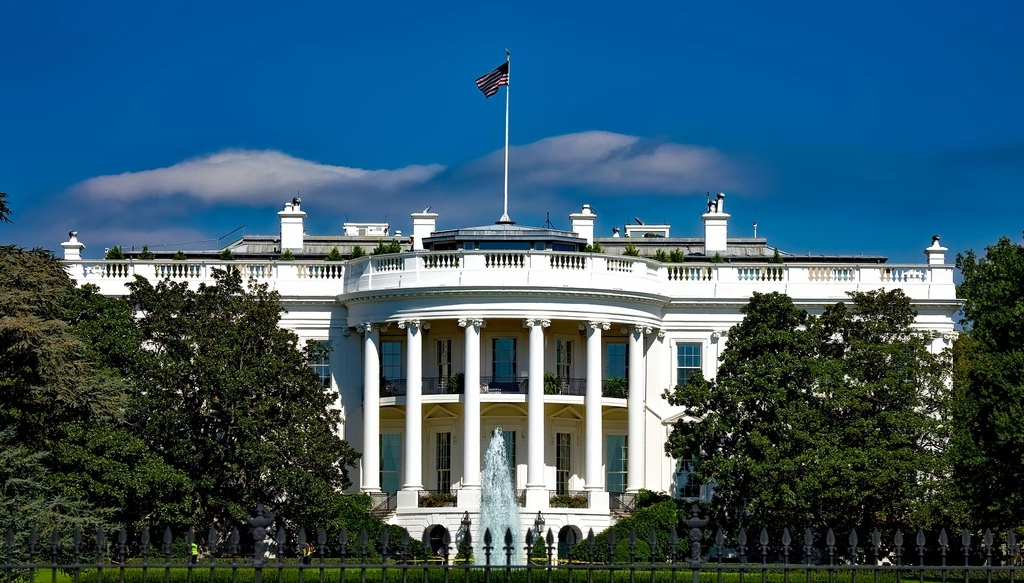
NYT (“Trump Is Wasting No Time in Tearing Down the East Wing“):
As roaring machinery tore down one side of the White House, President Trump acknowledged on Wednesday that he was having the entire East Wing demolished to make way for his 90,000-square-foot ballroom, a striking expansion of a project that is remaking the profile of one of the nation’s most iconic buildings.
Mr. Trump was unsentimental as news of the demolition spread. “It was never thought of as being much,” he said of the East Wing, which was home to the first lady’s office and spaces used for ceremonial purposes. “It was a very small building.”
The process of tearing down the East Wing was expected to be completed as soon as this weekend, two senior administration officials said, as Mr. Trump moved rapidly to carry out a passion project that he said was necessary to host state dinners and other events.
But the previously unannounced decision to demolish the East Wing was at odds with Mr. Trump’s previous statements about the project, and underscored his intention to blast through the sensibilities of many in Washington to continue putting a lasting imprint on the White House.
[…]
The West Wing and the White House residence, where the president lives, are not affected by the project, which is the largest renovation to the White House in decades.
When Mr. Trump first announced his plans for the ballroom, he pledged that the White House would not be touched by the construction.
“It won’t interfere with the current building. It’ll be near it but not touching it,” he said in July. “And pays total respect to the existing building, which I’m the biggest fan of.”
Upon further evaluation, the White House determined it was cheaper and more structurally sound to demolish the East Wing than to build an addition, one of the administration officials said.
[…]
Sara C. Bronin, a law professor at George Washington University who led the Advisory Council on Historic Preservation under former President Joseph R. Biden Jr., said that Mr. Trump’s decision to tear down the East Wing appeared to run afoul of the National Historic Preservation Act, which requires federal agencies to take into account the effects of their actions on historic places.
Others disagree.
Fast Company (“Why Trump is allowed to tear down part of the White House“):
Despite the White House’s historic and symbolic significance, there was little to protect it from the demolition work now underway. The White House, along with the Supreme Court building, the Capitol building, and several other properties, is exempted from historic preservation rules that would otherwise stand in the way of such a building being torn down.
Under section 106 of the National Historic Preservation Act of 1966, a strict review process is required for federal projects that may affect historic buildings, leading to both public scrutiny and legal obligations surrounding any proposed changes to existing historic resources. When it comes to the White House, various other entities have some level of oversight, including the National Park Service, the Commission of Fine Arts, and the National Capitol Planning Commission, but none can fully override a project like the demolition and ballroom addition due to the building’s Section 106 exemption.
[…]
The White House’s exemption from the Section 106 review process is “unfortunate,” says Priya Jain, an associate professor of architecture at Texas A&M University. “This project and what is happening serves as a reminder of how far that exemption can be taken,” Jain says.
The exemption for the White House, along with the Supreme Court and the Capitol, is not explicitly explained by the policy, but Jain says it likely has to do with evolving security and operational needs that officials don’t want bogged down with an official review or approval process. “Security and safety concerns are paramount,” she says.
Jain is also chair of the Heritage Conservation Committee of the Society of Architectural Historians, which recently issued a statement expressing concern over the lack of oversight on this project, calling for “a rigorous and deliberate design and review process.”
The organization notes that the White House has undergone numerous exterior and interior modifications since construction began in 1792, including a major reconstruction after the British set fire to the building during the War of 1812, the construction and expansion of the West Wing in the first decade of the 1900s, and the construction of the two-story East Wing building in 1942. This was the last major addition to the White House.
The piece links an extensive essay by White House Historical Association president Stewart McLaurin recounting the history of presidential changes to the building—almost all of which sparked controversy.
Thomas Jefferson, the third president and an accomplished architect, envisioned the White House as a reflection of classical ideals. During his presidency, he added the east and west colonnades to connect the main residence to service buildings, enhancing both functionality and aesthetic symmetry. These covered walkways, inspired by Palladian architecture, facilitated staff movement and added a refined architectural element to the White House.
Jefferson’s colonnades faced immediate criticism for their cost and perceived extravagance. The National Intelligencer published editorials questioning the necessity of such embellishments for a government building, especially given the young nation’s financial constraints. In Congress, Federalist opponents argued that Jefferson’s alterations reflected aristocratic tendencies, clashing with the democratic simplicity the White House was meant to embody. Nevertheless, the colonnades proved durable and functional, becoming integral to the White House’s layout.
It’s noteworthy that Jefferson moved into the White House only a year after it opened.
Under President Andrew Jackson, the White House gained one of its most iconic features: the North Portico. Added in 1829–1830, this grand entrance, designed by architect James Hoban, addressed the building’s lack of a formal entryway on its northern side. The portico, with its imposing columns, aligned with the South Portico also added by President James Monroe after the original White House was rebuilt from the British fire, and gave the White House a more balanced and stately appearance.
The North Portico’s construction, for which Congress appropriated $24,729 (approximately $850,000 today), was controversial due to it being proposed during a period of economic downturn. The United States Telegraph criticized Jackson for prioritizing grandeur over the needs of ordinary citizens, portraying the portico as a symbol of his populist yet paradoxically lavish presidency.
In Congress, Whig opponents questioned the expenditure, arguing that the funds could have been better spent on infrastructure or debt reduction. Some critics also felt the portico’s classical design was too ostentatious for a democratic republic. Nevertheless, the North Portico became a defining feature, now synonymous with the public face of the White House.
A pattern emerges: the change is resisted and then soon becomes an iconic part of the building.
Theodore Roosevelt’s energetic presidency brought significant changes to the White House in 1902. He oversaw the removal of the Victorian-era conservatories to the west of the White House residence—glasshouses used for growing plants—and replaced them with what we now call the West Wing, a dedicated space for the president and key staff offices. Architect Charles McKim’s design separated the president’s private residence from the growing administrative functions of the presidency.
The demolition of the conservatories sparked outrage among preservationists and horticultural enthusiasts. The Washington Post lamented how Roosevelt’s “attempt to ‘modernize’ [the White House] has destroyed its historic value and does not seem to have made it much more desirable as a residence.” Critics argued that Roosevelt’s modernization prioritized utility over historical charm.
In Congress, the $65,000 cost (roughly $2 million today) drew scrutiny, with some lawmakers questioning the need for a new office wing when existing spaces sufficed. Despite the criticism, the West Wing’s functionality proved its worth, accommodating the expanding demands of the executive branch, and eventually having its own television series!
It’s now almost unimaginable that the President wouldn’t have an office in the White House. The next Roosevelt made a similarly huge change:
During Franklin D. Roosevelt’s presidency, the White House saw the addition of the East Wing in 1942 to house additional staff and offices, reflecting the growing complexity of the federal government during World War II. The East Wing over time provided space for the first lady’s staff and social functions, including a shelter for wartime security.
The East Wing’s construction was highly controversial due to its timing during wartime. Congressional Republicans labeled the expenditure as wasteful, with some accusing Roosevelt of using the project to bolster his presidency’s image. The secretive nature of the construction, tied to military purposes, further fueled suspicions. However, the East Wing’s utility in supporting the modern presidency eventually quieted critics.
The East Wing, which is being destroyed as I type, was built within living memory. In addition to covering the underground bunker, it’s now seen as an essential element of the building. For many reasons, FDR is widely regarded as the first modern President, overseeing a massive executive apparatus. It was only fitting that the White House’s utiliity as an office building expanded under his tenure.
Perhaps the most significant renovation in White House history occurred under President Harry Truman, when structural deficiencies necessitated a complete gutting of the interior from 1948 to 1952. Engineers discovered that the White House was in danger of collapse due to weakened wooden beams, outdated plumbing, and electrical systems. The $5.7 million project (approximately $60 million today) involved dismantling the interior, preserving only the outer walls, and rebuilding with modern materials, including steel and concrete.
The scale of the Truman renovation shocked the public and drew intense scrutiny. Preservationists mourned the loss of original interiors, while media outlets questioned the project’s cost during post-war economic recovery.
In Congress, Republicans accused Truman of mismanaging funds, with some suggesting less invasive repairs could have sufficed. The Commission on the Renovation of the Executive Mansion faced pressure to balance modernization with preservation, leading to debates over details like the reuse of historic woodwork. Despite the controversy, the renovation ensured the White House’s structural integrity, allowing it to serve future generations.
The White House is, after all, first and foremost the residence and workplace of the President and his immediate staff. It is only secondarily a historic landmark.
In addition to the gutting, Truman proposed adding a balcony to the second floor of the South Portico, now known as the Truman Balcony, to provide the first family with a private outdoor space and enhance the building’s aesthetics.
The Truman Balcony was one of the most contentious of all White House alterations. Architectural purists argued it clashed with the original Palladian style, while Truman’s opponents in Congress, like Representative Frederick A. Muhlenberg of Pennsylvania, accused him of misappropriating the White House for personal indulgence, reminding Congress that “this building belongs to the American people.”
A familiar refrain!
The White House Rose Garden, redesigned by Jacqueline Kennedy in 1962, is one of the most iconic outdoor spaces in the White House complex. The site had been established by Ellen Wilson in 1913, replacing Edith Roosevelt’s 1902 Colonial Garden. Kennedy’s vision, executed by Rachel Lambert Mellon, sought to expand and transform the space into a formal garden fit for official events, inspired by French and English designs.
The Kennedy Rose Garden’s redesign faced criticism at the time. In Congress, some conservative lawmakers viewed Kennedy’s focus on aesthetics as elitist, accusing her of prioritizing style during a time of civil rights tensions and Cold War anxieties. The garden’s elegance and functionality ultimately won over skeptics, cementing its status as a cherished White House feature.
Trump recently paved over the Rose Garden lawn, but the rose bushes remain.
In 1970, President Richard Nixon converted the White House’s indoor swimming pool, built in 1933 for Franklin Roosevelt’s physical therapy, into today’s James S. Brady Press Briefing Room to accommodate the growing press corps.
The decision to cover the pool was met with dismay by historians and preservationists. The New York Times lamented the loss of a space tied to FDR’s legacy, calling it a “sacrifice of history for convenience.”
In Congress, some Democrats accused Nixon of undermining the White House’s heritage to suit his media strategy. The $574,000 cost (over $4 million today) drew scrutiny during economic strain. However, the press corps welcomed the new facility, and the briefing room became a vital hub for White House communications, softening criticism of the conversion over time.
The criticism seems silly in hindsight.
There’s a whole lot more to the essay, but you get the idea.
Back to the Fast Company piece:
Notably, all these changes happened before the creation of the 1966 National Historic Preservation Act, which is why the Society of Architectural Historians is so concerned about the Section 106 exemption being exploited for such a large demolition and construction project.
“The preservation field has come a long way,” says Jain. She notes that though the section had exempted the buildings at the time of writing, their status as prominent public buildings sets a precedent for other preservation projects and “they should follow some of these best practices that have been established.”
And this is an important point: while we’ve always had a knee-jerk reaction to any changes in the White House, a whole profession has grown up around historical preservation. While Presidents should have latitude in adapting the space for modern needs, the planning should be informed by those best practices. And, clearly, that hasn’t happened in this case. Indeed, the plan seems to be evolving in real time.
As to the utility of a massive indoor ballroom, of which I was initially skeptical, I have seen many people who are decidedly not Trump supporters argue that this is long past due. While Buckingham Palace only has the capacity to seat 180 people for state dinners, slightly fewer than the East Wing had before it was demolished, American Presidents frequently host much larger events. A recent NPR report notes,
The largest event space at the White House now is the East Room, which only seats about 200 for dinner.
So, when the White House needs more capacity for a state dinner, they go outdoors, usually putting up large fancy tents, complete with flooring.
“You have to make it so it doesn’t look like you’re just outside sitting on a lawn … the decor with the flowers and the lighting and the chandelier, to tablescapes,” said Deesha Dyer, who was White House social secretary in the Obama White House. “So, it’s a rather large operation.”
There are many examples of White Houses hosting state dinners in tents over the decades. In recent times, Obama hosted several state dinners in tents, including for leaders from India, Mexico, the Nordic nations, and for a summit with leaders from Africa. Former President Joe Biden held four of his six state dinners in outdoor pavilions.
Trump is, to say the least, not a fan of tents. Or, apparently, lawns.

So, when facing the White House, it appears Trump has demolished the “right wing”. With any luck, demolishing right wings will become habit forming for Trump.
Jonathan V. Last has this to say about the need to tear down this monstrosity and rebuild the White House:
I wholly endorse this.
Also, what about the security concerns from ripping out a third of the White House? How does this not create enormous vulnerabilities during demolition and construction? Who’s vetting the contractors?
Oh, right, security is for cucks. Except when you can beat up the enemy within with ginned up versions of security issues.
I take the general point about reactions to change at the White House.
And while some of those changes could have been linked to the ego of the president or even for mere aesthetics, this one seems different in context. It is about Trump’s ability to unilaterally make this call and fund it via shake-downs. And the goal here really isn’t a functionality one, like a lot of the projects noted above.
Whu? Is Trump doing without a bunker during construction? Is the War Room, in which President Muffley banned fighting, under there? What if Putin launches missiles? This seems to raise a lot of unaddressed questions.
Henceforth, all temporary occupants of the White House should be required to post a $100 million bond as security deposit.
Hear hear! This is SO corrupt! Look at the list of donors…corps that have business with the government and Trump’s billionaire buds who, like Scott Bessent’s pal who is deeply invested in Argentina, have monetary interests in federal policy. But as Karoline Leavitt likes to remind us, it isn’t corrupt if it is done openly.
@Steven L. Taylor: While it seems the President has the authority to do this, I agree that bypassing the normal review processes is highly problematic. Similarly, while we’ve been funding monuments (the Vietnam and WWII Memorials, for sure, but likely many others) and inaugural festivities with private funds for decades now, I agree this feels different.
@gVOR10: Presumably, the bunker remains intact. But, yes, there are some security concerns otherwise.
During a WH appearance yesterday with NATO’s Mark Rutte, he showed off project artwork and said many things, including this:
My first thought is that I hope his friends don’t expect special ballroom privileges during future administrations. My second thought is that sanewashing of his references to the military could result in the conclusion that the bunker is intact…but he didn’t say that, not even in typical non-specific terms for public consumption, so I would conclude only that he wants the public to believe that the military wants “to make sure everything is absolutely beautiful.”
He also said,
Hopefully this is true. It will make for a more straightforward ballroom demolition project.
@James Joyner:
From what I can read, access to the deep bunker under the East Wing is via a single elevator located in the East Wing. If that’s true, and if Trump is indeed tearing down the entire East Wing building and connecting corridor, the elevator may be inaccessible for a considerable time.
All of the East Wing construction was during times when asbestos was extensively used. Trump appears to be tearing the building down without the mandatory asbestos evaluation being performed.
@Michael Cain:
In that case, El taco should closely inspect the demolition process and take very deep breaths.
Maybe the asbestos will make him immune to the common cold.
There’s no reason that state dinners have to be in the White House. Why not build the ball room in some other place in Washington that’s not being currently used for its intended purpose, like the Supreme Court.
It’s now being reported that the emergency operations bunker will be upgraded as part of the White House demolition and ballroom project. I doubt that the bunker upgrade portion of the project is being funded by trump’s donor friends. It’s possible that “upgrade” in this case means rebuilding it in a different location at the White House.
This is somewhat analogous to the Qatari 747 that he plans to use after it undergoes major refitting. That is, perceived elegance and bragging rights are the first considerations, and functionality for the tasks of the president and related security are afterthoughts. It’s well known that what makes Air Force One are the president-specific security and functional features that are built into the aircraft, along with a level of luxury appropriate for a president. The Qatari 747 had none of those features — just an appearance of elegance. The ballroom is likewise an appearance of elegance and bragging rights to be deployed for visiting world leaders. If the security and functionality planning of the White House demolition is anything like that of the Qatari plane, then it’s an afterthought and likely evolving as the East Wing has already been reduced to rubble.
Nothing can be done.
Anyone who looks at the fat bastard and his clothes and his buildings and apartments cannot be surprised.
And now we are stuck with this monstrosity.
It’s NOT the pyramid at the Louvre. It’s a tumor.
An important correction:
As Politico has noted, the controversy has clearly unsettled the regime, which has bombarded traditional and social media with propagandists trying to justify the project with inane talking points. Naturally the MAGA base is running enthusiastically with them, including the remarkably foolish one that tearing down the East Wing and replacing it with a grotesque Trump monument is exactly like Obama modifying an existing tennis court so it could also cater for basketball.