Electoral College Math Likely to Get Harder for Democrats
The gradual population shift from blue states to red continues.

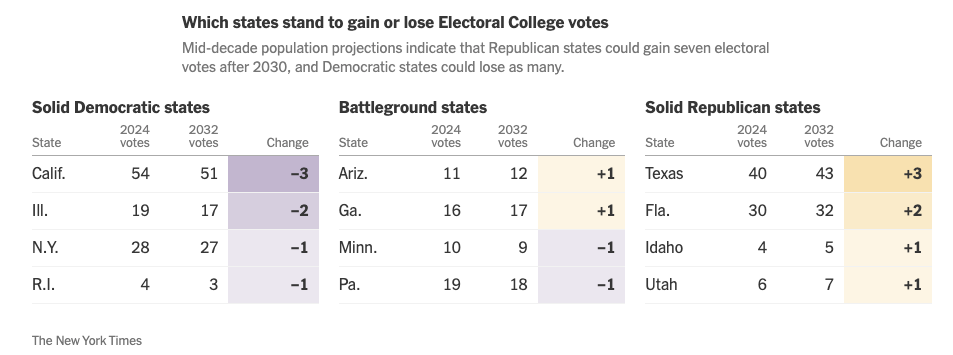
NYT (“How the Electoral College Could Tilt Further From Democrats“) paints a depressing future for Democrats.
AI Summary:
The Electoral College is on track to tilt even further against Democrats by 2032, thanks to population shifts that will follow the 2030 Census. States like Texas and Florida are projected to gain millions of new residents, while blue strongholds such as New York and Illinois are expected to shrink. If reapportionment happened today, red states would pick up five congressional seats—and therefore five electoral votes—while blue states would lose the same.
That shift could have devastating consequences for Democratic presidential hopes. In 2024, Democrats had 25 plausible paths to an Electoral College majority. By 2032, under current projections, only five would remain. Even the once-reliable “blue wall” of Michigan, Pennsylvania, and Wisconsin, along with swing states like Nevada or New Hampshire, might not be enough to secure the White House. A separate projection from the Brennan Center suggests the picture could be even bleaker, with Republicans gaining still more safe seats.
These structural disadvantages come on top of Democrats’ political woes. The party is still reeling from the 2024 defeat: fundraising has dried up, voter registration is down, and leadership is adrift. Meanwhile, Republicans—under Trump’s direction—are pressing ahead with mid-decade redistricting in red states to lock in congressional dominance. That fight doesn’t directly affect the Electoral College, but it underscores the broader imbalance Democrats face.
Democrats’ only path forward, the article argues, may be to do something that has seemed unimaginable in recent decades: invest seriously in the South. Demographic shifts in places like Texas and Georgia offer glimmers of opportunity, as population growth in major metro areas is being driven by communities of color. Mississippi has the highest share of Black voting-age adults in the country, Alabama and Louisiana have recently added majority-Black congressional districts, and even Arkansas saw small Democratic gains in its legislature. But turning any of these states into true battlegrounds will require massive, long-term commitments of money and organizing muscle.
The party has so far struggled to provide either. Southern Democratic organizations are skeletal, with little donor infrastructure and minimal staff. The Mississippi governor’s race in 2023 provided a telling example: Brandon Presley, a popular Democrat and cousin of Elvis Presley, came within three points of ousting an unpopular Republican incumbent. Yet national Democrats gave him little help, leaving him to build his own operation from scratch.
Ken Martin, the new DNC chair, has pledged to change that. His strategy includes shifting resources toward red states, giving them more monthly support than their blue-state counterparts. He argues that Democrats proved in 2024 they can raise extraordinary sums—nearly $3 billion—and must adopt a long-term, 50-state mindset. Still, even optimists acknowledge that turning the tide in the South would take years of sustained investment. Georgia, they note, only became competitive after a decade of concentrated work.
The bottom line is stark: unless Democrats expand their map and pour resources into states long written off as unwinnable, they face an Electoral College system that is rapidly moving out of reach. Population growth is reinforcing Republican strongholds, while Democratic bastions are losing ground. Without bold action, the party’s road to the White House may soon shrink to a narrow and perilous path.
Key Graphic:
A December report from the left-leaning Brennan Center shows how the shifts have played out regionally, using House seats as the baseline:
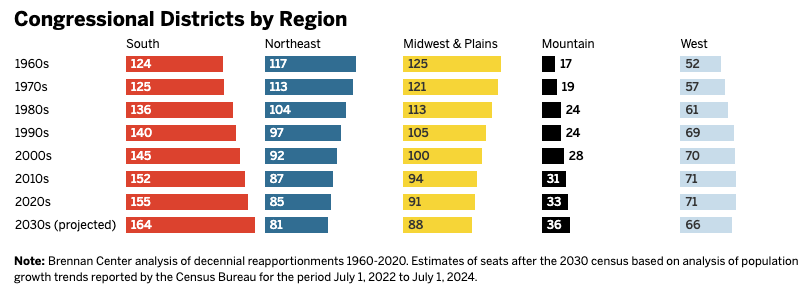
The share of the population has been shifting gradually toward the South and slightly away from the Northeast and Midwest every decennial cycle during my lifetime. Given party realignment, that has redounded to the benefit of Republicans.
The NYT piece presents this scenario:
In 2024, Democratic presidential nominee Kamala Harris could have won the Electoral College by winning the states she carried, Nebraska’s 2nd Congressional District (Nebraska allocates some electoral votes by district), plus the so-called Blue Wall battleground states of Michigan, Pennsylvania, and Wisconsin.
By 2032, that strategy would no longer work. Given the shift of electoral votes to the South, even if a Democrat in 2032 were to carry the Blue Wall states and both Arizona and Nevada, the result would be only a narrow 276–262 win.
Looking at the current Electoral College distribution, adding Michigan, Pennsylvania, and Wisconsin to Harris’ column would have turned the election from a 312-226 loss to a 270-268 win. That the projected reapportionment would have her still losing even if she added Arizona’s Electors (now 11, then 12), is just wild.
Of course, the fact that we have to think about the race in terms of states rather than people is increasingly nuts.

Back after a long trip.
If there’s a silver lining here, it’s that the competitiveness of states could change (and some probably will). Much of this analysis assumes that partisan alignment is fixed, which we know from history it isn’t. And so much depends on the dynamics of any race. Trump will be gone, he’s sui generis, and no one really knows what will happen to the current GOP coalition once he exits. Trump could be like Tito, the only thing holding it together. We shouldn’t forget that there’s been a non-trivial realignment over the last decade plus with the basket of high-propensity voters becoming much more aligned with Democrats and low-propensity voters much more aligned with the GoP, among other changes. Are the recent GoP gains with Hispanics enduring? Who knows!
In 2032, it could very well be a Democratic incumbent running for reelection after winning in 2028. Thermostatic public opinion and recent trends suggest the Democrats should have an advantage in 2028, especially considering all the unpopular stuff Trump is doing and assuming they nominate a decent candidate who doesn’t commit any own goals (admittedly, that’s a high bar).
Not to mention the electorate will change. In 2023 the youngest Boomers will be pushing 70, my Gen-Z kids will be in their late 20’s, and millennials will be ruling the roost.
So I think it’s way too early to draw such dire political conclusions. But I think Democrats do need to refocus on candidates and messages that can win across a broad slice of the public. Yes, I know it’s the case that many voters are partisan regardless, but our elections are close enough that the mushy mass of swing voters, marginal voters, and infrequent voters tend to be decisive in determining outcomes, and demographic groups do and have changed their general party alignment.
It also matters who is moving to the red states. If it is right-wingers fed up with the socialist utopia of Washington, that’s very different than the politically moderate family that was priced out of California and are moving to the exurbs of Austin.
ETA: Do we have updated date since Roe v Wade was overturned? I think a lot of people would be hesitant to move to a state with abortion bans, which will not only affect the type of people who move in (more right-wing), but how many (fewer).
@Andy:
Exactly this. Blue voters do not magically turn red because they crossed a line on a map. Such shifts could put states in play for Democrats. Virginia was reliable D, then reliably R, now reliably D again.