Empirical Evidence of our Presidentialized Politics
A significant slice of the electorate focuses only on the president.

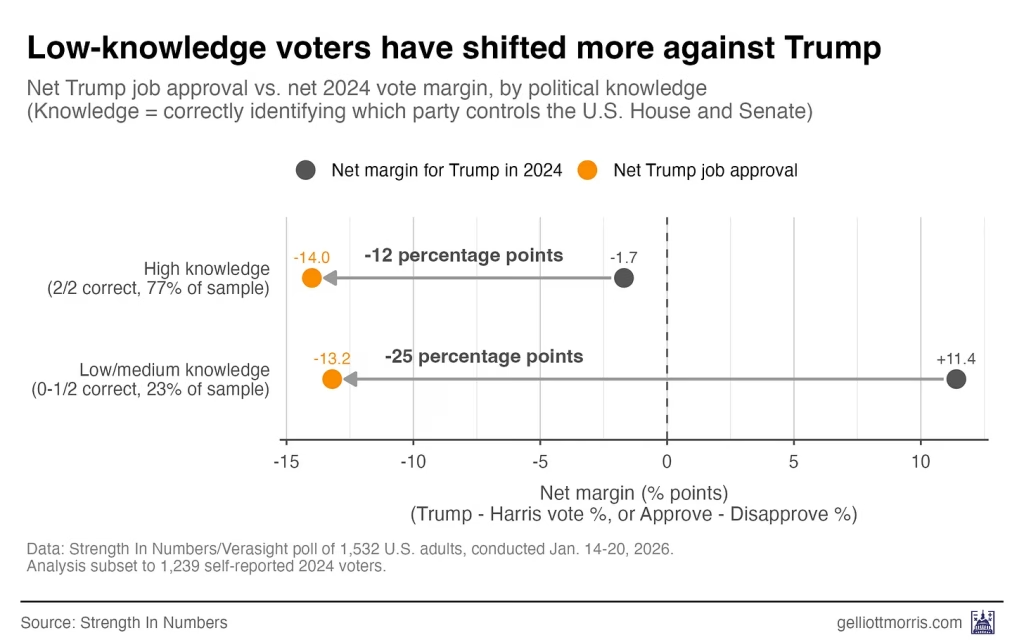
To add to an ongoing theme in my writings (most recently here), G. Elliot Morris provides an empirical example of what it means for our politics to be presidentialized: The less voters knew, the more they liked Trump in 2024. Not Anymore. Specifically, he notes how “low-knowledge voters” have shifted their views on Trump. His definition of “low-knowledge voter” is not being able to correctly identify which party controls the House and Senate.
What such a data point tells us is that a lot of voters don’t pay much attention to the news or to very basic issues of governance. They don’t really have a strong understanding of partisan politics, and they are not making voting decisions based on messaging in congressional campaigns, i.e., what “The Democrats” or “The Republicans” are saying. What they do know is who the president is and what their general feelings are about politics, society, and the economy.
Such voters are basically reacting to how they feel about the incumbent president and vote accordingly. So, for example, if they are unhappy with inflation and have lingering frustrations over COVID, and Biden is the incumbent president, they are likely to vote for the challenger.
A lot of those voters who were unhappy with Biden in 2024 are now unhappy with Trump.
Our politics are hyper-focused on the presidency, and it stands to reason that many voters would simply know who the president is and how they feel about life in general before they vote.
Hence, if we take into account the fact that most voters are largely dedicated to their preexisting partisan identities and whatever swing we are likely to see is going to be mostly in these types of voters,* then 2024 is not a surprising outcome.
A reminder: Trump’s margin of victory, 1.47%, is the smallest margin between the winner and loser of the popular vote since 2000 (where Gore won the popular vote by 0.51%). It is worth noting that Hillary Clinton won the popular vote by 2.09%.
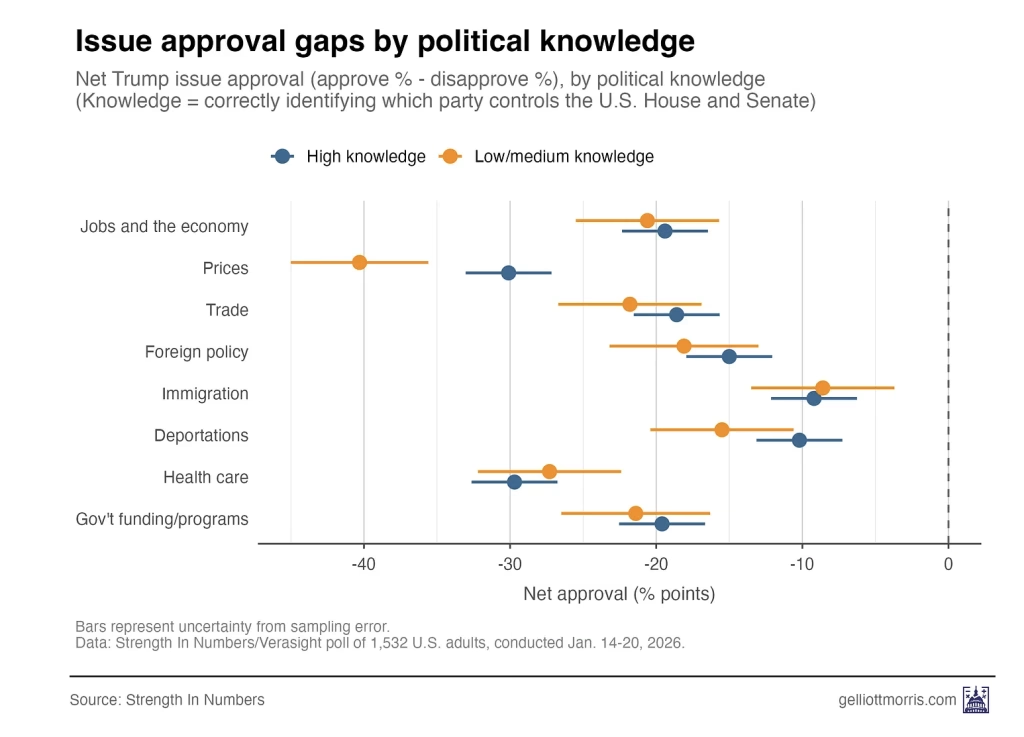
By the way, Morris’ poll adds more empirical data to the notion that the economy is a key variable, as it is the area of significant difference between the two groups of respondents. This adds additional evidence to the best likely explanation of the 2024 outcome was inflation, not messaging fails by Harris and other Democrats on trans rights or other issues.
So, what do I think all this helps us understand?
- It provides further evidence to the basic theory that 2024 was an anti-incumbent outcome, driven heavily by feelings over inflation.
- It is a mistake to view 2024 as a massive turn of the country towards Trumpism.
- It shows how heavily presidents shape our politics, in terms of voting and, therefore, policy.
- Messaging arguments are not as key as many argue they are (note, again, the second chart above).
Moreover, it shows how various features of our constitutional order, not the least of which being various minoritarian features of the system (e.g., the Electoral College, the Senate, and how those factors influence who sits on SCOTUS) can allow a handful of voters who don’t even know who runs Congress to unlock the doors of power to a White nationalist, authoritarian segment of our politics.
None of this is to state that GOP party leaders and GOP voters don’t have agency or moral culpability for their choices and behaviors, but all of this shows the problems with a national politics focused solely on one person can go horribly wrong.
All of this furthers the argument that while structure isn’t everything, it is massively important.
Let me conclude by noting that all of this is just one piece of a broader puzzle (or, maybe multiple pieces as the role of the president affects voters, co-partisans in office/in campaigns, and the policy-making process). Other key puzzle pieces that directly interconnect include rigid bipartism, a highly polarized electorate, minoritarian features of our system, and numerous institutional features of our constitutional order that I regularly write about.
Appendix: A Trip Down Memory Lane
I started down this rabbit hole and decided to be a bit more focused above, but found the following worth keeping.
Let’s not forget that a crowded primary field and the inability of the Republican Party to coordinate around an alternative led to Donald J. Trump becoming the party’s nominee in 2016 after receiving only a plurality of the primary vote (55.1% of GOP primary voters wanted someone else).
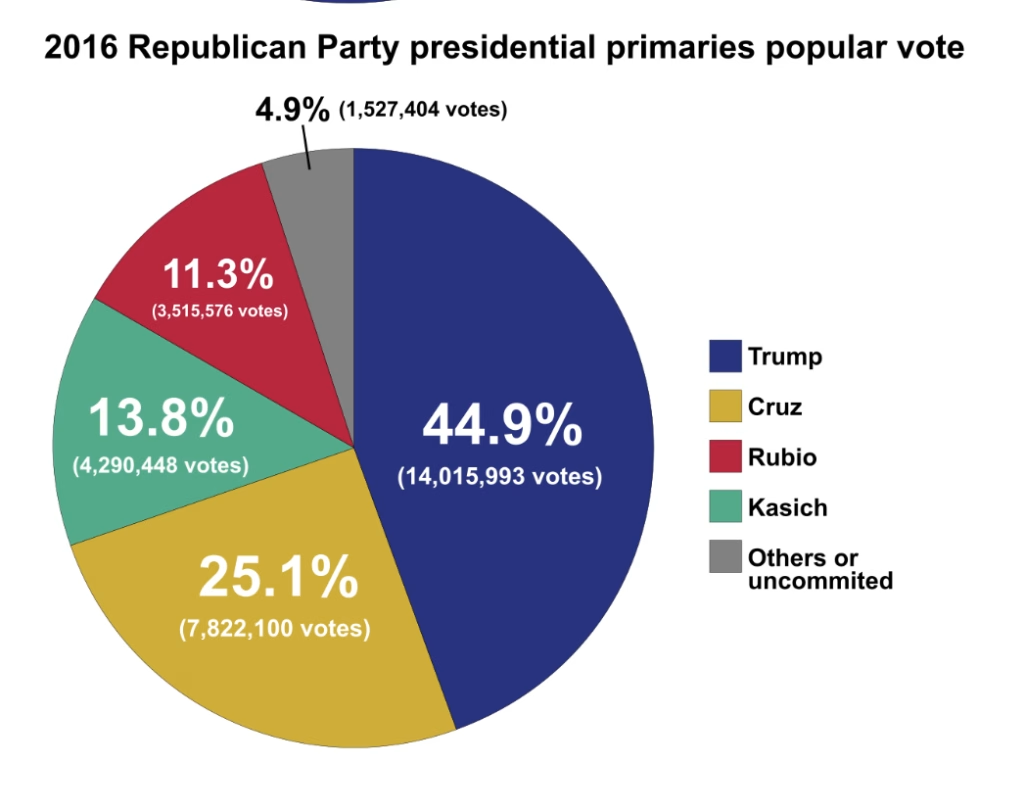
So, a guy who did not get an absolute majority of primary votes, and went on to win the Electoral College but lose the popular vote by almost three million, was placed in the office that shapes American politics more than any other. We have all watched the ways in which co-partisans have fallen into line (just go back and look at people like Lindsey Graham, Ted Cruz, and Marco Rubio, just to name three), have changed their tune once they understood how the person who occupies the presidency can influence their career goals. We have seen how voters have shifted their views (e.g., on tariffs, on Russia, on J6, and on and on) to conform to the view of their party’s leader.
*Some other posts of relevance to swing voters/undecideds that are possibly worth revisiting, some of which directly reinforce the basic thesis of this post:

I find it amazing we’re seeing the world fall apart, because some people don’t understand inflation.
So swing voters are pretty much unreachable by campaigns. Thus, the smart way to campaign is to prioritize energizing your own partisan voters and, if you can find a way, deenergizing the opposition partisans.
I find myself wondering if we aren’t living in a time where people are less informed than they have been for a long, long time.
It seems like that, but it could also be my old man reflex. Get off of my lawn, you whippersnappers! Read a newspaper, I mean a news website, I mean a video news feed. Dammit! Inform yourself somehow youngun!
LGM refers to the kind of voters spoken of here as Ariana Grande voters. Not a slur on AG, but to refer to their own lack of depth of knowledge about AG. “I think she’s a singer, right?”
In engineering speak, these constitute a low-pass filter. Not a lot of noise gets through to them, just some very low-frequency trends. Like, “wow, prices keep going up”. And also after a year of Trumpism, they are kind of thinking, “Hey, this kind of sucks, and also prices are still up”.
I think the takeaway for people who want to have impact in this space is that you have to be very persistent. Hammer the same thing for a long, long time. This runs counter to my nature. I get bored with the same thing month after month. But I think it works in the space of this kind of voter (or consumer).
I’m going to assume that they do not understand the filibuster, or how the Supreme Court is appointed. I know that a lot of people were mad with Biden for taking away the right to abortion.
If we had a parliament, would that mean fewer low-knowledge voters? And would that even help?
England doesn’t look great these days, so I don’t think it would necessarily stop the slide towards fascism, but it does have fewer moving parts.
Perhaps these are just unhappy people.
@Gustopher:
Yup. Voter remorse has become endemic across democracies, particularly those that are “developed nations.” Though, it has always been part of the US political system. An electorate elects a president and two years later an somewhat different electorate punishes him by voting against his party.
Not sure what to do about the low-knowledge voter, but the structural issues with US governance are impossible to fix. Every now and then, a conservative sallies forth and declares that to vote, a citizen should be required to pass a citizenship test, perhaps we should take them up on that.
I don’t know if he still uses it, but Political Scientist Larry Bartels used to like a very simple model that pretty well captured the popular vote for prez. It had only two variables: change in real per capita income in the two quarters before the election, and years of incumbency of the current party in the White House. An explanatory, not predictive model, as the Q3 econ data wasn’t available before the election. But that seems to be it: did voters feel like they lately had more money, and how long had the current prez been in office. (I haven’t checked how Bartels’ model worked in 2020. But people didn’t feel good about $ and they sure blamed Biden.)
@Gustopher:
My guess is that more voters in the UK know who control the House of Commons given that that fact is central to who the PM is.
I get it, things suck in various ways in various places. I am simply trying to explain some of the US-specific reasons things suck here and to try and to explain why they would suck a little less under different parameters.
@Jay L. Gischer: I suspect people are consuming more information than ever before. We’re drowning in it. It’s just that it’s now personalized by algorithms to maximize attention capture and reinforce existing biases.
@James/@Jay: I was going to note the same thing. The problem is not. lack of news/information; the problem is that we can create our own news bubble and lack any meaningful mass-level shared news experience.
One more very basic comment on parl v. pres: the problem with presidentialized politics is that it makes it easier for the public to reduce politics down to one person. Parliamentary politics makes it more likely that parties are the focus. Moreover, presidential politics makes citizens focus on the executive as the source of governance and politics in general, while parliamentary politics emphasizes the legislature.
And I would add that what we are seeing out of the Trump admin not only helps illustrate this fact, but the Trump administration is demonstrating long-term concerns over presidentialism that were thought not to apply to the US.