Former South Korean President Sentenced to Life in Prison
Apparently, masterminding an insurrection is a crime in some countries.
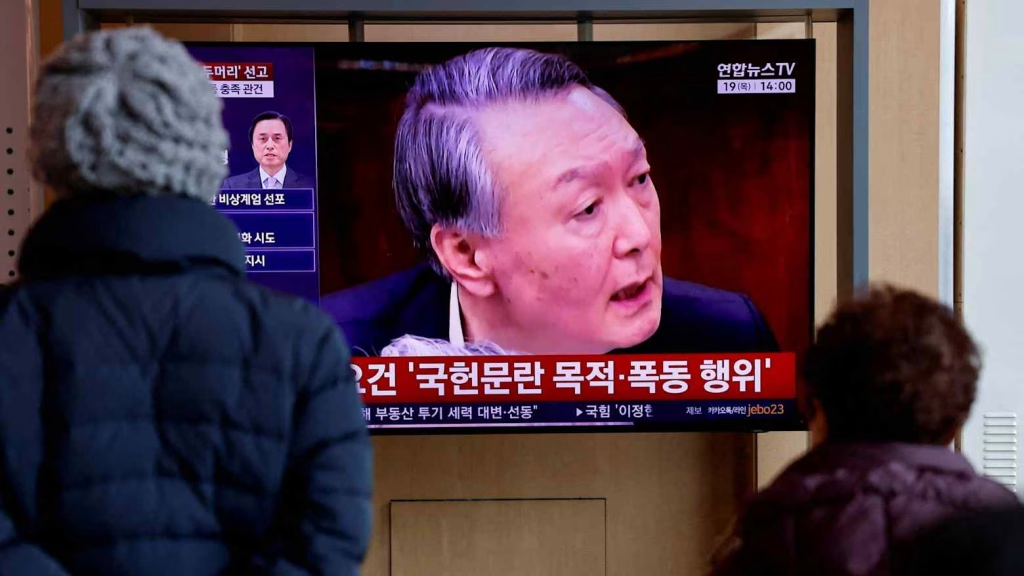
Nikkei Asia (“South Korean ex-President Yoon receives life sentence for insurrection“):
South Korean court sentenced former President Yoon Suk Yeol to life in prison on Thursday for leading an insurrection in the most significant legal ruling connected with the protracted political crisis that started in late 2024.
The Seoul Central District Court announced its decision that Yoon’s attempt to impose martial law and deploy soldiers to the National Assembly constituted the crime of insurrection, which carries a possible death sentence. South Korea’s Criminal Act defines insurrection as the creation of “violence for the purpose of usurping the national territory or subverting the Constitution.”
Ji Gwi-yeon, the judge who read out the verdict, said that the core fact of the case was Yoon having sent soldiers to the legislature, which Ji said amounted to an attempt to violate the constitutional order. The judge said Yoon had planned to arrest high-ranking politicians and the speaker of the National Assembly.
“There is enough reason to say that the objective was to paralyze the National Assembly’s activities or to prevent it from functioning,” Ji said.
Prosecutors sought the death penalty, although South Korea has not carried out an execution since the late 1990s.
Explaining the sentence, Ji said Yoon “directly and proactively planned this crime, involving numerous individuals in the act” and did not apologize for the enormous societal costs incurred due to his imposition of martial law.
But the judge added, the plan “does not appear to have been meticulously devised” and “it seems intended to minimize the use of physical force … and most of the plan failed.”
I’m vaguely reminded of another incident, but can’t quite put my finger on it.
This is a breaking story, so NYT is running a live blog (“South Korean Ex-Leader Is Sentenced to Life in Prison“). Among the noteworthy points they add:
The Seoul court that sentenced former President Yoon Suk Yeol to life in prison on Thursday also delivered verdicts on seven officials who had been indicted on charges of playing a role in his martial law decree.
Five were convicted, and they received prison sentences ranging from three to 30 years. Two were acquitted.
and
A notable voice missing from the chorus of reactions to the Yoon ruling is that of his longtime political rival: President Lee Jae Myung. Lee’s spokesman said his office had no comment to offer on the ruling. Earlier in the day, Lee praised South Koreans for peacefully defeating Yoon’s attempt to impose martial law.
Imagine refraining from politicizing the proceedings of the justice system. It may catch on elsewhere.
And, yes, there is politics to be played here:
The dueling protests outside the Seoul courthouse where former President Yoon Suk Yeol of South Korea was sentenced to life imprisonment on Thursday were heavy on bitterness and retributive fervor — familiar sentiments in a country with deep political polarization.
The court found Mr. Yoon guilty of leading an insurrection in 2024, when he declared martial law and sent special forces into the National Assembly to arrest his political opponents. The presiding judge said he had pushed South Korean society into an “extreme state of conflict” between warring political camps.
On Thursday, those tensions were on display outside the courthouse, where pro- and anti-Yoon groups blared their respective slogans — and calls for Mr. Yoon and his political nemesis, President Lee Jae Myung, to receive the death penalty — through loudspeakers.
In one camp, hundreds of Yoon supporters gathered in front of a makeshift stage with a screen playing a live broadcast of the trial. Some waved American flags, a symbol commonly used by South Korea’s far-right movement. One man stood atop a van wearing a jacket that said “MKGA,” short for Make Korea Great Again. Mr. Yoon has enthusiastically courted such crowds ever since his impeachment.
It’s hard to imagine the justice system functioning this smoothly amid extreme political polarization and a cult of personality around a disgraced leader.

It seems more like other countries have justice systems, America has a system of courtroom drama.
So, both Brazil and Korea have shown that executives can be held to account.
A shocking development!
Ji Gwi-yeon is what anti-American fraud John Roberts pretends to be.
The American justice system can’t run smoothly with its Supreme Court controlled by intellectually dishonest rightwing hacks.
@Steven L. Taylor:
Peru and France as well.
I suppose the only responsible thing to do is to tariff South Korea.
@Gustopher:
Okay, you made me laugh out loud.
@Kathy: Indeed. There is a list.
@Steven L. Taylor:
Come to think of it, Peru has so many former presidents in prison, they built them their own jail.
So, it’s a bit questionable how much of a deterrent this is, at least for Peru.