Genocide, War Crimes, and Gaza
There are no satisfying answers.
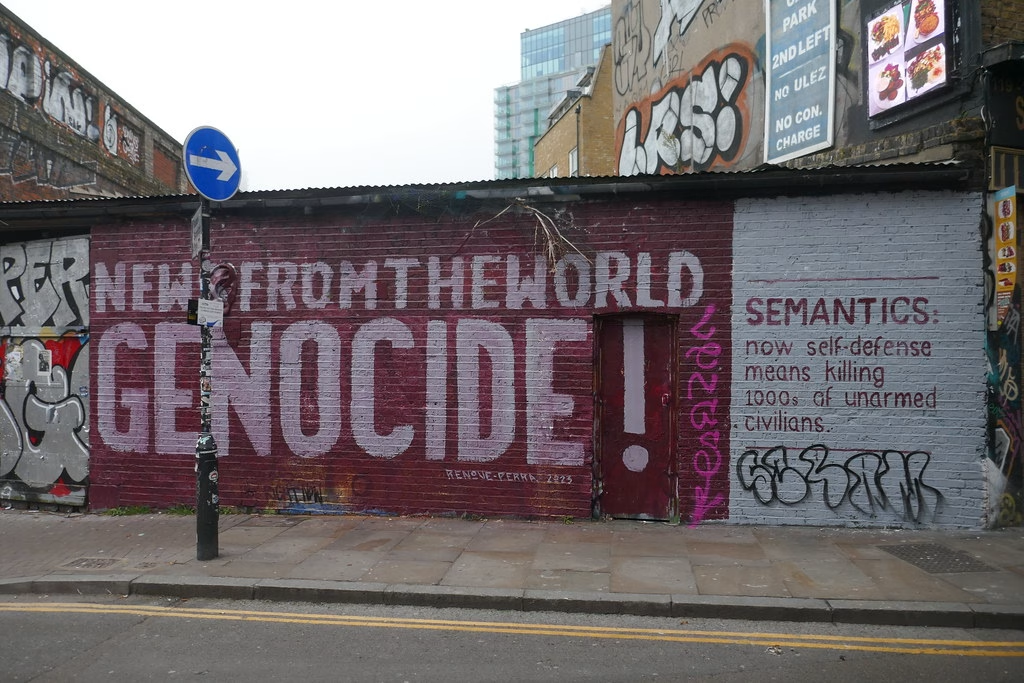
The latest episode The Ezra Klein Show, “When Is It Genocide?” is characteristically insightful, if ultimately unsatisfying. The conversation is 1 hour, 42 minutes in length and and the transcript is sufficiently long to make excerpting and discussion of even the major points prohibitively time-consuming.
Here’s an AI-generated summary, which I’ve verified for accuracy:
Opening framing: U.S. empathy gap
- Ezra Klein recalls how, after Oct. 7, 2023, President Biden tried to convey Israel’s trauma by comparing it to “fifteen 9/11s” for a country the size of Israel.
- Nearly two years later, Klein says, Gaza’s death toll is estimated at over 61,000 people, in a population just over 2 million. For the U.S., “that would be… like 2,500 Sept. 11s.”
- He notes skepticism about casualty numbers from the Hamas-run health ministry, but cites The Lancet’s analysis finding “the true number… was far higher.”
Scale of destruction and famine
- Gaza, “about the size of Detroit,” has had over 100,000 tons of explosives dropped on it since Oct. 7 — “more tonnage than was dropped on Dresden and Hamburg… and London combined during World War II.”
- 70 % of all structures — “homes, hospitals, schools” — are “severely damaged or destroyed.”
- Israel has restricted food flows; in March 2024, it blockaded aid for 11 weeks, dismantled the UN’s distribution network, and replaced it with “four sites run by inexperienced American contractors.”
- “Famine is spreading across Gaza. People are dying of hunger… This is hunger as policy. Hunger as a weapon of war. This is a siege.”
Questioning the siege’s purpose
- Is it to destroy Hamas? A group of ex-Israeli security chiefs says Hamas “no longer poses a strategic threat to Israel.”
- Is it to free hostages? Klein cites the main hostage families’ group: “Netanyahu is leading Israel and the hostages to doom.”
- “What is this? This is a war crime… But more and more people are using another word… ‘genocide.’”
Klein’s shift on the term “genocide”
- In December 2023, when South Africa accused Israel at the ICJ, Klein “thought they were wrong… Israel had been attacked. Its defense was legitimate.”
- Over the next year, “a slew of organizations and scholars” — Amnesty, B’Tselem, HRW, Holocaust scholars — came to believe it had “become genocidal.”
- His hesitancy: public imagination ties “genocide” to “the Holocaust,” but “the legal definition… encompasses much more than that.”
Introducing Philippe Sands
- Sands is a lawyer who has tried genocide cases, teaches at Harvard Law and UCL, and wrote East West Street about the concept’s creation.
Raphael Lemkin’s path to “genocide”
- Born in what is now Belarus; influenced by pogrom accounts and mass-killing stories from his mother.
- Shocked by a 1921 case in Berlin: Armenian survivor Soghomon Tehlirian kills a Turkish official linked to the Armenian massacres. A professor tells Lemkin that “under international law… you are the property of your ruler… If they want to kill you, they’re perfectly free to do it.”
- Lemkin began seeking an international legal concept to protect groups from their own governments.
Lemkin’s broad conception
- Identified patterns before mass killing: restrictions on jobs, education, housing, language; forced relocation; ghettoization; eventual extermination.
- For Lemkin, “the entire process is a genocidal process… you don’t wait until… killing.”
Tension with Hersch Lauterpacht
- Lauterpacht focused on protecting individuals (“crimes against humanity”); feared protecting “groups” could replace “tyranny of the state… with the tyranny of the groups.”
- Lemkin countered: people are attacked “because they’re a member of a group that is hated” — so the law must protect groups.
From Nuremberg to the Genocide Convention
- Nuremberg in 1945 invented new crimes: war crimes, crimes against humanity, crime of aggression.
- “Genocide” appeared in indictments but not the statute; was omitted from the final judgment — Lemkin called this “the blackest day of his life.”
- Lemkin’s lobbying led to the 1948 Genocide Convention, defining genocide as acts “committed with intent to destroy, in whole or in part, a national, ethnical, racial or religious group” through killing, serious harm, inflicting destructive conditions, preventing births, or transferring children.
Narrowing of the legal standard
- Sands: Lemkin’s original bar was “much lower” — no requirement of special intent, broader group coverage.
- Courts in the 1990s–2000s pushed the bar “even higher,” requiring that genocidal intent be the only reasonable inference from conduct.
- This creates a “gap” between public and legal understandings, fueling political disappointment when atrocities aren’t legally genocide.
Why proving genocide is hard
- Leaders don’t write down extermination plans; intent must be inferred from patterns.
- The ICJ’s standard means that if there’s any plausible non-genocidal intent (e.g., self-defense), proving genocide is “very difficult.” Sands calls this too strict, noting humans often act from “multiple different intents.”
Applying to Gaza: South Africa’s case
- Argument: genocidal rhetoric + famine as a weapon leave “no military justification” — “the only reasonable inference… is an intention to destroy a group.”
- Klein notes that Hamas “has been completely degraded… And yet they’re starving the people of Gaza” — shifting even skeptics toward the genocide label.
- Sands: “Lemkin… would certainly characterize what is happening now in Gaza as genocidal.”
Destruction of Gaza’s viability
- Blatman & Goldberg (Haaretz): “Gaza, as a human, national-collective entity, no longer exists. This is precisely what genocide looks like.”
- Only 1.5 % of arable land remains; famine risk is immense.
- Sands: such factors match Lemkin’s 1944 conception, though “ethnic cleansing… has been ruled not to be genocidal” under current law.
Genocidal rhetoric
- Netanyahu has invoked biblical commands to annihilate Amalek; Herzog has said “it is an entire nation… responsible” and dismissed civilian/non-combatant distinctions.
- Many leaders equate Hamas with all Gazans.
- Sands: distinguish between “genocidal rhetoric” and legally provable “genocidal intent” — courts need to link statements to concrete acts.
Cultural stakes
- Klein: the goal for some is “to attach to Israel… the charge of genocide, and make it stick in cultural memory… to change the meaning of the Jewish state.”
The danger of indifference
- Klein cites polls showing 79 % of Israeli Jews “not troubled at all” by Gaza’s famine — likening this to Hannah Arendt’s “indifference… as the soil… for genocide.”
- Sands: “It is literally beyond my comprehension… it’s always about dehumanization… Therefore, we are free to treat them in this way.”
Longer historical arc
- Palestinians see Oct. 7 not as a starting point but an “eruption… inside a long process of their erasure,” including blockade and West Bank settlement expansion.
- Sands: recent recognition of Palestinian statehood by Spain, Ireland, France, and soon the UK could become a “game changer” in international law and politics, isolating Israel if policies persist.
Israel’s possible legal defense
- Primary claim: actions are self-defense, not extermination; war would end if Hamas surrendered and released hostages.
- Sands: “Under international law, this kind of treatment is not justifiable… whether you call it war crimes… or genocide.”
- He co-authored an Oct. 2023 statement affirming Israel’s right to self-defense but warning that it “is not unlimited” and must comply with international law.
Closing cautions
- Sands: “The longer this goes on, the more difficult it is… to resist the argument that this meets the definition of genocide under international law.”
- Klein: beyond labels, “it is utterly appalling and unjustifiable, and it should not be happening.
Ultimately, it seems highly doubtful to me that Israel or the Netanyahu government will be found to have committed genocide here. While I agree with Klein and Sands that several high Israeli officials, including President Herzog, have used “genocidal rhetoric,” there are clearly explanations other than genocidal intent. Indeed, since humans rarely do anything without mixed motivation, that’s a near-impossible bar to clear.
It’s far more likely that courts will find the government guilty of crimes against humanity, violations of the laws of armed conflict, or even ethnic cleansing. While those all potentially add up to “genocide” in the philosophical literature, they don’t clear the high legal bar enacted in 1948 and litigated in many cases in the decades since.
That no government has ever been found guilty of genocide is an indicator, perhaps, that there is little utility in the question itself. It’s hard enough to hold them accountable for lesser crimes without trying to clear a near-insurmountable bar. It may be that, as Klein suggests, the only real utility is in how it sits in the public and historical consciousness.
It also seems clear to me that, for not only hard-right Israeli politicians but the vast majority of Israeli Jews, the distinction between the Gazans, or even the Palestinian writ large, and Hamas is largely non-existent. A recent episode of The Daily, “What Many Israelis Don’t Want to See,” provides a human dimension to the polling data. In the minds of many, the children who are being killed or starved today are tomorrow’s terrorists, who will perpetrate the next October 7 attack.
And, of course, all of the laws in question were made in the aftermath of the Second World War in the context of wars between state actors. International law is really not designed to deal with terrorist groups like Hamas that completely disregard the laws of armed conflict and hide among the civilian population. Mass killing is almost inevitable when fighting such a foe. The use of seige warfare and mass starvation, however, is much harder to justify.

Netanyahu wrote off the hostages on Oct. 8.
Never again – to us.
I need to listen to the podcast, but I get the issue with the legal argument–it is likely a bar that is almost impossible to surmount, to be honest. It almost requires a leader to write down, “I plan to do a genocide.”
Regardless, while I get the issue, as I think I said before: if we are having to have a serious argument about whether something is a genocide or not, it must be pretty damn bad and ought to be stopped.
What I think I find the most frustrating about this conversation (and this is not directed at the OP, but to the broader discourse), is that it seems like some people are willing to let this continue as long as it isn’t “genocide.”
It’s only attempted genocide.
Plenty of (or a few) commenters here (and in other places) will come back with the ‘Well, if the Israelis wanted to commit genocide they’re doing a poor job of it since there are still millions of Gazans alive!’ and sit back in satisfaction.
@Steven L. Taylor: Ultimately, I think that’s right: the real question is whether this is an acceptable way for a state to pursue its policy interests. Klein believed that, in the wake of October 7, it was perfectly reasonable to respond with a massive show of force. He’s long stopped thinking that the continuation is reasonable.
Clearly, intentionally starving kids is of a different nature than bombing Hamas strongholds with known high collateral damage. But I continue to have no answer for how Israel can achieve its war aims given the nature of the adversary.
I’ve been pretty much alone here in arguing that this is not genocide. One does not pause genocide to give out polio shots. Nor does one take two years to kill ~3% of the population, not when the accused side could be killing off multiples of that daily.
The word has been defined down to the point where the US war against Japan would be a much clearer genocide. The Israelis have not yet firebombed Gaza City as we did numerous Japanese cities. And BTW, yes, Japanese people were starving, even as we burned their cities.
Insisting on genocide is entirely unnecessary as the unadorned, un-hyped reality in Gaza is fucking awful, and it already has a name: war.
This addiction to turning rhetoric up to 11 lands us right here, wasting time and energy debating semantics, while the situation is not in any way improved. And the insistence on the ‘g’ word just convinces Israelis that the people using it are anti-semites. Not anti-Israel, not anti-Netanyahu, but Jew-haters. And with good reason since Jew haters have been desperate since 1945 to attach genocide to Jews so they can trivialize the Holocaust.
I do not mean to say that critics of Israel’s brutality are anti-semites, but they have definitely played into the hands of the anti-semites. And why? To what end? To win the competition for most outraged?
@Kathy:
Attempted? Jesus Christ they have Gaza surrounded and cut off and could wipe the place from the face of the Earth within a week. No, it is not genocide and no it is not attempted genocide. It is war. This is what war is.
These lexical debates are not helpful in my view. The Oct 7 attacks were wrong, brutal, and criminal. Israel’s response has been more than disproportionate. The world’s sympathy has turned against Israel. In the US support for Israel has been pissed away. People are dying of being bombed and starved.
BTW, the US response to 9/11 was wrong.
@Michael Reynolds:
Perhaps, IF we grant that this is what war is WITHOUT the historically expected humanitarian “rules of war” which mandate some protection of civilians during armed conflict.
I mostly agree with Michael here. But here are some points, most of which I’ve made before.
It’s just inherently the case that war in urban areas with civilians results in a lot of civilian deaths. This isn’t something unique to Gaza, although there are some unique aspects to that conflict (more on that shortly.)
In Falluja in Iraq in 2004, there were ~1.5k insurgents killed, 106 US, and perhaps 1k civilians. The fighting there destroyed much of the city in over a month of fighting, but fewer civilians were killed than otherwise would have been because most had fled.
In Manila in WW2, MacArthur initially ordered that there were to be no airstrikes in the city for the campaign to take it back from the Japanese because he didn’t want to destroy the significant cultural and historical sites, and because he wanted to spare civilians. Unfortunately, the Japanese did not allow that. And the result was ~100k civilians, ~1k US and allied, and ~16k Japanese killed in a month of fighting, plus the almost complete destruction of the city. All because of the methods used by the Japanese, who deliberately used civilians and civilian areas. ~100k civilians were about 10% of Manila’s population at that time.
In Mosul Iraq, Iraqi and US forces retook the city from ISIS over 9 months. Half the city was destroyed, at least 11k civilians killed, ~9k-11k ISIS fighters killed, and several thousand coalition forces killed, mainly Iraqis. Here ISIS fought similarly to the Japanese and Hamas, deliberately using the civilian population.
Gaza isn’t an anomaly in terms of urban warfare occupied by civilians. And while I think what the Israelis are doing now is wrong in terms of what passes for the occupation of Gaza and the plans for war termination, they took more proactive steps at sparing civilians in Gaza than any of the historical examples cited.
What is different about Gaza is two things:
– The consensus among the international community that civilians should not have the right to flee or choose to flee the combat zone. In Manila and Mosul it was mostly the Japanese and ISIS that prevented civilians from fleeing – in Gaza it is mostly the international community and Egypt and Israel.
– Secondly, is the extent to which Hamas has made the generation of civilian deaths and hardship a core part of its strategy. I’m not aware of any place in history where a civilian urban areas have been militarized to the extent depth (literally) that Hamas has. ISIS was not dug-in in Mosul. The Japanese had some fortifications, but nothing like what Hamas built. The reality is that any fight against Hamas in Gaza would necessitate the destruction of much of the civilian infrastructure because Hamas intentionally designed its defenses that way.
Here in the comments and elsewhere, there have been many calls for Israel to “use special forces” or “be more careful” or not to do this or that, but most of those calls are ignorant of the reality of the war and the ways and means Hamas chose to fight.
As I’ve argued before, Hamas is not really or just a terrorist group. It won elections in 2006 and then did what many do who don’t want to share power – hunted and murdered all opposition. Hamas may not be recognized internationally, but that is not relevelant to reality – it is and remains the government of Gaza. When talking about Palestinian death statistics, we usually talk about the numbers from Gaza’s Health Ministry, which Hamas controls.
Hamas operates ministries similar to those in recognized governments. Already mentioned in the Ministry of health, but there are ministries of education, interior, public works, and finance. Hamas has/had a civil service-like payroll for tens of thousands of employees, including teachers, police officers, and municipal workers. It ran/runs a judicial system based partly on the pre-existing Palestinian Authority system, but also on its own Islamist legal interpretations. Until most of them were killed, Hamas had a distinct military force.
All these are things that mere terrorist groups do not or cannot do. That said, it is true that Hamas uses the tactics and strategy of terrorism, and it also has genocidal goals (irony alert).
I’ve already addressed the issue of “seige warfare.” I’ve yet to hear from anyone how it is actually possible to fight Hamas any other way, and I’ve given examples that show it isn’t possible. It’s why I’ve argued that the civilians in Gaza should be allowed to flee the conflict, but even westerners who claim to care about Palestianians would deny them this basic right – to say nothing of regional governments, especially Egypt, which has spent tremendous efforts over the last two years further militarizing the border in ways that only a guy like Trump can fully appreciate.
As far as mass starvation, lots of people have been claiming that for years now. Semafor’s description of how the NYT sought to find photographic evidence of it is just the latest in a long line of people making claims that aren’t backed by reality.
And that Gaza health ministry – its database of those killed in the current conflict states that a bit over 200 were from “malnutrition.” While 200+ dead from malnutrion is a terrible figure if true and accurate, it represents the tragedy of a war that has gone on for the better part of two years, not famine or mass starvation. It’s probably is low compared to most historical urban conflicts. It remains the case that Gaza receives more aid than any comparable population and that, despite whatever intentional or unintentional problems with distribution exist, that aid has prevented starvation and famine, unlike so many other places in the world that no one gives a crap about.
If I have time later, I will post another comment on where Israel has and is going wrong in its conduct and prosecution of this war, particularly in recent months.
Sparkling mass slaughter of civilian populations while openly stating that they are going to take their land, and killing more journalists than any conflict since WW2, all “by accident”.
Also, shooting people trying to get food from aid groups.
But not Genocide (TM).
@Michael Reynolds:
I think you would benefit from a listen to the interview. You may be correct that the legal definition of genocide has not been reached, but you are applying a maximalist one that is also incorrect.
And this is not simply war. War crimes are being committed if you don’t want to use the g-word.
@Andy: I take the general point about urban warfare in Mosul or Manila. But I would counter that Mosul is one city in a large country. Gaza is basically the size of Manhattan or Detroit, and it is all there is for these people. They are bound on one side by the sea, on one side by Israel, and via a small border with Egypt. There is nowhere to go. This changes the dynamics and consequences of Israeli actions and amplifies the significance of the destruction.
There is no countryside to flee to. There are no other cities to seek refuge in.
This has to come into the assessment of the situation.
@Steven L. Taylor:
The people in Manila and Mosul had nowhere to go either. You’re right about how Gaza is geographically small and “hemmed in.” But it’s simply not true that there are no places for people to go. The problem is not logistics or geography; the problem is political. Neither Egypt nor Israel will let them pass, and no country wants Palestinian refugees, even if they could pass. So the narrative becomes people claiming that Palestinians are being genocided in Gaza, while simultaneously insisting that they should not be allowed to have the choice to flee the genocide. Those facts also have to be considered in the assessment of the situation. It’s an unfortunate reality that I’ve been pointing out for a long time.
There are other things I mentioned that also change the dynamics and consequences that you didn’t address, namely, Hamas’ war strategy. It is that, more than anything else, that drives the destruction in this conflict. It’s what drove the destruction in Manila, in Mosul, and in Aleppo, Madaya, and Gouta, and elsewhere in Syria that killed about 300k civilians. McArthur didn’t want 100k dead civilians – it was the Japanese that made that inevitable.
The history on this is incontrovertible – when you have civilians trapped in an urban battlespace, a lot of them will die, especially compared to combatants. Gaza is not unique, and no one has yet found a way to conduct a war under those circumstances and avoid killing civilians, including the US military, which takes that more seriously than just about anyone in history.
The reality is what it is. So what should have been done instead?
Now some comments on Israel.
For most of the war, I think it did the best it could considering the circumstances described above and other factors mentioned in other threads. Especially near the beginning, Israel took extraordinary steps to avoid killing civilians, things that not even the US did or would do.
However, things changed with Israel tactically defeating Hamas and Hamas’s allies in Lebanon and Iran. Israel moved into more of an occupation role, attempting to decisively and strategically defeat what remained of Hamas and its control of Gaza. That effort failed, and continues to fail, but Israel continues to double down.
It’s been evident to me for a while now that Israel can’t strategically defeat Hamas, so the responsible play would be to set the conditions for a deal favorable to Israel and get the remaining hostages back. Both sides would make promises in a ceasefire they never intend to keep, and the stage would be reset with Hamas likely retaining control as the government of Gaza, with a conflict in the future likely. But in the meantime, Israel would have its hostages back and be in a position of real strength, having defeated all of its most serious enemies.
But Israel didn’t do that when conditions were ideal, and still isn’t trying to do that. And Hamas is happy to see the war continue in the present circumstances, so they have had a lot of incentive to increase demands and scuttle potential deals. Israel’s hand grows weaker in negotiation as both the legitimate and illegitimate complaints about Israel’s conduct buttress Hamas.
Then, after years of useful idiots in the West crying wolf and calling out non-existent famines in Gaza, Israel’s current course of attempting to wrest control of aid from Hamas risks an actual famine. There isn’t famine yet, but there is real danger on a level not seen before.
The IDF is also a tired and increasingly undisciplined force. This is an inevitability with a reserve-dominated army that is in the field for too long, fighting among a hostile population with an enemy who does little but commit war crimes. While not all or even most of the reports of supposed Israeli war crimes are accurate, enough of them seem legitimate enough to show that the IDF is breaking and can’t continue on the present course.
I don’t know how this ends.
If this were a more normal conflict (see the Balkans, Somalia, Sudan, and many, many other places), there would be proposals for a stabilization or peacekeeping force that would manage Gaza after an Israeli withdrawal as part of any deal. But for the same reasons that no one wants to accept Palestinian refugees, no country wants to commit to enabling a stable war termination effort, even as claims of genocide are being bandied about.
This is another uncomfortable fact for Western audiences who have a distant but keen interest in this conflict. Like the issue of the silence around the consensus of not allowing any Palestinians to flee a supposed genocide, there is also a silence around any kind of real international effort to actually enable a ceasefire.
@Andy:
Netanyahu defined victory in a way which cannot be achieved.
The Egyptians have been awfully quiet, haven’t they. There’s ‘genocide’ going on literally next door and they won’t open a gate? Who else doesn’t want them? Fatah. It’s a laugh so you don’t cry situation. How do you flee when you’re in a box?
Not heard much from Mr. Erdogan, either, and they’re the go-to’s for policing a post-truce Gaza.
This is sickening on so many levels. It’s one of those slow-motion train wrecks of history.
@Steven L. Taylor:
Genocide is a maximalist word. It deserves to mean something. I don’t know the word that is the superlative to genocide. Super genocide? Genocide Extra?
There are a whole lot of tribes and peoples who have disappeared from history, wiped out by Mongols or Huns or Muslims or Christians. Genocide. It’s just about the worst thing we can do as human beings. Gaza isn’t that. We can do so much worse.
Robotic dogs in war. Really. Some have guns.
@Andy:
I am not saying they had good places to go, but they could flee in ways that are simply impossible for Gazans.
@Michael Reynolds:
You are being obtuse.
@Andy:
Please cite an example of a metropolitan area under this level of bombardment where there is literally nowhere for the population to go.
@Michael Reynolds:
Yes, it has never happened before in all of human history for a state actor to ignore the plight of their neighbors. That means, by definition, that it’s not so bad!
For example, this proves that the Holocaust didn’t happen! QED!
@Steven L. Taylor:
and
Any number of cities in history that enemy armies have surrounded – several in Syria previously mentioned, Leningrad, Stalingrad, Sarajevo to name a few off the top of my head. Even Manila, which was surrounded by US forces on one side and the sea on the other. Yes, the civilians trapped in Manila did not have good places to go – to put it mildly – and as a result, a huge number of them were killed, as is the case in Gaza.
But I can give you an island example – Okinawa. It was not highly urbanized, but it is small, and the population there was literally trapped by geography, with literally nowhere to go. During the US invasion, at least 25% of civilians died. That’s 100k-150k out of a population of ~350k+ in less than three months. Granted, some number of them committed suicide or were forced to by the Japanese military.
All these examples reinforce the point that when civilians are trapped in a war zone, particularly an urban zone, for whatever reason (and those reasons can vary from a surrounding army, to geography, to unfriendly neighboring countries, to internal forces preventing it), they are going to suffer significant and disproportionate casualties.
You can’t dance Gaza on the head of a pin as some kind of special exception whose circumstances are so unique that this long historical record is irrelevant to the fundamental reality of the inherent danger civilians trapped in a war zone, particularly an urban one in which Hamas has spent well over a decade turning it into a series of fighting positions and specifically uses civilians in its tactics, and then uses their deaths in Hamas’ strategic IO campaign.
But Gaza is unusual in the sense that the civilians there are trapped not only by the warring parties, but also Egypt, regional governments, and the international community. Gaza is not an island. It’s outside actors who are specifically not allowing people in Gaza to go anywhere. My view is that they ought to have the right to leave if they want to, and they are being denied that right.
@Michael Reynolds:
Holocaust.
@Michael Reynolds: @Andy: One of the things that I sort of knew but that the interview crystalized for me is how new most of these concepts are. While there had been some minor attempts to regulate armed conflict previously, the very idea of crimes against humanity and genocide crystallized during WWII.
Americans, including Justice Jackson (who presided over the Nuremberg trials), were exceedingly skeptical of the latter, and the Nazi leaders were not charged with that crime. Partly, because we rightly saw this is an ex post facto law. The Holocaust wasn’t actually illegal until 1948. Partly, because we’d been guilty of genocide under Lemkin’s definition in our treatment of the American Indians and Blacks. (The ultimate legal definition was narrower than Lemkin’s.)
All of which is to say that examples from before the Genocide Convention and various other international agreements are useful in showing a break in norms, not hypocrisy in applying those norms to Israel.
While I’ve been queasy about the mass destruction and open-ended war aims of the Israeli effort, I’ve largely defended them. While arguably disproportionate even in the face of October 7, most of the calamity could be blamed on Hamas’ hiding among the civilian population and in sanctuary structures, itself a war crime. But it’s hard to defend intentionally starving the civilian population, targeting aid workers, and the like.
Interesting how people are pretty much openly advocating ethnic cleansing, since there’s close to zero likelihood that Gazans, once pushed into Egypt, would be able to return. I mean, since there’s obvs no justification for asking Israel to change its strategy.
Let’s also not ignore that peoples feelings about places like Mosul, and many other conflicts, might have been different had they seen as much of the devastation and impact on people’s lives as they see coming out of Gaza. How much did we see on TV of the impact of Iraq War 2, where we have no idea of how many Iraqi civilians died? The most images I saw (and I could be wrong) was tracer fire going into the air and explosions in the night.
@Andy: I can’t decide if the problem is, as usual, your inability to move off the point you want to make and therefore your standard unwillingness to give any ground or if I am being unclear.
I concede that there are real comparisons to other examples of urban warfare in this case.
And sure, a city can be surrounded by military forces, making escape very difficult.
While I still contend the ways in which Gazans are surrounded are still substantially different than, say, Manila, you are ignoring that not only is this an urban zone wherein civilians are trapped, but that the entirety of the population of the entity in question is in this space. While yes, there are other Palestinians elsewhere, Gaza is a self-contained entity.
As such, the way that the Israelis are conducting this war, including occupation and possible expulsion of the population kind, creates a different situation was true in Manila or Mosul, or Okinawa.
There was never any possibility that Mosul was going to be drained or Iraqis and replaced with Americans, ditto Manil and Okinawa.
And not all of the Philippines was in Manila, and so forth.
Urban warfare is hell. I agree.
Civilians suffer in war. I agree.
But the general situation in Gaza is not as directly comparable to those cases as you are making it out to be.
Also: how long was the assault on Mosul?. How long was the assault on Manila? I will admit that I do not know, but were either over a year? This one is approaching two.
@James Joyner:
This part really struck me. It is noteworthy that Americans wanted to avoid this conversation at the time, which illustrates that even ~80 years ago, we knew what we had done (and such ideas are not just a contemporary, “woke” interpretation of our past).
@Steven L. Taylor:
No, I am being accurate.
Here’s my question to you: given that Nazis and other anti-semites have for decades tried to attach the word ‘genocide’ to Israel, and given that the word’s use in this context is at least questionable, and given that there are other alternatives, why do you insist on it?
@Assad K: Indeed. While I understand the need and purpose of making historical comparisons, maybe the lesson from Mosul shouldn’t be, “Hey, that’s just what urban warfare is like,” and should instead be “The horrors of such warfare should be avoided.”
I understand why Israel responded as it did to 10/7. But that does not justify the ongoing assault.
And it is indeed gross and disheartening to have ethnic cleansing seemingly on the table and arguments over “genocide” because, you know, war is hell.
@Michael Reynolds: I actually haven’t insisted on it.
To quote me above:
Does that sound like insistence to you?
It was an offer to move off the semantics. You keep wanting to just pedantically point out “this is war.” And yet, war crimes are beyond “this is war.”
And trying to make this into some Nazi-adjacent issue/suggesting by inference that I am being antisemitic by arguing with you about this, is rather insulting.
You are also essentially what-abouting here. The issue is not what may have been said by bad people in the past; the question is what is going on now.
You have a tendency to infer people are Nazis (the whole “good German” bit you also slung at me once) is not cool, to put it mildly.
I deserve better than that.
@James Joyner:
‘most of the calamity could be blamed on Hamas’ hiding among the civilian population and in sanctuary structures, itself a war crime.’
I probably shouldn’t post this, but.. This remains to me, an interesting intellectual perspective. Defining this as a war crime makes it seems like a definition that plays totally into western military dominance.. or military dominance, anyway. Especially in terms of insurgencies. Let me start off by saying that I have zero love for Hamas, and Oct 7 was an atrocity (because if I don’t make that clear from the start.. well, you know).I’m sure I’m not going to phrase things properly, but when two sides have such asymmetry of resources and abilities, short of the inferior side deciding to just surrender, how do they work to overcome those deficiencies? Especially after so many decades. Looking at Gaza specifically… Where exactly would Hamas base itself? Even if they had leaders who decided to strictly follow the niceties of the laws of war.. Where is the literal physical space for them to have barracks, armouries, training facilities etc.. and not have them bombed easily whenever Israel decides to mow the lawn? It’s not like they have a robust air defence system, or strategic depth, or an ocean separating them from their enemies. If the US came under occupation by a force that outmatched it as much as Israel outmatches Hamas.. would fighters not also try to conceal themselves as much as possible, rather than put themselves in easily bombable places? It’s a terrible analogy, of course, since the US has such wide swathes of wilderness (though again, I’m talking about extreme technical superiority, so maybe better detection tech). But how about something smaller? Let’s say that somehow Trump gets the US Armed Forces to go along with, say, blockading off Chicago and occupying it. For decades. What would rebel forces do there? I know Andy has said that any American resistance would forever remain strictly following rules of war but I’m.. not so sure of that.
And again, I’m just talking about technical things, not the values and principles of Hamas. I don’t know how many people here would condemn Ukrainian fighters for hiding among the population etc against the Russians.
One more point from the Klein podcast linked in the OP as it pertains to whether past examples of urban warfare in terms of determing the degree to which this case may not be unique, per se, but has, shall we say, distinct qualities:
That’s a lot of ordinance on a small space wherein the entire population of the beligerent entity lives.
So, I couldn’t say what percentage of structures in Mosul were damaged or destroyed. I will, for the sake of fairness, note that “damaged” could be doing a lot of work here. But, again, in terms of how Gaza is different in terms of making a judgment about what this devastation means, for all practical purposes 70% of a country, not just a city in a country, has been destroyed or damaged.
I know that the Gaza Strip is not a sovereign state, and therefore is not a country/nation/state. But the factors of space, place, and population have to be taken into consideration as we assess the morality of Israel’s actions and what they should be called.
@Assad K:
What’s more–Israel is fighting an insurgent force not in battle but while it’s supposed operatives are at home, surrounded by civilians. Americans used to get angry at the idea of Vietnam vets being nothing more than assassins killing anything that moved and then the killing a battle and the dead the Viet Cong. Israel is barely trying to change the record. If the IDF kills a journalist and his family, and then says he’s in Hamas, what kind of idiot would take that as face value?
@Steven L. Taylor:
Yeah, but blah blah blah WW2 blah blah blah WW2. You know it’s the only war that’s ever happened? And it only happened on American television?
Just for the record:
WW2 has nothing to offer as guidelines for what’s appropriate in Gaza. As terrible as the damage inflicted on Germany and Japan, they did much worse wherever they went. Forget the Holocaust. Look up the number of civilian dead in the Soviet Union, in China, and so on. You can not say that about Hamas. On October 7th, Hamas killed 1,200 people. By WW2 math, the IDF gets to kill about 200 Palestinians. I don’t think the bloodlust of the WW2 buffoons is going to be assuaged by that.
@Steven L. Taylor:
I’ve typed out several post-length comments explaining my arguments, and your response was to simply insist that Gaza is different and demand that I provide historical examples, which I did, without addressing anything else I wrote. Not convinced by those examples, you dismiss them and reiterate your belief that Gaza is materially different from every other similar conflict in history. What am I supposed to give ground to? You haven’t addressed most of what I wrote. From my perspective, it seems you are trying to invalidate my entire argument by insisting that Gaza is different. Well, I disagree that it’s different.
I am not ignoring that at all, but your point is not relevant. It makes no difference. Again, the truth of history is that when civilians are trapped in a war zone in an urban environment – regardless of the reasons for their entrapment – they inevitably suffer to a much greater degree. Gaza being a self-contained entity is irrelevant to this historical truth.
If you want to say Gaza is different, I’ll agree in one respect. One of the unusual aspects of Gaza is the level of effort Hamas has made over two decades to build military infrastructure throughout the civilian areas in Gaza. Miles of underground tunnels, fighting positions in apartments and schools. A tactical strategy that specifically sought to exploit the Israeli unwillingness to kill civilians to the maximum possible extent. Hamas rigged buildings with explosives and in some cases, successfully brought them down on Israeli troops. Hamas makes it difficult to impossible to distinguish its fighters from civilians. You want to judge the morality of Israel’s actions in attempting to fight Hamas in these conditions that Hamas created, well, shouldn’t we assess the reality (and morality) Hamas’s actions and factor that into the calculation? You can’t judge one side in a conflict in isolation.
And what, specifically, would you suggest that Israel do that is moral in your view to fight and defeat Hamas, given how Hamas set many of the conditions for this conflict?
The problem with these conversations is that no one ever produces a viable alternative. Hamas started this conflict and set the stage in a such a way that fighting them will inevitably produce a lot of civilian deaths. Inevitably. They’ve openly stated in the past that creating martyrs is part of their strategy. What is any opponent of Hamas supposed to do against that which you would find to be sufficiently moral? Please be specific.
There isn’t an ongoing assault. The conflict has been, for many months now, in an occupation phase. I wrote above that I think Israel needs to stop, get a deal to get all the hostages back, and then pull out. I think any attempt at occupation will lead to ruin for both Gaza and Israel.
@Assad K:
Yes, that’s always the excuse given by outsiders to justify denying Palestinians the right to choose to leave or flee – a perverse paternalism. And while there is undoubtedly a risk that they wouldn’t be able to return, it is not an inevitability and would depend on the circumstances. If Israel is not occupying Gaza (and I think we all agree on that), then the only thing preventing their return would be Egyptian opposition.
And this is another reason why I think more involvement by the international community is necessary, with a stabilization or peacekeeping force to enforce the terms of any ceasefire and guarantee rights of passage to Palestinians.
@Assad K:
From a purely utilitarian and practical POV, yes, it makes sense what Hamas is doing. Hamas is creating its own asymmetrical advantages, which is what any military force tries to do. But if you’re going to grant Hamas moral leeway to do that and justify it as a valid tactic, then you can’t be one-sided about it and not also grant the same moral leeway to Hamas’ enemy. Personally, I do not subscribe to that view, which I believe just ensures that war will be worse.
Hamas built bunkers, tunnels, and fighting positions under hospitals, UN compounds, and civilian buildings. They choose to do that not because there is a lack of space in Gaza, but because they knew it would protect them from air attack. The leaders regularly held meetings in schools and hospitals for the same reason, not because they couldn’t build a conference room.
I’d also point out that it was Hamas that chose to attack Israel. Israel was not “mowing the lawn” in Gaza. Hamas could have spent all the money time, money and effort building Gaza’s economy and human capital, but it instead spent it on yet another futile attempt to attack Israel and kills Jews and the Jew-adjacent. Hamas’ goals have never merely about defending Gaza from the potential of an Israeli attack.
@Steven L. Taylor:
That number didn’t pass the smell test for me, so I looked up the source. Turns out the 100k figure originates with the Hamas Government Media Office (GMO), which is its propaganda arm.
I spent time researching, and basically, there is no reliable information on the tonnage of bombs dropped by Israel. There is no evidence, in particular, to support a 100k figure – it’s just what the GMO claims. Israel hasn’t published figures, and everything else out there is just guesses. The US government, way back in early 2024, published a rough count of munitions expended for the first few months of the conflict that included everything from unguided rockets from helicopters up to 2k pound precision bombs, but didn’t show the numbers of each type. So we can’t get tonnage from that. There are lots of “estimates” from Palestinian-aligned organizations that are in the 70-80k range, but most of those appear to be repeating previous GMO propaganda, or don’t come with any kind of facts to validate the claims.
This is a good lesson on the information war that is part of this bigger conflict. Klein, despite working for the premier global news outlet and having a staff of fact checkers, cited a completely unverified Hamas propaganda claim as fact. Which then spread and is being repeated as fact here and elsewhere, and used (conveniently) to make the argument that Israel’s bombing campaign is (variously) the worst in history and probably genocide or at least a war crime, or immoral.
But let’s assume for the sake of argument that the 100k figure is accurate. I looked up the estimates of the tonnage dropped on Hamburg, Dresden, and London, and then put the civilian death estimates from Wikipedia next to them:
– Dresden: ~4k tons (25k)
– Hamburg: ~10k tons (40k)
– London: ~13k tons (40-43k)
For a total of 27k tons of bombs. That is indeed much less than 100k, about 1/4.
So, looking at the total civilian deaths using Wikipedia’s numbers, the figure comes out to 105-108k.
In Gaza, the Hamas Health Ministry says 61k have been killed directly or indirectly, but they don’t break down how many of those are civilians. Again, for the sake of argument, let’s take Hamas propaganda on faith and assume they are all civilians.
So Israel, in a tiny geographical area, killed roughly 45% fewer civilians despite using four times more ordnance. Such a strange genocide for Israel to drop so many more bombs and fail to kill as many civilians, even using Hamas propaganda figures!
Thank you for coming to my Ted Talk.
@Andy:
But you are ignoring the point I have repeatedly tried to make, even as I attempt to accept and understand what you are saying. You are so focused on the urban warfare component, you are ignoring the implications of what is essentially a city-state v. a city in a state and what it means in terms of the relative scale and proportion of devastation to a people group.
Part of why genocide and things like ethnic cleansing keep being raised is because 100% of Gazans live in Gaza, meaning the devastation is being experienced by 100% of the population in question, which mathematically is not the case in other examples of urban warfare you are citing.
Say whatever you like about Mosul but it did not account for 100% of Iraq, and so there was no reason to even consider genocide or similar issues.
You are getting caught up on the urban warfare angle, and I appreciate that you are trying to make a point about the horros thereof.
But that isn’t what I am trying to address.
This is the crux, I think. You and MR both believe that there is a justification to utterly destroy Hamas, but will not accept that the only way to utterly destroy Hamas is to utterly destroy Gaza, including a huge percentage of all Gazans, because there is no way to know for sure when you have gotten every last one.
I accept that Hamas has created a moral quandary by the way it is integrated into civilian infrastructure.
The funny thing is that for both of you, the only logical conclusion if Hamas never surrenders is, in fact, ethnic cleansing, if not genocide. After all, they started it, and Israel has the right to finish it.
Morally, at some point, the human cost has to outweigh the potential security risk of allowing food aid in en masse and allowing international relief organizations to do what they can.
I will also note something I have noted in the past: if the goal of all of this is to stop further terrorist attacks, then while I think it will do so in the short term, I honestly think that Israel is currently radicalizing a new generation of Gazans. So I am not convinced that all of this devastation even solves the problem it purports to solve over time.
@Andy: I appreciate you looking into the figure. I was simply quoting Klein, and will admit I did not independent research.
@Steven L. Taylor:
If you had stated that so clearly and concisely earlier, I would have understood where you are coming from.
I think many would dispute the characterization that Gaza and the people living in Gaza are a distinct entity from other Palestinians, especially those in the West Bank, but in terms of the geopolitical reality of the situation, where Gaza is de facto a separate statelet, I think that characterization is accurate. I don’t, however, share where you go from there from a moral angle, though I understand and accept the argument. I don’t think there is any moral difference regarding who gets killed when it comes to the fates of civilians trapped and killed in a war zone – it is a terrible and unfortunately inevitable fact of warfare, which is why war should be avoided.
and
There are two things here, I think. On one hand, Hamas certainly deserves to be destroyed, or at least prevented from retaining control of Gaza and building up for another round of martyrdom in the future at the expense of the people of Gaza. Their actions have proven that they are a genocidal death cult. The same can be said of any number of groups the US has fought, but has failed to absolutely destroy.
On the other hand is the reality of what can be accomplished, and in particular what can be accomplished via military force. I go back to my definition of war, which is “the use of organized violence between political communities to achieve political ends.” If we’ve learned anything over the past 25 years, it should be the limits on what military force can accomplish within that framework. In my view, Israel has done all it can militarily against Hamas, so it should cut a deal with what remains to get the hostages back, and go home. It would be nice if the international community had a genuine interest in actively facilitating that outcome, but it’s clear that most don’t, especially many of the key regional players. Quite a contrast in terms of proposals and action compared to the rhetoric of genocide.
At the same time, Palestinians who want to destroy Israel also need to learn the same lesson about the limits of the use of military force. Starting in 1948 they have tried and tried again and again to ethnically cleanse and kill jews, and have consistently lost with dire consequences for Palestinians each time. It’s the definition of insanity – doing the same thing over and over again and expecting different results.
@Andy:
Here we agree.
The only reason I entertain the possibility that terms like genocide, ethnic cleansing, and war crimes is because the Israeli government does appear inclined to agree with us.
@Steven L. Taylor:
Glad we could end on a note of agreement. This will be my last post for a while, I’m travelling extensively for the next several days. Cheers!
wrt the tonnage of bombs dropped on Gaza, a healthy dose of skepticism is in order when the only source has an obvious political objective. We don’t know if more than 100,000 tons of explosives have been “dropped” on Gaza, as claimed by the Hamas GMO. But the answer is complicated, and so common sense tests don’t shed much light. One source that seems to indicate that the GMO number is at least in the ballpark is a 2024 UN Environment Programme Report, which states:
I’m sure there’s more information out there, and someone with a little time could perhaps find multiple sources that roughly corroborate the tonnage of explosives used for the duration of the conflict. But I’d say that 25,000 tons in the first 4+ months, if accurate, tells us that the GMO estimate may not be too far off.
…Link to UN Report
@Eusebio:
Yes, but you know the UN is also a propaganda arm of Hamas. As is WCK. And anybody/everybody else.
@Assad K:
If we’re to throw up our hands and exclaim that there are no reliable sources for this kind of information, then we should ask why the sources who know the answer almost precisely are not talking–not even to rebut the figures that have been estimated. Furthermore, the WWII analogies, for the most part, fall flat. Dresden, for example, was bombed intensively over just two days by planes that flew hundreds of miles from their home frontiers, and I don’t see how that compares to a campaign lasting well over a year in what is essentially home airspace.
@Eusebio:
Just to avoid confusion, I was being snarky and agreeing with you! And with your second post.