Getting Old in America
It beats the alternative but it ain't for sissies.
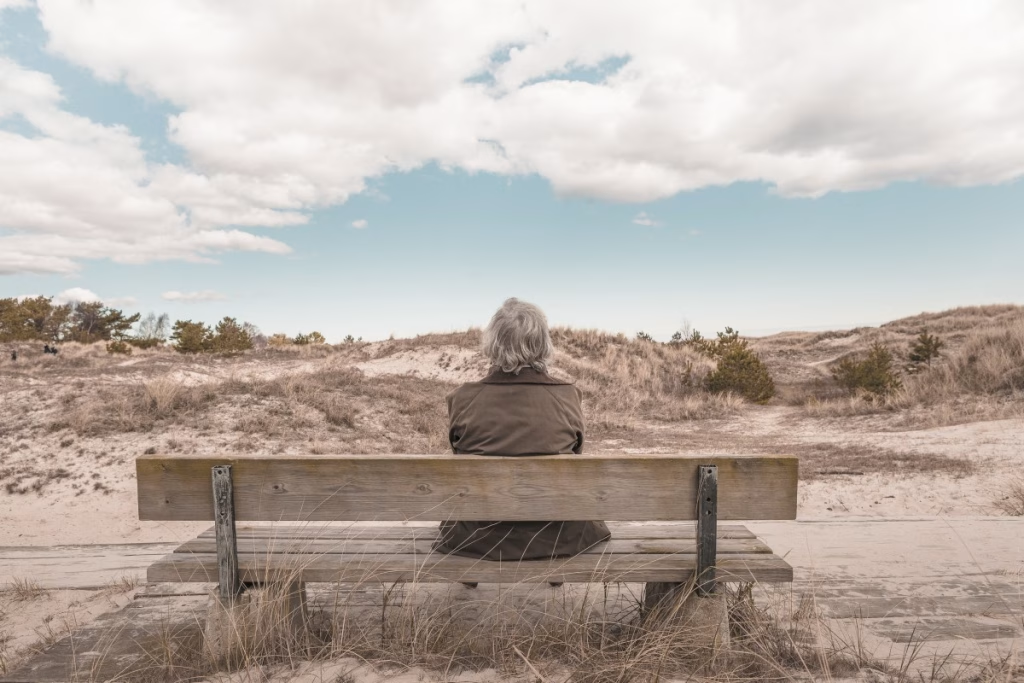
A confluence of somewhat related pieces in the NYT opinion pages talk about the issue from very different perspectives.
Ken Stern demands, “I’m 62. Stop Telling Me I’m Old.“
If there is a commonly accepted age for becoming old in America, it’s 65. That’s when I will become eligible for Medicare coverage, and it’s been, roughly speaking, the most common retirement age for American men for the last 60 years.
It is strange that we use the calendar in such a deterministic fashion, since we all age so differently. If you’ve met one 70-year-old, you’ve met one 70-year-old. I’m 62, active, healthy and still working. But in the last few weeks, I’ve been shamed on the pickleball court and at the gym by people in their 70s, and also visited with a 70-year-old whose body had betrayed her so much that the simplest acts of showering and toiletry are far beyond her capacities. As life expectancy continues to extend, chronological age is telling us less and less about people’s physical and cognitive abilities.
Sixty-five has long been a generally accepted demarcation for old age. But it’s been with us so long that the definitions make little sense — and now operate to our collective detriment.
[…]
You’ve certainly heard people say that 70 is the new 60 or some such similar sentiment. It would be easy to dismiss such statements — except that it understates the physical advancements that we have made over the last half-century.
The best data on this comes from the Japanese, who have been tracking the physical progress of older generations for decades. They do so by measuring both walking speed and grip strength, two widely accepted measures of physical capacity among older adults. Over a period of 20 years, the walking speeds of older Japanese men and women increased at significant rates. Today’s 75- to 79-year-olds walk faster than those five years younger did a generation prior. The data in Japan is particularly notable, but similar studies have shown progress across generations in the advanced economies of the world.
Being prematurely classified as old has negative consequences for both individuals and society. American businesses’ tendency to disfavor “old” workers cuts millions of people off from social networks, exposing them to greater risks of loneliness and social isolation. And older people in the United States often perceive themselves to be old and declining, as you might expect from a lifetime of living in what is often thought of as one of the most ageist societies on earth.
Cathi Hanauer, who’s about a year older than Stern, assures us, “We Had a Long, Mostly Good Marriage. It’s OK That It Ended.“
Rates of “gray divorce” — couples 50 and older — are surging (numbers for the over 65s have tripled since the 90s) and more than two-thirds of all divorces are initiated by women. Even so, people routinely said, “I’m sorry,” when they heard about us. I get it; change can be scary and sad. I often responded, “Thanks, but it’s OK. We’re good.”
[..]
[P]arting in midlife can devastate the unhealthy — or alone-averse. I’m neither, but tromping single around Paris or Maine, I’ve sometimes wished for someone to dine or hike with. I’ve spent hot Augusts and holiday weekends solo in Manhattan, watched divorced friends endure Christmas isolated and missing their kids. I needed my daughter to retrieve me post-colonoscopy, and I worry about injury or aging alone — though ultimately most women age alone anyway, since we live an average five years longer than men.
More darkly, Michelle Cottle tells us, “‘We Had No Idea What Was Coming’: Caring for My Aging Father.” Most of the piece, naturally, is anecdotal. And while the human interest parts are worth reading, I’ll focus on the more generalizable observations:
In recent years, I have become borderline obsessed with the graying of the nation and the challenges it brings — challenges for which our society has not prepared. The numbers are ominous: Each day, more than 10,000 baby boomers turn 65. Between 2010 and 2020, the population of seniors grew about five times as fast as the overall population. That is sending the demand for medical care, long-term care, safe housing and other resources skyrocketing, along with the costs.
On the front lines of this transformation stand nonprofessional family caregivers. An estimated 59 million people in the United States are providing informal care for an adult, the overwhelming majority looking after someone age 65 or older. A small percentage of family caregivers receive payment for their work, but the vast majority do not. The need crosses nearly all demographic lines: age, race, geography, politics, religion. In our fragmented society, it is as close to a universal concern as you can find.
Beyond the numbers are the politics. While caring for loved ones is a deeply personal charge, the weight of that responsibility is influenced by public policy in areas ranging from taxes to labor law to entitlement spending. In his 2024 campaign, Donald Trump promised a tax credit for family caregivers. “They add so much to our country and are never spoken of, ever, ever, ever, but they’re going to be spoken of now,” he vowed during a rally at Madison Square Garden the week before Election Day.
Back in office, however, Mr. Trump promptly abandoned the idea. It was not among the raft of tax cuts in his domestic policy bill. Worse still, he has taken steps likely to make families’ caregiving burdens far heavier. Two major moves stand out. One is the slashing of Medicaid. The other is the broad-based assault on immigration. Together, those actions risk upending a caregiving ecosystem already under strain, throwing millions of families into crisis.
[…]
Caring for seniors, while a labor of love, can nonetheless be grinding. It is often compared to parenting, but the emotional and cultural space it occupies is very different. With a frail parent, there is no sense of guiding someone toward a bright future. Quite the opposite. There is no senior equivalent of mommy-time play groups, much less an ocean of lighthearted books, movies and social media posts chronicling the experience. A diaper disaster involving your toddler makes a great party story. One involving your mother? Not so much.
Feelings of isolation and loneliness are common among family caregivers. Nearly one in four reports feeling alone, according to a report by AARP. Many talk about “feeling invisible,” said Margie Omero, who has conducted focus groups for AARP. Many caregivers don’t talk a lot about their experiences, she said, while many noncaregivers “dismiss the work that goes into it until they have to do it.”
[…]
Those not in the caregiving trenches often don’t want to think about the issue, period, much less chat about it. I mean, who wants to dwell on frailty and death? Among those in the thick of it, many need a nudge to open up — as though broaching the subject themselves would be bad form — but then their stories pour out.
Surveys and other research spotlight the toll this duty can take. Sixty-four percent of family caregivers experience high emotional stress, and 45 percent suffer physical strain. Between 40 percent and 70 percent show clinically significant symptoms of depression. Caregivers report chronic conditions — including heart disease, cancer, diabetes and arthritis — at almost twice the rate of noncaregivers (45 percent vs. 24 percent). Women are particularly hard hit, reporting higher levels of stress than men.
The more involved the caregiving, the greater the strain. More than half of family caregivers handle medical or nursing tasks in addition to helping with the activities of daily living. Looking after someone with dementia can be extra rough. Loved ones’ confusion, fear and, often, resentment and anger about what is happening make taking care of them all the more complicated. And all too often, a physical issue will contribute to cognitive troubles — or vice versa — resulting in a snarl of mutually reinforcing problems.
Even the most devoted family caregivers may occasionally need outside help, if only a few hours of respite care a week. When that happens, many wind up relying on America’s newcomers. Foreign-born workers are the lifeblood of paid caregiving in the United States. More than 820,000 immigrants provide long-term care services in the direct-care work force (defined as including aides and nurses), according to KFF. Overrepresented in their fields, foreign-born workers account for 28 percent of personal care workers and 40 percent of home health aides, according to the Bureau of Labor Statistics.
High demand for such workers is already causing shortages in home-based and institutional care alike, with the situation on track to get worse. The Bureau of Labor Statistics projects that the demand for care aides will rise 17 percent over the next decade, making it one of the occupations with the most growth.
As Mr. Trump throttles the flow of immigrants into the United States, families are likely to have more and more difficulty finding help. Already, the cancellation of the temporary protected status of hundreds of thousands of migrants is causing upheaval. “We’re seeing a jarring, sudden loss of workers, of people who are being sent back” to their home countries, said Katie Smith Sloan, the head of LeadingAge, an association of community-based organizations that provide services for seniors. In addition to creating gaps in staffing, “the relationships that they’ve built with the residents and clients that they’re serving are just broken,” she said.
Further disruptions loom. For instance, the administration has put new barriers on a type of visa that “brought in a lot of nurses from the Philippines,” said Ms. Smith Sloan. Facing access barriers and a hostile climate in the United States, those nurses are likely to head for more welcoming countries, such as Canada, Germany and Australia, she said. “The more restrictive we are, the more it’s going to hurt us in the long run.”
I turned 60 earlier this month and agree with Stern that there’s no single age at which people become “old.” I’m considerably healthier and more active than my parents were at my age. Yet, as of last count, 11 of the 88 people in my high school graduating class have already passed.
My wife is almost exactly a year younger than me. Given that we married in our 50s, we’re unlikely to grow apart in the way that couples who married in their 20s do.
The issue of eldercare is more sobering. My parents are both gone. Hers are both still with us, although her dad is in terrible health. Hopefully, we won’t be in the need of assistance for quite some time, but it’s certainly not a burden we’d want to impose on the kids.
As a society, we certainly need to figure out how to extend both the usefulness and dignity of our rapidly aging population. As Cottle notes, immigration had long been a dual solution, both covering up for our less-than-replacement birth rates and providing for a cheap labor force to provide help for older folks who are somewhere in between being able to fully take care of themselves and the need for long-term medical care. We’ve closed that door, at least for now.

Indeed. The own-goal of it all is profoundly frustrating.
The AIDS epidemic really did wipe out a generation of LGBT folks, and it’s it good of you to acknowledge that, but I don’t think “sissies” is the preferred term.
Only if we want to extend the usefulness and dignity of our rapidly aging population.
As a society, we’ve been really good about not caring for people we don’t care about. See LGBT folks during the Reagan years, and how the FDA and CDC had to be dragged kicking and screaming to eventually begin looking at treatments for AIDS.
We just have to decide that we don’t care about old people, and then the problem will take care of itself.
In retrospect, it may have been a mistake for Boomers to begin actively destroying the notion of social fabric of (White) America when Bill Clinton got elected. It was the first time in a long time that a group of White America decided that another group of White America was illegitimate and had no political legitimacy, and did not need to be included — between impeaching the President over trivialities, and the Hastert Rule that tried to exclude Democrats from any shared power, that was kind of new.
Perhaps the real problem was a section of (White) America that listened to the pretty words about equality, and thought they would try to bring brown and black folks and even women into the coalition. Perhaps that was a betrayal of everything (White) America stood for, and the schism was inevitable.
Anyway, we will finish dismantling anything to care for old people as the Boomers die off largely from neglect. And the youngsters will be too busy to care for them because they’re trying to buy a house, knowing that their parents’ homes will be sold off to pay for medical care and nursing homes and there will be no inheritance windfall.
Problem solved.
We already started seeing these policies of neglect being openly advocated during the pandemic. Were there not people arguing that we can’t close down anything to protect grandma, and that grandma would probably happily make that sacrifice?
I’m hopeful that there will be a backlash to seeing old people homeless and dying on the streets, or neglected in emergency rooms, or turned into Soylent Green, and that Gen X will benefit from a restoration of a lot of these programs.
Plus, there will left over infrastructure for it. If we care for just half of our elderly Boomers, then there will be enough nursing homes beds for Gen X.
We just have to get through all these Boomers, and then get the Millennials and Gen Z to care again. It’s doable.
I’m optimistic.
(I bet you just rolled your eyes at the flippant “sissies” comment, but it was thematic! And then you rolled your eyes again at “(White) America”)
You’re also missing a few alternatives.
First, growing old somewhere else is a possibility. As a rule of thumb other countries don’t want old people coming and leaching off their social services, but money goes a lot further in some countries than it does in the US.
And, if we are just doing to dismantle the US social services anyway…
Second, you can just not grow old. Peter Thiel staves off old age with blood transfusions from young men, and he doesn’t look a day older than 58. A weirdly sweaty 58.
You might say that this is because he is 58, but he turned 58 on October 11th, and if you looked at him you wouldn’t think that his birthday was about 50 days ago. It’s working!
You could also combine these two strategies, by going to Transylvania and become a literal vampire. There are lots of options.
When I turned 65, I thought aging wasn’t bad. I was quite active and not on any meds. At 72, I broke my ankle jumping off a modest height. The recuperation was long but almost total. After 75 I was clearly declining. I’m a few months older than Trump and physically in better shape. I still get most questions right on Jeopardy except for popular culture events after 1990. I went on a five mile hike a few days ago with a group in their sixties. But I am clearly like a car with 250,000 miles; lots of dings and rust, a lot slower, strange noises and smells. There is no trade-in in sight. I’m calm and happy and can not ask for more.
@Slugger:
As long as your 8-track still works, you’ve got music in your heart. All good.
Been through it all, with parents, in-laws, now friends. Dementia, illness, injury prone, loneliness, target for predators. Growing old isn’t for the faint of heart (literally and figuratively). Lack of money, resources, family can make it a hellish process. This is where the rubber hits the road for us as a society — do we do the right thing for those who need? As a society and as individuals?
A bright point — technology, data management, smart phones, online services, ride share, have all extended the the capacity of our older citizens. Smart phones in particular, function to augment declining memory capacity — bionic enhancement of human neurology. The future is here today! Bring on the robot assistants!
@Gustopher:
There are more than a dozen countries that are safer, less expensive, offer a better quality of life on $2000 per month, than the USA. Anyone who chooses to grow old here out of some odd sense of patriotism is making life harder on themselves than it needs to be. Moving to the DR was the best decision I ever made as an adult. Just sorry it took me so long to do it.
@EddieInCA: What are those 11 other countries?
I can’t actually see myself moving outside of the PNW because I like the grey weather — if we could just get rid of the summer it would be perfect. Might need to figure out a housing swap with someone who has my weather in the southern hemisphere.
@Gustopher:
Ecuador
Panama
Albania
Phillipines
Thailand
Columbia
Peru
Bulgaria
Portugal
If your budget is $3K per month, you can actually live very comfortably in rural areas of France, Spain, and Italy.
Before choosing the DR, I was leaning towards Ecuador (because they use the US Dollar, and houses on sand of the Pacific Ocean are ridiculously affordable for someone coming from California) and Panama. But being able to get citizenship in the DR made it an obvious choice.
Most of the countries listed above allow you to become a citizen if you can show proof of income of [as little as] $1000. Some others offer a lifetime retirement visa with proof of [as little as} $1500.
At my wife’s insistence, we are planning on staying here full time, except for when I travel for work.