Iran War One Month In
There's still no strategy.
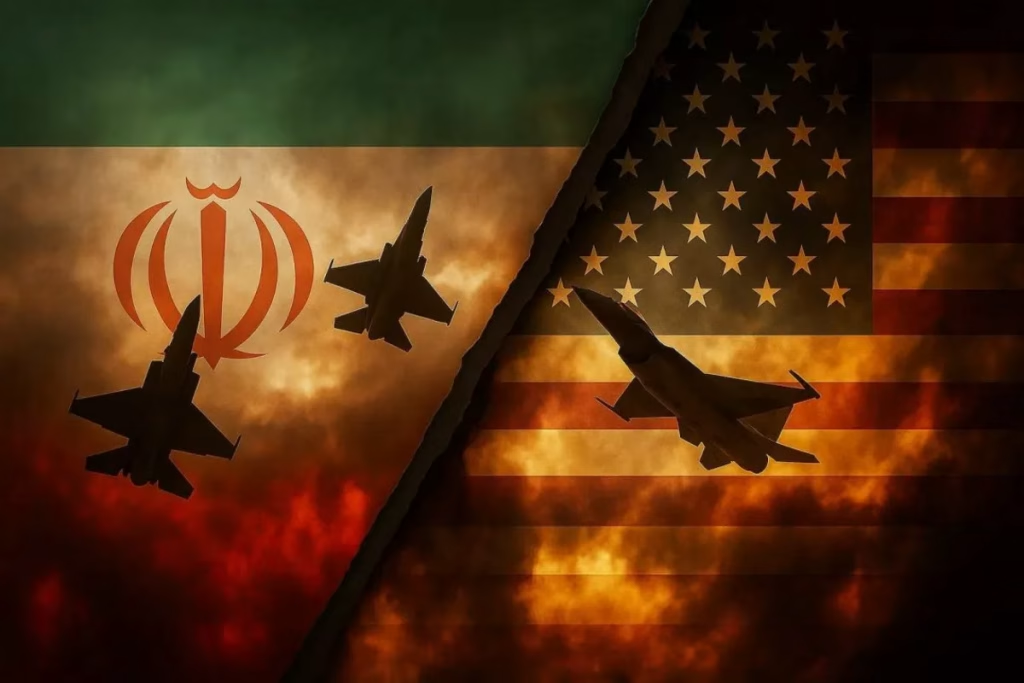
NYT (“Wild Ultimatums and ‘Bombing Our Little Hearts Out’: A Portrait of Trump at War“):
President Trump was fresh off the golf course, and his fury was building.
It was March 21, and as he settled back into his Mar-a-Lago estate for the evening, he was reading another news account about how, for all the military success the United States had in Iran, he had yet to achieve his political objectives.
At 7:44 p.m., the president made his frustration known with an extraordinary ultimatum: If Iran did not reopen the Strait of Hormuz within 48 hours and allow much of the world’s oil and gas to flow through, he would bomb Iran’s civilian electric power plants. It was the kind of attack that could constitute a war crime under the Geneva Conventions.
But just hours before the Monday deadline expired, Mr. Trump delayed his threat by five days, easing fears of an imminent escalation with profound military, diplomatic and economic implications.
Still, he warned that “we’ll just keep bombing our little hearts out” if Iran would not make a deal, and as the week progressed he made new threats that left allies off balance and spooked the markets. So on Thursday afternoon, after stocks on Wall Street suffered their largest daily decline since the start of the war, he added another 10 days to the clock, again seeking to ease the fears ignited by his own hard-line positions.
It is too soon to know whether the extra time will result in productive diplomacy. But it is already clear that Mr. Trump’s wild swings — from optimism to frustration and anger, from de-escalation to escalation — have combined to give his management of the war an erratic, make-it-up-as-it goes feel.
Ever since the United States, alongside Israel, launched the war on Feb. 28, Mr. Trump has vacillated between chest-thumping about U.S. military superiority and deep frustration that the tactical achievements on the battlefield did not seem to be producing the strategic outcome he predicted.
POLITICO (“‘He just chose not to listen’“):
NATE SWANSON spent nearly two decades in the U.S. government, including most recently as the National Security Council’s director for Iran. Days before the U.S. bombed Iran, Swanson published a piece predicting that Iran would do exactly what it has done should the U.S. attack.
That’s expertise President DONALD TRUMP had available to him — until Swanson, an BARACK OBAMA holdover, was “forced out” of his post after a critical tweet from LAURA LOOMER, Swanson said. Neither the White House nor Loomer returned a request for comment.
In his piece for Foreign Policy published Feb. 24, Swanson wrote that Iran would not capitulate after a bombing campaign, but rather escalate and “target global oil flows and international shipping, sending energy prices up and creating a serious political liability for Trump.” And indeed, Iran has made scattershot attacks on energy targets and others across the region, as well as throttling passage through the Strait of Hormuz by threatening attacks on ships.
[…]
We spoke with Swanson this week about his predictions — and what he thinks comes next in the war with Iran.
This interview has been edited for length and clarity.
Trump keeps saying Iran’s response has surprised him — that no one told him Iran would retaliate against regional energy infrastructure. How does that kind of comment from the president sit with you?
Obviously, it’s not true. There are many people in the government who told him that there was high risk involved. He just chose not to listen to them. And as someone who was forced out of the government and wrote pretty much exactly what was fairly obviously going to happen, that doesn’t sit super well.
What is your current take on the state of the war today?
I think both sides are probably irrationally confident in their standing, and so I think that’s a little worrisome. So I think the war is probably going to go on longer than anyone anticipated.
Trump continues to believe that military success is leading to Iranian political capitulation, which isn’t happening.
Let’s remember that Iran has a vote and Iran is dead set on resisting and defying expectations. I also think they’re kind of irrationally confident without an off-ramp.
I think we’re going to be stuck in this conflict longer and with likely escalations to come. I think the problem is the president is not going to get any off-ramp, and I think we’ll probably go through some of these ground operations he’s considering.
So you’re not convinced by these negotiation talks right now?
One, Iran has rejected them. It’s the same thing that Iran rejected for previous iterations. They’re feeling confident. They feel like they should be making the demands, not the U.S., and obviously the U.S. isn’t adhering to that. So I don’t think either side is ready to compromise.
You negotiated with the Iranians last year, representing the Trump administration posture at the time. What do you think are the most notable changes from either side since then?
On Iran’s side, I think there’s a real hardening coming out of the June war. They didn’t know what to make of Trump before that. I think they have hardened and shown less flexibility. So they haven’t really seriously engaged, it’s more performative than serious. That’s where Iran has shifted a lot since last June.
In the U.S, I think the shift came earlier. And I think they didn’t know what they wanted out of a deal and I think the U.S. became more beholden to our domestic politics on this, and listening to outside influence so no enrichment, etc.
If you were still there at the NSC, what advice would you give to the president today?
You’re not gonna be able to control the off-ramp. Iran is not going to capitulate, so the idea that you’re gonna be able to unilaterally set the off-ramp isn’t going to happen. Either you’re going to have to escalate or you’re going to have to compromise. And so those are just the two options.
Compromise is not exactly Trump’s style, which seemingly leaves escalation. And we certainly seem to be posting in that direction.
WSJ (“What an Influx of 17,000 U.S. Troops Could Mean for the Iran War“):
If President Trump gives the go-ahead, the U.S. could soon have more than 17,000 ground troops on Iran’s doorstep. That is far short of what would be needed for a full-scale invasion, but they could seize strategic territory on the mainland, secure Tehran’s uranium stockpiles or take an island.
The Pentagon is considering sending another 10,000 ground troops to the Middle East, even as Trump weighs peace talks with Tehran, The Wall Street Journal has reported. That would add to roughly 5,000 Marines and 2,000 paratroopers from the 82nd Airborne Division already ordered to the region. The additional troops would likely include infantry, armored vehicles and logistics support.
That’s far fewer than the 150,000 troops the U.S. deployed in March 2003 to invade Iraq, a country much smaller in terms of both geography and population than Iran.
[…]
If Trump orders the deployment, the troops could be used to seize strategic locations such as the islands off Iran’s southern coast or parts of the coastline. They could also secure the regime’s 970 pounds of enriched uranium that Tehran could use to try to build nuclear weapons.
Each of those missions would be complex and dangerous. A battle for a beachhead near Bandar Abbas, Iran’s main naval headquarters, or for Kharg Island, a crucial oil export hub, would risk significant American casualties, former officials said.
U.S. forces could also target islands around the Strait of Hormuz’s “elbow,” including Abu Musa, Greater Tunb and Lesser Tunb, making it easier to reopen the passageway. From there, they could help shield ships from Iranian missiles and drones and launch land-based strikes against the mainland.
But reaching those areas would be difficult. U.S. ships would have to pass through the strait’s narrow, shallow waters, flanked by Iranian forces armed with missiles and drones and potentially seeded with sea mines. Alternatively, troops could be airlifted from Persian Gulf nations.
The sea approach also offers other dangers. Supersonic antiship missiles could travel from the Iranian mainland in a matter of seconds, while Iran could use its fast attack boats and drones to bombard both naval craft and positions on land, said Seth Jones of the Center for Strategic and International Studies think tank.
“I would be shocked if this could be done without any casualties or commercial or naval ships being hit,” said Jones, a former Defense Department and U.S. Special Operations Command official.
Once on the ground, American forces would need to defend against an array of threats, from Iranian cruise and ballistic missiles and drones launched from boats or from the shoreline. Kharg Island, just 16 miles from the mainland, would require robust air defenses, likely including interceptor-equipped destroyers or sustained air cover.
“That will become a chance to kill Americans who are aggregated and concentrated,” said Mark Montgomery, a retired rear admiral and senior fellow at the Foundation for Defense of Democracies think tank. “They’d be sitting ducks.”
A force of 17,000 troops isn’t enough to hold any location for an extended period, particularly if they are under fire from the regime, said retired Vice Adm. John Miller, a former commander of U.S. naval forces in the Middle East. Those threats would need to be suppressed from the air.
“The longer you are at those locations, you are exposed to greater risk,” Miller said.
The President is certainly getting advised of these risks in great detail. But, while the NYT report calls JCS Chairman Dan Caine a “Trump Whisperer,” the fact of the matter is that Trump heard the risks and decided the reward was worth it a month ago. He may well double down on that bet in the coming days, lest he appear weak.
Meanwhile, the Houthis are firing missiles at Israel, further expanding the war’s footprint.
And then there’s this:
NY Post (“Trump considers renaming Strait of Hormuz after either America or himself — once he evicts Iran“):
To the victor go the naming rights.
President Trump is prioritizing taking control of the Strait of Hormuz as he grows frustrated with the lack of help from allies to force open the crucial waterway. And once Trump ends Iran’s reign of terror over the shipping route, he’s considering rechristening it the “Strait of America” or even naming it after himself, sources told The Post.
“We are taking the Strait back. It’s guaranteed, and they will never blackmail us on that strait,” one senior administration official said. “You can take it to the bank.”
[…]
“He does believe that if we’re going to guard it, if we’re going to take care of it, if we’re going to police it, if we’re going to ensure free safety through it that, why should we call it that [Hormuz]?” the senior official said.
“Why don’t we call it, you know, the Strait of America?”
Trump told a Saudi investor forum Friday evening in Miami that he might decide to call the Strait after himself, rather than America.
“They have to open up the Strait of Trump — I mean Hormuz,” Trump said.
“Excuse me, I’m so sorry. Such a terrible mistake. The Fake News will say, ‘He accidentally said.’ No, there’s no accidents with me, not too many.”
[…]
The renaming concept gained traction by unlikely means — after an image of an apparently phony Truth Social post purportedly authored by the president showed a map of the strait with the new name.
“President Trump just posted this picture renaming the Strait of Hormuz the ‘Strait of America.’ Let’s make it happen!” pro-Trump influencer Benny Johnson, who faced repeated plagiarism allegations in his former journalistic career, posted on Facebook on March 16.
That doctored map does not appear to have actually been posted by Trump on any of his main social media platforms this month — but Johnson’s post nonetheless raked in 5,200 mostly supportive comments from people who believed it was real, along with 40,000 “likes” and nearly 3,000 shares.
Because of course.

Gee, such a cheerful post to start the weekend.
It’s difficult to see what could be accomplished without deploying 100,000 troops.
“Tim Snyder”
etc etc
“Wajeeh Lion”
etc etc
BTW, there is a railroad linking China to Iran, so sea blockades can not stop the chemicals supply.