Jesse Jackson, 1941-2026
The controversial civil rights leader is gone at 84.
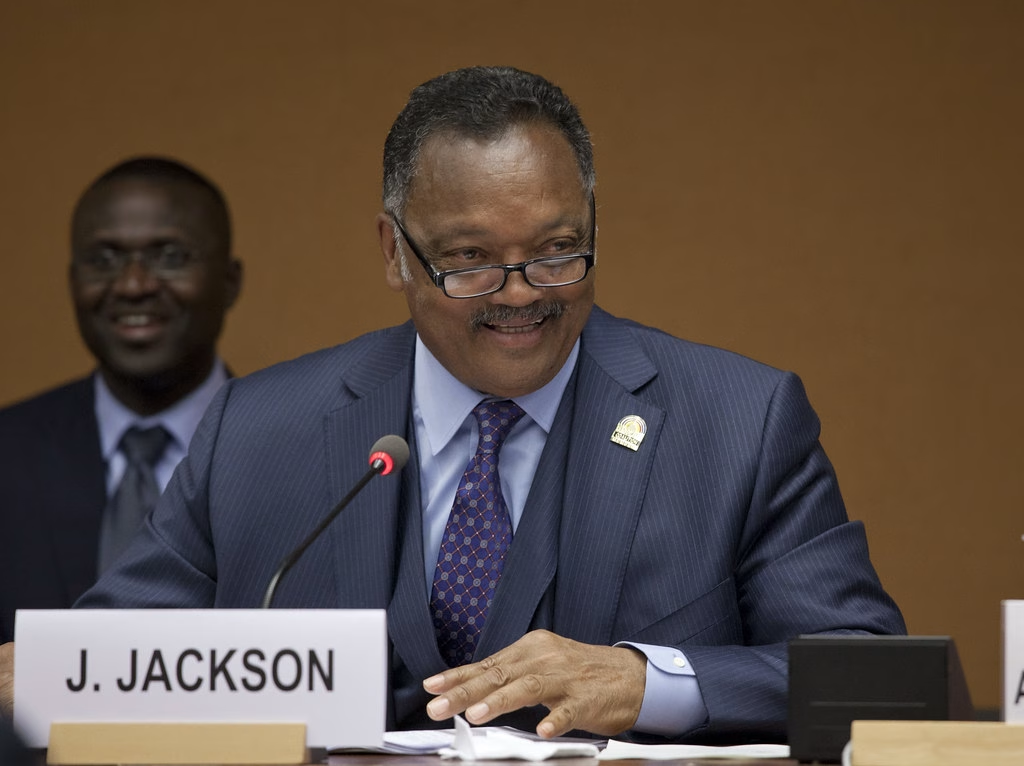
The New York Times, “Jesse Jackson, Civil Rights Leader Who Sought the Presidency, Dies at 84“
The Rev. Jesse Jackson, whose impassioned oratory and populist vision of a “rainbow coalition” of the poor and forgotten made him the nation’s most influential Black figure in the years between the civil rights crusades of the Rev. Dr. Martin Luther King Jr. and the election of Barack Obama, died on Tuesday. He was 84.
[…]
Mr. Jackson picked up the mantle of Dr. King after his assassination in 1968 and ran for president twice, long before Mr. Obama’s election in 2008. But he never achieved either the commanding moral stature of Dr. King or the ultimate political triumph attained by Mr. Obama.
Instead, through the power of his language and his preternatural energy and ambition, he became a moral and political force in a racially ambiguous era, when Jim Crow was still a vivid memory and Black political power more an aspiration than a reality.
With his gospel of seeking common ground, his pleas to “keep hope alive” and his demands for respect for those seldom accorded it, Mr. Jackson, particularly in his galvanizing speeches at the Democratic conventions in 1984 and 1988, enunciated a progressive vision that defined the soul of the Democratic Party, if not necessarily its policies, in the last decades of the 20th century.
It was a vision, animated by the civil rights era, in which an inclusive coalition of people of color and others who had been at the periphery of American life would now move to the forefront and transform it.
[…]
“My constituency is the desperate, the damned, the disinherited, the disrespected and the despised,” Mr. Jackson said in the rolling cadences of the pulpit at the 1984 Democratic National Convention in San Francisco. “They are restless and seek relief.”
His transcendent rhetoric was inseparable from an imperfect human being whose ego, instinct for self-promotion and personal failings were a source of unending irritation to many friends and admirers and targets for derision by many critics. Mr. Jackson, the writer and social commentator Stanley Crouch once said, “will be forever doomed by his determination to mythologize his life.”
Still, he offered an expansive vision of American opportunity that admirers say helped change the nation’s landscape of possibility. And his idea of a multiracial coalition empowered by an activist government to confront rampant inequality in American life remains central to the progressive wing of the Democratic Party and has inspired groups like Black Lives Matter.
The Washington Post, “Jesse Jackson, a leading African American voice on global stage, dies at 84“
The Rev. Jesse Jackson, a charismatic preacher who became the leading voice of Black American aspirations in the years after the assassination of the Rev. Martin Luther King Jr. and was the first African American to gain significant traction as a presidential candidate, died Tuesday. He was 84.
[…]
At the height of his influence, Rev. Jackson was widely regarded as the nation’s preeminent civil rights leader, a ubiquitous presence before the television cameras. He showed up at protests and marches across the country to champion civil rights and social justice. And when civil disorder broke out — as it did after King’s assassination in 1968 and, decades later, after the fatal police shooting of 18-year-old Michael Brown in Ferguson, Missouri, in 2014 — he urged restraint and nonviolence.
In the late 1970s, he began to expand his activities beyond the United States. He thrust himself into Middle East peacemaking, prisoner-release efforts and the movement against apartheid in South Africa, and he was regularly seen in the company of presidents and foreign leaders.
He was ordained as a Baptist minister but never had his own church, preferring the wider stage of civil rights activism. At 6-foot-2, with the power and fluid grace of an athlete, he was a commanding presence wherever he went. As a public speaker, he was electrifying.
Rev. Jackson’s oratorical style, like the civil rights movement, was rooted in the Black churches of the South. He would begin slowly, in an almost conversational tone, and gradually build to a crescendo that left some listeners in tears.
[…]
His drive and passion also brought him detractors. At times, he annoyed King, and he feuded with other King aides, some of whom considered him a shameless self-promoter.
Like many who knew him well, Roger Wilkins found Rev. Jackson both inspiring and exasperating. As an editorial writer for The Washington Post in the 1970s, Wilkins had to deal with Rev. Jackson as a frequent, and often uninvited, visitor.
“He would just show up,” Wilkins said. “It was, ‘Rev. Jackson with Dr. So-and-So is downstairs to see you.’ He wanted his name in the paper.”
In 1968, Wilkins, as a young African American official in the Justice Department, walked the streets of Washington amid the rioting that followed King’s assassination. He made his way to 14th Street NW, where Rev. Jackson was speaking to an angry crowd.
“It’s not Black pride to burn down a Black man’s store,” Wilkins recalled Rev. Jackson saying. After a while, the anger subsided, and the crowd began to drift away. “I saw it with my own eyes,” Wilkins said. “He really did preach the violence out of those people.”
Rev. Jackson ventured where no civil rights leader had gone before by seeking the 1984 Democratic presidential nomination. He was widely viewed as a gadfly with no chance of winning. By all accounts, his poorly funded campaign was the most chaotic and disorganized of the modern era.
He amassed more than 3 million votes during the primaries, and he took 384 delegates with him to the Democratic National Convention in San Francisco. From an initial field of eight candidates, he finished third in the primary campaign, behind former vice president Walter F. Mondale, the eventual nominee, and Sen. Gary Hart of Colorado.
“When they write the history of this [primary campaign], the longest chapter will be on Jackson,” Mario Cuomo, the New York governor, said to The Post at the time. “The man didn’t have two cents. He didn’t have one television or radio ad. And look what he did.”
Four years later, Rev. Jackson again sought the Democratic nomination. He was better financed and organized, and he easily improved on his 1984 results. He won about 7 million votes, including 12 percent of White voters.
[…]
On April 4, 1968, King was shot by a sniper as he stood on the balcony of the Lorraine Motel in Memphis. Rev. Jackson was in the motel courtyard at the time. His actions over the next several hours drove a deeper wedge between him and other King aides but also served to propel him toward national prominence.
Rev. Jackson immediately returned to Chicago. Dressed in the bloodstained turtleneck shirt he had worn in Memphis, he arranged to be interviewed on local television programs and NBC’s “Today” show, telling reporters that King died in his arms.
Rev. Jackson’s conduct and his account of King’s last moments infuriated the other aides, who vehemently denied his version of the events. Rev. Jackson always defended his actions, which, whatever his intentions, elevated his public profile. In April 1970, Time magazine put an image of Rev. Jackson on the cover of a special issue on Black America.
The Wall Street Journal, “Jesse Jackson, Civil-Rights Leader and Democratic Presidential Candidate, Dies at 84“
The Rev. Jesse Jackson, a longtime civil-rights activist and Democratic political leader, has died. He was 84.
A gifted public speaker, Jackson was known for fiery rhetoric, often advocating for the interests of working people, especially minorities. In one of his most famous speeches, delivered at the Democratic National Convention in Atlanta in 1988, he urged different American groups—Black and white people, liberals and conservatives—to seek common ground.
“Progress will not come through boundless liberalism nor static conservatism,” he said, “but at the critical mass of mutual survival…It takes two wings to fly.”
[…]
Jackson, who was ordained a minister in June 1968, clashed with the Rev. Ralph Abernathy, one of King’s colleagues and then SCLC chairman, about the group’s direction and who would lead the organization. In 1971, Jackson and supporters left to form the Chicago-based Operation PUSH, which organized boycotts of businesses it stated weren’t doing enough to help minorities.
He believed the U.S. was morally obligated to help improve the lot of low-income people.
“There is something morally degenerate about the system that has the ability to deal with man’s basic problems of poverty, ignorance and disease but does not have the will to do it,” he said on conservative columnist William F. Buckley’s television program in 1971.
Jackson started his campaign for president in 1983, shortly before he organized the Washington-based National Rainbow Coalition in 1984 to press for federal policy changes and more funding to aid poor Americans and minorities. He endorsed full diplomatic relations with Cuba, an independent Palestinian state and full economic sanctions on South Africa, and for reducing the role of the military as a tool of foreign policy.
The campaign drew support from liberal members of the Democratic Party, especially minority groups.
Jackson had “the guts and intellect to take his mark in the starting blocks of mainstream Democratic Party politics” and could defeat then-President Ronald Reagan, Maynard Jackson, Atlanta’s first Black mayor and no relation, told the New York Times.
His critics saw the effort and Jackson’s frequent appearances in the media as self-aggrandizing.
“His agenda is the promotion of Jesse Jackson as the king, the emperor, the most important Black person of this century,” Vernon Jarrett, a longtime Black columnist, wrote for the Chicago Sun-Times.
Jackson ran into trouble when he referred to Jewish people as “Hymies” to a reporter and to New York as “Hymietown.” He lost the New York primary to Vice President Walter Mondale, who went on to secure the nomination. The comments would continue to weigh on his political ambitions.
Jackson ran into trouble when he referred to Jewish people as “Hymies” to a reporter and to New York as “Hymietown.” He lost the New York primary to Vice President Walter Mondale, who went on to secure the nomination. The comments would continue to weigh on his political ambitions.
[…]
Fellow Chicagoan Barack Obama ran for and won the presidency in 2008, becoming the first Black president. Jackson publicly supported Obama, but their relationship was strained after Jackson made remarks that were critical of Obama. In one “hot mic” incident in 2008, Jackson was heard to complain that he felt Obama was “talking down to Black people.”
Two of his sons followed him into politics. Jesse L. Jackson Jr., a former Democratic congressman from Chicago, resigned in 2012 during an investigation into alleged misuse of campaign funds. In 2013, the younger Jackson pleaded guilty to violating campaign-finance law and other charges. The elder Jackson wasn’t implicated in any wrongdoing.
Another son, Jonathan Jackson, was elected to Congress from Illinois as a Democrat in 2022, took office in 2023, and was re-elected in 2024.
Jackson was, to say the least, a complicated man. For a very long time, I focused almost entirely on the negative, seeing him primarily as a con man and a grifter. Over time, my view of him has softened.
There’s no doubt that he was a self-promoter and a fabulist. He certainly was not above telling lies, big and small, in service of his ambitions. Then again, that’s been true of so many American politicians, ranging from Bill Clinton to Donald Trump.
I’ve come to see his stated policy aims, even beyond racial equality, as genuine. The above New York Times obituary points to the circumstances of his youth:
He was born Jesse Louis Burns on Oct. 8, 1941, in Greenville, S.C. His mother, Helen Burns, was 16 at the time, a high school majorette renowned in town for her coloratura soprano singing voice. His father, Noah Louis Robinson, was a handsome, imposing 33-year-old former boxer who lived next door, married to another woman. That he was not involved in his son’s rearing was a source of humiliation for Jesse as he grew up in his small, segregated Black community.
In 1943, his mother married Charles Jackson, whom she had met while he was a shoeshine attendant at a barbershop, before he joined the Army. Mr. Jackson did not adopt Jesse until 14 years later. When the couple had a son of their own, Jesse was sent to live with his maternal grandmother in a shotgun shack around the corner.
Rejected by his father and not fully embraced by his stepfather, he was taunted by other children, all while learning the racial caste system of the segregated South. Years later, he recalled the two water fountains at Claussen’s bakery, where he worked on Saturday mornings, and the first time his mother led him to the back of the bus.
After graduating from high school in 1959, Mr. Jackson enrolled at the University of Illinois Urbana-Champaign on a football scholarship, an opportunity that allowed him to escape Jim Crow for the first time.
He soon experienced what he later described wryly as “the legendary liberalism of the North.” He had never been called the most hurtful racial slur in the South, he said, but he was taunted with it by college students in the North. “It was the same thing as South Carolina,” he said, “just way off somewhere else.”
His bravado shaken, he transferred after his freshman year to what is now North Carolina Agricultural and Technical State University, a historically Black institution in Greensboro. There he found the familiar cadences of Southern life; friends recalled the gospel music of Mahalia Jackson pouring out of his room. He became a leader in his fraternity and eventually president of the student body.
The combination of brutal poverty, paternal abandonment, and being viewed as a second-class citizen despite enormous talents is one I’ll never fully understand. But, certainly, it could motivate a man to seek validation through any means necessary.
That he would go on to make two credible runs for the presidency and see two of his sons elected to Congress is simply extraordinary considering where he started.

About 15 years ago I was on a work trip to Guinea and Mali. On the way home our plane made an unscheduled (or, at least, unannounced) landing in Liberia (I think, its been awhile). We taxied up to the gangway, and a few minutes later Jesse Jackson and three very, very skinny men came on board, got in their seats, and we were back on our way.
One of my travelling companions–who was as about a reactionary conservative I’ve ever met, and who later would tell me in detail how much of a horrible person Jackson was in his view–waived down Jackson when we disembarked in NY, and we all got to chat with him for a few minutes. The three skinny guys who got on the plane with him were, until a few days earlier, political prisoners under a torture regime. I’ve forgotten from which nation they hailed, but I want to say Eritrea. Under Bush Jr., and continuing under Obama, Jackson was employed by the White House periodically to negotiate with certain regimes in Africa to release political prisoners. He said it was his 10th trip to the continent, and he had secured the release of about a dozen people.
For a guy who was well known to seek the spotlight, I thought it was cool that he did this unsung work for many years.
Rest in Peace Rev. Jackson.
From the Wikipedia entry for the 1972 Democratic Convention:
Rick Perlstein describes this is basically the moment the Daley machine got busted. And Jackson was the guy to do it.
Jesse Jackson came to speak of the University of Washington while I was living in Seattle. He was supporting Bill Clinton for president and the campaign stop was an electrifying experience. Both Jackson and Clinton spoke, but I have more vivid memories of Jackson’s speech. How I miss the soaring oratory of both men.
That just sounds like Wilkins is complaining about one of the major risks of his job as an editorial writer. And that Jackson wanted to get Dr. So-and-so in the paper, and was using his own name as access.
A good chunk of his “complicated” legacy is things like that — he was pushy, knew he could use his status for access, and try to force the people and things he cared about in front of other people’s faces. Generally good things that he cared about.
I suppose we will have to wait for Ezra Klein’s thoughtful determination of whether he “did politics the right way,” like Charlie Kirk.
Of course, the other part of Jackson’s “complicated” legacy is shit like “Hymie Town.”
As Lou Reed wrote and sort-of-sang about Jackson:
NPR just ran this clip, which I had forgotten about. He had a sense of humor!
“Keep hope alive.”
Not bad words to remembered for.
RIP.