Jobs Report
A better than expected January, but downward revisions for 2025.

Via CNBC: U.S. payrolls rose by 130,000 in January, more than expected; unemployment down to 4.3%.
Job growth was stronger than expected to start 2026, providing some relief to concerns about the state of the U.S. labor market.
Nonfarm payrolls increased by 130,000 for January, above the Dow Jones consensus estimate for 55,000, according to seasonally adjusted figures the Bureau of Labor Statistics released Wednesday. The total also was an improvement over December, which saw a gain of 48,000 after a slight downward revision.
The unemployment rate edged lower to 4.3%, below the forecast to stay unchanged at 4.4% from the prior month. A more encompassing measure that includes discouraged workers and those holding part-time positions for economic reasons slipped to 8%, down 0.4 percentage point from December.
All well and good, and something for the administration and its allies to tout.
Still, it needs to be consideredin the broader context.
January was the best month for payroll growth since December 2024, following a year in which job creation averaged just 15,000 a month.
[…]
In addition to the monthly numbers, the BLS released final benchmark revisions for the period of April 2024 to March 2025. Those numbers saw the initial counts revised lower by a total 898,000 on a seasonally adjusted basis. That was a bit lower than the 911,000 figure for the initial estimate last September but around Wall Street expectations.
Here are the last several years broken down by monthly gains and losses:
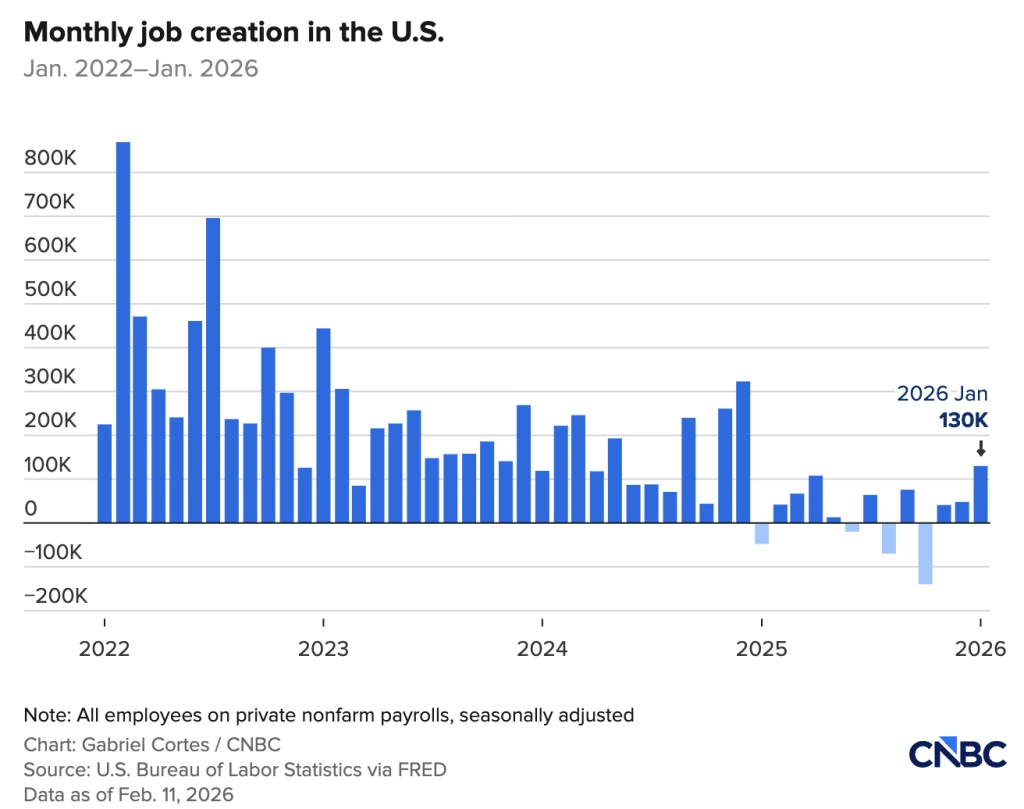
As long-term readers know, I am not prone to simplistic statements about who is in the White House and the macroeconomic indicators, unless there can be a direct line drawn between specific policies and obvious effects. While I would never suggest that a one-to-one correlation exists between policy and things like job creation, it is hard not to see how the uncertainty that Trump has created via his utterly capricious tariff policies has affected the broader economy.
Between tariffs and other foreign policy actions, this administration has been throwing monkey wrench after monkey wrench into the global economic order upon which many domestic business and consumer decisions are made. That this has a disruptive effect on the economy, including job creation, seems pretty obvious.
Maybe the January numbers are indicative that the TACOing out on tariffs (which are still high, just not at the threatened levels) has led to some adjustments to business practices, or maybe it is a one-month blip. Clearly, after a series of Trump-created dips in the market, the Dow has learned to deal with Trump’s chaos, given that it hit 50K recently.
BTW, I do trust the jobs numbers, despite the fact that I understand skepticism about any data coming out of this administration. If they were going to cook the books, there would have been different revisions for 2025, and I think that the January numbers would have been much better. But we shall see how things progress.
See also Paul Krugman, Making America Stagnate Again, wherein he addresses the relationship between immigration and jobs.
Note his conclusion:
Which brings me back to the stunning stagnation of job growth that has already taken place on Trump’s watch. Trump’s minions would have you believe that near-zero job growth is fine because immigration has plunged — even though they assured us that this wouldn’t happen. But the reality is that the war on immigrants, in addition to being a moral and civil liberties nightmare, will make native-born Americans poorer — and send thousands of us to an early grave.
BTW, here is an example of an admin shill making the case that the deportations are why the 2025 jobs numbers are bad, and why it is a good thing. There may be some pretzels in that logic.
As Krugman notes, I thought the administration’s logic was that immigrants were taking jobs away from native born folks. And so, wouldn’t all of these deportation be leading to job openings for citizens? It’s as if all this disruption isn’t achieving what they claimed it would.

I think that you should emphasize that ‘somewhat better’ means ‘horrible, and due to Trump’s policies’.
We have to work at every step to not normalized Trump’s evil.
An article I read the other day talked about immigration and jobs, and how the admin doesn’t understand the relationship between the jobs immigrants take and what happens when those folks are deported. Basically the articles point was that the job becomes automated as the only reason that a human was doing the job was the willingness to work cheaply.
To illustrate the point they featured a dairy farmer that suffered an immigration raid and replaced the workers with an automated milking machine and a floor cleaner to pick up the poop.
Not being familiare with automated milking, out to YouTube and sure enough several videos showing the cows lined up at the machine, stepping into it, having the udders cleaned, the milking apparatus attached and the cow getting a treat as she walks away.
For those of you who don’t want to know where your food comes from. Cows when they need to be milked are uncomfortable and have learned that relief can be found at the milking parlor, stepping on the machine is just a little different than having a human begining the milking process.
Given the fact that the 2025 jobs report was inflated by 300% I see no reason why I should believe any number coming from the Trump regime.
Excluding covid 2020, last year was the worst job creation number since 2003. In 23 years! So much winning. I am sure if you provide that factoid to your local Maga cult Kool aid drinker, they will tell you that’s Bidens fault. Lmao
My interpretation of the thrust of Trump’s efforts is that he is largely focused on building or making things here in the US. So, while it’s fine that there are more workers in the service industry (healthcare etc) the Trump’s emphasis is on the goods-producing sector.
A lookback at track record in that good-producing sector by FINALIZED and BENCHMARKED* data is that the goods producing sector has shrunk by 82,000 jobs during Trump’s year. That is not a trajectory of success !
* the only BLS numbers that can be counted on are those that have had all the employers inputs, and the reconciled with all the state’s employment data – that is what I mean by finalized and benchmarked (reconciled). And even then the margin of error needs to be applied.
@Michael Reynolds:
Please explain, as I am unclear on what you are referencing.
@Steven L. Taylor:
The full year of jobs created in the USA in 2025 was an initial number of 580,000. After the downward revision, the actual number for the full year was 181,000.
That’s a difference of 320%, to Michael’s point.
@EddieInCA: But revisions are common, and can sometimes be dramatic.
No one can accuse me of being soft on this administration, and I am more than willing to be skeptical of whatever they do or say, but this all appears to me to be ongoing common practice.
Am I missing something other than the fact that numbers were revised downward (which would be an odd thing to do if you were lying)?
I mean, if you are going to trust that the 118,000 is real as a basis of critiquing the 580,00, then you are definitionally accepting at least some of the data, yes?
If you think they were consciously lying about the first number, why even cite the second one? It is like one of those logic puzzles Kirk used to use to talk a computer into dying.
@Steven L. Taylor:
No. You’re not missing anything.. What has alot of. people upset is that the revisions came at the end of the year. Usually, revisions happen monthly. You give your current number and revise last month’s number – up or down. This administration fired the person in charge because of revisions, which, as you say, is normal, but this administration didn’t like downward revisions.
All you need to know about the jobs number is that tepid response by Wall Street. If the numbers hold up, interest rates stay where they are. If there is another month of high job numbers, interest rates might rise, because inflation will raise it’s ugly head again. I feel bad for the incoming Fed Chair. Trump is going to pound him repeatedly.
But ADP said jobs losses are very high, which runs counter to the BLS numbers. Additionally, some of the BLS numbers seem sketchy.
BLS Labor Report Defies Consensus
Isn’t this a kind of “in front of our noses” thing?
Hottest economy in the world! Dismal employment numbers! It’s all the fault of illegal immigants!*
Or as Judge Engoron said of the defense during the Taco fraud lawsuit trial: the documents don’t say what they say.
*”Immigants! I knew it was them! Even when it was the bears, I knew it was them!”
@Michael Reynolds: @Steven L. Taylor:
If we were to understand what the “revisions” are based upon, we could have a better handle on the “why” of revisions.
As we all (hopefully) know the monthly BLS “Current Establishment Employment” that most people quote as the “monthly jobs numbers” is based on an estimate/extrapolation of (potentially) 160,000 individual employers that report their payroll as of the 12th of the previous month. Unfortunately not all the survey participants get their data in to BLS on time for the monthly jobs report, never the less the BLS then estimates/extrapolates to the whole of the country. We should note that the 160,000 employers that are BLS sampled monthly is approximately only 1.3% of all the private employers that are required to report to their State’s Employment Commissions in the US.
For the next two months, more of the monthly reports come in and so the estimate/extrapolation is corrected until third month, when the BLS stops taking in monthly reports from individual employers (in that 160,000 sample). So month to month revisions to their estimate/extrapolations are generally not massive.
BUT, (and here is where the BIG revisions occur): the previous released jobs reports are benchmarked against the MANDATED employers report of every employee.
These QCEW (Quarterly CENSUS of Employed workers) is not a sampling.
BLS then tries to reconcile their estimate with the census.
And that’s how the “final” jobs numbers (after full reconciliation with the census) come to be.
Unfortunately BLS only runs that reconciliation process periodically (because the employment census data is only required quarterly.
BTW, until I did some extensive research, I was unaware of the above.- so I don’t “fault” anyone for not knowing this.