Via Axios: The rise of the political potty mouth. To which I say, who the fuck cares? We are in the middle of growing fascism, but sure, let’s worry about some salty language.
Trump’s view of government and power on display, not to mention more of his truly unhealthy obsession with the Nobel Peace Prize.
Heaven help us
Trump: “If anybody thinks that Norway doesn't control the Nobel Prize, they're just kidding. They have a board, but it's controlled by Norway, and I don't care what Norway says."pic.twitter.com/Csg46p8dvF
Steven L. Taylor is a Professor Emeritus of Political Science and former College of Arts and Sciences Dean. His main areas of expertise include parties, elections, and the institutional design of democracies. His most recent book is the co-authored A Different Democracy: American Government in a 31-Country Perspective. He earned his Ph.D. from the University of Texas and his BA from the University of California, Irvine. He has been blogging since 2003 (originally at the now defunct Poliblog).
Follow Steven on Twitter and/or BlueSky.
Boromir was, famously, wrong about thinking he could use the One Ring for good.
Tolkien, and even the LOTR films, make this as clear as day. So clear, in fact, that I think that Lee is saying that the Republicans should not use the power of the government (and thus repeat Boromir’s mistake), but rather destroy this power now that they have the chance.
That may be dumb in the real world, but it is not necessarily authoritarian.
Carney’s words have detonated through the corruption of MAGA propaganda and their corporate media hostages/collaborators/ shills/stenographers and extortion victims. It is simply jarring to the American ear to hear such a clear, focused explanation, declaration and enunciation of values, ideals and principles. It was extraordinary.
Mark Carney is the leader of the free world.
A hundred million Americans — at least — are grateful tonight for his titanic leadership, courage and honesty.
We the people must face reality.
Please read them and remember the Teddy Roosevelt adage: “Speak softly and carry a big stick.”
Mark Carney is a brilliant financial strategist.
Mark Carney holds the cards because Mark Carney has lots of T-bills.
He doesn’t have to say Trump’s name because the truth of the matter is that holding $38 trillion in US debt means America is owned by Canada, Europe and China.
When America stops believing in America it means that the world loses faith in America because faith in America was always the rock upon which faith in the future was anchored.
It’s gone.
Here is the opening part of Mark Carney’s remarks:
It’s a pleasure — and a duty — to be with you at this turning point for Canada and the world.
I’ll speak today about the rupture in the world order, the end of the pleasant fiction and the dawn of a brutal reality in which great-power geopolitics is unconstrained.
But I submit to you all the same that other countries, in particular middle powers like Canada, aren’t powerless. They have the power to build a new order that integrates our values, like respect for human rights, sustainable development, solidarity, sovereignty and the territorial integrity of states.
The power of the less powerful begins with honesty.
Every day we are reminded that we live in an era of great power rivalry. That the rules-based order is fading. That the strong do what they can, and the weak suffer what they must.
This aphorism of Thucydides is presented as inevitable — the natural logic of international relations reasserting itself. And faced with this logic, there is a strong tendency for countries to go along to get along. To accommodate. To avoid trouble. To hope that compliance will buy safety.
It won’t.
So, what are our options?
In 1978, the Czech dissident Václav Havel wrote an essay called The Power of the Powerless. In it, he asked a simple question: how did the communist system sustain itself?
His answer began with a greengrocer. Every morning, this shopkeeper places a sign in his window: “Workers of the world, unite!” He does not believe it. No one believes it. But he places the sign anyway — to avoid trouble, to signal compliance, to get along. And because every shopkeeper on every street does the same, the system persists.
Not through violence alone, but through the participation of ordinary people in rituals they privately know to be false.
Havel called this “living within a lie.” The system’s power comes not from its truth but from everyone’s willingness to perform as if it were true. And its fragility comes from the same source: when even one person stops performing — when the greengrocer removes his sign — the illusion begins to crack.
It is time for companies and countries to take their signs down. For decades, countries like Canada prospered under what we called the rules-based international order. We joined its institutions, praised its principles, and benefited from its predictability. We could pursue values-based foreign policies under its protection.
We knew the story of the international rules-based order was partially false. That the strongest would exempt themselves when convenient. That trade rules were enforced asymmetrically. And that international law applied with varying rigour depending on the identity of the accused or the victim.
This fiction was useful, and American hegemony, in particular, helped provide public goods: open sea lanes, a stable financial system, collective security, and support for frameworks for resolving disputes.
So, we placed the sign in the window. We participated in the rituals. And largely avoided calling out the gaps between rhetoric and reality. This bargain no longer works. Let me be direct: we are in the midst of a rupture, not a transition. Over the past two decades, a series of crises in finance, health, energy, and geopolitics laid bare the risks of extreme global integration.
More recently, great powers began using economic integration as weapons. Tariffs as leverage. Financial infrastructure as coercion. Supply chains as vulnerabilities to be exploited. You cannot “live within the lie” of mutual benefit through integration when integration becomes the source of your subordination. The multilateral institutions on which middle powers relied— the WTO, the UN, the COP—the architecture of collective problem solving — are greatly diminished.
As a result, many countries are drawing the same conclusions. They must develop greater strategic autonomy: in energy, food, critical minerals, in finance, and supply chains. This impulse is understandable. A country that cannot feed itself, fuel itself, or defend itself has few options. When the rules no longer protect you, you must protect yourself. But let us be clear-eyed about where this leads. A world of fortresses will be poorer, more fragile, and less sustainable.
And there is another truth: if great powers abandon even the pretence of rules and values for the unhindered pursuit of their power and interests, the gains from ‘transactionalism’ become harder to replicate. Hegemons cannot continually monetize their relationships. Allies will diversify to hedge against uncertainty. Buy insurance. Increase options. This rebuilds sovereignty— sovereignty which was once grounded in rules—but which will be increasingly anchored in the ability to withstand pressure.
This classic risk management comes at a price. But that cost of strategic autonomy, of sovereignty, can also be shared. Collective investments in resilience are cheaper than everyone building their own fortress. Shared standards reduce fragmentation. Complementarities are positive sum.
The question for middle powers, like Canada, is not whether to adapt to this new reality. We must. The question is whether we adapt by simply building higher walls — or whether we can do something more ambitious.
Canada was amongst the first to hear the wake-up call, leading us to fundamentally shift our strategic posture. Canadians know that our old, comfortable assumption that our geography and alliance memberships automatically conferred prosperity and security is no longer valid.
Our new approach rests on what Alexander Stubb has termed ‘values-based realism’ — or, to put it another way, we aim to be principled and pragmatic. Principled in our commitment to fundamental values: sovereignty and territorial integrity, the prohibition of the use of force except when consistent with the UN Charter, respect for human rights. Pragmatic in recognising that progress is often incremental, that interests diverge, that not every partner shares our values.
We are engaging broadly, strategically, with open eyes. We actively take on the world as it is, not wait for the world as we wish it to be. Canada is calibrating our relationships, so their depth reflects our values. We are prioritising broad engagement to maximise our influence, given the fluidity of the world, the risks that this poses, and the stakes for what comes next. We are no longer relying on just the strength of our values, but also on the value of our strength.
We are building that strength at home. Since my government took office, we have cut taxes on incomes, capital gains and business investment, we have removed all federal barriers to interprovincial trade, and we are fast-tracking a trillion dollars of investment in energy, AI, critical minerals, new trade corridors, and beyond. We are doubling our defence spending by 2030 and are doing so in ways that builds our domestic industries.
We are rapidly diversifying abroad. We have agreed to a comprehensive strategic partnership with the European Union, including joining SAFE, Europe’s defence procurement arrangements. We have signed twelve other trade and security deals on four continents in the last six months. In the past few days, we have concluded new strategic partnerships with China and Qatar. We are negotiating free trade pacts with India, ASEAN, Thailand, Philippines, Mercosur.
To help solve global problems, we are pursuing variable geometry— different coalitions for different issues, based on values and interests. On Ukraine, we are a core member of the Coalition of the Willing and one of the largest per-capita contributors to its defence and security. On Arctic sovereignty, we stand firmly with Greenland and Denmark and fully support their unique right to determine Greenland’s future.
Our commitment to Article 5 is unwavering. We are working with our NATO allies (including the Nordic Baltic 8) to further secure the alliance’s northern and western flanks, including through unprecedented investments in over-the-horizon radar, submarines, aircraft, and boots on the ground.
On plurilateral trade, we are championing efforts to build a bridge between the Trans-Pacific Partnership and the European Union, creating a new trading block of 1.5 billion people. On critical minerals, we are forming buyer’s clubs anchored in the G7 so that the world can diversify away from concentrated supply. On AI, we are cooperating with like-minded democracies to ensure we will not ultimately be forced to choose between hegemons and hyperscalers.
This is not naive multilateralism. Nor is it relying on diminished institutions. It is building the coalitions that work, issue by issue, with partners who share enough common ground to act together. In some cases, this will be the vast majority of nations. And it is creating a dense web of connections across trade, investment, culture on which we can draw for future challenges and opportunities. Middle powers must act together because if you are not at the table, you are on the menu. Great powers can afford to go it alone. They have the market size, the military capacity, the leverage to dictate terms. Middle powers do not.
But when we only negotiate bilaterally with a hegemon, we negotiate from weakness. We accept what is offered. We compete with each other to be the most accommodating. This is not sovereignty. It is the performance of sovereignty while accepting subordination.
In a world of great power rivalry, the countries in between have a choice: to compete with each other for favour or to combine to create a third path with impact. We should not allow the rise of hard power to blind us to the fact that the power of legitimacy, integrity, and rules will remain strong — if we choose to wield it together.
Which brings me back to Havel. What would it mean for middle powers to “live in truth”?
It means naming reality. Stop invoking the “rules-based international order” as though it still functions as advertised. Call the system what it is: a period where the most powerful pursue their interests using economic integration as a weapon of coercion.
It means acting consistently. Apply the same standards to allies and rivals. When middle powers criticize economic intimidation from one direction but stay silent when it comes from another, we are keeping the sign in the window.
It means building what we claim to believe in. Rather than waiting for the hegemon to restore an order it is dismantling, create institutions and agreements that function as described. And it means reducing the leverage that enables coercion.
Building a strong domestic economy should always be every government’s priority. Diversification internationally is not just economic prudence; it is the material foundation for honest foreign policy. Countries earn the right to principled stands by reducing their vulnerability to retaliation.
Canada has what the world wants. We are an energy superpower. We hold vast reserves of critical minerals. We have the most educated population in the world. Our pension funds are amongst the world’s largest and most sophisticated investors. We have capital, talent, and a government with the immense fiscal capacity to act decisively. And we have the values to which many others aspire.
Canada is a pluralistic society that works. Our public square is loud, diverse, and free. Canadians remain committed to sustainability. We are a stable, reliable partner—in a world that is anything but—a partner that builds and values relationships for the long term.
Canada has something else: a recognition of what is happening and a determination to act accordingly. We understand that this rupture calls for more than adaptation. It calls for honesty about the world as it is.
We are taking the sign out of the window. The old order is not coming back. We should not mourn it. Nostalgia is not a strategy. But from the fracture, we can build something better, stronger, and more just. This is the task of the middle powers, who have the most to lose from a world of fortresses and the most to gain from a world of genuine cooperation.
The powerful have their power. But we have something too — the capacity to stop pretending, to name reality, to build our strength at home, and to act together. That is Canada’s path. We choose it openly and confidently. And it is a path wide open to any country willing to take it with us.
There were two big puzzles confronting structural theories of international relations at the beginning of the 1990s. The first was straightforward: why had everyone been surprised by the dissolution of the Soviet Union? The USSR had been the second pole of a bipolar world order, and theories of world politics should probably be able to account for the advent, and the exit, of the superpowers that shape the world those theories purport to explain.
The second was more vexing—and more interesting, because it looked forward: why had the bipolar world been succeeded by a unipolar world? Why hadn’t Japan, Germany, or other countries seized the moment to balance against the United States and become superpowers themselves? After all, if countries are motivated by the prospect of maximizing their relative power and security, surely it’s better to be the leader of your own camp rather than a follower in another’s. How long could unipolarity last? And would what came afterward be as sanguinary as the multipolar world that had collapsed into the First World War?
And yet the world remained stubbornly unipolar for decades. The United States worried about rising powers and rogue states, but the major powers in the system—Russia eventually a notable exception—were largely content to let Washington take the lead. For some, this vindicated theories in which institutional legacies were most important; for others, it pointed to the importance of the full-spectrum power—soft, hard, smart, and dumb—that the United States could maintain.
A quieter camp pointed out that the United States was generally doing a lot—not all it could, but a lot—to make its leadership attractive to the other major powers: providing security, yes, but also shouldering a good share of global burdens in many fields while also linking its economy and society to the rest of the world. This approach, a few observers noted, managed to satisfy the range of potential powers who could actually undermine the United States and its order. One prominent theory noted that since the Second World War, the United States had engaged in practices of self-binding—generally asking for less than it could have taken and giving more than it needed to in order to make its leadership more attractive to others than the alternatives open to its rivals. For this group, there was an ongoing process of ratifying the U.S.-led order that relied on Washington realizing that its power conferred influence but its right to rule relied on the acquiescence of (most) other leading powers.
Well, all that is done now. Self-binding is over and Donald Trump killed it.
…
Canada’s Prime Minister Mark Carney, possibly the world leader with the greatest insight and problem-solving resume, has put the point well in a speech just now. As he observes, the degradation of international institutions means that other powers will have to work around the wreckage, collaborating in a way that reduces their reliance on the United States while ensuring that the minnows can join against the sharks. What he doesn’t say is that this world will be poorer than it would have been if they didn’t have to do that—defense is an expense, not a benefit—but he is right that it is necessary.
And it is necessary, despite the costs. Trump is chucking away the residual goodwill and confidence in the system that other powers had been willing to extend to it. They had done so for too long, out of some combination of hope and uncertainty, and like all self-interested players they have abandoned their previous course not out of altruism but self-regard.
The unipolar world, what was left of it, has died—of suicide, not murder. As I wrote several years ago, “the most successful blow to American primacy came not from external balancing, as realists long predicted, but from the free choice of American voters.” Twice, now, in fact.
@charontwo: Let me answer the first question. “Why were people surprised by the dissolution of the Soviet Union?” Because we were told over and over again that they were an implacable enemy intent on our destruction and must be opposed everywhere on Earth. This message was drummed into us, and we built military bases all over the world, built up a military industrial complex that consumed much of our economy, and engaged in wars in countries like Korea and Vietnam that the average person could not find on a map. The elites in power in both countries found this a useful paradigm to absorb economic and legal power to those elites.
Currently, we are told to oppose Chinese advances in acquisition of rare earths for technology development. If the Chinese make advances in technology, does that hurt me and you?
@charontwo: Thanks for the links, especially the Carnet speech. Impressive. Would be interested in the take of a political science guy on his thoughts. A part of me thinks maybe things can be normalized after Trump leaves but then I remember that the people who elected him are still around.
@charontwo: I don’t buy the argument that the US debt can be held over our heads. Especially under Trump.
Trump believes having others hold his debt gives him power. He’s shown over and over again that bankruptcy is good for him personally. It’s the ones loaning the money that are at risk. Because they care more about what is owed them than Trump does.
Inflation and high interest rates are politically damaging, and Trump appears to care plenty about both.
Foreigners can push the dollar down by buying fewer, causing inflation. Foreigners can push interest rates up by buying less Treasury debt instruments, bonds, notes, T-bills. Any connection of these to Trump’s personal finances is tenuous.
There’s an old saying: Borrow a dollar and the bank owns you. Borrow a million, and you own the bank.
Bonds are not the same as loans, and countries are definitely not banks. A few years ago I heard US bonds describe das tribute paid by other countries to to America. I didn’t understand it at the time, given it came without an explanation, but I think I do now. Essentially other countries finance the ever growing US debt, which comes from chronic deficit spending.
If Europe and Canada sells their US treasuries en masse, how does that affect the price, and thus the yield of new debt bonds? What does that do to the value of the dollar vs other currencies? How much does the Fed hold in treasury bonds?
It’s not a field I understand well. So, I’m not sure about much of this nor know what else is involved. Or how much would the holders be hurt if they sell large amounts.
He’s gone TACO before when the bond and stock markets sank. Long term interest rates climbing to near 10% might even have R’s screaming for impeachment.
Interest payments on outstanding Treasury paper is already a big chunk of the federal budget. The deficit means the constant issuing of new paper which adds to that amount. A lot of the outstanding paper was issued when interest rates were lower, so as that comes due it gets replaced by new paper at higher rates.
So there are potential problems, linked to how much faith people have in the probity of the central bank (the Federal Reserve system).
@Slugger: I accept that we need rare earths to keep up in the technological part of the arms race. China might collapse one day, but it might well not be before doing a smash and grab with Taiwan and elsewhere in Asia.
I do not accept that we need to own Greenland in order to get these rare earths. Apparently the residents of Greenland don’t feel all that well-disposed toward giant mining operations, but it probably isn’t an all-or-nothing thing. We can just buy the stuff. We can lease land. And so on.
My very rough understanding of how it works is that as the price goes down the yield goes up. If it’s cheap, no one’s buying it therefore you have to offer a higher yield to entice people to buy. The U.S. was able to rig the system in its favor by being able to price oil in dollars AND offer a stable place to park your money. It was boring, but safe. It was also basically concrete, because as noted above, the U.S. general didn’t demand as much as it could in return.
This is where it doesn’t matter how irrational Trump gets. That whole system was predicted on two things: 1. The U.S. as a whole remaining stable and basically rational, and 2. Pure, uncut, fucking vibes. The U.S. has proven that it is both not stable and wildly irrational. The GOP in its current form is one part of that. Another part is that, effectively, half the country decided to give Trump another go after what we went through the first time. Trump, the GOP, and more broadly C/conservatives can remain irrational much longer than anyone else can stand to deal with them. This is important because the rest of the world understands that right behind Trump is Vance and his fucking brain is cooked on conservative bullshit too. My guess that the only differences between a Trump admin and a Vance admin is that 1. Vance won’t be constrained by whatever weird fears about killing people and markets like Trump does, and 2. The cult of personality dies with Trump.
My question is what is the minimum percentage of debt can the Europeans and Canadians dump to cause a sharp hard shock in the U.S. without nuking their own economies. The other thing that the Europeans and Chinese can do is to refuse to pay for oil in Dollars. The economy is the true strength and weakness of the U.S.
@Jay L. Gischer:
The main rare earth bottleneck for the OECD vs China is refineries, not mines.
There plenty of deposits elsewhere, including the US, Canada, Australia, Europe, Brazil that are going to be way lower cost to mine than Greenland.
The entire kerfuffle regarding rare earths is a point in the argument against purely market driven economics and for industrial policy. China has cornered the market on rare earth refining because the consumers or rare earths looked for the cheapest price and the non-Chinese producers either moved operations to China and/or shut down non-Chinese refineries.
Governments saw moving refining to China as solving a pollution problem as RE refining is messy with a lot of nasty waste.
Mexico has had economic and debt crises to spare. The big difference is we do get loans from banks, and from international institutions like the IMF and the World Bank, and these are different from government debt bonds (which we also have).
in some of these, there was much talk by politicians and pundits about capital flight. This means both foreign and domestic investors, large ones, taking their money out of the country. Inevitably this would involve the sale of government bonds. The consequences aren’t good.
And this was mostly due to economic mismanagement and corruption, not of an unstable leader or internal repression.
@Kathy:
There are various aspects to the US bond market in relation to foreign demand.
Firstly, the doallar is the effective gloabl reserve currerncy
60% of of global trade is conducted in dollars; about $20 trillion per annum, iirc.
The dollar is on one side of about 90% of all foreign exchnge transactions, running at about $8.5 trillion per day.
Half of all cross-border bank loans and international debt transactions are in dollars: about $40 trillion total value.
Non-US banks hold about $15 trillion in dollar-denominated assets.
All this means there is a simply mind-boggling enormous quantiy of dollars around the globe seeking for places to get parked that are both secure and interest bearing.
If they don’t get into US Treasury bonds directly, the banks offering such account will themselves use their dollar deposits to buy US bonds at scale.
All this means US Treasuries have a huge market demand, which in turn makes US bond interest rates lower than they would otherwise be, and props up the value of the dollar.
So US federal debts are cheaper to fund, and deficits are easy to finance.
And all this works … until it doesn’t.
Things that could topple it are: artificially depressed interest rates relative to inflation, a dollar value crash, a bond market panic and slump, a turn away from the dollar as defualt international reserve currency, a failure to fund the deficit, a general depression in the US, etc. In practice they would all interact.
Which is why Trumps running battles with the Fed, and administration remarks about being “relaxed” about a dollar devaluation make the traders nervous.
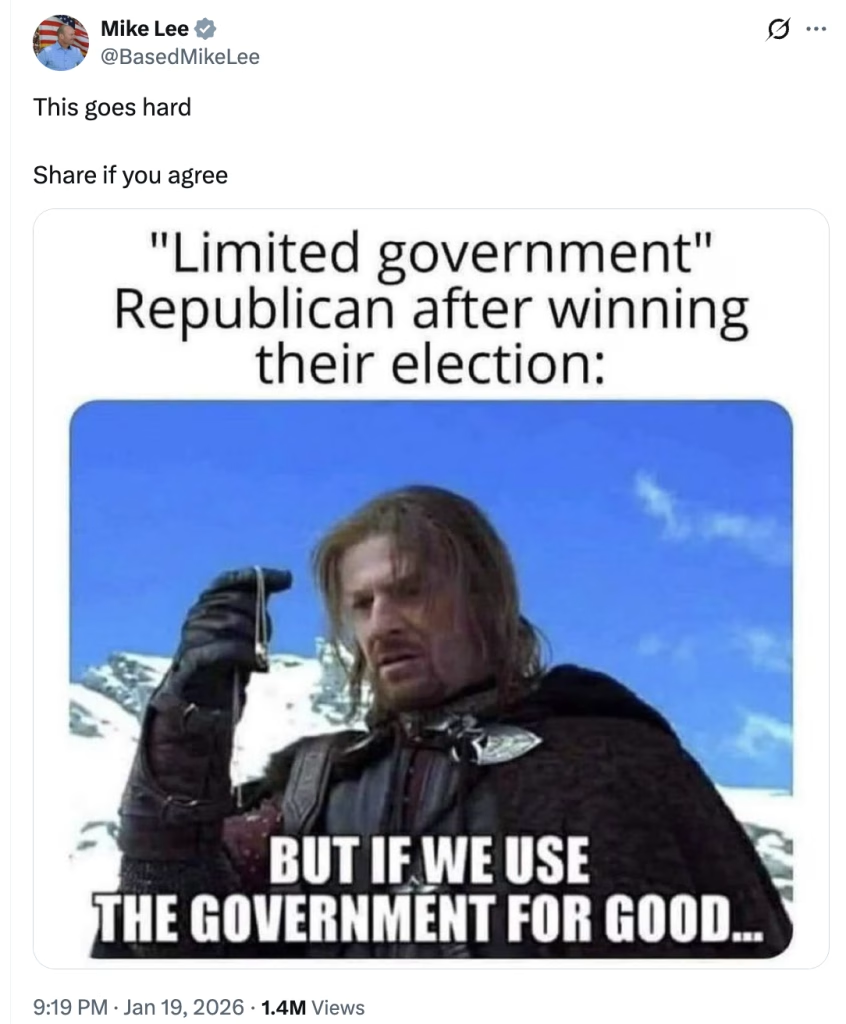

OK, now you made me defend Mike Lee.
Boromir was, famously, wrong about thinking he could use the One Ring for good.
Tolkien, and even the LOTR films, make this as clear as day. So clear, in fact, that I think that Lee is saying that the Republicans should not use the power of the government (and thus repeat Boromir’s mistake), but rather destroy this power now that they have the chance.
That may be dumb in the real world, but it is not necessarily authoritarian.
The market slid because it recognizes the new reality of American abdication of its leadership role.
Here is Steve Schmidt, commenting on the implications of a speech by Canada’s Prime Minister Mark Carney at the World Economic Forum at Davos:
“Steve Schmidt”
Here is the opening part of Mark Carney’s remarks:
Here is a CBC link re: Carney speech:
“CBC“
@charontwo:
Hopefully not too OT, some more links relevant to America’s evaporating hegemony:
“Foreign Affairs/Drezner”
“Paul Musgrave”
…
@drj:
I don’t think Mike Lee understands that.
The meme is making fun of people who don’t understand the temptation of the ring.
And Lee is very much seeing using the government to his prefered ends.
Related, Canada’s been wargaming a US invasion.
At this point, I wouldn’t be surprised if Canada began to develop nuclear weapons and delivery systems.
@charontwo: Let me answer the first question. “Why were people surprised by the dissolution of the Soviet Union?” Because we were told over and over again that they were an implacable enemy intent on our destruction and must be opposed everywhere on Earth. This message was drummed into us, and we built military bases all over the world, built up a military industrial complex that consumed much of our economy, and engaged in wars in countries like Korea and Vietnam that the average person could not find on a map. The elites in power in both countries found this a useful paradigm to absorb economic and legal power to those elites.
Currently, we are told to oppose Chinese advances in acquisition of rare earths for technology development. If the Chinese make advances in technology, does that hurt me and you?
@Steven L. Taylor:
This is, of course, not very important, but the quotation marks around “limited government” seem to indicate irony (what else are these doing there?).
I’ll grant you that Mike Lee may have rather spectacularly missed the point, but the original meme maker perhaps not so much.
@drj: I think Lee is misinterpreting the meme.
@charontwo: Thanks for the links, especially the Carnet speech. Impressive. Would be interested in the take of a political science guy on his thoughts. A part of me thinks maybe things can be normalized after Trump leaves but then I remember that the people who elected him are still around.
Stevel
@charontwo: I don’t buy the argument that the US debt can be held over our heads. Especially under Trump.
Trump believes having others hold his debt gives him power. He’s shown over and over again that bankruptcy is good for him personally. It’s the ones loaning the money that are at risk. Because they care more about what is owed them than Trump does.
@steve222:
Alliances and other relationships need trust to work. America can’t be trusted while over half of Republican voters are Trumpist/MAGA.
NATO is badly compromised now and can never fully recover, likewise many other relationships.
@Scott:
Inflation and high interest rates are politically damaging, and Trump appears to care plenty about both.
Foreigners can push the dollar down by buying fewer, causing inflation. Foreigners can push interest rates up by buying less Treasury debt instruments, bonds, notes, T-bills. Any connection of these to Trump’s personal finances is tenuous.
@charontwo: You are, of course, technically correct. However, we are dealing with Trump. Expect the irrational.
@Scott:
There’s an old saying: Borrow a dollar and the bank owns you. Borrow a million, and you own the bank.
Bonds are not the same as loans, and countries are definitely not banks. A few years ago I heard US bonds describe das tribute paid by other countries to to America. I didn’t understand it at the time, given it came without an explanation, but I think I do now. Essentially other countries finance the ever growing US debt, which comes from chronic deficit spending.
If Europe and Canada sells their US treasuries en masse, how does that affect the price, and thus the yield of new debt bonds? What does that do to the value of the dollar vs other currencies? How much does the Fed hold in treasury bonds?
It’s not a field I understand well. So, I’m not sure about much of this nor know what else is involved. Or how much would the holders be hurt if they sell large amounts.
@Scott:
He’s gone TACO before when the bond and stock markets sank. Long term interest rates climbing to near 10% might even have R’s screaming for impeachment.
@Kathy:
Interest payments on outstanding Treasury paper is already a big chunk of the federal budget. The deficit means the constant issuing of new paper which adds to that amount. A lot of the outstanding paper was issued when interest rates were lower, so as that comes due it gets replaced by new paper at higher rates.
So there are potential problems, linked to how much faith people have in the probity of the central bank (the Federal Reserve system).
@Slugger: I accept that we need rare earths to keep up in the technological part of the arms race. China might collapse one day, but it might well not be before doing a smash and grab with Taiwan and elsewhere in Asia.
I do not accept that we need to own Greenland in order to get these rare earths. Apparently the residents of Greenland don’t feel all that well-disposed toward giant mining operations, but it probably isn’t an all-or-nothing thing. We can just buy the stuff. We can lease land. And so on.
@Scott:
@Kathy:
My very rough understanding of how it works is that as the price goes down the yield goes up. If it’s cheap, no one’s buying it therefore you have to offer a higher yield to entice people to buy. The U.S. was able to rig the system in its favor by being able to price oil in dollars AND offer a stable place to park your money. It was boring, but safe. It was also basically concrete, because as noted above, the U.S. general didn’t demand as much as it could in return.
This is where it doesn’t matter how irrational Trump gets. That whole system was predicted on two things: 1. The U.S. as a whole remaining stable and basically rational, and 2. Pure, uncut, fucking vibes. The U.S. has proven that it is both not stable and wildly irrational. The GOP in its current form is one part of that. Another part is that, effectively, half the country decided to give Trump another go after what we went through the first time. Trump, the GOP, and more broadly C/conservatives can remain irrational much longer than anyone else can stand to deal with them. This is important because the rest of the world understands that right behind Trump is Vance and his fucking brain is cooked on conservative bullshit too. My guess that the only differences between a Trump admin and a Vance admin is that 1. Vance won’t be constrained by whatever weird fears about killing people and markets like Trump does, and 2. The cult of personality dies with Trump.
My question is what is the minimum percentage of debt can the Europeans and Canadians dump to cause a sharp hard shock in the U.S. without nuking their own economies. The other thing that the Europeans and Chinese can do is to refuse to pay for oil in Dollars. The economy is the true strength and weakness of the U.S.
We’ve killed that.
@Jay L. Gischer:
The main rare earth bottleneck for the OECD vs China is refineries, not mines.
There plenty of deposits elsewhere, including the US, Canada, Australia, Europe, Brazil that are going to be way lower cost to mine than Greenland.
The entire kerfuffle regarding rare earths is a point in the argument against purely market driven economics and for industrial policy. China has cornered the market on rare earth refining because the consumers or rare earths looked for the cheapest price and the non-Chinese producers either moved operations to China and/or shut down non-Chinese refineries.
Governments saw moving refining to China as solving a pollution problem as RE refining is messy with a lot of nasty waste.
@Beth:
Mexico has had economic and debt crises to spare. The big difference is we do get loans from banks, and from international institutions like the IMF and the World Bank, and these are different from government debt bonds (which we also have).
in some of these, there was much talk by politicians and pundits about capital flight. This means both foreign and domestic investors, large ones, taking their money out of the country. Inevitably this would involve the sale of government bonds. The consequences aren’t good.
And this was mostly due to economic mismanagement and corruption, not of an unstable leader or internal repression.
@Kathy:
There are various aspects to the US bond market in relation to foreign demand.
Firstly, the doallar is the effective gloabl reserve currerncy
60% of of global trade is conducted in dollars; about $20 trillion per annum, iirc.
The dollar is on one side of about 90% of all foreign exchnge transactions, running at about $8.5 trillion per day.
Half of all cross-border bank loans and international debt transactions are in dollars: about $40 trillion total value.
Non-US banks hold about $15 trillion in dollar-denominated assets.
All this means there is a simply mind-boggling enormous quantiy of dollars around the globe seeking for places to get parked that are both secure and interest bearing.
If they don’t get into US Treasury bonds directly, the banks offering such account will themselves use their dollar deposits to buy US bonds at scale.
All this means US Treasuries have a huge market demand, which in turn makes US bond interest rates lower than they would otherwise be, and props up the value of the dollar.
So US federal debts are cheaper to fund, and deficits are easy to finance.
And all this works … until it doesn’t.
Things that could topple it are: artificially depressed interest rates relative to inflation, a dollar value crash, a bond market panic and slump, a turn away from the dollar as defualt international reserve currency, a failure to fund the deficit, a general depression in the US, etc. In practice they would all interact.
Which is why Trumps running battles with the Fed, and administration remarks about being “relaxed” about a dollar devaluation make the traders nervous.
@JohnSF:
Empires never figure they’ll fall or decline, but none has yet done anything but in the end.
Usually, though, they last far longer than a century and a half. And I’d place the US as predominant only since the end of WWII.