Recent South Korean Elections
Some context.
To follow on from James Joyner’s post about the martial law declaration in South Korea, I first went to the BBC’s ongoing coverage which led me to look at recent electoral results.
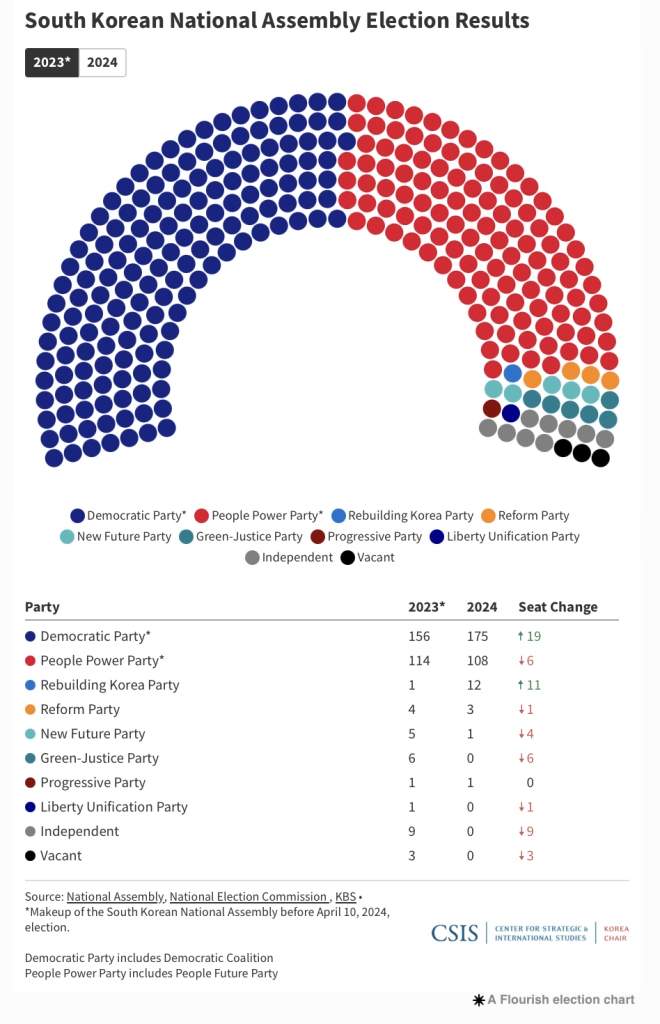
It is worth noting that in the April 2024 elections, the opposition won handily (via the CSIS, South Korea’s 2024 General Election: Results and Implications):
On April 10, South Korea held its 22nd general election. The main opposition Democratic Party (DP) emerged victorious, winning a majority of the 300 seats in the National Assembly, with 175 of seats to the ruling People Power Party’s (PPP) 108 seats. The overall voter turnout was 67 percent, which was the highest record in 32 years. Traditionally considered as an implicit referendum on the incumbent president, the election received considerable attention as an opportunity to gauge South Korean citizens’ level of approval of President Yoon Suk Yeol. President Yoon’s domestic and foreign policy will face significant headwinds but given that he inherited a divided government two years ago, we do not expect significant changes.
Here’s the seat distribution:
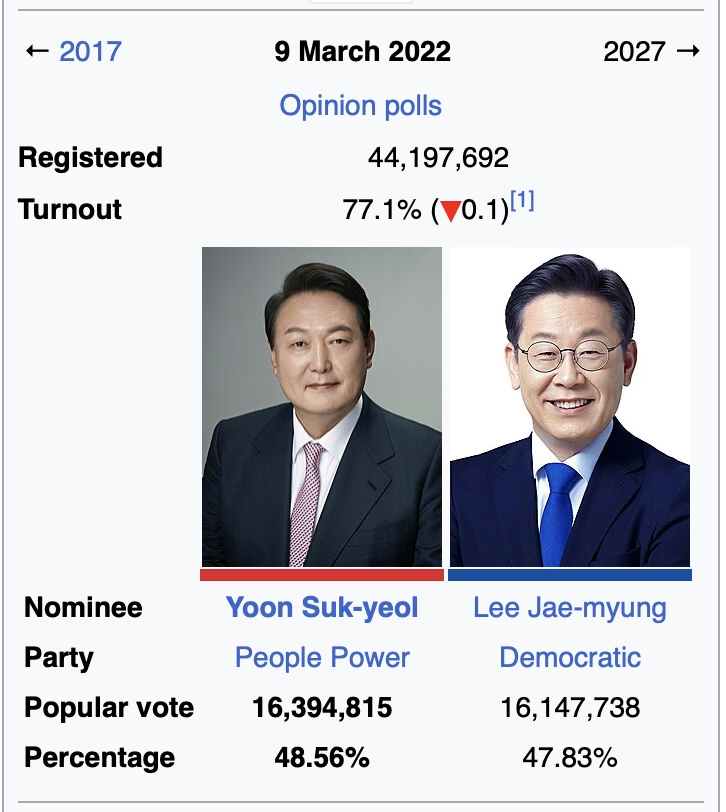
Then, stepping back two years to the 2022 presidential election, we find that President Yoon barely won the election. He won a plurality and only bested his opponent by 0.73%
I am no expert on South Korean politics, although I have some general knowledge. I find President Yoon’s claims that the South Korean Democratic Party has to be tamed because of North Korean sympathies to sound like nothing but a pretense for declaring martial law, not a serious accusation.
This appears to be nothing more than an authoritarian move by Yoon.
More from the AP:
The surprising move harkens back to an era of authoritarian leaders that the country has not seen since the 1980s, and was immediately denounced by the opposition and by the leader of Yoon’s own conservative party.
[…]The leader of Yoon’s conservative People Power Party, Han Dong-hoon, called the decision to impose martial law “wrong” and vowed to “stop it with the people.” Opposition leader Lee Jae-myung, who narrowly lost to Yoon in the 2022 presidential election, called Yoon’s announcement “illegal and unconstitutional.”
Yoon said during a televised speech that martial law would help “rebuild and protect” the country from “falling into the depths of national ruin.” He said he would “eradicate pro-North Korean forces and protect the constitutional democratic order.”
“I will eliminate anti-state forces as quickly as possible and normalize the country,” he said, while asking the people to believe in him and tolerate “some inconveniences.”
[…]
Yoon’s move is the first declaration of martial law since the country’s democratization in 1987. The country’s last previous martial law was in October 1979.

Per CNN, the leader of Yoon’s own party is calling this illegal.
Self coup.
@Michael Reynolds: Yep. AP confirms above.
@Kathy: Yep.
It sounds as though this is going to be short-lived given there seemed to be little signs of preliminary work to make this stick. However, I haven’t followed South Korea. My experience with the country consists of being there in the 80s and watching Pachinko on Apple. So, no valid opinion.
Atrios had this to say,
It is what DeUseless would do if the state lege by some miracle went Dem.
I’m looking forward to Cracker’s input on all three posts on the subject, given the years he lived there teaching at university.
@Flat Earth Luddite: Wow, zeeb, this is pretty outside my experience. It is reminiscent of stories students told me about the Gwangju Uprising, either from their own experience or accounts from parents and relatives, though.
It appears as though Lee Myung-bak may well mark the end of normalcy in Korean conservatism. From Park Geun-hye on, Korean political conservatism has been continually been remodeled (and renamed as a political party/faction) to distance it from the previous debacle of conservative governance. My contacts in Korea expressed surprise at the election of Yoon, thinking he was a bridge too far, but it’s been as common to alternate between conservative and liberal there as it is here.
It will be interesting to see what Korean conservatism will transmogrify into after this. I don’t think it will be any better than any other evolutions that are currently in progress. It would be nice to have conservatism as a counterweight to liberal excess, just as liberalism serves in the other direction. But that doesn’t appear to be on the horizon.
Context for some of the tension/conflict in South Korea from a South Korean journalism professor
This seems to be an ongoing theme in conservative governments since before Lee Myung-bak. He was openly corrupt and corruptible, but nothing like this–or even Park Geun-hye.