Record Number of Congressmen Not Running for Re-Election
An ominous sign for the majority party.
NPR (“The record-setting pace of retirements from Congress continues, led by Republicans“):
One in eight members of Congress now say they plan to leave their current seats after this election cycle, the second-highest total in the last century.
According to NPR’s congressional retirement tracker, as of March 5, there are 67 current representatives and senators who are retiring or running for a different office — 13 senators and 54 House members.
They include the surprise retirement announcements this week from Montana Republicans Sen. Steve Daines and Rep. Ryan Zinke and Utah Republican Rep. Burgess Owens’ decision in the wake of that state’s redistricting that adds a Democratic-leaning seat.
In total, 36 lawmakers say they intend to retire from public office with the rest looking to run for a different office. There are 15 looking to become governors of their states, 15 looking to make the jump from House to Senate and Texas Republican Rep. Chip Roy is running for attorney general of his state.
Roy heads to a May 26 runoff after finishing second in Texas’ March 3 primary.
Other notable retirements include longtime leaders such as California Rep. Nancy Pelosi and Kentucky Sen. Mitch McConnell and a slew of politicians looking to flee Washington, D.C., for state or local offices.
Tennessee Republican Sen. Marsha Blackburn and Colorado Democratic Sen. Michael Bennet are not up for reelection in 2026 but would resign their seats if they win their respective gubernatorial races.
They join 10 lawmakers who began the 119th Congress in January and have since died or resigned. Former Rep. Mikie Sherrill resigned her New Jersey House seat effective Nov. 20 after winning her race for governor earlier in the month.
As the 2026 midterm primaries get underway, Texas Republican Rep. Dan Crenshaw is the first incumbent that voters chose to send home.
Four other Texas incumbents — Republican Sen. John Cornyn and Democratic Reps. Al Green, Christian Menefee and Julie Johnson will also have their fates decided in the runoff. Republican Rep. Tony Gonzales announced late March 5 that he would retire at the end of his term after admitting he had an extramarital affair with a former staffer who later died by suicide.
Add one more to the list: California Republican Rep. Darrell Issa, whose seat got consolidated in the recent partisan gerrymander, and announced late yesterday that he would not run.
Let’s grant that there are multiple categories here that we should not lump together:
- House Members running for a higher office and thus ineligible to run for re-election
- Elderly Members who really ought to have retired years ago, most of whom are almost sure to be replaced by co-partisans
- Relative moderates who have been ousted by more ideological candidates in a party primary
- Those who are just sick of the environment in DC
- Those who would likely lose in November, so are bowing out to avoid the embarrassment
Still, those situations exist in most cycles, and we’re at near-record levels.
My strong guess, then, is that we’re seeing an usually high number of the last two, particularly the last one. Usually, that means the insiders anticipate a wave election that’s going to oust members of their party—usually the majority party.
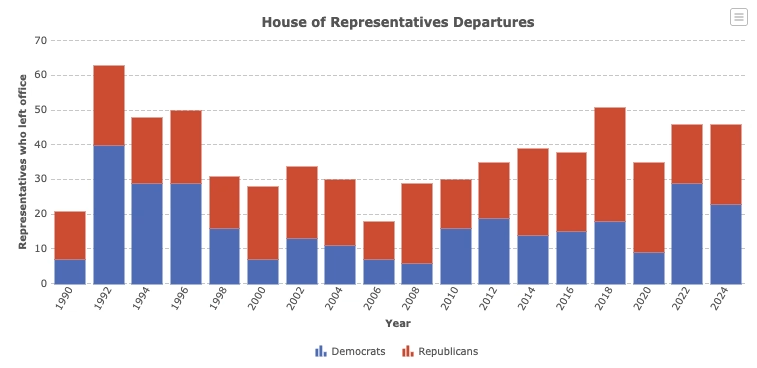
OpenSecrets has tracking going back to 1990 for both the House:
and the Senate:
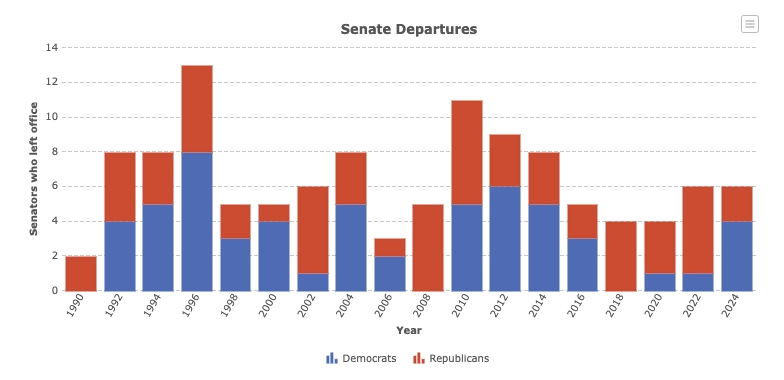
Coincidence with wave elections is imperfect but noticeable.

One of the subtle things that generally causes more House Republicans to retire than House Dems are the caucus rule changes Newt Gingrich made. Republican committee chairs are term-limited and the rules for selecting Republican chairs greatly devalued tenure. Being a House member at 68 and getting all of the perks that go with being chair of a major committee is one thing; being 68 and a back bencher with none of those perks is quite another.
The Dems will never have a Paul Ryan figure — elected Speaker at age 45 after already chairing the Budget Committee and the Ways and Means Committee — unless they change their rules.
To the list you can add Darrell Issa RCA, while fellow Cali R Kevin Kiley has filed to run as an independent.
Starr County Texas, went 58% for Trump. In this primary, there were 6,698 votes cast in the Democratic primary, and 249 cast in the very competitive Republican primary. 96% of votes were cast for Democrats, and 4% for Republicans.
Starr County is right up against the Rio Grande and is 96% Hispanic.
How mad are Hispanic voters at Trump? Of that Democrat number, ~2,000 votes were cast for a Black woman. Eight times as many Hispanic voters went for the Black woman over either of the two white Republicans.
Carville the other day pointed out that Democrats are getting that rarest of political opportunities: a second look. If there is one thing we need to do it’s court Hispanic voters. Three words: Nevada, Arizona and Texas.
It’s funny. Darryl Issa makes a short list of Jay’s favorite Republicans because of his relentless support for Net Neutrality. Since he has roots in the tech world, he understood this was not just something to protect bleeding hearts, but all independent websites. These days, nobody cares about independent websites except for a few fringe lunatics *cough*.
This is in spite of Darryl Issa being the guy responsible for the Gray Davis recall, which he thought gave him a shot at being governor. Like Arnold Schwarzenegger, he could probably never win the Republican primary, but once Arnold threw his hat in, he was doomed.
@Jay L. Gischer:
Hey, now. I definitely care about independent websites. Plus, infrastructure companies (ISPs) have no business choosing how to prioritize everyday traffic or picking winners and losers.
Oh, nevermind. I’m included.
—
Have there been any studies about the order in which residential services are repaired and restored after disasters or other outages? Does it have correlations with demographics?
@Kurtz:
There are lots of studies for the big-picture widespread disaster problem. It’s a classic optimal scheduling problem. As I recall — it’s been quite a long time — the biggest problem is getting accurate data in sort of real time. What exactly is broken? When will major replacement parts be available? What roads are open? How soon will the folks from LADWP* head home? Lots of pieces to juggle.
When I worked on the similar problem for the phone companies back in the day, the penalties that might be imposed for too many people out of service for too long were based on gross numbers. One time I heard a senior manager put it this way: “The Congressman, no matter how mad he is about waiting another day, can’t do as much damage to us as the PUC staff will if we leave that 1,000 customer poor neighborhood down for another day.”
I’m sure there are individual cases that are discriminatory. I worked for a while with some people who did repair work for cable TV outages in the Atlanta area. There were neighborhoods where the repair people didn’t go after dark. There were jobs that went to the bottom of the list because the first troubleshooter who went by looked at the amplifier through binoculars and the obvious reason for failure was someone had shot it six times.
* A friend who lives in the part of North Carolina that got hit hardest by Hurricane Helene sent me a picture he took about six days into the recovery of a bunch of Los Angeles Dept of Water and Power trucks/crews in the staging area one morning getting assignments.
@Michael Cain:
Thanks.
My experience (ie, anecdotal observation) has been that the order in which power is repaired after a hurricane appears logistical. But that is from casual tracking of maps after the storm has passed.