Robert Redford, 1936-2025
The actor and director is gone at 89.
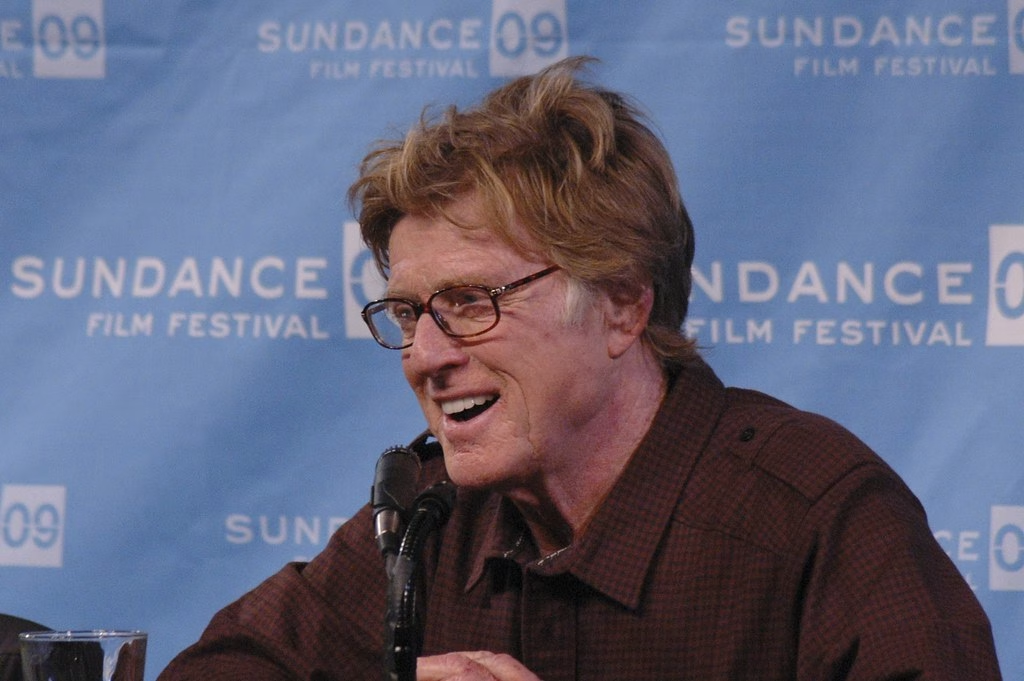
New York Times, “Robert Redford, Screen Idol Turned Director and Activist, Dies at 89“
Robert Redford, the big-screen charmer turned Oscar-winning director whose hit movies often helped America make sense of itself and who, off screen, evangelized for environmental causes and fostered the Sundance-centered independent film movement, died early Tuesday morning at his home in Utah. He was 89.
His death, in the mountains outside Provo, was announced in a statement by Cindi Berger, the chief executive of the publicity firm Rogers & Cowan PMK. She said he had died in his sleep but did not provide a specific cause. He was in “the place he loved surrounded by those he loved,” the statement said.
With a distaste for Hollywood’s dumb-it-down approach to moviemaking, Mr. Redford typically demanded that his films carry cultural weight, in many cases making serious topics like grief and political corruption resonate with audiences, in no small part because of his immense star power.
As an actor, his biggest films included “Butch Cassidy and the Sundance Kid” (1969), with its loving look at rogues in a dying West, and “All the President’s Men” (1976), about the journalistic pursuit of President Richard M. Nixon in the Watergate era. In “Three Days of the Condor” (1975) he was an introverted C.I.A. codebreaker caught in a murderous cat-and-mouse game. “The Sting” (1973), about Depression-era grifters, gave Mr. Redford his first and only Oscar nomination as an actor.
Mr. Redford was one of Hollywood’s preferred leads for decades, whether in comedies, dramas or thrillers; studios often sold him as a sex symbol. His body of work as a romantic leading man owed a great deal to the commanding actresses who were paired with him — Jane Fonda in “Barefoot in the Park” (1967), Barbra Streisand in “The Way We Were” (1973), Meryl Streep in “Out of Africa” (1985).
“Redford has never been so radiantly glamorous,” the critic Pauline Kael wrote in The New Yorker, “as when we saw him through Barbra Streisand’s infatuated eyes.”
He branched into directing in his 40s and won an Academy Award for his first effort, “Ordinary People” (1980), about an upper-middle-class family’s disintegration after a son’s death. “Ordinary People” won three other Oscars, including for best picture.
His next film as a director, “The Milagro Beanfield War” (1988), a comedic drama about a New Mexican farmer denied water rights by uncaring developers, was a flop. But Mr. Redford stubbornly refused to pursue less esoteric material. Instead, he directed and produced “A River Runs Through It” (1992), a spare period drama about Montana fly fishermen pondering existential questions, and “Quiz Show” (1994), about a notorious 1950s television scandal. “Quiz Show” was nominated for four Oscars, including best picture and best director.
Perhaps Mr. Redford’s greatest cultural impact was as a make-it-up-as-he-went independent film impresario. In 1981, he founded the Sundance Institute, a nonprofit dedicated to cultivating fresh cinematic voices. He took over a struggling film festival in Utah in 1984 and renamed it after the institute a few years later.
Variety, “Robert Redford, ‘Butch Cassidy’ and ‘All the President’s Men’ Icon, Dies at 89“
Robert Redford, the leading man with the golden-boy looks who won an Oscar for directing “Ordinary People” and later became a godfather for independent film as founder of the Sundance Film Institute, has died. He was 89.
Cindi Berger, chief executive of the publicity firm Rogers & Cowan PMK, confirmed the news to Variety.
“Robert Redford passed away on September 16, 2025, at his home at Sundance in the mountains of Utah — the place he loved, surrounded by those he loved,” Berger said in a statement. “He will be missed greatly. The family requests privacy.”
The actor-turned-director — who had a stellar run in such films as “Butch Cassidy and the Sundance Kid,” “The Way We Were,” “The Sting,” “Three Days of the Condor” and “All the President’s Men” — had worked less frequently both in front of and behind the camera in recent years.
His last on-screen acting job was in 2019’s “Avengers: Endgame,” in which he reprised his role as Secretary Alexander Pierce and joined several other Marvel vets such as Michael Douglas and Tilda Swinton.
Redford had starring roles in “A Walk in the Woods,” which became a breakout indie hit, while 2018’s “The Old Man & the Gun” drew positive reviews. He also served as executive producer on numerous television projects, most recently for AMC thriller “Dark Winds.”
In his ’70s heyday, few actors possessed Redford’s star wattage, aided considerably by his tousled blond locks, granite jaw and million-dollar smile. With his environmental activism, anti-establishment approach to filmmaking and pioneering efforts in providing a platform for indie filmmakers, Redford was able to use his celebrity to subvert the status quo while advancing his own creative agenda.
Like Gary Cooper, Gregory Peck and Steve McQueen, Robert Redford was never about having a particularly wide range as an actor, but as a movie star in his prime, few could touch him.
“He’s a very instinctive, impulsive actor,” the late Sydney Pollack told Variety in 2002. “I don’t think there’s anything studied or premeditated about the work. He’s the opposite of the actor who wants to rehearse and pin things down.”
Starting in 1959, Redford traded his time between television, appearing in such shows as “Perry Mason,” “Playhouse 90,” “Alfred Hitchcock Presents” and “The Twilight Zone,” and acting on the New York stage, in such productions as “Tall Story,” his theatrical debut, and Neil Simon’s “Barefoot in the Park” (1963), reprising the latter role in the 1967 Hollywood version opposite Jane Fonda.
He made his feature film debut in 1962’s “War Hunt,” in which he appeared with another young actor, Pollack, who would eventually direct Redford in seven movies, also including “Out of Africa” and “The Electric Horseman.’
After co-starring in two films with Natalie Wood — “Inside Daisy Clover” (1965), a lurid tale of the Hollywood starmaking machinery, and “This Property Is Condemned” (1966), his first collaboration with director Pollack — Redford’s breakthrough role was as the Sundance Kid to Paul Newman’s Butch Cassidy in what would become the top-grossing film of 1969.
In 1972, “The Hot Rock” and “The Candidate” both provided solid roles before a string of films that made him a superstar.
Starting with successful Western “Jeremiah Johnson,” he then reunited with Newman, and earn an Oscar nomination, for “The Sting,” the Motion Picture Academy’s pick for best picture of 1973, and would become the No. 1 box office star for the next three years. Also in 1973, he cemented his role as a romantic lead opposite Barbra Streisand in “The Way We Were.” Despite lukewarm reviews, it made $50 million dollars and bolstered his smoldering reputation.
Subsequent starring roles included “The Great Gatsby,” “Three Days of the Condor” and “All the President’s Men,” which Redford exec produced, starred in and shepherded from the early manuscript stage of Bob Woodward and Carl Bernstein’s bestselling book. The film racked up eight Oscar nominations, losing the top award to “Rocky.”
In the 1980s and ’90, he transitioned into more mature roles, from the middle-aged baseball player of “The Natural” to the free-spirited big game hunter in “Out of Africa” and the callous rich gambler in “Indecent Proposal.”
Redford’s rise to the top was all the more remarkable given his penchant for characters who were aloof, sardonic, even thorny. In films like “This Property Is Condemned,” “Downhill Racer” and “Tell Them Willie Boy Is Here,” he played unrepentant heels, and yet his charisma was undeniable.
The sheer breadth and longevity of his career were remarkable. Going from movie star to top-tier director has precedent, of course, but it’s still unusual. That he may be best remembered for taking a moribund film festival and making it a major annual event is quite the legacy.

Three Days of the Condor
The Sting
Butch Cassidy and the Sundance Kid
All the President’s Men
All is Lost
Ordinary People
The Old Man and the Gun
Barefoot In the Park
Sneakers
Jeramiah Johnson
The Horse Whisperer
The Electric Horseman
The Way. We Were
Out o Africa
The Last Castle
Legal Eagles
Out of Africa
Quite the legacy. I’m bummed I never got to work with him. Met his daughter in Utah during covid, and she was lovely. Spent about an hour with her touring Utah Film Studios.
RIP, Mr. Redford. Say hi to Paul Newman for me.
The Sting, All the President’s Men, and BCATSK are my favorite Redford films he acted in. As for him as a director, I have more mixed feelings. Ordinary People won him an Oscar but I’m not a fan of the movie. Quiz Show OTOH was excellent. ‘What do we do now?*’ Oh RIP
*- Famous last words of Redford’s character in The Candidate.
RIP to a great actor. As a kid, The Natural was awesome. It will always be my baseball movie. Spy Game was also a good one for him later in life. Him, Newman and Eastwood can do more with a stare than most for sure. Something in their eyes, and all that talent sure helps as well.
As usual, Variety’s reporting is sloppy and incomplete.
Redford’s actual last screen appearance was in an episode of the most recent season of Dark Winds, in which he and his partner in EPing George RR Martin appeared for one scene a grumpy old men…
Mike Nichols on telling Redford he can’t play a loser:
“I interviewed hundreds, maybe thousands, of men,” Nichols admitted of the casting process per Vanity Fair, before his conversation with Redford turned out to be a short one. “I said, ‘You can’t play it. You can never play a loser’. And Redford said, ‘What do you mean? Of course I can play a loser’. And I said, ‘OK, have you ever struck out with a girl’. And he said, ‘What do you mean?’. And he wasn’t joking.
In the early 2000s, I knew someone who worked at a very fancy hotel in Manhattan were celebrities liked to stay. He was pretty jaded about famous people. One day, the concierge told him that whoever was under the fake name checking in tomorrow was Robert Redford. He swore him to secrecy. The next day, the entire staff of the hotel (working or not) plus a few of their friends happened to be in the neighborhood, just accidentally dropping in when Redford was checking in. He said it was like a stakeout.
@Bill Jempty:
As is your right, but damn, not many directorial debuts win four Oscars, including Best Picture and Best Director. I still believe Mary Tyler Moore deserved an Oscar for her performance – which Redford pulled out of her. Judd Hirsch was amazing, playing against type. And Dinah Manoff. gave the best performance of her life. And I fell completely in love with Elizabeth McGovern. (I got to work with her in the mid 90’s and she was still stunning, gracious and made my crush on her even stronger.)
It’s a near perfect movie in terms of structure, story, acting and directing.
It won many, many awards, including Academy, Golden Globe, DGA, National Board of Review, National Critics, WGA,
It has a 90%+ rating on Rotten Tomatoes, and a perfect A+ on Cinemascore.
Not many films have that pedigree.
Robert Redford
Twilight Zone 1962
I remember seeing this as a rerun many years ago. “That’s Robert Redford!”
I was an avid Zone follower during it’s original run and likely saw this when it first aired.
I would have been 14 years old and no clue who I was watching.
Nobody is mentioning Redfords role in “Captain America: The Winter Soldier” where he played a heavy. Yes, it’s a superhero movie. Consider the plot:
A secret organization infiltrates and takes over the government and launches a plan to engage in a surveillance state, watching every single citizen, and snatching the “undesirables” off the street, or maybe just killing them outright.
Naw, way to far-fetched. That would never happen here, right?
@EddieInCA:
Roger Ebert described McCabe and Mrs. Miller as perfect. What film was he listening to I ask? The film’s sound is a mess, and director Robert Altman supposedly even admitted it.
So much for perfect movies. Why I didn’t like OP, I don’t recall. I saw the movie in the theaters when I was 19 and maybe once on HBO when it premiered there. I have no desire to watch it again.
@Gregory Lawrence Brown:
Redford also appeared on Perry Mason.
@EddieInCA: “As is your right, but damn, not many directorial debuts win four Oscars”
To be fair, any very good film directed by an actor has a great chance of winning best picture, because actors make up such a large proportion of the Academy’s voting membership. And this was a very good film, history seems to suggest that the one that deserved the award that year was Raging Bull.
Now if we were talking about Quiz Show, I’d be all in…
@EddieInCA:
Moore was very good. Of the nominated actresses that year, Sissy Spacek (who won for Coal Miner’s Daughter) and Gena Rowlands (nominated for Gloria) were both stronger. Spacek was completely deserving.
If I had my druthers, it would’ve been Shelley Duvall for The Shining. Her unfairly-maligned performance is extraordinarily real, which makes sense once one learns how Kubrick tortured her on set.
Awards in general shouldn’t be taken too seriously though, as a measure of artistic merit. The amount of dreck cleaning up at awards shows while masterpieces are overlooked tells that story. Zero competitive Oscars for Hitchcock? Come on. The Color Purple 0-11 while Out of Africa rakes in statues? Silly. Has anyone voluntarily screened Out of Africa in the past thirty years? — no offense to the late Mr. Redford.
Who was it that said “The Oscars are not serious, and anyone who takes them seriously is in for a headache”? I think maybe first female Motion Picture Academy President, Bette Davis.
@DK:
I haven’t, but I did see it twice in 1985. It may be the only movie I’ve seen in the theater more than once–I went with someone who hadn’t seen it yet and was perfectly happy to see it a second time, due in no small part to Redford and Streep. I can’t say the same for the next Best Picture winner I saw in the theater, which I would not have sat through a second time.
Let’s not forget The Great Waldo Pepper. There are scenes, in particular ones of danger and death, that are difficult to forget. And I don’t know who would’ve made a better Waldo Pepper than Robert Redford.
@EddieInCA: In a political blog you leave out The Candidate?