Scott Adams, 1957-2026
The legendary cartoonist turned MAGA influencer is gone at 68.
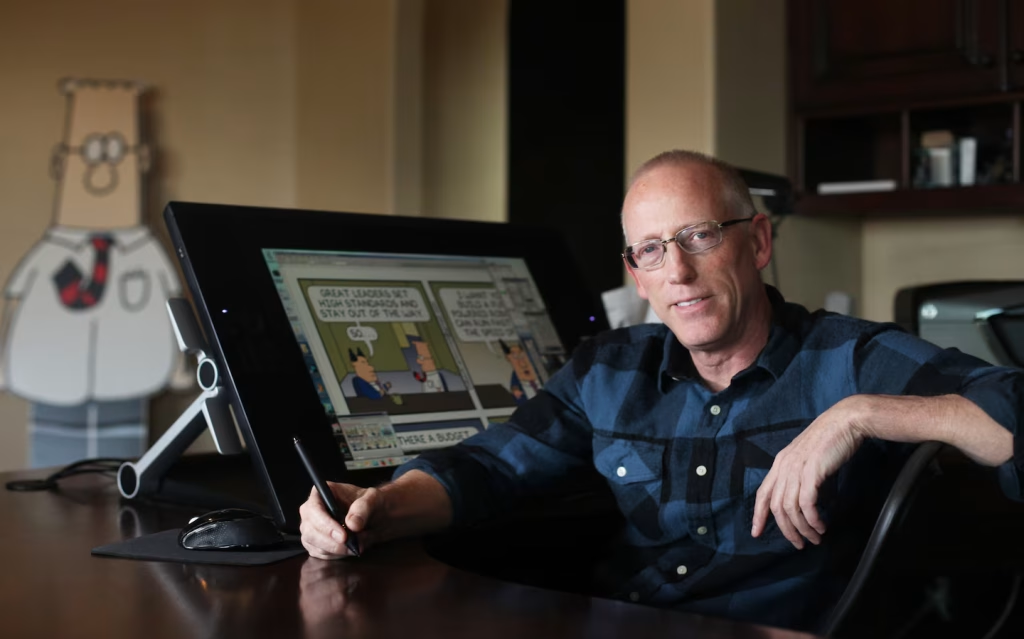
New York Times, “Scott Adams, Creator of the Satirical ‘Dilbert’ Comic Strip, Dies at 68“
Scott Adams, whose experience as a bank and phone company middle manager gave him the material to create the comic strip “Dilbert,” a daily satire of corporate life that became a sensation but was dropped by more than 1,000 newspapers after he made racist comments on his podcast in 2023, died on Tuesday at his home in Pleasanton, Calif., in the Bay Area. He was 68.
His former wife Shelly Adams confirmed his death, saying he had been receiving hospice care. Mr. Adams announced in May that he had aggressive prostate cancer and that he probably had only a few months to live.
For more than 30 years, “Dilbert” chronicled the absurdities of the high-tech workplace and skewered management. The title character was a frustrated engineer working from a cubicle at a high-tech company whose intelligent, anthropomorphic pet, Dogbert, dreamed of world domination. Other characters included Dilbert’s co-workers, Alice, Asok and Wally; the hapless Pointy-Haired Boss; and Catbert, the fire-red-colored cat and evil head of human relations.
At its peak, “Dilbert” was syndicated to about 2,000 newspapers internationally, placing it in the realm of other popular syndicated strips like “Peanuts,” “Doonesbury” and “Garfield.” Mr. Adams also published numerous “Dilbert” collections and wrote business books, including “The Dilbert Principle,” which posits that “the most ineffective workers are systematically moved to the place where they can do the least damage — management.”
[…]
“One of the reasons for his success was that he was the first one to have an office-based strip with recurring characters people could identify with, like Alice, a really smart woman who never got attention or praise,” Alan Gardner, the editor of The Daily Cartoonist website, said in an interview.
Mr. Adams suggested that Dilbert gave voice to isolated cubicle dwellers. “That’s the amazing thing I found when I went on line a couple of years ago,” he told The New York Times in 1995. “I heard from all these people who thought that they were the only ones, that they were in this unique, absurd situation. That they couldn’t talk about their situation because no one would believe it.”
Washington Post, “Scott Adams, ‘Dilbert’ creator who poked fun at bad bosses, dies at 68”
Scott Adams, who became a hero to millions of cubicle-dwelling office workers as the creator of the satirical comic strip “Dilbert,” only to rebrand himself as a digital provocateur — at home in the Trump era’s right-wing mediasphere — with inflammatory comments about race, politics and identity, died Jan. 13. He was 68.
[…]
Mr. Adams announced in May 2025 that he had metastatic prostate cancer, with only months to live. In a YouTube live stream, he said he had tried to avoid discussing his diagnosis (“once you go public, you’re just the dying cancer guy”) but decided to speak up after President Joe Biden revealed he had the same illness.
“I’d like to extend my respect and compassion for the ex-president and his family because they’re going through an especially tough time,” he said. “It’s a terrible disease.”
Mr. Adams was working as an engineer for the Pacific Bell telephone company when he began doodling on his cubicle whiteboard in the 1980s, dreaming of a new, more creatively fulfilling career as a cartoonist. Before long, he was amusing colleagues with his drawings of a mouthless, potato-shaped office worker: an anonymous-looking man with a bulbous nose, furrowed pate and upturned red-and-white striped tie.
[…]
Years before the film comedy “Office Space” and TV series “The Office” satirized the workplace on-screen, “Dilbert” poked fun at corporate jargon, managerial ineptitude and the indignities of life in the cubicle farm.
In one strip, the title character is awarded a promotion “with no extra pay, just more responsibility,” because “it’s how we recognize our best people.” In another, he’s presented with an “employee location device” — a dog collar.
Other “Dilbert” cartoons could be crassly funny. Seeking to improve the company’s image, Dilbert’s pointy-haired boss hires an ad agency that uses a computer program to come up with a new “hi-tech name” for the firm, using random words from astronomy and electronics. Their suggestion: “Uranus-Hertz.”
Mr. Adams proved adept at growing his audience during the tech boom of the 1990s, creating a “Dilbert” website long before most other cartoonists took to the internet. He also became the first major syndicated cartoonist to include his email address in his comic strip, an innovation that allowed readers to contact him directly with ideas. Their feedback convinced him to focus the cartoon entirely on the workplace, after some of the strip’s early installments explored Dilbert’s home life.
Interviewed by the Wall Street Journal in 1994, Mr. Adams observed that “the universal thread” uniting the strip’s readers “is powerlessness. Dilbert has no power over anything.”
By the end of the decade, Dilbert seemed to be everywhere, appearing on the cover of business magazines and in book-length compendiums. Mr. Adams signed off on the creation of a Dilbert Visa card and a Ben & Jerry’s ice cream flavor, branded as Totally Nuts; licensed his cartoon characters for commercials; and partnered with “Seinfeld” writer Larry Charles to develop an animated “Dilbert” television series, which aired for two seasons on the now-defunct UPN network.
Capitalizing on the cartoon’s success, he also put out a shelfful of satirical business books, beginning with the 1996 bestseller “The Dilbert Principle.” Inspired by the Peter principle, a management concept in which employees are said to be promoted to their level of incompetence, Mr. Adams argued that “the most ineffective workers are systematically moved to the place where they can do the least damage: management.”
He wasn’t entirely joking. As he saw it, the people who spouted inane ideas, sucked up to management and pretended they knew more than they did were the ones who got promoted. The workplace was a mess, he suggested, but by calling out bosses’ bad behavior, “Dilbert” could be a force for good.
“I heard from lots of people who told me, ‘My boss started to say something that was ridiculous — management fad talk, buzzwords — but he stopped himself and said, “Okay, this sounds like it came out of a ‘Dilbert’ comic,” and then started speaking in English again.’
Back when most of us got our news from newspapers, the comic strip was a big deal. Along with Calvin and Hobbes and The Far Side, Dilbert was the greatest cartoon that debuted during my time. Not only did I faithfully read all of them, but I bought multiple compendium paperbacks. In the case of Adams, I also bought a couple of his prose books, with The Dilbert Principle being the one I most remember, and was a pretty regular reader in the early days of his blog.
Alas, while he’ll likely be primarily remembered for Dilbert, his career and reputation took a turn about a decade ago. I first noted it here in an August 2015 post titled “Donald Trump, Human Bias, and the Art of the Deal.” Adams was remarkably prescient about what the future 45th and 47th President’s seemingly outlandish statements were effective with so many people.
He kept at it, repeatedly extolling Trump’s virtues as a salesman and communicator while insisting that he, personally, disliked Trump and thought he’d make a terrible President. As noted in my June 2016 post, “Dilbert’s Scott Adams and Donald Trump,” people (in this case, Amanda Marcotte) began accusing Adams of being a closet Trump supporter. I defended him, noting that this was consistent with his longstanding approach to dissecting the world. (See, for example, my July 2010 post “Steve Jobs: Phones Suck,” wherein Adams backhandedly extols the Apple founder’s brazen defense of a phone that wouldn’t make phone calls.)
Eventually, Marcotte was proven right. He became more openly MAGA and, as noted in my February 2023 post, “Dilbert Canceled,” fired after a bizarre, racist rant.
He gave off a vaguely Republican vibe but seemed quite mainstream, aside from a belief that writing affirmations out fifteen times a day will magically enable anyone to achieve wildly ambitious goals like being the world’s most successful cartoonist.
I cited his blog quite a lot in the early days of OTB but gradually drifted away from reading it in much the way I did other blogs. Overall, he seemed like a really bright guy with some interesting insights into the world.
I hadn’t given him much thought in years, though, until he resurfaced as a thinly-disguised Trump supporter during the 2016 campaign. At first, he seemed to be simply a detached analyst, noting that, however absurd Trump’s claims seemed to a rational observer, they were actually incredibly powerful as influencing measures. Soon, though, that drifted into some QAnon-adjacent conspiracy-mongering and just plain weirdness.
Whether those tendencies had always been there and I had simply missed them, or he got crotechty in his old age (see, for example, Bill Maher), I can’t say. I’ll mostly remember him for his heyday, but there’s undeniable tarnish from his venture into political commentary.

You had, but then a lot of people had. He was flirting with Holocaust denial back in 2006.
https://forward.com/fast-forward/538571/dilbert-cartoon-creator-scott-adams-holocaust-blog/
It’s endlessly frustrating to me how little attention this has gotten among Adams’ litany of offensive remarks, and it cuts against a narrative I often run across that anti-Semitism is overexposed in our culture and invariably provokes more pushback than other forms of bigotry. This is a pretty blatant example of when this was not the case.
Man, what an evergreen sentence. You can apply it to Rowling, Rogan, the Vice President, half of the current White House staff, Marc Benioff, Elon Musk (fuck, pretty much all of the Tech Bros), David Mamet, Roseanne Barr, and a thousand other people…
I guess if you are able to convince yourself that there is any redeeming quality in Trump, you are able to convince yourself of pretty much anything.
I stopped reading the Dilbert strip in 2016, when Adams urged people to vote against Hillary Clinton.
Looking back on it then, his humor was too mean. Humor tends to be mean, of course. A lot of jokes contain put downs, mockery, and insults. A lot more demeans the object of the joke, or ends with people in terrible, painful, or tragic circumstances.*
I won’t repeat them, but back in the 70s and 80s I heard lots of jokes mocking people with leprosy, with handicaps, with mental illness, with developmental problems, etc. these were rather popular, too. And ethnic and racist jokes are all too well known.
For all that, Adams’ humor was too mean.
Despite relentless, and deserved, mockery of the pointy haired boss, or his bosses above him, neither Dilbert nor his coworkers came on top often. Not to mention the boss kept enjoying financial success and a good life. The only regulars who ever came on top were Dogbert and Catbert (hey, I didn’t name them). Both of whom were downright cruel.
*I will cheerfully admit this is the case in all my El Taco jokes. A lot fo them are repurposed jokes of the kind I wouldn’t repeat in their original form.
@Kathy:
It’s the punching up vs. punching down principle. Humor based on attacking the powerful is not only valid, it’s one of the most important tools we have. And to some extent Dilbert fell in that tradition, with its mockery of the modern corporation, and the abuse it heaps on its employees. At the same time, the strip ended up mocking the employees’ helplessness. Punching-up can easily turn into punching-down for those who aren’t careful.
What I found most telling about Adams was that his descent into sexism, racism, and other egregious beliefs was driven heavily by mindless, knee-jerk contrarianism. It’s an outlook that’s captured in a quote from Glengarry Glen Ross: “I subscribe to the law of contrary public opinion. If everyone thinks one thing, then I say bet the other way.” It’s the delusion of independent thinking when a person is not thinking at all, just engaging in a narcissistic bid for attention by being different for the sake of being different. Adams questioned the Holocaust but tried not to sound like a garden-variety neo-Nazi. He questioned the theory of evolution but tried not to sound like a garden-variety creationist. He was always trying to give the impression that he was just a disaffected dude poking holes in anything he perceived as dogmatic, which is a game that can be used to undermine literally the entire edifice of knowledge in our society. When battling his cancer I assume Adams went to a doctor and not a witch doctor, but I could come up with a post questioning that choice, using the same empty-headed rhetoric he used so many times for other topics.
I miss The Far Side. Remember in 80’s going straight to Style in WaPo to read the daily Far Side before heading out to school. Or Dad saying “did you see Far side today?”lol. RIP to Dilbert guy. Strip had some good ones. Definitely have to separate the art from the artist, they can be cuckoo for coco puffs at times. Imagine if Picasso had a Twitter account…..it wouldn’t be good.
@Jc: The Far Side is absolutely my favorite comic of all time, and Larson has never had the kind of baggage you see with Adams. He’s had his share of controversies, but most of them were pretty mild, especially when measured against Adams. (The most famous controversy of all, the kerfuffle involving that cartoon about Jane Goodall, made both Larson and Goodall come off as champs and the person who protested the strip a hopeless buzz-kill.) And while the strip was rarely overtly political, many of the cartoons had pro-environmental undertones, in my opinion. It’s nice for a change not to have to separate the art from the artist. I don’t know the guy, and maybe he’ll show up in the Epstein files tomorrow, but from all the impressions I’ve gotten thus far he seems on the side of the angels.
I’m a cat guy so I always enjoy humor that laughs at dogs…
Gary Larson
Sounds exactly like the White House, that he supported, to me.
In the early days Adams’ time at Pacific Bell led to some strips that were hilarious to a select audience only. I was working at a giant telecom, and was having to follow along as some technical standards were developed. In the strip, the vendor rep tells Dilbert, “And the device conforms to every applicable international telecommunications standard.” To which Dilbert replied, “You mean, it doesn’t work and it’s not your fault.”
It reduced me to tears. It was the day after I had received a copy of a letter from Switzerland demanding that some aspect of the standard be changed. Since I was building an implementation, I could read the demand and know exactly what mistake some Swiss engineer was making (because I made the same mistake six weeks earlier). But the rules forbid me from telling the Swiss people about their mistake. It was a miracle that anything conforming to the standard ever worked properly.
I wonder where the anti feminist thinking in his life came from. The stultifyingly ignorant bosses in my life were always anti feminist treating their female employees as inferior beings. If you’re going to lampoon them, which they richly deserve, wouldn’t you avoid their attitudes?
He and Steven Jobs show us the value of unconventional medicine. Cancer doesn’t care that you’re the smartest guy in the room.
@Slugger:
He got divorced in 2014.
Ok, that sounds like an entirely glib response, and I will admit to doing no research beyond typing “Scott Adams divorce” into a search bar, but… a lot of men become raging fucking assholes after they get divorced.
Something about having to deal with a reality in which their wife is not their property and can make their own decisions — such as choosing to become an ex-wife, and using the power of the state to make that happen without their manly consent — breaks them.
Not all divorced men are horrible people, obviously, and there are many horrible people who are not divorced, but it’s definitely an inflection point.
@Slugger: @Gustopher: I think I remember a poll from 2024 indicating that divorced men overwhelmingly supported Trump—which may seem to conflict with the more traditional pattern (which still held in exit polls that year) that married people are likelier to vote Republican, unmarried people Democrat.
I also think that, when it comes to offices, one big dividing line is attitudes toward the modern crackdown on sexual harassment in the workplace. Given Adams’ generation and the way he talked about these matters (you can even see hints of it in the strip), he was exactly the type of man to think women had become emboldened to weaponize frivolous sexual harassment allegations against men, effectively neutering men from engaging in the “guy talk” he grew up thinking was acceptable and was unwilling to adjust his thinking on when it increasingly came under scrutiny in the broader culture.