Steven Takes a Picture (or a Few)
This time at the Georgia Capitol.

Part of why I have not written as much over the last several days is that I was sojourning for a few days in Atlanta. During my visit, I visited the state Capitol. Not surprisingly, there are a lot of pro-Confederate statuary and the like on the grounds and inside the building. A resident of Alabama, for example, should not throw stones, I guess.
Still, some specific things struck me.
First, it was this statue of Alexander Stephens.
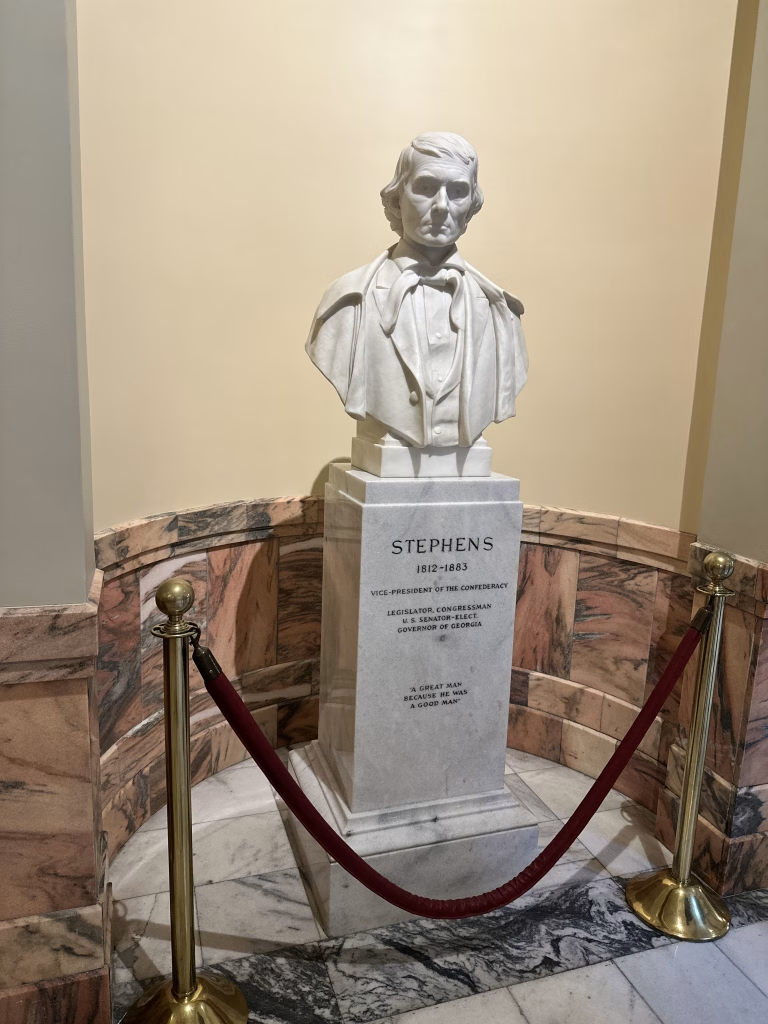
Now, just in case readers are unaware, Stephens was not only, as the statue notes, the Vice President of the Confederate States of America, but he was also the author and presenter of what is known as the Cornerstone Speech.
Allow me to quote it.
Our new government is founded upon exactly the opposite idea; its foundations are laid, its corner-stone rests, upon the great truth that the negro is not equal to the white man; that slavery subordination to the superior race is his natural and normal condition.
I would contrast that quotation with this statement engraved in the base of the statue.
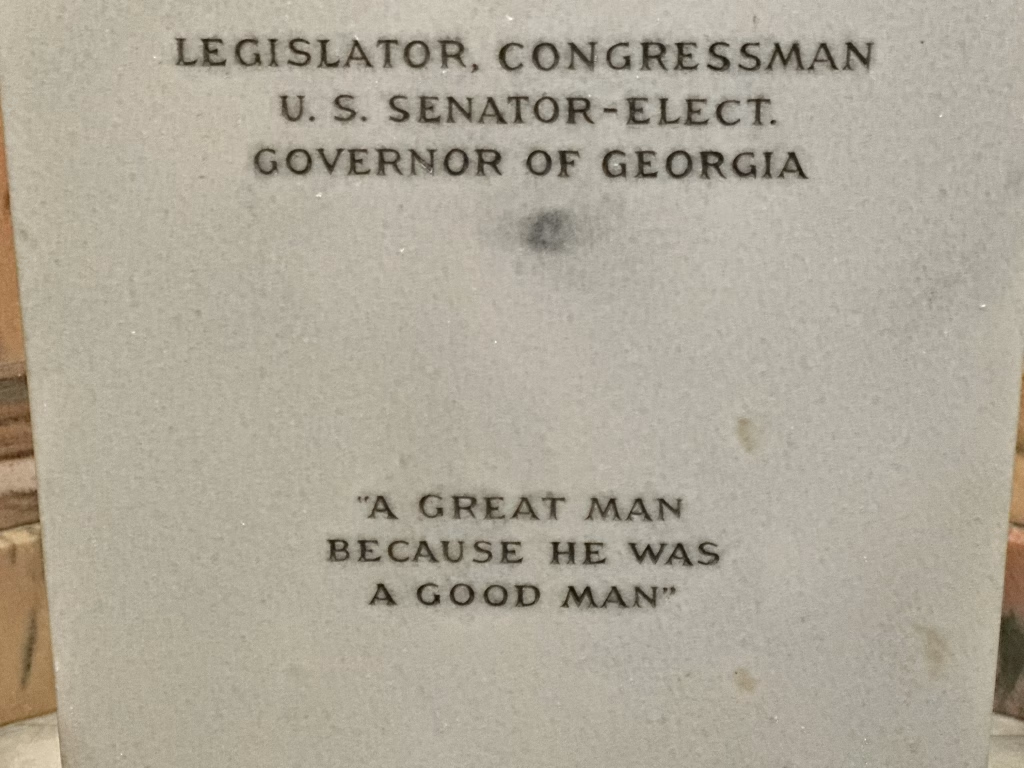
If Georgia wishes to have a statue of Stephens in its Capitol, in a place of honor, without posting that speech next to said statue, then it is making a choice to sanitize who he was and what he wanted.
I would contend that a “good man” would not have rebelled against the US for the expressed purpose of maintaining slavery.
It is worth noting that one of Georgia’s two statues in National Statuary Hall in the US Capitol building is also a statue of Stephens.
Now, a clear reason the Stephens would have a statue in the state Capitol is that he was the Governor of Georgia from 1882-1883. Astute students of history would note that that was after the Civil War. Indeed, not only was Stephens governor after the Civil War, but he was also a member of the US House from 1873 to 1882.
And it is this fact that connects to several other statues. For example, this one of Benjamin Harvey Hill. The inscription on the plinth notes he was a US Representative and a US Senator prior to the Civil War, but also a member of the convention that formed the CSA and a member of the CSA legislature.
He was, after the Civil War, a US Representative and a US Senator.
It also says that “He was at all times the champion of human liberty.” I would suggest that phrase is only accurate if one thinks that non-whites are not humans.
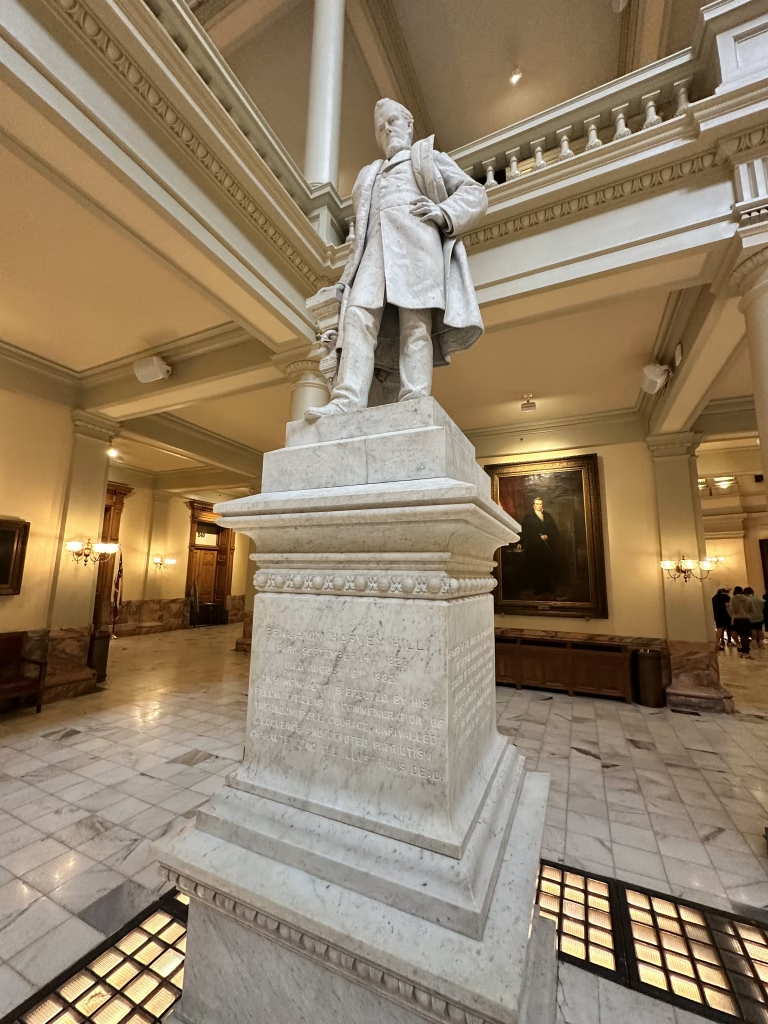
Additionally, here’s Jospesh Emerson Brown.
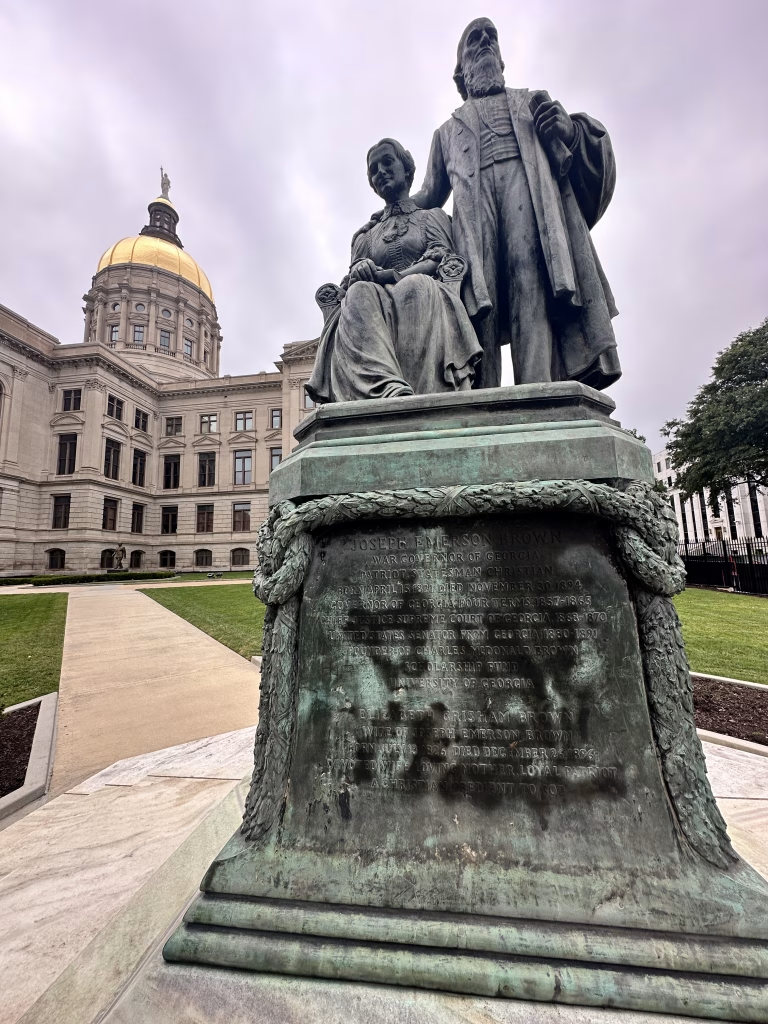
Again: a politician who served the CSA who later served in the US government.
None of this is a new observation, but it remains striking, especially the older that I get, the degree to which our politicians and citizens still wish to revere Confederates.
But, moreover, is that all three of these statues remind me of the utter lack of consequence for the rebellion and the degree to which the CSA elite were allowed to stay elites and faced little long-term consequences for their actions.
It is more than a little stunning that the Vice President of the CSA was allowed to stay in elected politics and to serve again in the US government.
How much better would we have been if there had been a more complete Reconstruction and the actual barring of high-level Confederates from office?
We are not good at consequences in the US, despite our alleged fealty to the notion of the rule of law and justice for all. (See also, Watergate).

In the Centauri trilogy books follow up to Babylon 5, there’s a gallery in the palace with portraits or statues of past emperors. There is one of Cartagia , the guy Londo and Vir had to kill to keep him from destroying Centauri Prime.
When Vir sees it, he’s puzzled by two things. First, that the piece is there at all, given the grievous harm the madman caused. And second for a sentence written in human characters next to it.
Londo explains the bad parts and the bad actors in history have to be remembered as well, to avoid repeating their malfeasance. And the words, he explains, are Latin: Sic semper tyrannis.
But that’s fiction.
Back to reality:
As you like to say: Indeed.
The harsh terms of the treaty of Versailles get too much attention. Much of it deserved, but not to the exclusion of other alternatives. For instance, the way the allies dealt with Germany after WWII was a better model: Much of the surviving leadership, and those responsible for the more heinous crimes were prosecuted, but the population as a whole was spared retribution.
This wasn’t perfect, and many escaped consequences, but it was better than how the US eventually dealt with the traitorous South.
Seems like history the Felon would approve of.
Someone always says you shouldn’t judge these people by our standards. But they can be judged by the standards of their time. The northern states had outlawed slavery by 1804 and the nation outlawed the external slave trade in 1808. England, our cultural exemplar, outlawed slavery within the country in 1772, outlawed the slave trade within the Empire in 1807, and slavery itself in 1833. Our neighbor, Mexico, had abolished slavery in 1829. Efforts to enforce the ban in Texas led to the Texas Revolution, making Texas, in IIRC Robert Farley’s phrase, the only state to commit treason in defense of slavery twice. These people can be condemned by the standards of their time.
They were also arrogant and stupid. They started a war of choice against the larger, more populous, and way more industrialized part of the country.
Significant observations. Will be sharing, referencing.
Amazing considering that upwards of 700,000 people died as a result of that insurrection. CSA mindset has survived to see another day. Also no small thing that neo-Nazism is having a resurgence. We just cannot kill off human ideation, even though it may be bad particularly when our leadership finds value in letting these things manifest.
Excellent piece, Steven.
The 1876 election and subsequent settlement of the election sold out Black people and civil rights for the next 80 years. And … we’re still not past it.
To me what we’re going through now feels a lot like the end of Reconstruction – Part 2 – especially as it pertains to our culture – to DEI, CRT, Women’s Rights, so-called Liberal Media, so-called Liberal Academia, and LGTBQ. It’s a massive reaction to the social and economic changes of the past 50 years or so.
The widespread collapse of most of our institutions, major organizations, and major corporationsbefore Trump is both amazing and depressing.
Is it lasting; is this going to be the political and cultural landscape for the next few years?
Who can say?
Things change more rapidly today than they did 10 to 50 years ago.
Thank you for this post. People always say to me “you want to erase history!” when I argue that CSA traitors should not be honored. I am all for remembering them and you can remember them on the battlefields and for their subsequent service to the United States in museums etc… But they were traitors. Traitors treated quite generously I might add after their heinous deeds. Many of which are white washed as you note above. A precedent set that haunts us still today. Even the treasonous actors of Jan 6th were ultimately treated as if they did nothing wrong. Ultimately setting a bad example for the future, again!
@gVOR10: “They were also arrogant and stupid. They started a war of choice against the larger, more populous, and way more industrialized part of the country.”
I’m not disputing your charge of arrogance. The stupidity, I think, comes from the arrogance. And from their determination to not be bluffed out of their purpose. Which is what they thought was happening.
And they thought they could win because they had a ‘warrior culture’, whilst the Northern oppressors were weak and effeminate. Or criminals and “roughnecks”.
I’m not making this up. I’m barely changing the language.
@Jay L. Gischer:
Oh I know you’re not making up any of that. Over the years I’ve read many quotes of those rationalizations.
I haven’t been able to find it, but I recall reading Sam Houston’s speech to the Texas lege before secession. I don’t see Houston as a hero, but he wasn’t stupid. He told them straight up that if they seceded there would be war, they would lose, their sons would be killed, and their wives and daughter would be impoverished.
@gVOR10:
Houston was certainly wrong in general, given his audience. One of our good host’s points is that to a considerable degree, the members of the Confederate state governments, governors and legislators both, weren’t killed or impoverished. The three examples in the post all survived the war, remained elites, and exercised considerable power in the federal government after the war.