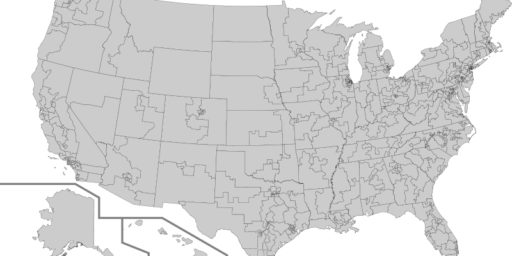
Supreme Court Takes Up Two New Partisan Gerrymandering Cases
The Supreme Court is taking up the issue of partisan gerrymandering. This time, though, they’re likely to reach the merits of the cases rather than punting like they did last year.
The Supreme Court is taking up the issue of partisan gerrymandering. This time, though, they’re likely to reach the merits of the cases rather than punting like they did last year.
The latest entry in the unity third party presidential candidate genre is just as bad as they always are.


After a barrage of criticism, New Jersey Democrats are abandoning a controversial redistricting proposal.
An argument against “bothersiderism” in this case and, yet again, noting the problem with single seat districts.
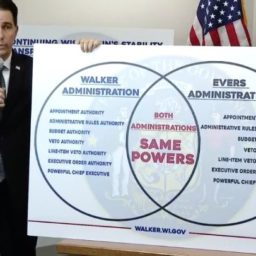
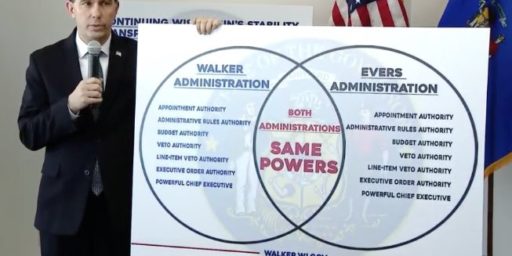
On the way out the door, Scott Walker signed a bill to take powers away from his successor (and demonstrated a lack of understanding of Venn diagrams).
Gerrymandering. It’s not just for Republicans.
Current attempts to take power away from the state executive branch illustrates a lot of what I have been writing about for years.


Once again, Republicans in California find themselves looking up and seeing a lot of desolation. They need to find a way to bounce back.
With most forecasts assuming that Republicans will at least lose control of the House, the odds are that the GOP will react to that by moving further to the right.
While I was originally content to let Brett Kavanaugh sail through to confirmation, I now feel compelled to oppose his nomination to be a Supreme Court Justice.
For the second time in two years, the Supreme Court starts a new term down one Justice. That isn’t as big a problem as it might seem.
A Federal Court has ruled that North Carolina can use its current Congressional District map for this year’s midterms notwithstanding a ruling that it is an impermissible gerrymander.


For the second time this year, a three-judge panel of Federal Judges has struck down North Carolina’s Congressional District map. The immediate question is what impact, if any, this will have on November’s election.
With just 72 days to go until Election Day, the chances that the Democrats will take control of at least one chamber of Congress are looking quite good.


A group of lawsuits filed across the country are seeking to challenge the predominant method for allocation of Electoral College votes. These lawsuits appear to have little merit.
Forget the “republic v. a democracy” abstraction. The numbers show some serious flaws in translating popular will into government.


There is a frustration and a growing sense that the American political system is illegitimate.


Progressive enthusiasm for the notion that our governing framework is dynamic and ought be constantly updated by the judiciary is waning.
The Supreme Court term began with hopes that the Justices would shake up the redistricting process with rulings against partisan gerrymandering. It has ended with three whimpers.
The Supreme Court has largely rejected a challenge to state and Federal redistricting maps in the State of Texas.
The Supreme Court avoided ruling on the merits of two partisan gerrymandering cases, but the issue will be back before them sooner rather than later.
A 9-0 ruling side-stepped the broader issue of to what extent purely political considerations may be applied.
With two more weeks to go, there are plenty of “big” cases still awaiting the release of a decision.
It isn’t a primary and it is an illustration of how electoral rules affect behavior.


With one month to go in its term, there’s still a lot on the Supreme Court’s plate.
Republicans are trying to fight back against efforts to limit their ability to gerrymander Congressional and State Legislative Districts. It’s a fight they deserve to lose.
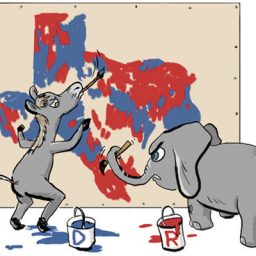

Ohio voters have approved a referendum designed to reform the manner in which district lines are drawn.
The Supreme Court heard oral argument in the challenge to President Trump’s Muslim Travel Ban. It didn’t appear to go well for the challengers.
The Supreme Court heard oral argument yesterday in a case alleging that Texas’s Congressional and state legislative districts were drawn with the intent to discriminate based on race.
The Supreme Court heard oral argument in the second partisan gerrymandering case of the term, and once again they appear to be divided.


If the polls are any indication, Democrats may fall short in their bid to take back the House in November.
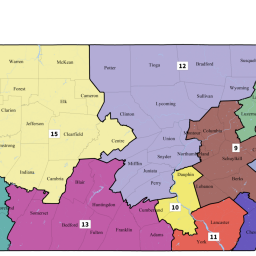
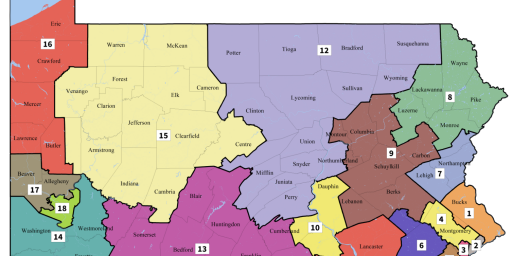
Challengers to the Pennsylvania Supreme Court’s ruling on Congressional redistricting suffered two big setbacks in court yesterday that suggest that they’ve reached the end of the road legally.
The Pennsylvania Supreme Court has redrawn the state’s Congressional Districts based on its recent ruling finding the current map to be unconstitutional partisan Gerrymandering. It makes a lot more sense than the map the state is currently using.
The Supreme Court has declined to stay a Pennsylvania Supreme Court ruling requiring the legislature to redraw the state’s Congressional District map.
A newly released poll has encouraging signs for Democrats in 2018, but there are several caveats.
Another win for forces fighting partisan Gerrymandering.
A Federal Court in North Carolina has issued a stinging ruling against the partisan gerrymandering undertaken by the Republican legislature in that state.
The Supreme Court has agreed to hear a second case dealing with political Gerrymandering.
The early numbers in the battle to control Congress look good for Democrats, but there are are a number of caveats to keep in mind.


The first in an occasional series.
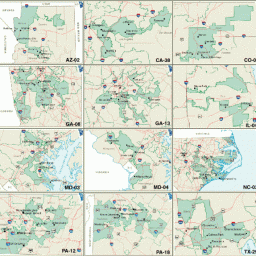
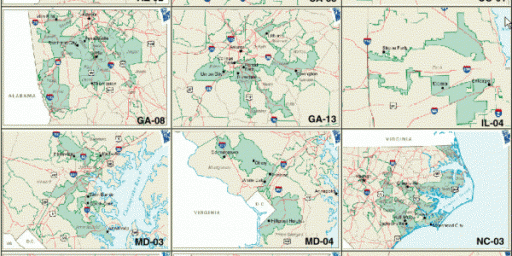
A complicated concurrence to Steven Taylor’s recent postings.
More thoughts related to Gill v. Whitford and the problem of extreme gerrymandering.
And even moreso when they are consciously created by the winner.
The Supreme Court appears split on the question of whether or not partisan Gerrymandering is unconstitutional.
Previewing the next term of the Supreme Court, which starts today.


Thoughts on the quality of our democracy.
Justice Kennedy is telling prospective law clerks for the term that beings in October 2018 that he is considering retiring at the end of the term that begins this October.