Musing About the Near Future of U. S. Security Policy

I’ve begun to wonder about the future of U. S. security policy. This isn’t a serious analytical post; it’s just what I call “musing”—committing disorganized thoughts to writing.
Matt Eckel’s takeaway from my Atlantic piece on How Perpetual War Became U.S. Ideology is that we need a peer competitor.
The 60 day deadline for Presidential discretion under the War Powers Act will expire next week. Congress won’t do anything about it.
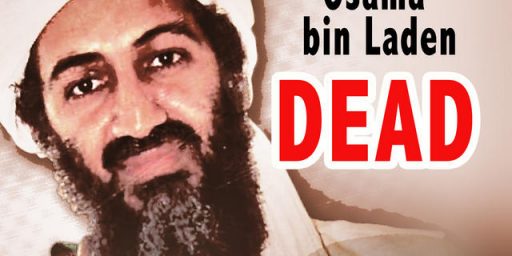
Not surprisingly, having ordered a successful mission to kill Osama bin Laden is being highlighted on President Obama’s re-election tour.
For the first time, a majority of Republicans support creation of a third political party. Does it really mean anything?
A lot of people appear confused at to what the debt ceiling is and why it has to be raised.
Why would David Petraeus take the thankless job of running the CIA?
The Pew Center is out with a new political typology.
The debate over “enhanced interrogations” has been renewed by the bin Laden mission, but whether it “worked” or not isn’t the question.
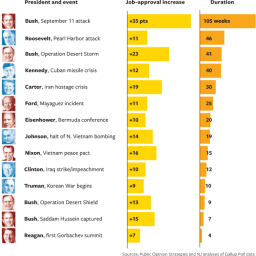
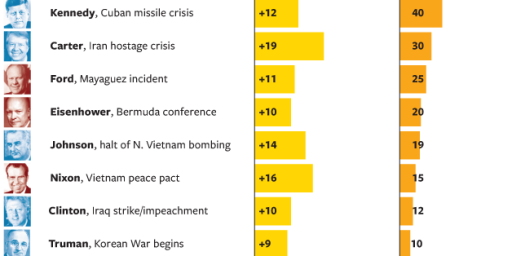
Americans are rallying around the President in the wake of the mission against bin Laden, but it’s likely to be short-lived.
Osama bin Laden is dead, but he’s succeeded in changing America for the worse.
I don’t feel the jubilation that came with Saddam Hussein’s capture in December 2003. Sadly, I know better this time.
A comedian-turned-Senator makes some strong points about how America goes to war.
An aide’s compliment about the president “leading from behind” has generated controversy.
The NYT says it’s time for U. S. advisers and military air traffic controllers on the ground in Libya.
Events in Syria, and the world’s response to them, are revealing the moral bankruptcy of the justification for the war in Libya.
The Pentagon is frustrated that the Obama administration doesn’t “seem to understand what military force can and cannot do.”
It may be time to change rules keeping women out of combat roles. But “fairness” isn’t the right question.
To borrow a phrase: budgeting is the science of muddling through (with an emphasis on the “muddling” far more than the “science.”
Stephen Walt doesn’t expect Obama’s foreign policy to change along with the names on the org chart.
Defense Secretary Gates hinted this week that the U.S. would stay in Iraq if the Iraqis wanted. It doesn’t seem like they do.
For the past day or so, America’s fighting men have been pawns in a cynical political game.
The duty to defend “hateful, extremely disrespectful, and enormously intolerant” expression.
President Obama says he acted in Libya to avert an imminent genocide, but there’s no evidence that any such thing was about to occur.
The ability of people to put aside rational judgment when it comes to political figures is, in a word, puzzling.
Like all Presidents before him, Barack Obama is asserting the right to virtually unfettered discretion when it comes to military matters.
The “Obama Doctrine,” such as it is, seems to boil down to moral self-certainty combined with a glaring ignorance of reality. That’s a dangerous combination.
Ten days after sending American forces into kinetic military action in Libya, President Obama addressed the nation to explain “what we’ve done, what we plan to do, and why this matters to us.”
Senator Joe Lieberman said today that we should intervene in Syria using the same rationale we did for Libya. Because, you know, what’s the big deal about a fourth war?
President Obama’s grand coalition against Libya is a lot less than meets the eye.
The public, and Congress, are skeptical of the mission in Libya, and the reason for that is because the President has failed to tell us exactly why we’re there and what we’ll be doing.
It has become quite apparent that neither the White House nor our coalition partners have any idea what the path to an endgame in Libya even looks like. That’s not good.
Newt Gingrich on Libya: “This is as badly executed, I think, as any policy we’ve seen since WWII, and it will become a case study for how not to engage in this type of activity.”