The Pro-Murder Narrative
Who needs evidence and due process when "bad guys" are involved.

I was just lamenting to a friend this week that a lot of Americans are going to be all too willing to look at the Trump administration’s policy of vaporizing boats on the high seas and simply see the elimination of the “bad guys.” On cue, Elizabeth Stauffer, writing in the Washington Examiner, provides, Democrats are choosing cartels over Americans.
She laments, “the Democrats’ sudden sympathy for two narco-terrorists — crew members on a drug boat who were being paid eye-watering sums to ferry deadly drugs into the U.S.”
Much of the column is made up of griping about the exact details of what order Hegseth did or did not give, and some sneering about war crimes.
Let me state the following: parsing the exact order that Hegseth gave is irrelevant to understanding this broader story. Indeed, it is a distraction that can cause the focus to be placed on the wrong issue.
The issue is that the United States government is actively engaged in a policy of murdering suspected drug smugglers. Calling them “narco-terrorists” doesn’t change what is going on.
One can pretend that all of this is Democrats placing their sympathies in the wrong place, but the reality is that the administration and its allies are celebrating summary executions and lawlessness.
But, of course, all of this is a major strength for Trump, and in general for any “tough on crime” policy. It sounds good to state that the US is using decisive action against bad guys in foreign waters, well away from any of us.
It seems plausible that these boats are all filled with drugs and that if we just pick them off, one by one, it will stem the tide of drugs coming into the US.
And most people don’t want to hear about the law or process. It just sounds like such things get in the way of protecting us all. This is, of course, a key authoritarian tool: the promise that violence directed at bad people will protect the good people. After all, the state knows best! They know who the bad people are and the right amount of death to rain down!
I mean, after all, as Stauffer notes, drug abuse is a problem and, obviously, the best way to deal with it blowing up some bad brown people.
Since 1999, drug overdoses have taken more than 1.25 million American lives, and these “very, very bad narcotics people” are responsible. Unlike previous U.S. presidents, Trump has the courage to confront this enemy head-on.
Overdose deaths and other effects of drug abuse are a massive problem, and lots of people die from cocaine, but the more significant share of those deaths is from opioids (see the NIH graph below). So, I guess we are going to drone strike the Sackler family soon? How about cars crossing the Mexican border with fentanyl?
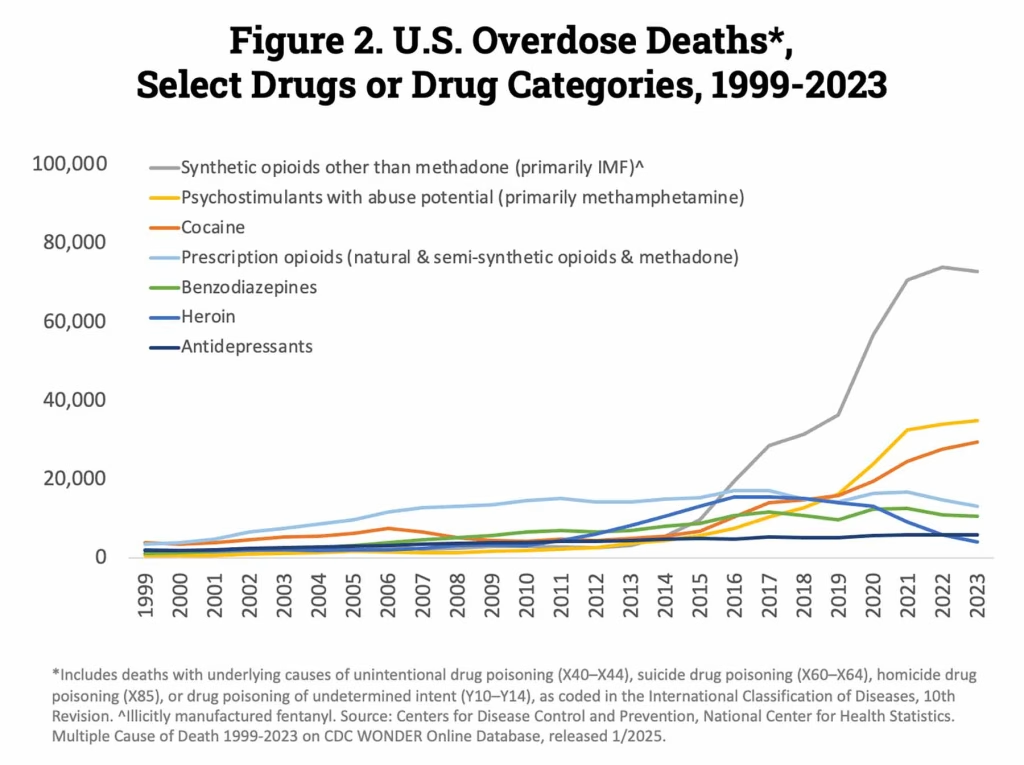
Back to Stauffer:
Each U.S. strike that wipes out a drug-laden vessel prevents American deaths. Moreover, the repeated strikes on these boats over the past three months have had a powerful deterrent effect, as noted by Trump during his Tuesday Cabinet meeting.
First, it is a mere assertion that each strike saves American lives. Not only do we not actually know if there are drugs on these boats, but we also don’t know where the drugs are going. Plus, we should not fall into accepting the notion that every time someone snorts cocaine, they die. This is simply not the case, but treating illicit drugs like weapons helps justify the strikes
Second, it seems worth noting that the US and its allies have been deploying violence against the drug trade for decades now, and there has not been a deterrent effect as a result. The sheer amounts of money involved always lead to new ways to transport the drugs. Also, we know that the likely effect is that the smugglers will be paid more to run drugs because of the increased risk. This still just encourages more smuggling and likely just increases street prices, which will, in turn, incentivize more dealing. And also, increased profits and potential disruptions in supply could create turf wars in American cities, increasing criminal violence. It is a pattern that we have seen over and over and over again.
Although the likely result is that all of this will have precious little effect on anything except the ongoing erosion of the soul of America, because we have decided that tough guy policy means murdering people on limited evidence, because we can is acceptable policy.
And never mind that interdicting and arresting these people, a we used to do, still has the effect of taking the drugs out of circulation while also potentially providing information and evidence about broader networks. Doing the actual work of investigation would have a better potential to stop moving drug flows than the current approach does.
Of course, given the demand for drugs in the US, all of this is just so many fingers in a wall of leaking dams. There will always be too much money to be made fulfilling the voracious appetite for these substances. So one of the sad truths is that the US government is behaving lawlessly and degrading our international reputation and harming the souls of members of the armed service for very little gain.
This is especially highlighted by the fact that Trump just pardoned a major cocaine kingpin, because, you know, reasons.

1) they make it sound as though the drug traffickers also forcibly administer drugs, and overdoses, to innocent Murikans just minding their own business.
2) The profits are so large, and the cost of labor in Latin America so low, that alternate means of transport will always be available. Not to mention the product is rather small and relatively easy to conceal, especially with modern synthetic drugs.
3) the war on drugs is over. The drugs won.
4) All sorts of people consume drugs, and not all are addicts; no more than all who drink are alcoholics. Since alcohol prohibition failed miserably at ending alcohol consumption, what make anyone think drug prohibition would fare any better? there was just no tradition of growing, selling, and using other drugs. If there had been, we’d see ads for heroin and cocaine, and they’d be sold in a broad range of price points.
5) it would be far better to legalize and regulate production, import, and consumption of drugs, using public funds for hard prevention/reduction facilities (to prevent overdoses), and leave the draconian measures for selling or giving drugs to minors.
@Kathy: Indeed all around.
Sounds like there is a newly freed man who has the resources to take on a contract.
Or, maybe, the RNC/DNC would-be pipe bomber is willing to make a deal.
@Kathy:
Ya know, I heard many times that Trump would keep us out of forever wars, but they sure are keen to ratchet up the foreverest one of all.
Democrats aren’t choosing cartels over Americans; MAGA is choosing murder over justice.
Maybe the Franklin cartoon posted by our DoD secretary was appropriate for the target audience. The simple reasoning of blowing up the boats with “bad guys” should not land so easily with grownups. I’m reminded of the gun scene in the movie Witness, when the young boy Samuel is asked by his grandfather, “Would you kill another man?” Samuel answers, “I would only kill a bad man.” The grandfather says, “Only the bad man…I see. And you know this bad man by sight? You are able to look into the heart and see this badness?”
Was “does change” a typo for “doesn’t change”?
I’m staring at it and can make an argument either way. Ultimately, we are just engaging in extrajudicial executions, so it doesn’t change, but by calling them —sigh— “narco-terrorists” it seems to justify the (unjustifiable) actions for about half the country and that does change what is going on on.
And the “terrorist” part of “narco-terrorist” is definitely going to be used in court if there is ever any attempt at legal consequences for our murder spree on the high seas.
There’s a reason they aren’t “narco-fascists,” and it’s not just that Republicans have embraced fascism.
Duplicate removed. Delete button not deleting.
(I’m impressed the delete button showed up at all… it’s an elderly, cantankerous site, and I am using a novelty browser. Edit works)
@Kathy:
Well famously the original Coke a Cola recipe had coke in it.
In the 1800s in general there were ads galore touting cocaine, morphine, opium etc as cure alls.
Into the more modern era examples…
https://mashable.com/feature/cocaine-paraphernalia-ads
The whole concept of the war on drugs thing is a much more modern thing. The root of all the drug war was/is of course based in laws that were designed to discriminate against blacks/immigrants/illegals.
@Gustopher: It’s a typo–it should say “doesn’t.”
I also plan to come back to this narco-terrorism bit.
@Matt:
Two important notes:
1) They were marketed as medication, not as recreational drugs like alcohol or cigarettes.
2) The doses of narcotics in these products were rather low compared to what a drug user or addict takes up.
All that said, there were abuse issues and people got addicted to these things.
IMO, the major issue is that in making them illegal and criminalizing them, especially criminalizing use, whatever benefit, if any, from lower drug use, is wiped out by a larger prison population and the street crime associated with drug dealing gangs.