Three States Send National Guard to DC
Politicizing the military is legal, but dangerous.
NYT (“3 Republican-Led States to Send National Guard Troops to D.C.“):
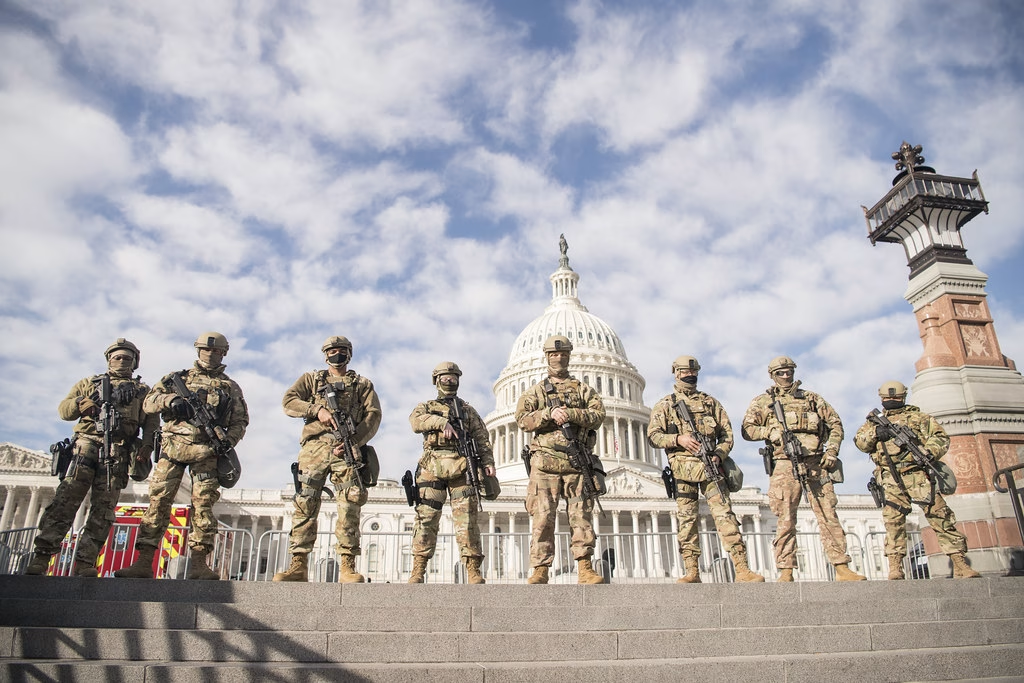
The National Guard’s presence in Washington will grow in the coming days after the governors of West Virginia, South Carolina and Ohio announced on Saturday that they would send troops from their states’ National Guard at President Trump’s request.
Gov. Patrick Morrisey of West Virginia said the state would send 300 to 400 troops to Washington to support Mr. Trump’s “initiative to restore cleanliness and safety to Washington, D.C.” Gov. Henry McMaster of South Carolina also pledged to send 200 troops from his state’s National Guard, saying “South Carolina is proud to stand with President Trump as he works to restore law and order to our nation’s capital.” And Gov. Mike DeWine of Ohio said 150 members of his state’s National Guard would arrive in the capital in “the coming days.” All three governors are Republicans.
A White House official confirmed that additional National Guard troops were being called in to Washington, reiterating that their role was to protect federal assets and provide a visible presence.
The 800 already deployed troops all come from the D.C. National Guard, which the president can call out directly. Governors typically control the National Guard in their states, though Mr. Trump circumvented this when he deployed troops to Los Angeles this summer, a matter currently under litigation in federal court.
The commitment of some 700 troops from West Virginia, South Carolina and Ohio combined means that in the coming days, the total number of National Guard troops in D.C. will nearly double.
National Guard troops have been called out on the streets of Washington before, including in a deployment five years ago during the protests after the killing of George Floyd. But this stationing of military personnel in the city during otherwise ordinary times has drawn significant criticism — possibly more so than some of the administration’s other actions this week, such as the president’s unprecedented step of directing the actions of the Metropolitan Police Department.
AP (“Three Republican-led states to send hundreds of National Guard troops to Washington“) adds:
The moves came as protesters pushed back on federal law enforcement and National Guard troops fanning out in the heavily Democratic city following President Donald Trump’s executive order federalizing local police forces and activating about 800 District of Columbia National Guard members.
By adding outside troops to the existing D.C. Guard deployment and federal law enforcement presence, Trump is exercising even tighter control over the city. It’s a power play that the president has justified as an emergency response to crime and homelessness, even though city officials have noted that violent crime is lower than it was during Trump’s first term in office.
National Guard members have played a limited role in the federal intervention so far, and it’s unclear why additional troops are needed. They have been patrolling at landmarks like the National Mall and Union Station and assisting law enforcement with tasks including crowd control.
[…]
A protest against Trump’s intervention drew scores to Dupont Circle on Saturday before a march to the White House, about 1.5 miles away. Demonstrators assembled behind a banner that said, “No fascist takeover of D.C.,” and some in the crowd held signs saying, “No military occupation.”
[…]
In his order Monday, Trump declared an emergency due to the “city government’s failure to maintain public order.” He said that impeded the “federal government’s ability to operate efficiently to address the nation’s broader interests without fear of our workers being subjected to rampant violence.”
In a letter to city residents, Mayor Muriel Bowser, a Democrat, wrote that “our limited self-government has never faced the type of test we are facing right now.”
She added that if Washington residents stick together, “we will show the entire nation what it looks like to fight for American democracy — even when we don’t have full access to it.”
I haven’t found the written orders for these call-ups, but I strongly suspect that they were done under what’s known as Title 32 authority. Essentially, the Guard members remain under the nominal control of their respective state governors but are carrying out a federal mission and paid out of the US Treasury rather than state funds. This is opposed to full federalization of the troops under Title 10 authority, in which case they have the same authorities and restrictions as other Active Duty forces.This is important, in that troops operating under Title 32 authority are not subject to the Posse Comitatus Act, which prohibits active duty military personnel from being used as law enforcement personnel.
Deploying the DC Guard, as has already been done, was clearly under President Trump’s authority as commander-in-chief. And, certainly, governors have the authority to send their Guard forces to help support missions under invitation from the Secretary of the Army or to help out governors of other states. That doesn’t make it a good idea.
Most obviously, sending military personnel in camouflage fatigues and carrying assault rifles for domestic policing should only be done in situations where local authorities can’t or won’t maintain public order. That’s simply not the case here.
Furthermore, this isn’t what these citizen-soldiers signed up for. These people have civilian day jobs. As Guardsmen, they expect to serve the “weekend a month, two weeks in the summer” they agreed to plus being called up to serve the nation in the event of war or the state in the event of a natural disaster or other emergency. Being called up to send a political message is a misuse of authority.
The partisan aspect of this is all very bad for civil-military relations. There should be no “Republican” forces. Most citizens don’t distinguish Guard and Regular forces to begin with and this further blurs the lines.

Surely the Ohio National Guard can be trusted to behave professionally.
Why not have another Civil War?
We persist in fighting the first one, why not a second? /s.
It seems clear, very obvious to me: Republicans want to crush Democrats.
The only surprise here is that my beloved /s governor DeUseless hasn’t sent FL Guard troops, yet. As with COVID, Trump creates an issue, and seeing that it’s popular with MAGA, the GOP governors cheerfully imitate Trump.
There is also the added bonus of making the deployments partisan, insofar as only Republican-controlled states are going to cooperate without a legal fight.
@Michael Reynolds: I was expecting this be be your link…
https://www.youtube.com/watch?v=l1PrUU2S_iw
Gov. Phil Scott has been asked to send Vermont’s national guard twice and has declined (politely) twice. Gov. Ayotte has ruled out redistricting. Not sure why other Republicans can’t manage to say “nah.”
@Steven L. Taylor:
That’s cool because they’re only being deployed to blue states.
If we’re (blue states) going to be attacked by the red states then we should stop funding them.
@wr:
You know, I wasn’t sure people would get the reference. No one under, what, 60 will?
Four dead in Ohio.
I don’t intend to sow division between states considered blue and those considered red, nor to treat family and friends any differently because of the politics of their state leadership, but I’m now less likely to patronize entities in WV, SC, and OH. I know it may not be fair to the many people in those states who don’t agree with their leaders, but enabling a corrupt authoritarian should have consequences. I likewise expect that my status and perhaps opportunity outside the US has been diminished due to my nation’s leadership.