Trump and Zelensky to Discuss Peace Plan
Ukraine's president is trying to negotiate a deal that Russia will surely reject.
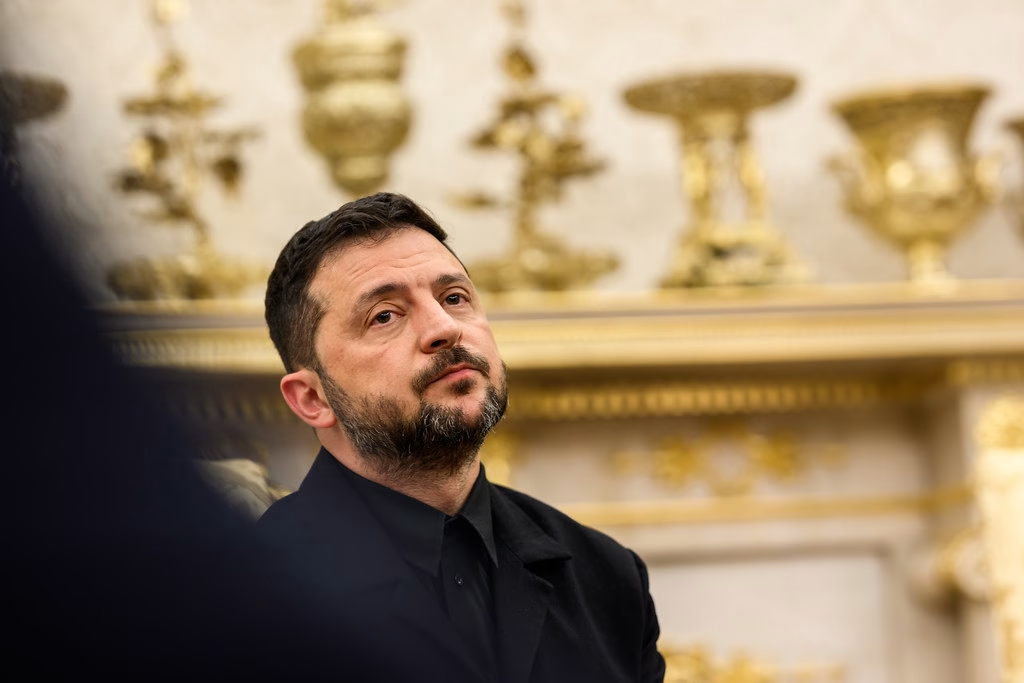
NYT (“Zelensky to Meet With Trump at Mar-a-Lago About Plan to End War With Russia“):
President Volodymyr Zelensky of Ukraine will visit Mar-a-Lago on Sunday for a much-anticipated meeting with President Trump, bearing a revised 20-point peace plan aimed at ending the war with Russia.
The proposal, developed by Ukrainian and U.S. negotiators, covers a wide range of issues, including security guarantees that Kyiv seeks to prevent future Russian aggression. But Mr. Zelensky has acknowledged that two major sticking points have emerged in talks between Washington and Kyiv: the fate of the Donbas region of eastern Ukraine and control of a Russian-occupied nuclear power plant.
[…]
Ukraine has been pushing for such a meeting for weeks, since the United States restarted its diplomatic efforts to broker a settlement.
At the same time, Mr. Zelensky has repeatedly questioned whether Moscow was serious about pursuing peace or simply stalling for time. Relentless Russian strikes on civilian targets, including a huge barrage fired at Ukraine’s capital on Saturday, Mr. Zelensky said, proved that the Kremlin had no real interest in ending the war.
[…]
Analysts have said that President Vladimir V. Putin of Russia, emboldened by his forces’ slow but steady advances on the battlefield, is unlikely to accept the peace proposal, and will instead stick to his maximalist demands. Those include Ukraine ceding a significant part of its territory, shrinking its military and ruling out a formal alliance with the West.
Mr. Zelensky has been keen to show he is fully committed to Mr. Trump’s push for peace, amenable and willing to make compromises. In recent days, he also has appeared at times to be trying to call the Kremlin’s bluff.
He told reporters on Tuesday that he was willing to pull Ukrainian troops back from areas of the Donbas region still under Kyiv’s control and turn those areas into a demilitarized zone — as long as Russia withdraws its forces from an equivalent area of land. Russia has insisted on keeping all of the land it has captured since its full-scale invasion almost four years ago, and has also demanded the portions of the Donbas that Ukraine still holds.
BBC (“Zelensky says Russia ‘doesn’t want peace’, ahead of Florida meeting with Trump“) adds:
The Ukrainian president has voiced optimism about the new peace plan draft, describing it as “a foundational document on ending the war”.
On Friday, he told reporters that it was 90% complete: “Our task is to make sure everything is 100% ready.”
But in an interview with Politico, Trump warned that Zelensky “doesn’t have anything until I approve it”.
Trump added that he was expecting to see the new draft on Sunday.
“I think it’s going to go good with him. I think it’s going to go good with [Vladimir] Putin,” Trump said in the interview, adding that he expects to speak with Russia’s president “soon”.
Following meetings with Canadian Prime Minister Mark Carney, Zelensky said Moscow’s latest attack on Kyiv was “Russia’s answer [to] our peace efforts and this really shows that Putin doesn’t want peace”.
Zelensky also took a call with European leaders to discuss diplomatic “priorities” ahead of his meeting with Trump, adding that “strong positions are needed” to move forward with the plan.
Kyiv has the “full support” of European and Nato leaders, German Chancellor Friedrich Merz said.
AP (“Zelenskyy says he’s open to creating demilitarized zone in Ukraine’s industrial heartland“) adds:
Zelenskyy said the U.S. proposed the creation of a “free economic zone,” which he said should be demilitarized. But it was unclear what that idea would mean for governance or development of the region.
A similar arrangement could be possible for the area around the Zaporizhzhia nuclear power plant, which is currently under Russian control, Zelenskyy said. He said any peace plan would need to be put to a referendum.
[…]
Russia has given no indication that it will agree to any kind of withdrawal from land it has seized. In fact, Moscow has insisted that Ukraine relinquish the remaining territory it still holds in the Donbas — an ultimatum that Ukraine has rejected. Russia has captured most of Luhansk and about 70% of Donetsk — the two areas that make up the Donbas.
Asked about the plan, Kremlin spokesperson Dmitry Peskov said Wednesday that Moscow would decide its position based on information received by Russian presidential envoy Kirill Dmitriev, who met with U.S. envoys in Florida over the weekend. Peskov declined to share further details.
[…]
Creating the demilitarized economic zone in the Donbas would require difficult discussions on how far troops would be required to move back and where international forces would be stationed, Zelenskyy said, adding that it should discussed at the leaders level.
The working U.S.-Ukraine draft also proposes that Russian forces withdraw from the Dnipropetrovsk, Mykolaiv, Sumy and Kharkiv regions. Zelenskyy envisions that international forces could be located along certain points of the contact line within the zone to monitor the implementation of the agreement.
Ukraine also proposes that the occupied city of Enerhodar, which is the closest city to the Zaporizhzhia power plant, become a demilitarized free economic zone, Zelenskyy said.
This point required 15 hours of discussions with the U.S., he said, and no agreement was reached.
For now, the U.S. proposes that the plant be jointly operated by Ukraine, the U.S. and Russia, with each side controlling a 33% stake in the enterprise — a plan Zelenskyy called “not entirely realistic.”
“How can you have joint commerce with the Russians after everything?” he asked.
Ukraine instead suggested that the plant be operated by a joint venture with the U.S. in which the Americans can determine independently how to distribute the energy from their 50% share.
Zelenskyy said billions in investments are needed to make the plant run again, including restoring the adjacent dam.
[…]
The working draft ensures that Ukraine will receive “strong” security guarantees that would require Ukraine’s partners to act in the event of renewed Russian aggression. That would mirror NATO’s Article 5, which says an armed attack on one member of the alliance is an attack on all.
Zelenskyy said a separate document with the U.S. will outline these guarantees. It will detail the conditions under which security will be provided, particularly in the event of another Russian assault, and it will establish a mechanism to monitor any ceasefire. The document will be signed with the main agreement to end the war, Zelenskyy said.
“The mood of the United States of America is that this is an unprecedented step towards Ukraine on their part. They believe that they are giving strong security guarantees,” he said.
Zelensky is negotiating shrewdly from a position of extreme weakness. The war is, after all, being fought in his territory and thus most of the destruction is there. Putin is gradually expanding his gains and seems quite indifferent to the massive casualties his forces have taken. And, rather clearly, President Trump cares significantly less about Ukraine’s plight than his predecessor did.
Given all of this, Zelensky is smart to cozy up to Trump and praise his plan, seeking only “10 percent” more. He has moved away from maximalist goals and comes across as reasonable. Given how badly Trump wants to make a peace deal to burnish his legacy—maybe even getting the Nobel Peace Prize he’s been clamoring for—this will put the pressure on Putin to agree to terms. When he doesn’t, Trump will be furious and likely give Zelenskyy more of what he wants.
It is still not at all clear what a security guarantee—essential for Ukraine to agree to a ceasefire—would look like. NATO’s Article 5 is being cited as the example, but Ukraine will certainly not be admitted to NATO. Further, the guarantee is not quite as strong as many imagine:
The Parties agree that an armed attack against one or more of them in Europe or North America shall be considered an attack against them all and consequently they agree that, if such an armed attack occurs, each of them, in exercise of the right of individual or collective self-defence recognized by Article 51 of the Charter of the United Nations, will assist the Party or Parties so attacked by taking forthwith, individually and in concert with the other Parties, such action as it deems necessary, including the use of armed force, to restore and maintain the security of the North Atlantic area.
While most interpret this to mean “If you get invaded, we’ll use any means necessary to repel the attack,” it’s really just an agreement to strongly consider one’s options. Unless there is a significant peacekeeping force put in place as a tripwire, it’s not at all clear that any NATO partner would be willing to risk World War III in Ukraine’s defense. Certainly, they haven’t been this go-round, in what is far and away the most devastating armed conflict in Europe in eight decades.

I’ve assumed the purpose of Article V, in part at least, was to prevent the USSR from taking pieces of Europe. Say if they were to take some Norwegian islands in the arctic, or detailed East German troops with taking a portion of West Germany. Nothing worth going to World War III over, right? But the mere threat or possibility that every other NATO country could get involved, would at least give the Soviets pause.
The big difference is that during the cold war, the USSR was an absolutist dictatorship intent on imposing its style of government over the world, and had done so over Easter Europe. Russia’s goals under Mad Vlad are far less ambitious, confined largely to recovering the Soviet era empire.
Seeing as how he likes to invoke history, he might want to ask Justinian how recovering the Western Roman Empire turned out. Better yet, he should ask Belisarius. He did, after all manage to take Rome.
Trump has absolutely no idea what he’s doing.
In other words it will be yet another staged press conference for Trump to hog the limelight with Zelenskyy there as a prop.
Not particularly extreme weakness, as Russia has been unable to win. What was expected to be a three day war is now in its fifth year or so.
I expect Zelenskyy as the Ukraine government are spending a lot of time carefully crafting what they can offer that will ensure Russia says no, and which won’t limit them when the real peace talks happen, possibly with Putin’s successor (the guy will eventually croak, if nothing else) if Putin never actually wants to negotiate.
And, I think the insistence upon a referendum on any peace plan is as maximalist a position as saying no territory will be yielded. It starts by forcing an acknowledgment of Ukrainian sovereignty over those areas.
I don’t think Ukraine will be in NATO, as I don’t think NATO survives for much longer. The US will pull out, and it will collapse and be replaced with an EU compact (probably with special guest star Formerly-Great Britain).
And I think that replacement will want to include the country that fought Russia to a standstill for the better part of a decade (this will keep going for a while) and that has the most practical experience with drone warfare. There may be a fig leaf of naming to let Russia save face, with Ukraine being an affiliate rather than a member, but I expect Ukraine to be very involved.
And maybe no Post-Nato-org troops on Ukraine soil, but a who lot of “trainers” there to be in harms way.
I’m not saying Ukraine is winning this war, because they clearly aren’t. But, just as clearly, Russia is losing.
@Gustopher: It’ll be three years in February. It’s a position of extreme weakness for the reasons I articulated in the post: the war is wreaking exponentially more havoc in Ukraine than in Russia, he cares much more about his people dying than Putin cares about his, and he’s absolutely reliant on US materiel support to keep on fighting.