Trump Doesn’t Want Museums Talking About How Bad Slavery Was
And other tales of subverting knowledge and expertise on the altar of a preferred mythic narrative.
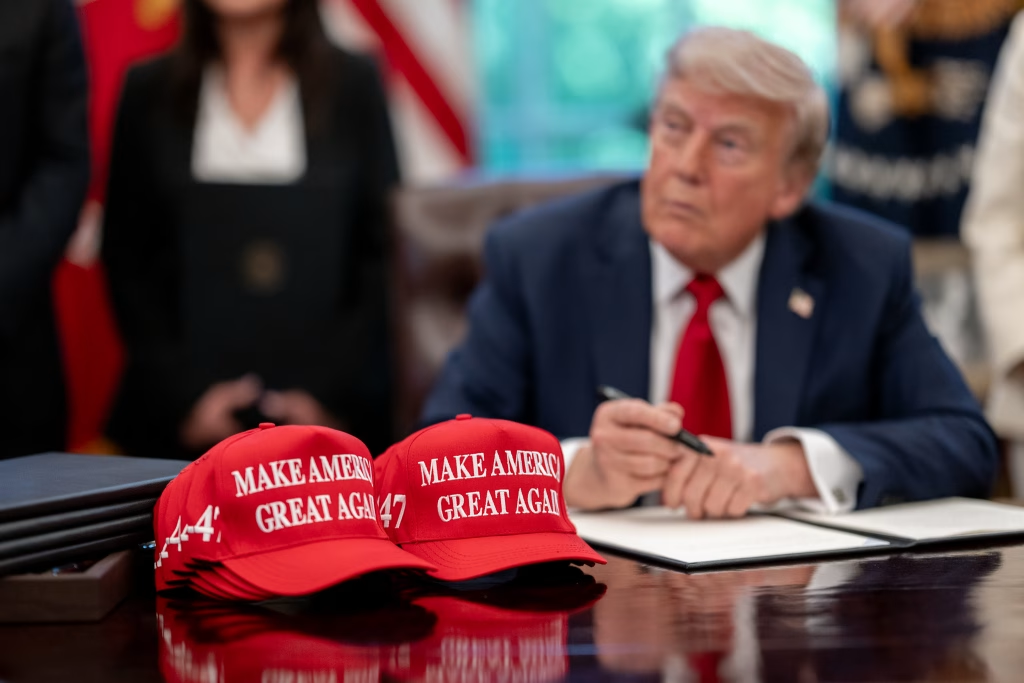
So, it’s back to Truth Social, where I had to again wade through a bunch of ads (so many ads!) and nonsense to confirm Trump’s post as shared below. As usual, there is a lot going on here. Let me note that, like his attacks on universities, his current mania about museums is about attacking sources of expert information. He even makes reference to the pressure he has put on universities in this post.
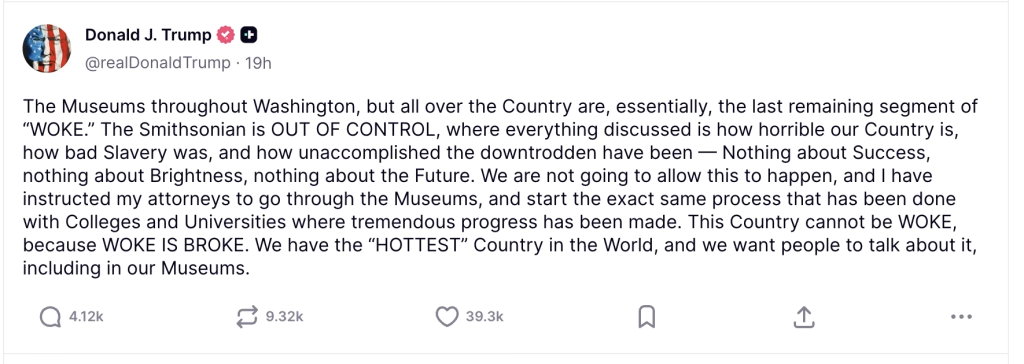
The notion that museums are “OUT OF CONTROL” suggests that they should, in fact, be controlled, and he seems to think that he, or his agents, should be doing the controlling. There is a word for the notion that a central figure should be able to dictate what information is shared with the public.
While readers seek to figure out that word, as usual, Trump’s post makes me think, yet again, of Stanley’s How Fascism Works. Chapter 3 is entitled “Anti-Intellectual,” and in looking for an appropriate quote or two, I find it tempting to say “go read the whole chapter.”
I’ll start with this.
In fascist ideology, there is only one legitimate viewpoint, that of the dominant nation. Schools introduce students to the dominant culture and its mythic past. Education therefore either poses a grave threat to fascism or becomes a pillar of support for the mythical nation (36).
Along those lines, notice Trump’s reference to the fact that museums (sorry, Museums) have the audacity to point out “how bad Slavery was.”
How dare they point out that white Christians did bad things! Amiright?
Why can’t we just tell heroic stories about westward expansion and conquering the land the way John Wayne intended?
Note the last sentence; he wants museums to be propaganda tools, not places of education or truth.
By the way, the notion that museums only talk about the bad things in the US’s past and ignore the good things is absurd. The Air and Space Museum (as well as places like the Space and Rocket Center in Huntsville, AL) is full of the triumphs of the United States. As is the National Museum of American History, among any number of other places. The fact is that alongside many things worth celebrating about the US, there are the sins of slavery, the war on Native peoples, and things like Japanese internment (to name but three). This is just reality, which is what you are supposed to get in a proper museum. Of course, I don’t expect Trump to have spent a whole lot of time in museums to get a first-hand experience.
To return to Stanley,
Fascism is about the dominant perspective, and so, during fascist moments, there is a strong support for figures to denounce disciplines that teach perspectives other than the dominant ones–such as gender studies or, in the United States, African American studies or Middle Eastern studies. The dominant perspective is often mispresented as the truth, the “real history,” and any attempt to allow for alternative perspectives is derided as “cultural Marxism” (43).
That last line took my mind to Ezra Klein’s interview with Yoram Hazony (author of The Virtue of Nationalism).
…most people on the right agree that there is a thing called woke, and most of them agree that it’s a strain of neo-Marxism.
It is a common accusation from many on the right, especially the nationalist right.
Setting aside deeper conversations about fascism and extreme nationalism, let me conclude with two observations.
- Trump is here admitting that “woke” means things like acknowledging the evils of slavery, and that is something he does not want in our museums.
- He thinks that the role of museums is to extol his version of American greatness in the moment.
In short, he wants museums to ignore truth in the service of a broader national mythology.
This is a clear attack on expertise and on truth.
It is not the proper realm for the president to be operating.
It is also extremely and grimly ironic that he has griped before that doing things like taking down statues and renaming buildings are some kind of erasure of history (when in fact, they are the revocation of undeserved honors), but here he is, arguing for the literal removal of history from museums.
Indeed, this is the administration that has restored the names of bases named for Confederates (wink-wink) and is currently restoring CSA monuments in the DC area, as the AP reported earlier this month: Confederate statues in DC area to be restored and replaced in line with Trump’s executive order.
Note: Trump is saying that talking about how slavery was bad is a problem, and he has ordered the restoration of monuments to Confederates.
Who won the Civil War, again?
Maybe I should go to a museum to find out before it’s too late…

Not all of American greatness. If you have visited the Museum of African American History, you will find a lot of African American greatness, including the kinds that the Trump administration has been deleting from government archives, from Harriet Tubman to the Tuskegee Airman to Frederic Douglass to MLK and the Civil Rights movement.
No, he doesn’t want all forms of American greatness, just White American greatness.
I have a Civil War question. Was this a good idea by the South? If they had avoided hostilities would it not have saved a huge number of lives and tons of money? Their economic and social model would have continued for a while longer; all economic and social systems change as science and technology advance certainly, but their system would have continued for a decade or more. Betting everything you have on a single roll of the dice isn’t smart ever, especially when you’re betting human lives. My theory is that if smart people ran the world there would be no war. Those Confederate generals were dumb because they didn’t understand the stakes in the game they thought they were playing. It wasn’t some chess match involving wooden pieces but real people, real flesh, real blood. Also, there is no honor in sacrificing other people’s blood.
I have been wondering about how this plays out for Trump emotionally.
I mean, it could be transactional. He had the support of certain people who want this.
It could be simple racism and expressive of a desire to keep “those people” down. There’s support for this kind of thing in his bio.
It could be his narcissism. Nothing bad about “my stuff” can be allowed to be spoken.
I mean, it’s a triple threat, I guess it could be all.
@Slugger: The simple answer to your question is that the founders of the Confederacy did not think the US Federals would fight very hard to keep them and preserve the union. They had a sort of belief about how they had the superior “fighting spirit” or some such thing. I think they badly misread the situation, in a highly American way.
There’s a speech by Jeff Davis from just before the outbreak of hostilities to this effect, but I have been having trouble finding it.
In some sense, they thought Lincoln was bluffing. When Jackson threatened them two decades earlier, they did not think he was bluffing.
Of course, this all reminds me of the idiotic focus on “warrior spirit” we now have.
@Jay L. Gischer: And in rebuttal to myself, I will note that the value of the slaves held in the US was about 4 billion dollars – and those are 1860 dollars.
So of course there is going to be a fight over it. If you thought you were about to lose 4 billion, you would probably put up a fight. Dumb or smart doesn’t have all that much to do with it.
And the people who held all that wealth were able to get other people to get out there and kill and die for them. As usual.
@Jay L. Gischer:
I believe it’s all three, but there is an order of operations as it were.
The narcissism comes first. You can see that in the bleat quite clearly. The US is the “HOTTEST” country right now and people should be talking about that and celebrating HIM for making it happen. But, his polling is in the crapper, he’s not finding enough time for his Ego Inflation rallies (while GOP pols are hiding from their constituents), and the press (albeit tepidly) is challenging his assertions of “This is Fine.”
The racism follows – if he’s not being celebrated, it must be THEIR fault. I’d just note that “those people” is an expansive cohort that correlates significantly with race, but that can include sex, ethnicity, and ideology groupings.
The transactional stuff brings up the rear. A sizable swath of his support wants the MAGA red meat, so with his ego bruised and his victimhood reinforced, Trump brings out the grievance smorgasbord for his sycophants to lap up with vocal appreciation.
Paul Campos has a good take at LGM.
@Jay L. Gischer:
The Japanese made the same mistake. They and the Confederates may have had more fighting spirit, but the United States had more men, more guns, more money, more foundries, more …
@Jay L. Gischer:
Smart would have seen the handwriting on the wall, stayed in the Union, and campaigned for compensated emancipation.
@Jay L. Gischer:
And wasn’t there a quaint belief among the Confederates that southern gentlemen fought better than Yankee rabble?
@CSK: Yeah, I think so, but I have not found a good source to cite for that.
The religious crime of heresy comes to mind.
When you can’t defend an idea on its merits, you resort to threats and intimidation.
As the nation’s de facto assignment editor, Trump is doing a bang up job. He happily directs the journalistic equivalent of 6 year old soccer players to chase every ball but the Epstein ball. It wasn’t that long ago that any politician at any level of government would have been run out of office and shunned for making just one ludicrous statement. Trump makes many such statements EVERY DAY, and does so in what can be described as the simian manner of “proudly showing his ass.”
@Charley in Cleveland:
To which I respond in detail here.
@Slugger: Jay makes two good points but you should also remember that a lot fo the European professional military thought that the South would win as it was thought that it was much easier to fight a defensive war.
More on topic, II think through most of the post slavery period kids were taught in school a very sanitized version of slavery. Popular culture gave us Gone With The Wind and happy slaves singing and dancing in the fields. Black people supposedly were better off under Jim Crow than they are now. Even today now that we have so much “wokeness” you still dont get much coverage or teaching about the really bad parts. For example almost always seem shocked when I tell them that during some of the lynchings they burned people to death and they also sometimes cut up the bodies and sold off pieces as souvenirs.
Steve
Steve
@Slugger:
The issue wasn’t even the end of slavery, it was the containment of slavery.
That cotton cash crop they were growing was big cash. Very big cash, in fact. It is said Savannah was the richest city in the world, that era’s Saudi Arabia. But there were no modern fertilizers and the science of crop rotation was in it’s infancy. Even if it had been a fully developed science crop rotation cuts into profits big-time. It also reduces out-put and England was busily seeking to diversify the sourcing of cotton, competition from Egypt and India loomed. They felt a desperate need for new land and never thought a war could result in the end of slavery itself.
They were willing to roll the dice of war over it as they thought the issue would be resolved within a few months. One or two major battles and that’s it. Over by Christmas! Had everybody known what they were getting themselves into….ah well… a heck of a lot of wars start with a rationalization that it will be easy.
Had everybody known what they were getting themselves into I doubt more than one or two states would’ve signed on to South Carolina’s secession, and Lincoln would’ve sworn on a stack of bibles he would never end slavery and let then have some of the West.
@Jay L. Gischer: I think a lot of it boils down the kind of attitude that one might see from an older White person who visits, say, Monticello, and complains about how much they talk about slavery on the tour. “I just want to hear about how cool Jefferson was! Do they have to keep putting slavery in my face?” It is a kind of deeply internalized white supremacy.
@CSK: And wasn’t there a quaint belief among the Confederates that southern gentlemen fought better than Yankee rabble?
Most Southerners could shoot and ride and forage. Throughout most of the war, Confederates fought well above their weight compared to their Union counterparts (such as at the Battle of Chancellorsville).
@gVOR10: the Confederates may have had more fighting spirit, but the United States had more men, more guns, more money, more foundries, more …
Guns are not always enough. It takes will to fight a protracted war.
Initially, the Union army was composed of shopkeepers, workers, and poor immigrants, many of whom would have preferred to just go home. By Gettysburg, they still wanted to go home, but knew the only way that would happen was to stand and fight, the shopkeepers having become seasoned soldiers.
@Steven L. Taylor: “I just want to hear about how cool Jefferson was! Do they have to keep putting slavery in my face?”
They talk plenty about “how cool Jefferson was” at Monticello. However, it is interesting to note that Jefferson himself often wanted to conceal slaves from his guests. For instance, Jefferson devised a dumbwaiter so guests could be served, with the actual preparation being done out of sight.