Trump Preparing For War With Iran
You’re going to be finding out over the next, maybe, 10 days. 10 to 15 days, pretty much, maximum.
WSJ (“Trump Weighs Initial Limited Strike to Force Iran Into Nuclear Deal“):
President Trump is weighing an initial limited military strike on Iran to force it to meet his demands for a nuclear deal, a first step that would be designed to pressure Tehran into an agreement but fall short of a full-scale attack that could inspire a major retaliation.
The opening assault, which if authorized could come within days, would target a few military or government sites, people familiar with the matter said. If Iran still refused to comply with Trump’s directive to end its nuclear enrichment, the U.S. would respond with a broad campaign against regime facilities—potentially aimed at toppling the Tehran regime.
The first limited-strike option, which hasn’t been previously reported, signals Trump might be open to using military force not only as a reprimand for Iran’s failure to make a deal, but also to pave the way for a U.S.-friendly accord. One of the people said Trump could ratchet up his attacks, starting small before ordering larger strikes until the Iranian regime either dismantles its nuclear work or falls.
A limited strike would lead Iran to walk away from negotiations, at least for a significant period, a regional official said, especially when officials in Tehran are currently formulating their response to U.S. demands.
It couldn’t be determined how seriously Trump is considering the option after weeks of deliberations, though senior aides have repeatedly presented it to him. Discussions of late have focused more on larger-scale campaigns, officials said.
On Thursday, Trump said he would decide his next moves on Iran within 10 days. Later he told reporters his timeline was a maximum of about two weeks. “We’re going to make a deal or get a deal one way or the other,” he said.
WaPo (“Trump appears ready to attack Iran as U.S. strike force takes shape“):
The Trump administration appears ready to launch an extended military assault on Iran, current and former U.S. officials said, as the Pentagon amasses an immense strike force in the Middle East despite the risks of U.S. combat fatalities and American ensnarement in an extended war.
The arsenal, under assembly for weeks, is awaiting the arrival of the aircraft carrier USS Gerald R. Ford and its accompanying warships, officials familiar with the matter said, after military leaders last week extended their deployment and ordered the ships to the region from the Caribbean Sea. The vessels were approaching the Strait of Gibraltar on Thursday, making an attack possible within days, said these people, who, like others in this article, spoke on the condition of anonymity to discuss sensitive military planning.
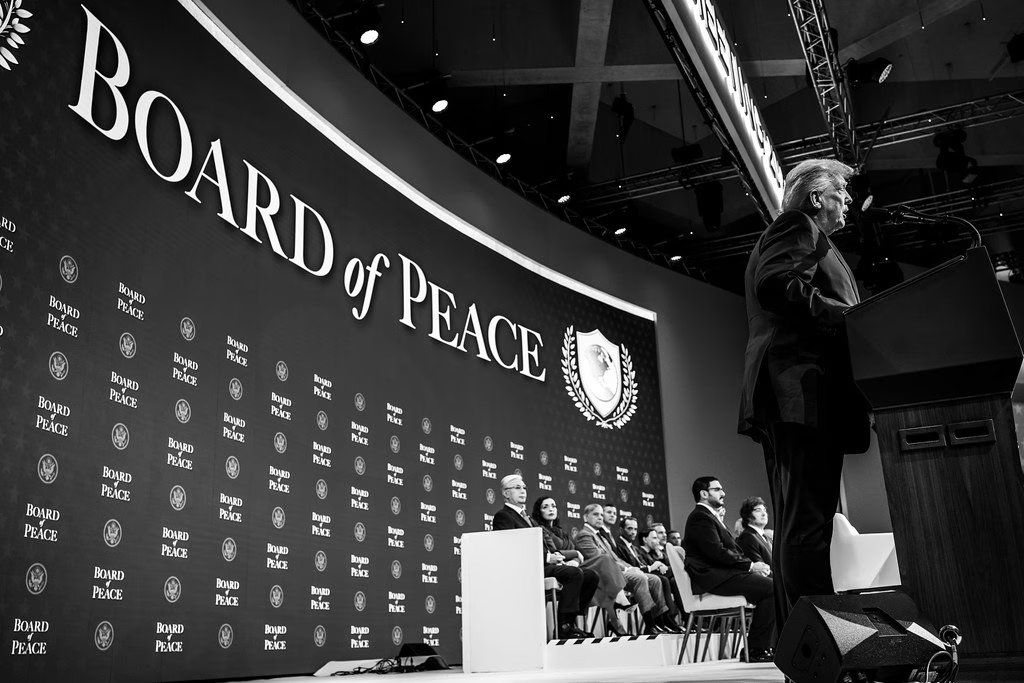
President Donald Trump, speaking Thursday morning at an event in Washington, was ambiguous about what he might do. “Maybe we’re going to make a deal. Maybe not,” he said at the inaugural meeting of his Board of Peace. “You’re going to be finding out over the next, maybe, 10 days.” Later in the day, he framed the timeline as “10 to 15 days, pretty much, maximum.”
Trump’s top national security advisers met in the Situation Room on Wednesday to discuss the Iran situation, and they were told that the U.S. forces that have been deployed to region will all be in place by mid-March, a U.S. official familiar with the issue said.
[…]
The United States, backed by ally Israel, would have an “overwhelming advantage” militarily over Iran, said Daniel B. Shapiro, a former U.S. ambassador to Israel and senior Pentagon official during the Biden administration. The warships in or nearing the Middle East join a sprawling array of combat power already in position, including dozens of fighter jets, air-defense capabilities and other weapons.
But a major conflict with Iran poses grave risks, Shapiro said, including ballistic missiles capable of killing U.S. troops in the region, a network of proxy forces across the Middle East that could quickly turn any attack into a far wider and deadlier war, and the potential for significant disruption to maritime shipping and the global oil market.
“They’ll definitely take terrible damage from combined U.S.-Israeli strikes,” said Shapiro, a distinguished fellow at the Atlantic Council, referring to Iran. “But that doesn’t mean it ends quickly, or clean — and they do have some ability to impose some costs in the other direction.”
At NYT, David Sanger observes, “As Trump Weighs Iran Strikes, He Declines to Make Clear Case for Why, or Why Now.”
With two carrier groups and dozens of fighter jets, bombers and refueling aircraft now massing within striking distance of Iran, Mr. Trump is threatening another attack. He is doing so without providing assessments about the urgency of the threat or any explanation of why he needs to strike again after claiming the nuclear sites he targeted had been “obliterated.”
Though Mr. Trump is largely fixated on the nuclear weapons program, at various moments he and his aides have cited a range of other rationales for military action: protecting the protesters that Iranian forces killed by the thousands last month, wiping out the arsenal of missiles that Iran can use to strike Israel, and ending Tehran’s support for Hamas and Hezbollah.
Then there is the question of whether military force, the hammer Mr. Trump reaches for so quickly, can even accomplish those ends. Most of Iran’s near-bomb-grade uranium is already buried from the last strike, in June. And it is not clear how airstrikes would immediately aid protesters around the country or persuade Iran to stop funding terror.
Mr. Trump has never consistently described his goals, and when he talks about them it is usually in a haze of brief, offhand comments. The president has given no speeches preparing the American public for a strike on a country of about 90 million people, and sought no approval from Congress. He has not explained why he has chosen this moment to confront Iran instead of, for example, North Korea, which in the years after Mr. Trump’s failed negotiations in the first term has expanded its nuclear arsenal to 60 or more warheads, by U.S. intelligence estimates, and is working to demonstrate they can reach the United States.
[…]
[N]one of the allies appear to be joining with the United States in military planning, except for Israel. Britain’s prime minister, Keir Starmer, held a phone conversation with Mr. Trump on Tuesday, and according to The Times of London, Mr. Starmer refused to let Mr. Trump use British airfield facilities at the Diego Garcia base in the Indian Ocean or a Royal Air Force station in Gloucestershire to conduct any operations against Iran. British officials did not confirm or deny the report, but the next day, Mr. Trump issued a blast against Britain’s pending deal for a 100-year lease on the Diego Garcia base.
At least the British were aware of Mr. Trump’s plans. Senior officials representing several of the United States’ closest NATO allies said at the Munich Security Conference last weekend that they had gotten almost no details of American plans from Washington. They spoke on the condition of anonymity to describe sensitive military issues.
Several of them expressed deep skepticism that the United States could make a compelling case that military action was needed.
In fact, Mr. Trump may well be ignoring one of the first rules of the “Powell Doctrine,” the lessons born of the Vietnam War and developed by Colin Powell when he was chairman of the Joint Chiefs of Staff.
“The essence of the post-Vietnam consensus on the use of force is that the political objective must be clearly articulated,” said Robert S. Litwak, a political scientist at George Washington University who has written extensively on negotiating with Iran. “With Iran, Trump is again breaking with that consensus by offering multiple rationales for this preventive military action, from nonproliferation to protecting protesters to regime change.”
Given that the administration claims that MIDNIGHT HAMMER “obliterated Iran’s nuclear program” in last month’s National Defense Strategy, the urgency to reach a deal is less than apparent. While administration officials have apparently outlined “red lines” to Iranian negotiators, they have not been made public.
All indicators are that Trump envisions accomplishing his goals, whatever they might be, with airpower alone. That’s incredibly optimistic.
First, as WSJ reports (“Iran Is Getting Ready for War With the U.S.“), the regime has spent the eight months since the joint US-Israeli campaign hardening their defenses:
Iran’s leaders want to reach a nuclear deal with the U.S., but they are also rushing to prepare for war in case talks between the countries fail.
Tehran is deploying its forces, dispersing decision-making authority, fortifying its nuclear sites and expanding its crackdown on domestic dissent. The moves reflect its leaders’ belief that the survival of the regime itself is at stake.
Domestically, the Islamic Republic is more vulnerable than it has been in decades. Its leaders are facing widespread popular discontent over the worsening economic picture and the mass killing of protesters last month. Meanwhile, the U.S. has deployed two aircraft carriers and a host of other warships and jet fighters to the region in preparation for a possible attack.
“Iran is facing its worst military threat since 1988,” when the eight-year war with Iraq ended, said Farzan Sabet, an analyst on Iran and Middle East security at the Geneva Graduate Institute in Switzerland. “Iran is preparing for strikes by putting its security and political leadership on high alert to prevent decapitation and to protect its nuclear facilities.”
Iranian officials have presented some concessions in pursuit of a nuclear deal, but Vice President JD Vance said Tuesday the offers have fallen short of the red lines set by the U.S., which wants Iran deprived of the ability to make a nuclear weapon. While Iran’s foreign minister publicly said the talks had made progress, the government now fears that the gap between what Tehran is willing to offer and what Washington is willing to accept may be unbridgeable, an Iranian official said.
Ali Larijani, the head of Iran’s National Security Council, said while Iran doesn’t want war, it is ready if one starts.
“We reviewed our weaknesses and addressed them,” he said in an interview aired Sunday on Al Jazeera. “If war is imposed on us, we will respond.”
Iran’s leaders are preparing for an attack that could disrupt its chain of command. The Islamic Revolutionary Guard Corps earlier this month announced plans to revive its so-called “mosaic defense” strategy, which gives commanders the autonomy to issue orders to their units. The strategy is designed to make the Islamic Republic more resilient to foreign attacks.
Iran is flexing its military muscle as best it can, sending the message that its armed forces have the capability of disrupting the global oil trade and of hitting U.S. interests across the Middle East.
Naval units of the paramilitary Revolutionary Guard were deployed this week to the Strait of Hormuz. The strategic waterway connects the Persian Gulf to the wider Indian Ocean and around a fifth of the world’s oil supply passes through it.
[…]
Iran has also been conducting work at its nuclear sites to better protect them from strikes, according to satellite imagery published and analyzed by the Institute for Science and International Security, a think tank based in Washington.
The satellite images show that Tehran has been hardening and strengthening tunnel entrances at its Isfahan site—where Iran is believed to have kept much of its highly enriched uranium and which was heavily damaged by U.S. and Israeli attacks last June—and at a deep underground tunnel complex in what is known as Pickaxe Mountain.
Second, to the extent the goals include regime change or even protecting demonstrators, simply blowing things up would seem to cause more problems than it solves. We tried toppling a regime without having a replacement plan in Libya; that didn’t work out well. (Granted, our replacement plans in Afghanistan and Iraq failed as well.)
Third, the regime sees itself and the Islamic Republic as one and the same. They’re likely to pull out all stops to survive. We’re amassing a huge armada, including two aircraft carriers, in the region. What happens if one gets hit?
Given that we’ve been building up our forces in the region for weeks, there is clearly no exigency requiring the President to forgo consultation with the Congress and, indeed, obtaining an Authorization to Use Military Force. And, given that a MIDNIGHT HAMMER style surprise is clearly not a possibility here, there’s certainly no reason not to make a case to the American people that war is necessary.

This just seems like a Very Bad Idea, and it is heartbreaking to think that American soldiers could be the immediate casualties. There has been no case made for this action, we’ve alienated virtually all of our allies, and most Americans are not paying attention to this. While I continue to believe that the chaos is the point, this particular brand of chaos is incredibly dangerous.
Out of curiosity, the other day I looked up how many carrier groups Bush43 committed to the opening salvo of the Iraq war, remember shock and awe? At that time 5 groups were deployed, roughly half the Navy, additionally Air Force battalions had access to bases in Turkey, Europe, various middle east kingdoms and Diego Garcia. None of these locations beyond where the US already has military installations appear to be available. So while this indeed is a powerful armada, it pales in comparison to what the US has deployed in the middle east before.
Like everything the felon does, this is half-assed without goals and objectives and without a plan for the next day.
Lots of memes on social media this morning reposting the felon’s old tweets predicting that Obama would start a war to rescue his flagging popularity. And here we are.
This is what happens when Congress cedes its constitutional authority (duty!) to a mentally ill ignoramus. The media should dub this saber rattling, “Operation Ignore Epstein.”
Fundamentally, Trump is neither the “peace president” nor the “war president”, he’s the bully president. He’s the guy who loves the “What are you lookin’ at?” mentality, wants to take an unprovoked swing to show people he’s tough, but really really doesn’t want to have to follow that up. Punch once, walk away with your fists raised in glorious victory.
We saw it in the first term, we’re seeing it again. MOAB was just for funsies, not needed to fulfill a real military purpose. “See this thing? We have it, we can use it, that means we’re better than you.” That is the mentality. That’s why he likes Hegseth and his warriors-should-be-feared bullshit. That’s why he releases videos of fishing boats being blown up even though it’s simply evidence of murder. That’s why he loves violent ICE raids. That’s why he ran the Venezuela op.
Iran is not Venezuela. If we do anything in Iran, it will be purely performative: violent but probably without real purpose or consequence. Maybe we blow up a factory somewhere, something that will do some secondary exploding. Maybe we bomb an underground bunker again. Video will immediately be released by the WH, so the explosion needs to be big. Trump will declare Iran’s nuclear ambitions “dead”. Media will move on to treating the next thoroughly corrupt trash from this administration as totally normal politics.
Obliterate: verb
past tense: obliterated;
past participle: obliterated
destroy utterly; wipe out.
I’m just sayin’…
How does Trump personally profit from this? His personal profit is the main driver of his actions. What is his cut of the action?
Is this all legal under US laws? The Middle Eastern wars of the last thirty years have brought little peace to the world or profit to the American people as best as I can see. Maybe we should rethink the whole process that gave presidents all of this war power.
@Sleeping Dog:
An important thing is that none of Iran’s neighbors are going to allow the kind of ground force staging that happened before both the Gulf and Iraq wars. The Marine expeditionary strike groups appear to still be in port. So far, no signals that there will be boots on the ground beyond the possibility of special forces operations.
@Michael Cain:
I don’t believe there are any plans for an invasion, he simply believes air power can do the job.
@Michael Cain:
Considering how much larger, more mountainous and more populous Iran is relative to Iraq, boots on the ground would seem to be obviously pretty foolish. Even for someone as dim-witted as Fatty.
Except that, Trump has already posted to Truth Social his opinions about this grave matter of national security. What more could the American people want before the king goes and does whatever the hell he decides is in our/his interest?
@Slugger: I demur just a bit. I don’t think financial gain is number 1 for Trump. I think “winning” is number 1. Getting the big shot of joy juice from your body that comes with “I won! I am the greatest!”. You can get this from a financial transaction. It’s not the only way.
I think @ptfe has it right. The script is
1. I take a swing and hurt you
2. I make demands and threats of more punishment
3. You cave to the demands, even though we both know you don’t want to
4. I get rewarded with a big dopamine (or whatever) hit.
5. The dopamine hit fades. Go to 1.
The demand may end up being a financial one. Often he takes payment as victory, I think.
AND, he grifts. Oh yes, he grifts. It’s an exercise in a different sort of power – the power to deceive. It’s the same hit of dopamine, though.
The worst thing you can do to him is ignore him. Go on being woke. Go on promoting trans rights. Go on with Pride Month. Go on with Black History month. Don’t obey in advance is a thing in general, but with Trump there is a cherry on top which is how much he hates being ignored.
@ptfe:
Exactly. He’s a thug.
“Forces in area”
With some discussion of what each type of asset does.
@charontwo:
It’s all air power. The loss of UK bases degrades US power somewhat. I wonder how Qatar feels about the use of their bases?
A decapitation strike won’t cut it, just as in Venezuela, the regime would likely survive. I imagine they have some spare Ayatollahs.
A small note of sympathy for the poor Russian Navy captain who caught the job of driving a corvette into the middle of two carrier groups. One does not simply paddle a rowboat into Mordor.
Latin American militaries tend to be rather small and not especially well equipped for major action. Throughout the XX century, they were used more for internal repression or in civil wars than for anything else, where they got any use at all.
See how Argentina fared against a British fleet in the Falklands War.
Iran, in contrast, saw a relatively large military buildup under the Shah for some reason. The current Islamic republic spent the first few years of its life fighting a war with Iraq, then developed ambitions to become the major regional power. So, yeah, they are far better armed than Venezuela.
BTW, if this were a 90s thriller or an action movie, there’d be a number of Iranian sleeper cells in America, set to perform spectacular terrorist acts when ordered to do so, or if the Supreme Leader should perish.
@Michael Reynolds:
Looks the UK is not willing to sign off in advance without a clear statement of the legal basis, and also of the mission objectives, boundaries, and contingencies.
There are several factors at work:
– The Trump administration is currently about as popular in the UK as swimming in vomit
– The US has sorely pissed off the UK governement
– The UK has paibful experience of being dragged into open-ended US actions
– The government has broad excecutive privilege regarding military operations (far more than, in theory, the US) but in the current situation could expect to be eviscerated in parliament and possibly yhje courts if it does not get solid basis from the US adminstration
– Contrast this with the 2023 UK deployment of air and naval forces to defend Israel in the first round of Iranian missile strikes. Defensive operations are one thing; association with some possibly half-arsed and legally dubious offensive quite another.
https://x.com/noeticnous/status/2024631303203586324
As the US is not sending any serious land forces or amphibous groups, it looks like the plan is “air only”.
Exactly what the plan may be remains to be seen.
I suspect the idea is to escalate from some intial moves to “regime decapitation”.
If so, this may be a mistake: if the idea is to topple the government, probably better to go all out from the outsey.
BUT: that plan must rely on an Iranian revolt to do the hard part; the problem is the regime still has very large numbers of well armed and motivated supporters, and a monopoly on the heavy weapons.
In such cases a revolt might well be crushed.
And what then?
There is no clear strategy here.
Eliminate the nuclear programme?
That plus missiles?
That plus missiles and regional proxies?
Those plus securing the Gulf?
Plus capability damage?
All that plus “regime replacement”?
Replacement by whom exactly? A more amenable faction of the regime? The “opposition” as how defined? A “regime moderate/opposition” coalition? The military?
It’s all far too nebulous.
A serious administration, even if not going the proper route of seeking support from Congress, would surely lay out the goals of the operation, and at least a basic outline of the means of pursuit to the Americn people.
Because if the US provokes a general uprising that ends in a mass slaughter, it’s reputation is going to stink in history, and likely totally alienate the Iranian people.
The best hope is that some face-saving compromise can be extracted: say an Iranian deal on nuclear materials and production, plus some vague and un-enforceable varbaige on missiles and proxies, in exchance for graduated santions relief.
But imho that’s running out of time.
The Ford will be in the eastern Med by Sunday; it then either takes station there or turns for Suez.
If the latter, another week before it’s in the Arabian Sea.
@Kathy:
The Argentinian navy was of small use for internal repression; hence it was rather starved of funds.
But it was enough of a threat for the Royal Navy to be deadly serious about sending it to the bottom if it showed it’s face.
Hence the Belgrano.
Hence the rest of the Argentinian fleet deciding discretion was the better part of valour.
The Royal Navy in a bad mood is to be messed with only at extreme peril.
As regards the Iranian military, a lot of reports indicate its been rather in decline since the 1990’s due to the military vs IRGC rivalry, and corruption.
Its air defences were crushed in the “Twelve Day War”.
What’s unclear is their capbility re missile strikes and “light naval” interdiction in the Gulf.
Can they actually interrupt the oil flow via Hormuz?
Also, what “unconventional warfare” capacity do they have in the region?
Another interesting data-point: US ground forces seem to be exiting eastern Syria
@Michael Reynolds:
I thought it odd that article mentioned the withdrawal of support from EU bases but no mention of what posture Qatar, UAE, and Saudi Arabia are taking. Enough basing can be had in those places and Israel to make the EU irrelevant. I suspect they have been silent, which would seem tacit support.
The question of why the Arab emirs have been handing billions to Trump Inc. may be being answered…
@dazedandconfused:
Total Euro-NATO cutoff would not be irrelevant.
US operations in the ME are very much dependent on basing and support out of Lajes, Lakenheath, Rammstein, Rota, Diego Garcia, Fairford, Aviano, etc.
If those supply routes were cut, the US forces would have serious poblems.
I doubt they wiill be; there is a a nice lawyerly distinction between force supply and offensive operaions.
The Arabians can certainly provide the airfields; they can’t ensure the logistics.
As to why the Saudis/Gulfies seem currently on board, when previously they have not is a very intersing question, to which I for one have no current answer.
Perahps total confidence in US firepower vs Iran?
And Iran regime fragility?
Or perhaps some assurance from Trump that it’s performative?
f.i.i.k.
As it will! “The job” being defined ex post facto as whatever the result of the air attack was.
@JohnSF: They typically use those places but absolutely don’t need to. The logistics are going to be a bit more complicated, but for an air war it’s no biggie. Diego Garcia is not exactly near the great circle line between the US and the ME, btw. We store stuff there but if we have basing all over the ME, from Kuwait to Qatar, and the Saudis have massive airfields, it’s not going to bother anyone at the Pentagon.
Btw, Bulgaria is scheduling a civilian flight shutdown in a couple slots next week, for US military traffic. So there is still a European airport being used.
@Ken_L: The result of the air war will destruction of Iran’s nuclear program. Again.
@dazedandconfused:
Bulgaria is fine, but limited capacity.
What’s in place in the Gulf is in place, and hardly needs direct logistic support via Europe now.
But in a sustained war?
That’s a diffrent matter entirely.
As of now, US forces continue to stage out of all said European bases,
As of now.
How many US flights can go all the way from the US to ME without stop-overs or refuelling out of European bases?
Peronally I doubt there will be a denial of use. The fudge will be “not for direct attack”,
That will likely work, for now.
@JohnSF:
Out of curiosity, I looked up the Falklands War entry on Wikipedia. I was surprised by how much navy the Argentinians had. among their various surface ships was a 38 year old aircraft carrier, ironically enough made by the UK for use in WWII. It carried A-4 Skyhawks, too. granted these were old and outdated by the early 80s, as a lot of the early 50s-60s jet fighters wound up. But that was a dangerous ship even for the RN.
I’m not sure, but I think the sinking of the Belgrano was the only time since WWII a submarine sank a ship. I also think it was the first nuclear sub to do so.
@Kathy:
The Veinticinco de Mayo had actually been upgraded quite considerably; the hull was old, but it was still an effective carrier.
Both Conqueror and Splendid SSN’s were tasked with killing it.
It rather sensibly buggered off.
Absent the RN SSN, it might have got a duel between it and the RN carriers and escorts.
Still likely to have come of the worse.
But it was a dangerous item, to be sure.
Royal Navy rule number 1:
“Don’t ever fight fair.”
Find, fix, kill.