Trump Wants to Nationalize Elections
What could possibly go wrong?
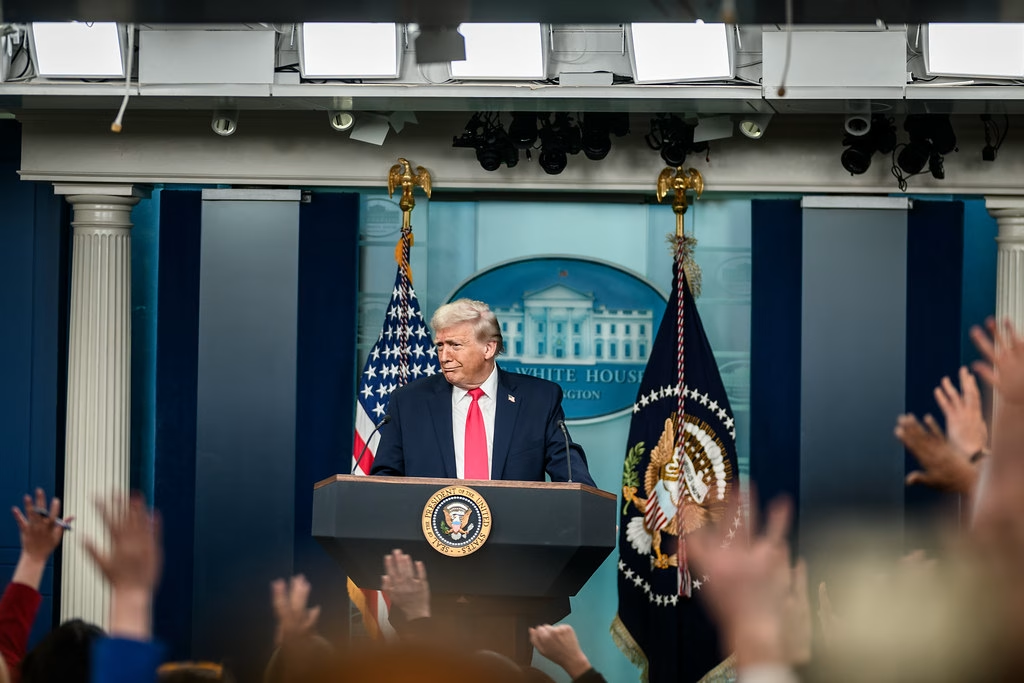
WSJ (“Trump Doubles Down on Calls for Republicans to Nationalize Elections“):
President Trump doubled down on his view that Republicans should “nationalize” voting in the U.S., questioning whether certain states should continue running their own elections as spelled out in the Constitution.
“I want to see elections be honest, and if a state can’t run an election, I think the people behind me should do something about it,” the president said Tuesday in the Oval Office, flanked by congressional Republicans during a bill signing ceremony to reopen the federal government.
“Take a look at Detroit…take a look at Philadelphia, take a look at Atlanta,” Trump said, referring to the cities in presidential battleground states as places of alleged corruption, without citing specific evidence. “The federal government should not allow that. The federal government should get involved. These are agents of the federal government to count the vote. If they can’t count the vote legally and honestly, then somebody else should take over.”
Trump’s comments echoed what he said in a podcast interview released Monday with Dan Bongino, his former deputy Federal Bureau of Investigation director, in which he urged Republican officials to “take over” voting procedures in 15 states, which he didn’t name.
Elections in the U.S. are run by state law under the U.S. Constitution, creating a decentralized voting system in which Americans cast ballots at precincts administered at the local level, and the federal government plays a limited role.
Democrats have assailed the president’s suggestions of any federal takeover of elections, calling it a dangerous undermining of democratic principles in violation of the Constitution. “Does Donald Trump need a copy of the Constitution? What he’s saying is outlandishly illegal,” said Senate Democratic Leader Chuck Schumer (D., N.Y.), who criticized Senate Republicans for being “silent as mice.”
Senate Majority Leader John Thune (R., S.D.) told reporters that while he was in favor of requiring voters to show identification to prove citizenship in voting, “I’m not in favor of federalizing elections, no. I think that’s a constitutional issue.”
House Speaker Mike Johnson (R., La.) told reporters Tuesday that the president was “expressing his frustration” about alleged problems in certain Democratic-leaning states enforcing election laws. Asked if Republicans should take over elections, Johnson repeatedly said, “no.”
[…]
Republicans in Congress have led a renewed effort to pass legislation that would require proof of citizenship for voters to register for federal elections. The GOP-led House approved the Safeguard American Voter Eligibility Act, or Save Act, which would, among other things, require people registering to vote in federal elections to present documentary proof of U.S. citizenship such as a U.S. passport or birth certificate. The bill is pending in the Senate.
Democrats have called the measure a voter-suppression effort that would complicate voter registration for U.S. citizens. Roughly 50% of Americans have a valid passport, according to the State Department.
NYT (“Trump Repeats Call to ‘Nationalize’ Elections, as White House Walks It Back“):
President Trump doubled down on his extraordinary call for the Republican Party to “nationalize” voting in the United States, even as the White House tried to walk it back and members of his own party criticized the idea.
Mr. Trump said on Tuesday that he believed the federal government should “get involved” in elections that are riddled with “corruption,” reiterating his position that the federal government should usurp state laws by exerting control over local elections.
[…]
Mr. Trump’s remarks came hours after the White House tried to walk back his comments from a day earlier that his party should nationalize elections. And they were the latest iteration of his unsubstantiated claims that U.S. elections are rigged, as Republicans face potentially big losses this fall.
During a podcast interview with Dan Bongino, his former deputy F.B.I. director, on Monday, Mr. Trump called for Republican officials to “take over” voting procedures in 15 states, though he did not name them. “The Republicans should say, ‘We want to take over,’” he said. “We should take over the voting, the voting in at least many — 15 places. The Republicans ought to nationalize the voting.”
[…]
But Karoline Leavitt, the White House press secretary, said on Tuesday that Mr. Trump had actually been referring to legislation that would require people to prove that they are U.S. citizens when they register to vote.
“What the president was referring to is the SAVE Act, which is a huge, common-sense piece of legislation that Republicans have supported, that President Trump is committed to signing into law during his term,” Ms. Leavitt said.
“I don’t think any rational person who is being honest with themselves would disagree with the idea of requiring citizens of this country to present an ID before casting a ballot in a federal election, or, frankly, in any election, and that’s something the president wants to see happen.”
But Mr. Trump never referenced the SAVE Act during the podcast or in his appearance in the Oval Office on Tuesday. And in any case, the SAVE Act does not federalize elections.
The degree to which this is an actual policy proposal rather than a vague “something oughta be done” is unclear. Given the events surrounding the 2020 election, though, the fact that he’s repeated himself on this in successive days is concerning.
That his staff keeps trying to walk it back is . . . interesting. That the Republican Speaker of the House and Senate Majority Leader are publicly speaking out against the idea is encouraging; alas, they have not thus far demonstrated the spine to stand up to repeated pressure from the President.
Meanwhile, Slate‘s Richard Hasen (“I Wrote a Book in Support of Nationalizing Elections. Trump Changed My Mind“) has had an epiphany:
If you look around the world at advanced democracies from Australia to Canada, they have an independent governmental body in charge all national elections. The body imposes uniform standards for registration, ballot access, voting machinery, and much more. One can walk into a polling place in Ottawa or Vancouver and have virtually the same experience.
These nonpartisan election administrators are headed by a civil servant or group that does not answer to the government. They and their workers have allegiance to the integrity of the election system, not to any political actor. In contrast, in the United States partisan actors play important roles in our election process, such as secretaries of state who run for office as Democrats or Republicans.
In The Voting Wars, I argued that by joining other advanced democracies we could decrease the amount of partisan fighting and litigation over election rules, increase the competence of election administration, and assure we have a system run with integrity and fair access to voting.
Donald Trump has caused me to abandon this argument. As I wrote in the New York Times last summer, when the president tried to impose his authority over various aspects of American elections via an executive order: “What I had not factored into my thinking was that centralizing power over elections within the federal government could be dangerous in the hands of a president not committed to democratic principles.” At this point, American democracy is too weak and fragile to have centralized power over elections in the hands of a federal government that could be coerced or coopted by a president hell-bent, like Trump, on election subversion. Courts have ruled that parts of Trump’s executive order are unconstitutional because the president has no role to play in the administration of elections.
Trump’s comments on nationalizing elections ironically prove the point that we should not nationalize elections. He apparently wants to target the administration at blue states, doing who-knows-what to make it harder for people to vote for Democrats. He desperately fears a Congress controlled by Democrats that could check his and his administration’s power. As he did in 2020, when he unsuccessfully attempted to overturn the results of the fair presidential election that he lost to Joe Biden, Trump hangs it all on voter fraud. His comments to Bongino about noncitizens voting, just like his comments about mail-in balloting, show Trump as either a liar or delusional. The amount of election fraud of this type is extremely rare. We know it because states, including red ones like Georgia—where Trump’s administration recently raided election offices in a serious threat to the 2026 vote—have gone hunting for fraud and found very little.
The Supreme Court provides another reason for not nationalizing our elections. The court could soon fully embrace that “unitary executive” theory that there can be no exercise of executive power by the federal government that ultimately does not report to the president. (It’s an argument with an exception likely to be applied to the United States Federal Reserve, in order to protect the value of the justices’ 401(k)s.) The unitary executive theory, if adopted, would mean that presidential control over an election body might be constitutionally required. The Trump experience shows why that would be far too risky.
We should now look to states to step up the competence, integrity, and accessibility of their election systems. They serve as the front line against election subversion. Diffusion of power in the states makes it much harder for Trump to mess with the midterm elections. Whether or not the Framers intended it, our messy, decentralized, partly partisan, uneven system of administering elections turns out to be the best bulwark against would-be authoritarian presidents
I wrote no such book, but have had that instinct for decades. Concentration of power raises the stakes and leads to corruption. For all its inefficiency, our disaggregated system is considerably more resilient than a centralized one.
Like Hasen, I would like Congress to use its power to standardize rules. Voter registration requirements and deadlines, ballot submission deadlines, and the like should be the same for federal elections regardless of where one lives. But the idea of Presidentially-appointed overseers is positively frightening.

The furious pace of detention facilities building suggest to me they have a use for them other than detaining immigrants.
This year in the 13-state western region, >90% of all votes cast in the November general election will be ballots that were distributed by mail. Seven of the 13 mail ballots to all registered voters. Two others have permanent no-excuse mail ballot lists with >75% of registered voters signed up. The remainder have no-excuse mail ballots that must be requested annually, and are used by anywhere from a few percent of voters to as high as 60%. After a few election cycles, mail ballots are enormously popular. After adopting mail ballots, states tend to replace the many small precincts in-person voting model with fewer larger full-service voting centers (my county — 2,600 square miles (that’s slightly larger than Delaware), 375,000 people — has five). When academic experts rate state voting systems for accuracy, security, and ease of use, the top positions are dominated by western vote-by-mail states.
Trump’s position is there should be no mail ballots. Depending on the day, that sometimes includes eliminating absentee ballots for military personnel stationed overseas. At a national level, the Republican Party seems to be moving in that direction. When Congressional Democrats were introducing voting reform measures, they were all clearly precinct voting first, mail ballots as an add on. They never allowed for the western system of mostly mail ballots with a few places for in-person voting.
My admittedly parochial position is that there is a known best practice for voting in the US, and that nationalization of voting methods will almost certainly not allow its use.
Positively frightening, yes. But while I don’t think it is your intent, I believe you are giving cover to the most frightening parts of this by coming at the issue so pragmatically and politically correct.
First, what is frightening is not “Presidentially-appointed overseers,” but Trumpist appointed overseers. We ought not pretend this is about Constitutional principles like State versus Federal powers. This needs to be properly characterized as a blatant power grab by a wannabe dictator.
Second, any talk of election reforms, even reasonable ones, needs to stop until Trump is no longer on the scene. There is NO evidence that the states aren’t currently managing elections with the highest level of validity, regardless of any variability between how Oregon and Ohio do it. Any time a Republican, like Thune or Johnson, speaks to alleged issues with election integrity, we need to hear political cowards afraid to confront their leader’s delusions about being cheated out of a win in 2020.
Or for that matter, cowardice in the face Trump’s persistent claims that he won in 2016 and 2024 by massive, mandate-conferring margins. Just last week, Trump defended his harsh immigration crackdowns by stating “Elections have consequences. The people want law and order.” Trump truly believes he has the consent of the governed due to no one shutting down his BS about voting irregularities having cheated him.
@Michael Cain: I like to point out that FL has a robust no-excuse needed, mail-in voting system, although they’re weakening it under MAGA/DeUseless propaganda pressure. Why did they implement this some years ago? Because the mail-in vote ran heavily Republican. And they weren’t at all scrupulous about trying to police double voting by snowbirds.
Team Trump must be terrified of losing Congress in the mid-terms. Some WH sources have pushed back on the notion, knowing it’s maybe an unconstitutional bridge too far.
Thune has said no to nuking the filibuster to please potus. At this point I bet lots of gop congress critters are privately wishing Steven Miller would diaf.
Let’s not get distracted by terminology. El Taco intends to steal the midterm elections.
He will try the legalistic means first, like gerrymandering (how’s that working out?) and voter suppression. That may not work. So he’ll resort to illegal, violent measures, his favorites. Like detaining large numbers of brown and black people on election day, especially around polling places.
Or he may declare marital law, seize ballot boxes before any ballots are counted, and other tricks and tactics favored by despots throughout history.
@Michael Cain:
This is among the reasons why absentee ballots were traditionally viewed as Republican-leaning. (I remember this being a factor in the 2000 debacle in Florida.) To my knowledge the last actual proven case of a fraudulent major US election was the one in North Carolina’s 9th district in 2018, which involved illegally improper collection of absentee ballots. After the scandal was uncovered, the election was invalidated and a new one was called several months later with a different Republican candidate (who did go on to win as it was a GOP-leaning district, though not totally out of reach to Dems during a blue wave year, so it’s possible the fraud achieved its purpose of keeping a Dem from winning when the iron was hot).
Nowadays, the distinction between “absentee” and “mail-in” voting does the rhetorical work in separating the traditional, Republican-friendly associations of not voting in person from the post-Covid expansion which Dems have embraced, enabling Republicans to imply there are “good” and “bad” versions of it. Even though Trump is calling for all forms of it to be shut down, it’s far likelier just a pretext for a more selective rejection of mail ballots where we know who will be favored.
@becca:
They bloody well should be. There is growing consensus that the US post-Trump has two most likely paths forward should we be able to thwart complete subversion of elections: 1) a persistent partisan authoritarian-light back and forth or 2) criminal accountability for the Trump regime via something like the Nuremberg Trials or the South African Truth and Reconciliation Commission in order to restore some status quo ante norms.
I’d prefer criminal accountability starting as soon as the Democrats control the House. Impeach Noem on Day 1 and find a way to convict Stephen Miller of federal crimes. Hold off impeaching Trump until late in his term to weaken him as a lame duck while keeping Vance out of power. In 2029, people need to go to prison for killing Good and Pretti and for torturing countless legal immigrants and protesters.
And there it is: Bannon is calling for ICE at polling sites.
Who has second US civil war in their 2026 bingo card?
I think this its resiliency also stems from the inconsistent ballot rules and technology that would block or expose large-scale attempts to interfere. What might allow a glitch in Illinois votes will create an obvious tilt in Indiana and so forth. I think the disaggregated system is a feature, not a bug.
One should not underestimate the things people will accept uncritically.
In the buildup to the Iraq quagmire, whatever one thinks about it, the Butcher of Baghdad held a referendum to renew his mandate(!) for another seven years. No, really. He really did.
The result was 100% for, 0% against, with 100% turnout.
I’ll pause for eye-rolling.
Ok, I know people who cited this result, claiming the Butcher had such massive and strong support, it would be suicide for any force to invade, as they’d meet massive, unrelenting resistance.
So, when El Taco claims immigrants are brought in illegally in order to vote for Democrats, you can be assured there are people who are not motivated by love of Taco, or prejudice, or grievance, or anything else, to swallow his orange sh*t, but who will do so anyway.
@Scott F.:
It needs to start then, to the extent possible, by House committees. But I expect criminal accountability for the murders of Good and Pretti to start before 2029…with state charges for Good’s killing, at least, in 2026. Granted, it would be the beginning of a multi-year legal process.
Prediction: The results of the 26 mid-term elections will not be known until the Supreme Court issues a ruling on the matter.
Thanks for covering this. I think I pretty much agree with you that it would be nice if standards were the same everywhere, but that would just mean that they would change every 4-8 years and would be particularly awful under Trump. The idea of an independent commission works in other countries I guess but Trump has, successfully, largely ignored rules about independent agencies and fired people so I dont see that working here.
Steve
@Eusebio:
I deferred to 2029 for the conviction of the murderers of protestors because federal prosecution there will have to be driven through the DOJ and the Independence-Be-Damned Trump DOJ ain’t gonna go there no matter who controls Congress. Noem, on the other hand, can be impeached without the DOJ and I can kinda sorta imagine that enough GOP dislike her that Senate acquittal in a near 50/50 Senate isn’t a given.
Legal consequences for Stephen Miller’s heinous disregard for due process and human decency, while most important to my mind, would be the most difficult to execute. No ability to impeach and an uncooperative DOJ would seem to insulate him somewhat. State charges, maybe?
James Joyner:
Yes, and one more thing: some rational mechanism bound into federal law that makes every attempt at unwinding gerrymandering.
This has not always been a strength, as the failure of Reconstruction and the resistance to ending Jim Crow demonstrated. And we’ve seen scattered election boards refusing to certify back in 2020, as the partisan members had less loyalty to the country than they did to Donald Trump.
I don’t have any particular larger point.
Maybe we need a centralized, but independent organization running elections nationwide, staffed by autistic people whose special interest is free and fair elections. That seems hard to set up.
@Kathy:
Sadly enough, I did. Although I didn’t pick the mid term election date…
@steve222:
In Australia it’s an independent commission in the sense it’s not subject to direction by the executive. The Australian Electoral Commission is, however, accountable to a Joint Standing Committee of the parliament, and ultimately to parliament itself. That stops the government of the day interfering in how the AEC does its work.
Nevertheless there is nothing in theory preventing a government with a solid majority in parliament appointing partisan members of the AEC who would implement measures intended to help the governing party win elections. Like so many elements of a democracy, the system ultimately depends on powerful people and institutions voluntarily abiding by certain core norms of behaviour – norms which the MAGA Republican party and numerous other centres of power in America have repudiated en masse this century.