Trump’s Iran Speech
Nineteen minutes. Zero answers.
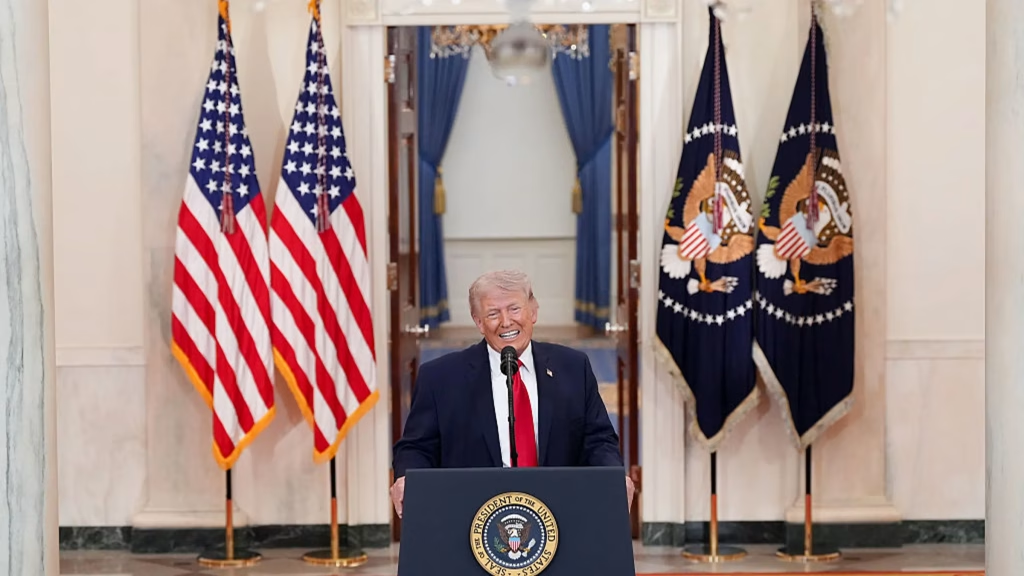
How it was covered in the major English-language press:
NYT (“Trump Claims Military Success but Offers No Clear Timeline to End Fighting“):
President Trump asserted the U.S.-Israeli war in Iran was “nearing completion” during a prime-time address on Wednesday, even as he offered no clear path out of the war and committed to bombing the nation “back to the Stone Ages where they belong.”
Mr. Trump did not make any revealing announcements in the speech. Instead, he described the military action against Iran as an overwhelming success and seemingly pleaded for concerned Americans uneasy about its costs and open-ended timeline to “keep this conflict in perspective.”
Mr. Trump ticked through the durations of the United States’ involvement in past conflicts, including the wars in Iraq and Vietnam, for the purpose of reminding Americans that the campaign against Iran had just entered its second month. But as he has done throughout the war, Mr. Trump did not offer a clear exit strategy and issued ambiguous and conflicting statements weaving diplomatic overtures with threats of escalating attacks.
“We’re going to hit them extremely hard over the next two to three weeks,” Mr. Trump said in the 19-minute address. “If there’s no deal, we are going to hit each and every one of their electric generating plants very hard and properly simultaneously.”
WaPo (“Trump says Iran war is ‘nearing completion’ as he seeks to calm economic worries“):
Facing economic and political headwinds a month after launching a surprise attack on Iran, President Donald Trump defended the increasingly unpopular conflict Wednesday night but assured the nation that the military operation in the Middle East was “nearing completion.”
In a speech from the White House, Trump said the United States was on track to complete all of its military objectives “shortly, very shortly” but first there would be a period of military buildup: “We’re going to hit them extremely hard,” he said. “Over the next two to three weeks, we’re going to bring them back to the stone ages.”
The president’s defense of his actions, and his direct entreaty to the American people, comes as the White House tries to contain the consequences of a conflict that has sent gas prices soaring and soured Americans’ feelings about Trump and the economy, six months before the midterm elections.
NPR (“Trump makes his case for war with Iran, saying the conflict is ‘nearing completion’“):
President Trump used a prime-time address to the nation on Wednesday to announce that the administration’s goals in Iran have nearly all been achieved and that the war there is “nearing completion.”
The roughly 20 minute speech was Trump’s first formal address about the war since the U.S. and Israel began striking Iran more than a month ago.
With rising gas prices sapping public support for the war, Trump sought to frame the conflict as a success thus far. “In these past four weeks,” he said, “our armed forces have delivered swift, decisive, overwhelming victories on the battlefield.”
However, the Trump administration has given shifting explanations of its goals, and its list of accomplishments in the conflict are mixed and unclear, at a time when the president has been talking about finding a way out of the war.
AP (“Takeaways from Trump’s address: No end date for Iran war and few details on strategy ahead“):
President Donald Trump sought Wednesday to explain his rationale for the war against Iran at a pivotal moment at home and abroad, but he offered few new details as he amasses extraordinary executive authority to prosecute the military operation.
Notably missing from Trump’s primetime address was his oft-repeated assertion that negotiations with Iran were underway. He softened his insults against NATO allies and did not indicate he was preparing to send in ground troops, particularly to retrieve Iran’s enriched uranium. But he gave no definitive end date for the conflict.
The war is fast becoming a signature of his second-term agenda, and the speech was a capstone to a remarkable day flexing presidential power.
Trump started the morning as the first sitting president to show up for a U.S. Supreme Court hearing, a stunning reach of the executive into the affairs of the judicial branch. He ended with his first address from the White House about a war he launched on his own, bulldozing past Congress.
Reuters (“Trump touts gains against Iran but gives no timeline to end war“):
U.S. President Donald Trump said in a televised speech on Wednesday night that the U.S. military had nearly accomplished its goals in Iran, but offered no clear timeline for ending the monthlong war and vowed to bomb the country back into the “Stone Ages.”
Facing a war-wary American public, sliding approval ratings and pressure from some allies to outline his war aims in more precise and consistent terms, Trump said the U.S. had destroyed Iran’s navy and air force, and crippled its ballistic missile and nuclear programs.
But he declined to lay out a concrete plan to wind down the war, now in its fifth week, beyond saying that the U.S. would finish the job “very fast.”
“We have all the cards,” Trump said from the White House in his first primetime address since the U.S. and Israel launched the war on February 28. “They have none.”
He glossed over some major unresolved issues such as the status of Iran’s enriched uranium and access through the Strait of Hormuz, a conduit for global oil supplies which Iran has effectively closed.
The strait, he said, would open “naturally” once the war ended.
Trump’s 19-minute address broke little new ground and offered scant reassurance to Americans and U.S. allies who are feeling increasing pain at the gas pump and growing impatience with the war.
BBC (“Trump leaves key questions unanswered as he seeks to calm nerves over Iran war“):
President Donald Trump’s address from the White House on Wednesday evening was – despite some speculation beforehand – largely a rehash of what he has been saying for days about the Iran war.
In a 20-minute primetime speech, he said the “core strategic objectives” of the US-Israeli military operation were “nearing completion” after a month of war and projected it would last another two to three weeks.
There were the usual threats against Iran, too, including a repeated pledge to bomb the country “back to the stone age”.
If you were to copy and paste his posts on Truth Social over the last week or so, you would not be far off this address to the nation.
The president did attempt to persuade Americans of the merits of this war. There is good reason for that, as polls suggest a consistent majority of voters disapprove of the military operation he launched on 28 February.
Trump urged Americans to see this war as an “investment” in their future, and suggested it was nothing compared to other conflicts over the past century or more in which the US has ended up being involved for far longer.
But there was little here for those hoping for clear answers on where this war is heading or potential exit ramps for the US. There were glaring omissions which leave a plethora of questions unanswered.
Early reactions:
Reuters (“Hopes dim for swift end to Iran war after Trump speech, oil prices surge anew“):
Hopes for a swift end to the Middle East war faded on Thursday after U.S. President Donald Trump vowed more aggressive strikes on Iran, sending oil prices back well over $100 a barrel in a blow to consumers around the world.
Stocks slid and the dollar gained after Trump said military operations would be intensified without offering the timeline that investors had sought for ending hostilities against Iran.
[…]
Trump said the U.S. would achieve its military objectives soon but suggested the war could escalate if Iranian leaders did not give in to Washington’s terms during negotiations, with strikes on Iran’s energy and oil infrastructure possible.
Iran’s armed forces responded with a warning for the United States and Israel of “more crushing, broader and more destructive” attacks in store.
Ebrahim Zolfaqari, a spokesperson of the Iranian military’s Khatam al-Anbiya central headquarters, said the war would continue until the “permanent regret and surrender” of Tehran’s enemies, according to a statement shared by Iranian media.
Tom Nichols, The Atlantic (“Maybe Trump Should Not Have Given This Speech“):
Americans have been waiting for their president and commander in chief to address the nation and explain why the country is at war. For weeks, Donald Trump has offered only snippets and sound bites about his decision to lead the United States into another conflict in the Middle East; his prime-time address this evening was, one assumes, aimed at informing and reassuring the American public.
Maybe he’d have been better off not trying. Trump’s critics (including me) have castigated him for refusing to go on television and provide a comprehensive explanation of the war to the American people. But given his performance this evening, perhaps he had the right instinct. His address did not come across as a wartime speech but instead was a disjointed series of complaints, brags, and exaggerations (along with a few outright lies) delivered by a man who looked and sounded tired. After his 19 minutes on the air—brisk by Trump’s standards—Americans could be forgiven for being even more concerned now than they were only a few days ago.
A speech that should have been a clear explanation of why the United States is fighting a nation of 92 million people began instead in shambolic style. He discussed the operation that captured the president of Venezuela, perhaps hoping to make listeners believe that the Iran war will be a similarly short operation. He then said that Iran has taken losses never seen “in the history of warfare”—as if the destruction of, say, the Axis in World War II had never happened.
Trump offered little that was new, instead repeating the same lines from a short video presentation the night that he ordered attacks on the Islamic Republic, more than one month ago. He listed—rightly and correctly—the various offenses that the fanatical Iranian regime has perpetrated against the United States and other countries for nearly a half century. But he couldn’t help himself: He patted himself on the back for killing the Iranian terror mastermind Qassem Soleimani in his first term, and for canceling the Iran nuclear deal negotiated by Barack Obama. (“Barack Hussein Obama,” of course.) The United States, Trump claimed in a strange moment, had emptied out all the banks in Virginia, Maryland, and the District of Columbia as part of that deal—“all the cash they had”—to send that “green, green” currency to Iran.
WSJ Editorial Board (“Trump Says He Will Finish the Job in Iran“):
President Trump on Wednesday made the case for going to war with Iran that he should have made at the outset, but it was still essential for Americans to hear it. The most important message we heard is that he’s not ending the war until the job is done, and Iran’s leaders would be wise to act accordingly.
The strongest argument for bombing Iran is to deny the radical regime a nuclear weapon, and Mr. Trump made the case with vigor. You can nitpick that he exaggerated the immediacy of when Iran would have a bomb or have missiles capable of hitting America. But only a naif would believe the ayatollahs weren’t set on both. Someone had to stop them, and Mr. Trump acted when other Presidents and world leaders would not.
Mr. Trump sent other important messages. He praised U.S. allies in the Middle East—Israel and the Gulf Arabs—for their help and said he wouldn’t let them be harmed. This will be reassuring in particular to the Arabs who have been targets of Iranian retaliation. Perhaps it will encourage them to join the fight.
We were glad the President didn’t repeat his threat to withdraw from NATO. But he did send a pointed message to Europe and our Asian allies that depend on Persian Gulf oil that they have a stake in helping the U.S. open the Strait of Hormuz. They should heed it.
The President also warned Iran’s leaders not to think they can survive if they fight on. Media coverage of the war in the U.S. has been so relentlessly negative that Iran’s leaders may really believe they are winning. But Mr. Trump assured them that he plans to continue the war to devastating effect if they don’t abandon their nuclear and terror ambitions. He made no offer of a cease-fire.
My take:
I’m pretty close to Nichols on this one. While I’ve thought President Trump owed the public more explanation for the war effort than he’d given so far, scheduling a prime time address creates expectations that some major new development will be announced. Simply, as BBC put it, rehashing his social media posts falls well short of that. This was the classic meeting that could have been an email.
The WSJ take, by contrast, is bizarre. If anything, the speech further muddied the waters. What are the conditions being sought to end the war?
Apparently, not regime change. Not anymore.
We want to stop Iran from getting a nuclear weapon. But, aside from blowing up sites—which we’ve done—what does that mean in terms of the conflict? What are the terms of the “deal” Iran must agree to?
Apparently, “the country has been eviscerated and essentially is really no longer a threat.” So, why are we continuing to strike?
The President declared, “Over the next two to three weeks, we’re going to bring them back to the stone ages, where they belong.” How does that square with the pre-war aims of freeing the Iranian people from regime brutality?

In hindsight, probably just a lame attempt to calm the markets – for now.
I think it is a fair assumption that the White House people don’t realize that they live in a bubble and have zero credibility outside of that bubble.
Looking at what is actually happening, though, marines and airborne troops are still being moved to the Persian Gulf, although in numbers far too small to achieve anything meaningful.
They’re just making it up as they go while making weak attempts to hide that reality.
Also, “two to three weeks” is now the new Friedman unit, I guess.
These excerpts (with the exception of Nichols) don’t touch on the fact that he was barely coherent and struggled to read the teleprompter. The use of President Obama’s middle name as a slur is just so old and tired and a dumb shtick.
This is a mess of his own creation, and just like every other phase of his life, he’s looking for someone else to clean it up. The US may never recover the level of credibility we had abroad before he was elected. What. A. Mess. There is no plan, and I’m sure someone in the administration got rich shorting the markets because that’s what they do.
Perhaps, in the end, Trump is easy to explain.
1. The American political order (democracy and the rule of law), as well as the world order, is the handiwork of generations of very smart people.
2. Trump is a moron who thinks he’s a smart person, smarter than anyone, driven by a desire to show all those eggheads how right he always is.
3. He has no decency, scruples, morals, or other internal guardrails. Instead, he just has the basest of desires, which are bottomless.
4. Therefore, we are just seeing him unravel all the good work of all the principled and smart people, on all fronts, domestic and global.
@Kingdaddy:
It is very much true that Trump doesn’t grasp that “We’re the biggest and baddest bully on the block” has obviously been tried a thousand times before and that – based on the resulting experiences – there is a multitude of reasons why smart people have stopped doing that.
Trump and his loser cabinet are so dumb that they honestly believe they’re the first ones to think of doing the most immediately obvious shit in the world.
And America elected this asshole twice.
The terms Trump now demands were negotiated by Barack HUSSEIN Obama and agreed to by Iran in the JCPOA that Trump blew up in 2017 because – and only because – the deal was consummated by Barack HUSSEIN Obama. And Obama did it without monkey wrenching the world economy or killing US military personnel and innocent Iranians. Bill Clinton, GW Bush, Obama and Biden were all smart enough to see through Bibi’s bullshit about Iran being “two weeks away from having the bomb.” Netanyahu found the perfect mark in a mentally unstable narcissist, surrounded by ideologues, grifters and sycophants.