Two Americas, Redux
Are Red and Blue states even part of the same country anymore?
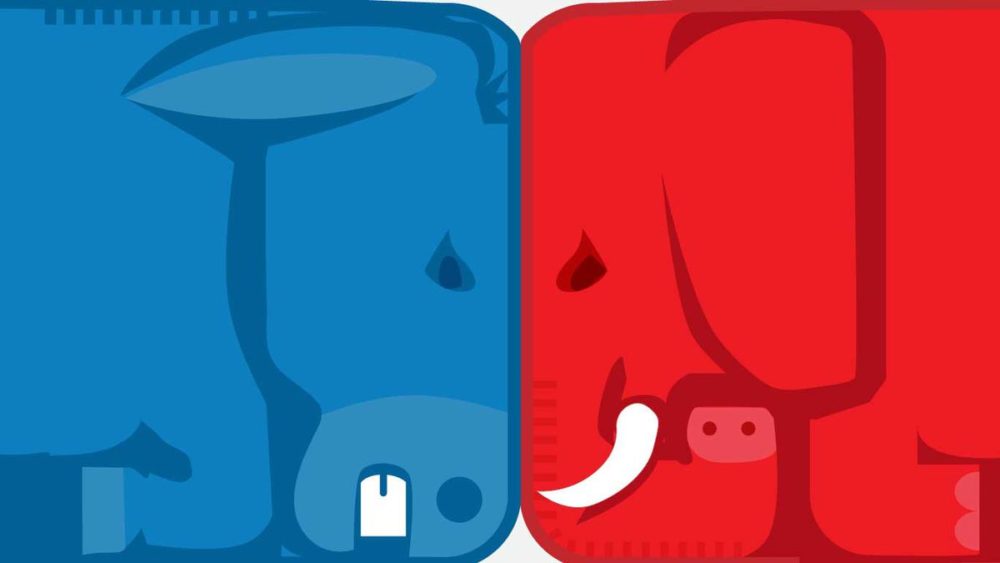
The WSJ report, “Gerrymandering by Both Parties Is Deepening America’s Political Divide,” by longtime political reporter Aaron Zitner, is both illuminating and frustrating. It simultaneously points to a real problem in our politics and confuses effect for cause.
America’s identity as a unified nation is eroding, with Republican- and Democratic-led states dividing into separate spheres, each with its own policies governing the economic, social and political rules of life.
Offhand, we might call that Federalism. But it’s much more than that.
The bitter fight over redrawing U.S. House maps, triggered by President Trump’s effort to protect his party’s majority in the 2026 midterm elections, is the latest example of how the dominant party in many states is making extraordinary efforts to impose its will.
In 40 states, a single party controls the House, Senate and governor’s office—a so-called trifecta—or else has enough power to block vetoes from a governor of the other party. That leaves less than 20% of Americans living in a state where the minority party has a meaningful voice in governance.
The result has been a deepening of differences in red and blue America. Abortion is now banned or heavily restricted in about one-third of states, all of them controlled by Republicans, while abortion access is protected or allowed in every Democratic trifecta state. Every GOP trifecta state has passed bans or limits on gender-affirming care for minors.
Red and blue states have moved in sharply different directions on employment law, gun regulation, immigration enforcement and other policies. When Louisiana passed a law last year that required the Ten Commandments to be displayed in public schools, later struck down by courts, 18 GOP-trifecta states filed a legal brief in support.
It has long, if not always, been the case that states have been dominated by one political party. What’s relatively new is the degree to which the parties have been nationalized. I’m old enough to remember when Montana Republicans were wildly different in their political preferences from Alabama Republicans. Hell, I’m old enough to remember when Alabama was so solidly Democratic at the local level that the party primary was effectively the election for governor. But Alabama Democrats were much more conservative than, say, New Hampshire Republicans.
“You’re seeing this divide—trifecta blue states and trifecta red—and it’s creating this remarkable contrast in which you’ve got radically different policies from state to state,” said Jay Richards, a senior research fellow at the Heritage Foundation, who tracks legislation regarding gender, marriage and religious liberty.
Again, there’s nothing inherently wrong with different states having politics that reflect their cultures. Even decades ago when it was Republican-leaning, California has always had different politics and policies than Mississippi or Utah. But nowadays the disputes are over fundamental rights and beliefs in a way we haven’t seen at least the 1960s, if not the 1860s.
And, when the stakes are seen as existential, the acceptable means change. When you can’t afford to lose, cheating becomes not only acceptable but necessary. The divide isn’t caused by gerrymandering; rather, gerrymandering is incentivized by the divide.
The television images of Democratic lawmakers who fled Texas for sanctuary in Democratic-led Illinois, New York and Massachusetts show that these differences reflect not just policy preferences, but are facets of a hostile confrontation. Red and blue states are threatening to use the maximum legal and political tools available to limit the power of the other party.
Texas Republicans, at Trump’s insistence, are undertaking an out-of-cycle effort to redraw their House districts to give the Republican Party more seats. They have also issued civil-arrest warrants to force quorum-breaking Democrats to return to the state so that the redistricting process can move forward. In return, lawmakers in Democratic-led California, Illinois and other states are looking at redrawing their own maps to give Democrats a stronger hand in House elections.
“This is a war. We are at war,” said Kathy Hochul, New York’s Democratic governor, as she appeared this past week in Albany with fleeing Texas lawmakers. “And that’s why the gloves are off. And I say: Bring it on.”
Democrats have disadvantaged themselves in this process. Most of the truly “blue” states have implemented policies that take the drawing of Congressional districts out of the hands of partisan legislators, assigning the task to impartial bodies tasked with drawing lines according to strict rules. That’s true even in my home state of Virginia, which has shifted from a solid Red to a solid Blue state on the national level, but where Republicans are competitive for the governorship and control of the state legislature. The redistricting commission, created in 2021 when Democrats controlled the governor’s mansion and both houses of the assembly, has strict guidelines that include population equality, voting rights, contiguity, compactness, consideration of communities of interest, and political neutrality.
Again, though, gerrymandering to make it more likely that the dominant party in the state is disproportionately represented in the US House of Representatives only tangentially impacts the divide Zitner’s piece highlights. Unless we nationalize laws on abortion access, LGBTQ rights, employment policy, drug use, immigration enforcement, and the like, Republican-dominant states are going to have wildly different policies than those dominated by Democrats.
To the extent the ways each state’s governor and state legislature election processes are democratic, one can argue that this is a good thing. Different polities have different preferences, cultures, and mores. It’s perfectly reasonable that they have laws and policies reflecting those differences.
But, taking the 2024 presidential election as a proxy, there’s not really such a thing as a Red state or Blue state, despite those terms having been fixed in our political vocabulary since the 2000 election. Leaving aside the District of Columbia, which Harris won by an astonishing 85.9% margin, the bluest state was Vermont, which went Democrat by a 31.8% margin. That still means a third of those who voted in the Green Mountain State are Republicans. The reddest state was Wyoming, which went to Trump by a 46.2% margin. Still, over a quarter of Wyoming voters went for Harris.
Looking at the three large states that are either in the process of or threatening to further gerrymander their House delegations, we see how wildly unrepresentative the winner-take-all mentality is.
Texas, which some analysts foolishly hoped would actually go blue in 2020 (Trump won by a 52-46 margin), went for Trump by a 13.7% margin in 2024. But that leaves a whopping 42.5% who preferred the Democrat.
California, Harris’ home state, went for her by a 20.1% margin. But more than a third of Californians (38.33%) voted for Trump. (The margin was actually wider with Biden on the ticket in 2020, 63.48-34.32).
New York was almost the mirror image of Texas, going blue by a 12.7% margin in 2024. Meaning, 43.3% voted Republican. (Once again, the margin was considerably higher in 2020, with Biden winning 61-38.)
That the lines would get drawn in such a way to minimize the voting impact of the minority party in those instances is obviously problematic from a democratic theory standpoint. But, again, the greater problem is that their day-to-day lives are governed by policies wildly out of step with their revealed preferences.

China Mieville’s book The City and the City comes to mind. It’s a tale of two cities occupying the same physical space, with residents of Beszel and Ul Qoma, respectively, trained from birth to ‘unsee’ the inhabitants of the other city.*
We’ve reached the point where this is starting to seem more plausible, even preferable.
*Fascinating idea from a genuinely brilliant writer. In the matter of imagination, I bow to few authors, but Mieville is up there with Iain Banks in the S-Tier.
Thank you for noting that while gerrymandering is “bothsides”, like most things, it’s far more one side than the other.
I would also note that on many issues, Republicans have fostered division as a tactic. Abortion is the prime example. I’m old enough to remember the lack of controversy when Roe was announced. Catholic officialdom was upset, but not much of anyone else. The line about, “Last year Jerry Falwell couldn’t even spell abortion.” pretty much encapsulates what happened, first Evangelical preachers found they could profit from the issue, then GOPs joined in. Having nothing positive to sell, they cheerfully fostered division.
Doesn’t this fact put the lie to this idea that…
The truly blue states vote consistently in greater numbers for the Democratic Party despite the fact these states have taken significant steps to reduce partisan gerrymandering. Doesn’t that tell us something about how the policies of those states better fit the revealed preferences of their voters – even those in the minority?
Cheating isn’t ever really necessary in a civil society, so I refuse to find it acceptable. The existentialism of the stakes is the lie promoted by the modern Republican Party for years and culminating in Trump 2.0. Ergo, a plurality victory in the 2024 general election translates to authoritarian Us versus Them rule, because common ground and moderation are anathema to the GOP base and the politicians who rely on these voters have decided to give them everything they want by any means necessary.
Zitner is suggesting symmetry that simply isn’t there. The threats to further gerrymander from the blue states are tit for tat acknowledgement that they are not willing to maintain their “disadvantage” in the application of gerrymandering if the red states are going to cheat.
@Scott F.: But, as seen in this article, the Democratic governors of the two biggest blue states are now ready to counter-cheat in retaliation. Hochul is going so far as to call it “war.” Republicans started earlier because they saw that, otherwise, they were going to lose–at least partially because immigration and the changing demographics of the country were making them a minority in what they think of as “their” country.
Indeed.
So, for example, I don’t get democratic heartburn over the notion that Alabama will elect a Republican governor (I get heartburn over the fact that it will almost certainly be Tuberville, but that is a different, albeit related, issue). There is no way to deny that the state is majority Republican.
BUT, as I have written here and elsewhere, the state legislature’s maps are heavily drawn to over-favor Rs, which means that not only is the state legislature overly-skewed to one party, but that means that the Democrats have less of a bench, and fewer resources, to compete at the state level. These kinds of factors work synergistically to underrepresent the population and make politics less competitive. Less representativeness and little competition mean weaker parties, especially weaker opposition parties.
And while I am more than happy to see some significant level of state-level governance, some things have to be nationally established rights, if anything, because of the numbers noted in the post.
Majority rule with minority rights is supposed to be how all this works, at least in theory (I am aware of he manifest faiulure of practice).
@James Joyner:
Don’t you see the ideas from the article you reiterate here clarifying in important ways?
There is a “war” going on right now for the future of democracy, so Hochul isn’t wrong calling a spade a spade is she? Not cheating in response to the opponent cheating first is noble and all, but it ain’t gonna win the fight for democracy.
Refusing to accept the loss of control of “your” country because of changing demographics is pure BS based on the premise that inability to continue controlling what you once controlled is the same thing as oppression of your culture and mores.
@James Joyner:
I was looking for some other reason, but the other day I found that in the most recent Census Bureau estimates, the largest sub-group in Texas is now Hispanic, narrowly larger than non-Hispanic white. Hispanic voters are not as single-party as Black voters. I do sometimes wonder, though, if gerrymandering and vote suppression and all of those tactics in Texas will produce a case of “they worked right up until the point where they suddenly stopped working”. I lived through Colorado’s really rather abrupt switch over the 2006 and 2008 election cycles, where the Dems suddenly captured the state legislature and the state-wide elections.
Structural incentives make divergence self-reinforcing. Scott Alexander’s Meditations on Moloch (sheesh, over 10 years old!) offers a useful frame. Moloch as the embodiment of coordination failure, where each rational step by an individual actor pushes the collective further into dysfunction.
The tragedy is that the very tools meant to secure short-term advantage — district maps, procedural maneuvers — lock us into a feedback loop where each “win” deepens the overall loss.
@Michael Reynolds: Glad you mentioned The City and the City, because I have a question I’ve been dying to ask someone smart about narrative since I read it years ago:
The novel presents the situation of the two cities as an essentially fantastic phenomenon, as if there’s some kind of tear in whatever it is that separates realities, making it possible to see or move between two separate dimensions.
But as I think further about the book, it seems to me that it’s just as possible that there is no fantastic phenomenon occurring here, and that it’s strictly a human, political choice to deny the reality of part of their own city and people — much as a North Korean would not be allowed to engage with a South Korean.
Was wondering if this ever occurred to you — or to anyone else here who’d read the book — and if so where you land on the subject…
Republicans cheating to win because they believe the country belongs to them and their values is exactly the problem: Republican* core values** do not include self determination or democracy. Were they core values they would not be so quickly jettisoned in favor of reaching autocratic anti-democratic goals. Ergo Republicans are not committed to, and in the present case are acting as an enemy of, democracy. They do not deserve the benefit of the doubt around this issue anymore.
*Republican here equals current leadership of the Republican Party and those who give them power via votes, money, and other actions
**I base my assessment of core values here on the behavioral choices of Republicans when values are in conflict, as for example in the OP
@Steven L. Taylor:
On different topic I’ve observed that when Truman decided to go along with establishing a Jewish homeland, instead of Palestine he should have used Alabama. Better for the Palestinians, better for the Jews, and likely better for the Alabamians.
@Erik:
Bless you for that. I think one of the commonest logical fallacies is incorrect definition of groups. Example: one can speak of “Israel” as a nation with a polity. One cannot speak of “Gaza” the same way. It’s necessary to distinguish between “Republicans” as voters and “Republicans” as pros: pols, staff, non-profits, donors.
@wr:
If I had to guess where Miéville’s process started, it could have been any Manhattan street. A New Yorker can walk through midtown and not see a lot of things – crime, filth, homelessness, or for that matter, any other human. A person walking along and attempting eye contact with passersby would be seen as crazy or a threat.
At the political level it was a choice to give one city a vaguely Slavic name and spelling, and the other city a seeming Arabic name. But I didn’t think his point was really that simple and it actually struck me as a mistake.
But I am not a good or deep student of literature, so I’m afraid I’m no help. The more I write fiction the less I read it – I’ve never actually read a kid’s book, YA or middle grade. I’ve only read one of my wife’s stand alone (non-collaborative) books and that was because she wanted me to assess the screenplay adaptation by Mike White. (Meh). Recently had to go through the same damn book to do a graphic novel adaptation, one of the most tedious things I’ve ever done. And she has read precisely none of my books. We read each others’ reviews and of course have boring work discussions along the lines of, ‘I’m thinking third present,’ or, ‘I’m halfway through and have no idea what this fucking book is about,’ or, ‘Is it a bad sign that happy hour now starts at 3 PM?’
I imagine it’s much the same when TV writers hang out – more talk of deals and contract terms and stupid notes than of technique.
@James Joyner:
“This is a vicious animal. When attacked, it defends itself.”
When Trump told Texas he needed a new map because he needs 5 more seats from the upcoming 2026 mid-term election, he was pretty much saying to California, Illinois, and New York, ‘you’re not going to do anything about it because you never do.’
Well, I guess it’s on.
@Michael Reynolds: I agree that it is very good. I was expecting more overt politics, since I had seen a few online things where Mieville speaks with his own voice.
But no, he is too good an artist for that.
I related to the thesis as more of a description of apartheid or of discrimination or something like that, rather than as a description of the Red/Blue divide. We know all about each other.
Of course, he gives no answer to the question of, “Who does this benefit? What is the thing that sustains it and keeps it going?” I suspect he isn’t that interested in that question. Or he thinks its obvious.
The system clearly has the ability to coopt people who might threaten it.
@wr:
@Michael Reynolds:
Mieville is a Londoner.
That explains a lot.
London has arguably always been several socially distinct cities existing in the same geographic space.
@Mimai:
Another appreciator of Scott Alexander?
It’s a basic aspect of post-neolithic human history: human-constructed systems come to be treated as somehow inevitable and justified.
When many of them are based more upon human habit, rather than some law of physics.
Many human institutions are more contingent than necessary.
That is the basis of liberalism; whereas the basis of sensible conservatism is that trying to upturn a complex contingent system and assuming the outcomes will necessarily will be beneficial may be a mistake.
MAGA-style populism lacks both the admirable objectives of “liberalism” and the sensible caustion of “conservatism”.
Also: Elua as a benign version of Charles Stross’s “Unborn God”, perhaps?
@JohnSF:
I appreciate this, especially the bit about how human-constructed systems come to feel inevitable. That’s part of what makes Moloch so insidious.
When incentive structures are deeply embedded, it’s easy to mistake them for natural laws rather than contingent arrangements we could, in principle, redesign.
Keen point re: liberalism’s willingness to challenge inherited structures and conservatism’s caution about unintended consequences. Both are important instincts if we want reform (or lack thereof) to be both principled and sustainable.
Unfortunately, our current political climate often chases disruption for its own sake or entrenches systems that serve narrow interests. Even worse are the current power players who say: “Wieso nicht beides?”
And yes, Elua as the benevolent counterpart to Stross’s “Unborn God” is a great way of framing it. A reminder that the gods we empower through our institutions can be shaped toward cooperation just as easily as toward destruction.
@Michael Cain: It happened in California in the 1990s. It was a reliably red state until Bill Clinton won it in 1992. When Pete Wilson pushed through Prop 187 in 1994, though, it became overwhelmingly Democratic and hasn’t looked back, other than Schwarzenegger’s time as governor.
@Scott F.: @Kathy: Oh, I’m not in any way saying this is equally bothsides. I wrote a couple pieces in 2022 calling out New York for unilateral disarmament on gerrymandering.