Undermining a Governance Success Story
One of the great success stories of American governance—economic growth paired with environmental progress—has gone largely unnoticed.
The federal government began taking the environment seriously as a domain for policymaking in the late 1960s, even before the creation of the Environmental Protection Agency in 1970. If one includes a single year on either side, that twelve-year extended decade of the 1970s was the only period in American history with an unmistakably pro-environment policy tilt.
Congress passed the Clean Air Act (1970), the Clean Water Act (1972), the Endangered Species Act (1973), and a host of related measures. In 1980, the Superfund law—Congress’s response to the Love Canal disaster—set rules and (inadequate) funding to clean up toxic waste sites. The 1970s also saw an enormous expansion in the number, coverage, and variety of national park and national forest units.
Since 1980, additional acts have been passed here and there, but the era of sustained pro-environment policymaking was brief. What followed since 1980 has been a long fight between pro-industry forces (Ronald Reagan as the archetype) and pro-environment forces (Barack Obama and Joe Biden). There has been meaningful if fairly measured progress over the decades in extending the reach and coverage of environmental protections, but every gain–no matter how modest– has been fiercely contested by industry, and forward steps have at times been met with equally determined retreats.
If the 1970s were a pro-environment era and the decades since have been a contested slog, the Trump administrations—both the first and especially the second—represent decisive retreats from environmental policy sanity, with no pretense of environmental concern. The decades of contestation, of battle between the forces of industry and the environment, has for now come to a close. Industrial profit has won, and then some.
The Trump-era arguments against environmental policy include some new themes (such as the environment undermining national security and violating common sense) but the old standby that environmental policies damage the economy remains alive and well. Its endurance and vitality comes from its plausibility. And indeed I do not doubt that heavy-handed, top-down regulatory interventions can create market inefficiencies. It is hard to imagine otherwise. But these claims are consistently overstated. The following EPA graphic illustrates this well.
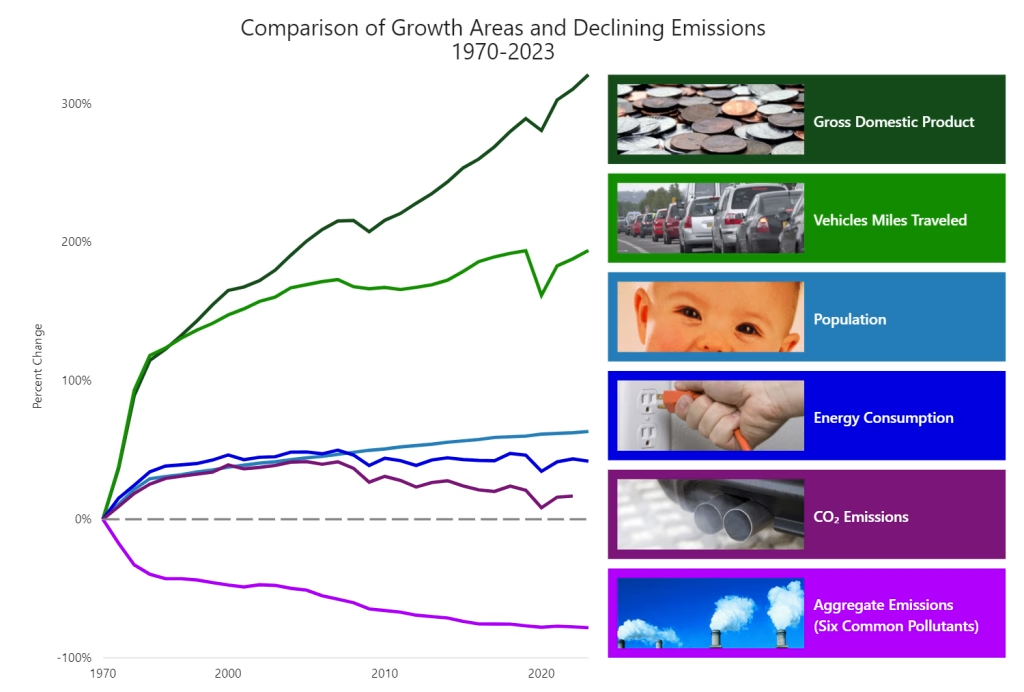
As depicted in the graphic, since 1970–and the advent of the Clean Air Act–the U.S. has seen terrific, if uneven, economic growth as well as excellent, if uneven, progress on reducing air pollution. GDP, vehicle miles, and population, have seen considerable (if variable) growth. Energy consumption has been steady in recent decades, CO2 emissions have declined slightly, and the aggregate amount of EPA-regulated emissions has plummeted dramatically since 1980
I fully recognize that correlation does not prove causation, and I also acknowledge the hypothetical possibility that, absent environmental regulations, we might have seen even steeper increases in GDP growth, vehicle miles traveled, and so on.
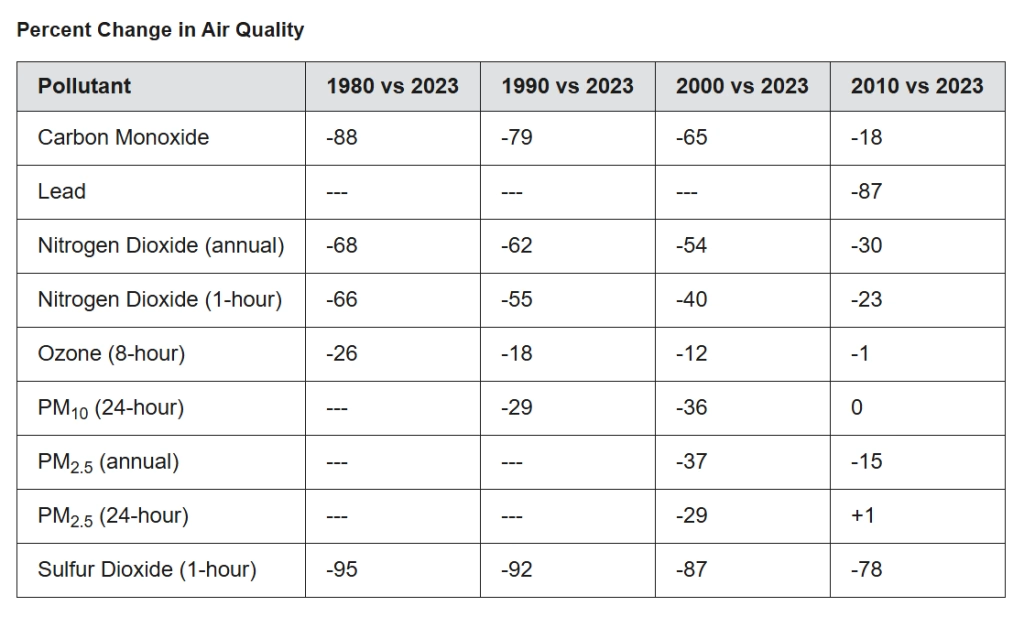
But two points are difficult to refute. First, there has been a substantial decrease in the pollutants in question since they became regulated. (See above for my caveats about correlation and causation.) The following graphic takes the aggregate in the graph above and shows the constitutive pollutants individually. The result is even more impressive. The Clean Air Act has been a great success story–at least as measured by its goal, which is to reduce certain designated pollutants.
A second point one can make regarding the graph, and more important for public debate, is that the American economy has not been crippled by environmental regulations. Instead, the United States has made serious progress on key pollutants while maintaining a first-rate economy.
This is a story neither party seems eager to tell. For Republicans, the reason is obvious: the facts run counter to their narrative that environmental regulations are economically destructive. For Democrats, the silence is more complicated. The data demonstrate real success in reducing pollution. These are only six pollutants, but across the board the trend is one of improvement. The rhetorical problem is that accelerating progress lacks the urgency of averting catastrophe.
The result is that one of the great success stories of American governance—economic growth paired with environmental progress—has gone largely unnoticed.
The unfortunate reality, however, is that because of the Trump administration’s actions, Democrats may soon have to call for ambitious environmental regulations simply to prevent real and possibly enduring environmental degradation. I’m not prepared to say we face an imminent ecological apocalypse, but long-term damage that is difficult to reverse is entirely possible.
(Note: Photo is mine, taken by me in 2015 outside of Yellowstone NP)

In the 70s and early 80s, the focus on air pollution was particulates, aerosols, and assorted toxic gases. Carbon dioxide was seen as “clean”, because it’s inert if breathed, and besides plants and some bacteria make use of it. So many of the early gains, like using natural gas instead of fuel oil, ignored emissions of CO2.
Things changed by the mid-late 80s, when observations revealed the greenhouse effect influence of CO2. The greenhouse effect has been known for longer, and there are other greenhouse gasses. What wasn’t known well was the magnitude of the effect of adding CO2 in ever increasing amounts. Now we know.
@Kathy: Thanks for the comment. We’ve learned a lot about GHG since that time, haven’t we? It’s so dispiriting that the Trump administration ignores what we do know.
Between attacks on vaccines and environmental protections, it seems more like a death cult. Next to go would be safety standards, particularly in the workplace.
@Kathy: If there comes a point where you have some spare time — doesn’t sound like it would be anytime soon — read the Massachusetts v. EPA opinion. That’s the one where the SCOTUS declared that CO2 was a pollutant under the CAA, and not only could be regulated but must be regulated. Spread across the opinion, concurrences, and dissents, there’s a lot of words spent arguing about what the word anyway means. That’s because where the decision ends up is that the EPA can regulate GHG emissions only from sources they would regulate “anyway” for non-GHG emissions. So power plants, okay. But not the big hospital’s gas-fired water heaters for the vast quantities of laundry they do.
Be sure to read Roberts’ dissent — he clearly thinks Anthony Kennedy stabbed him in the back by joining the liberals to grant standing, and whines like a fifth-grader with hurt feelings.
I expect to see Massachusetts overturned. Probably not this SCOTUS term, but almost certainly in the next one.
As a general matter, I am pro-free market, but one thing is utterly clear to me: the ideology of profit maximization uber alles is a scourge on society. That certainly applies to the Trump administration’s view of environmental policy.