Virginia and Off-Term Elections

Rather than provide a super-lengthy comment on James Joyner’s post on the Virginia governor’s race, I will point out my post on the same subject from 2021, Election 2021 Context, Part 2: Virginia. More importantly, I will reshare a table I made for that post and draw everyone’s attention to the far right-hand column.
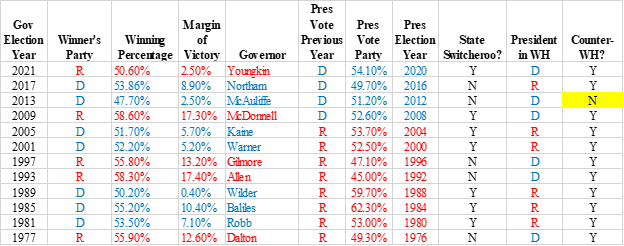
There is a substantial pattern here, and it is one that would suggest that while there will not be a state switcheroo (see the original post) given that Harris won the state 51.83% to 46.05%, it seems pretty darn likely that the Democratic candidate will win the governor’s office in Virginia this year.
As I keep noting, voting is often about a generalized response to the current political environment, and the incumbent party (as defined by the party of the president) usually takes the blame for things that may not be going well. As a general matter in normal times, some substantial number of voters are disappointed in the incumbent party because things they wanted to happen failed to materialize.
In case anyone hasn’t noticed, times are not exactly normal, and a lot of that is directly attributable to Trump. I expect voters will behave accordingly when the opportunity presents itself, including likely more motivation for Democrats to turn out than Republicans.
Given that Virginia is already more reliably Democratic than Republican in statewide elections, coupled with both the clear pattern going back decades, and Trump’s lack of popularity, I would bet D for governor.
Granted, if the Democratic candidate ends up having some awful revelation in the middle of the campaign, that could change the dynamic.
Meanwhile, note this polling from Roanoke College in February.
Overall assessments of the direction of the country and the commonwealth remain quite steady over time. A small majority (51%) thinks that Virginia is headed in the right direction, while 67% think the country is on the wrong track. Job approval for President Donald Trump (37%) is well within the range he experienced in his first term. Gov. Glenn Youngkin’s job approval rating (53%) is also steady.
Virginians remain more likely to view Youngkin favorably (48% favorable/42% unfavorable), while Trump’s favorable rating is again similar to his first term (37% favorable/58% unfavorable). The two likely 2025 gubernatorial candidates are viewed similarly here (Spanberger at 37% favorable/37% unfavorable; Earle-Sears slightly underwater at 34% favorable/39% unfavorable) with about a quarter of respondents not offering an opinion. We also asked about several federal institutions. The CDC was viewed favorably by nearly two-thirds (62%) of Virginians, with the FBI coming in at 59% favorable and the CIA at 55% favorable. All of these questions show significant partisan differences (see Topline).
That Youngkin remains above water is good news for Republicans, but the 37% approval of Trump and the 67% wrong-track number mean a lot of voters are going to be in an anti-R mood. And if, as James notes in his post, most Virginians don’t know a lot about these candidates, then party will become even more important in determining the outcome.
