We’re at War With Iran
"Major combat operations" are underway.
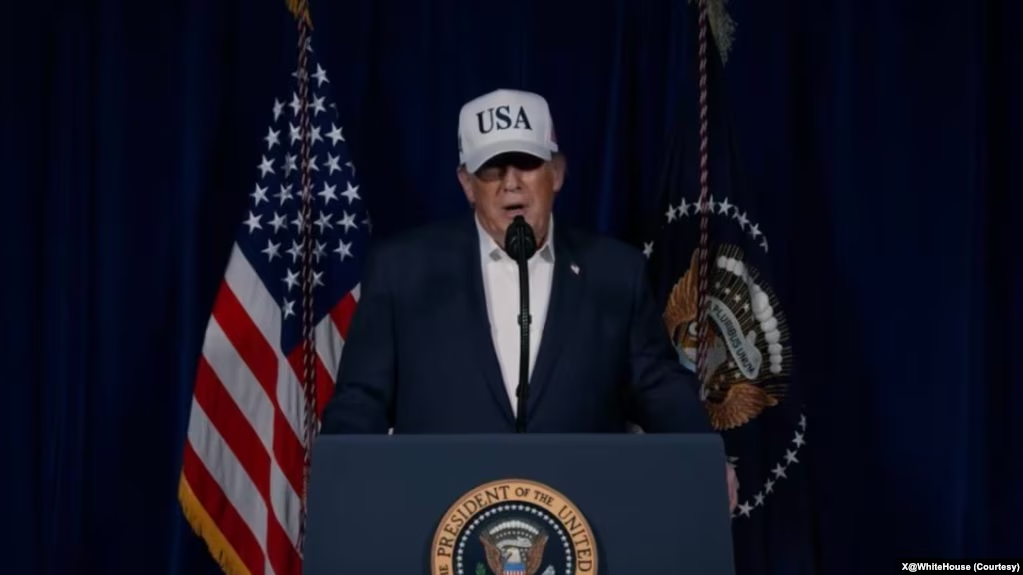
President Trump announced the start of “major combat operations” with the goal of “regime change” in Iran on Truth Social at 2:30 am Eastern, as one does. The Pentagon is calling this OPERATION EPIC FURY.
AP (“US and Israel launch a major attack on Iran and Trump urges Iranians to ‘take over your government’“):
The U.S. and Israel launched a major attack on Iran on Saturday, with President Donald Trump calling on the Iranian public to “seize control of your destiny” and rise up against the Islamic leadership that has ruled the nation since 1979.
Some of the first strikes appeared to hit areas around the offices of Supreme Leader Ayatollah Ali Khamenei, and Iranian media reported strikes nationwide. Smoke could be seen rising from the capital. It wasn’t immediately clear whether the 86-year-old leader was in his offices at the time of the strike.
“When we are finished, take over your government. It will be yours to take. This will be probably your only chance for generations,” Trump said in a video announcing “major combat operations” were underway. “For many years, you have asked for America’s help, but you never got it.”
Israeli Prime Minister Benjamin Netanyahu echoed that sweeping goal. “Our joint operation will create the conditions for the brave Iranian people to take their fate into their own hands,” Netanyahu said.
The strikes opened a stunning new chapter in U.S. intervention in Iran and marked the second time in eight months that the Trump administration has used military force against the Islamic Republic.
[…]
Iran responded as it had been threatening to do for months — first launching a wave of missiles and drones targeting Israel. It followed with strikes targeting U.S. military installations in Bahrain, Kuwait and Qatar. The United Arab Emirates and Iraq shut down their airspace.
[…]
Israel said the operation was carried out as a “broad, coordinated, and joint operation against the regime” that has been planned for months between the Israeli and U.S. militaries.
Trump, in justifying the military action, claimed that Iran has continued to develop its nuclear program and plans to develop missiles to reach the U.S.
He also acknowledged that there could be American casualties, saying “that often happens in war.”
It was a notable call on Americans to brace themselves from a U.S. leader who swept into office on an “America First” platform and vowed to keep out of “forever wars” that had bogged down his recent predecessors.
Trump’s statement indicated the U.S. was striking for reasons far beyond the nuclear program, listing grievances stretching back to the beginning of the Islamic Republic following a revolution in 1979 that turned Iran from one of America’s closest allies in the Middle East into a fierce foe.
The U.S. president said he was aiming to “annihilate” the Iranian navy and destroy regional proxies supported by Tehran.
He also called on the Iranian Revolutionary Guard to lay down its arms, pledging that members would be given immunity, while warning they would face “certain death” if they didn’t.
Jerusalem Post (“Senior IRGC, regime officials killed in Israel-US strikes on Iran, source says“):
Israeli and US strikes on Iran killed several senior Islamic Revolutionary Guard Corps commanders and Islamic Regime political officials, an Iranian source close to the establishment told Reuters on Saturday.
Iran’s Security Council instructed residents of Tehran, as well as other major cities, to stay in safe, protected locations until further notice, Walla reported.
Security forces blocked roads in the Tehran area that is home to the offices of Supreme Leader Ayatollah Ali Khamenei, President Masoud Pezeshkian, and parliament, witnesses said.
[…]
Khamenei is not in Tehran and has been transferred to a “secure location,” an Iranian official confirmed to Reuters earlier on Saturday.
Satellite imagery showed an alleged Israeli strike on the bunker where Khamenei is being guarded.
Most other outlets, including the NYT, WaPo, WSJ, and the BBC, are in live blog mode.
Early reviews from abroad are mixed. BBC (“Arab allies fear Iranian state could collapse“) reports
The Qataris, the United Arab Emirates, Kuwait, Bahrain and Jordan say they are intercepting missiles fired from Iran at US military bases on their territory.
Some of them have said they reserve the right to respond, but they would almost certainly calculate that move very carefully.
This is exactly the outcome that regional leaders have been working very hard to prevent over the past weeks, throwing themselves into efforts to mediate between Iran and the United States.
It’s clear now that the Trump administration took advice from Israel rather than that of its Arab allies.
The Arabs are concerned that the US and Israeli air strikes will destabilise the region and draw it into the war.
They fear that Iran could strike not only the US targets on their soil, but also infrastructure such as gas and oil facilities, or possibly close the Strait of Hormuz through which oil exports are shipped.
In a worst case scenario, they worry that the Iranian state could collapse, leading to a flow of refugees and weapons across their borders, especially as Trump has made clear the aim of the operation is regime change.
Western allies are mostly guarded, saying they support the Iranian people and hope the conflict stays within Iran’s borders. The UK wants everyone to know they are not participating. Moscow is calling the operation “reckless.” [UPDATE: Canadian PM Mark Carney, who famously called Trump out at Davos, has issued a statement that “Canada supports the United States acting to prevent Iran from obtaining a nuclear weapon and to prevent its regime from further threatening international peace and security.” Ditto Australian PM Anthony Albanese. French President Emmanuel Macron, on the other hand, says the operation has “grave consequences for international peace and security.”]
The NYT Editorial Board asks, “Why Have You Started This War, Mr. President?“
In his 2024 presidential campaign, Donald Trump promised voters that he would end wars, not start them. Over the past year, he has instead ordered military strikes in seven nations. His appetite for military intervention grows with the eating.
Now he has ordered a new attack against the Islamic Republic of Iran, in cooperation with Israel, and U.S. officials say they expect this attack to be much more extensive than the targeted bombing of nuclear facilities in June. Yet he has offered no credible explanation for why he is risking the lives of our service members and inviting a major reprisal from Iran. Nor has he involved Congress, which the Constitution grants the sole power to declare war. He has issued a series of shifting partial justifications, including his sporadic support for the heroic Iranian people protesting their tyrannical government and his demand that Iran forswear its pursuit of a nuclear weapon.
That Mr. Trump declared the Iranian nuclear program “obliterated” by the strike in June — a claim belied by both U.S. intelligence and this new attack — underscores how little regard Mr. Trump has for his duty to tell the truth when committing American armed forces to battle. It also shows how little faith American citizens should place in his assurances about the goals and results of his growing list of military adventures.
Mr. Trump’s approach to Iran is reckless. His goals are ill-defined. He has failed to line up the international and domestic support that would be necessary to maximize the chances of a successful outcome. He has disregarded both domestic and international law for warfare.
Congress, alas, has been asleep at the switch for some time now. Trump has been publicly signaling that war was imminent for well over a week. While a handful of members, including Republican Thomas Massie, have been demanding Congress be consulted, they have done nothing to force the President’s hand.
Meanwhile, Roger Wicker, chairman of the Senate Armed Services Committee, praised Trump: “Today, our commander-in-chief took decisive action against the threat posed by the world’s leading proliferator of terrorism, the Iranian regime.” He added, “This is a pivotal and necessary operation to protect Americans and American interests.”
Tuesday morning, speculating whether warnings from his hand-picked Chairman of the Joint Chiefs that launching this war came with big risks would sway him, I concluded,
[U]nlike the first Trump administration, there’s no one who is going to tell POTUS “No.” If he decides he wants to take a high-stakes gamble, they’ll rally around him and carry out the mission.
It appears that Bibi Netanyahu was more influential in guiding Trump’s decision than his own national security team. Now, we wait to see the fallout.
So far, air defenses in Israel and around US air bases in the region are holding up.
Assuming the campaign goes swimmingly, with no loss of American or Israeli life and the regime of the ayatollahs gets toppled by the Iranian people, the question becomes: And then what? We have proved quite adept at toppling authoritarian regimes. Our record of replacing them with functional, democratic governments has been considerably less stellar.
UPDATE: IR scholar Paul Musgrave (“An Unpopular, Doomed, Bloody War“) is skeptical. His top line view:
This will go poorly; it is stunningly unlikely to achieve its objectives; it will undermine the U.S. position in the Middle East and elsewhere; it will be unpopular at home in the United States; and it runs the risk of catastrophe for limited upsides at a certain cost in Iranian, Israeli, American, and possibly Arab lives.
In terms of IR theory:
I’ve mentioned before Phil Haun’s book Coercion, Survival, and War, which addresses the puzzle of why the United States—a very powerful country—only rarely gets its way when it issues threats of military force. Haun argues that many of these threats fail because the United States is so powerful that it jeopardizes the existence of the (government of the) threatened state, making it impossible for the other side to give in. More than that, some of those threats are issued not to be successful but merely to give a pretext—a fig leaf that negotiations have taken place—precisely because those threats are unacceptable to the other side, leaving the impression that talks have fallen through. Cynical strategy, but plausible.
In terms of strategy:
[T]he Trump administration has adopted a maximalist goal—regime change—that is not clearly in U.S. interests and is far from achievable via the means (airstrikes) that are being employed. A limited strike on conventional and military targets might have signaled a goal of something less than regime change and more like pulling the regime’s teeth—humiliating for Tehran and costly for both sides, but not existential. And indeed you can imagine that violently reducing Tehran’s stocks of short and medium range missiles might have been quietly welcomed in European and Middle Eastern capitals threatened by them. Taking advantage of Tehran’s weakness to achieve that goal would have been brutal and unfair but more calculable. Regime change, by contrast, is a goal likelier to have originated with American extremists and the government in Israel, and it is one that risks perennial frustration unless U.S. and Israeli ties to an opposition in Iran are far greater than they appear in public.
While I’m skeptical of long-term success, there is relatively recent precedent for achieving regime change in exactly the manner Trump and Netanyahu have urged: Libya. As was the case then, there have been mass protests against the regime. It’s quite plausible that taking out regime tools of suppression via aerial strikes will enable locals to act as ground forces and finish the job.
As already noted, my skepticism is what comes after.
Regardless, I fear Musgrave is right here:
Iranian doctrine privileges asymmetric and distributed warfare against a variety of targets using drones, anti-ship missiles, proxy war, and ballistic missiles. These are all hard to defend against, and just as Golden Dome proved less capable over time we should expect some of these missiles to hit. In extremis, we might even see a Falklands War-esque successful strike on a U.S. naval vessel—this is not inconceivable.
And here:
The U.S. reputation as a fair dealer and reliable partner will be in shambles. Yet again, the Trump administration has apparently used peace talks as a pretext for striking at an adversary, making it pointless for future adversaries to engage in negotiations. If negotiations are a way of resolving disputes without overt conflict even if “all options are on the table”, then scuppering your own reputation for negotiating is folly—and harmful in the long term. Other countries will also now be vastly more wary of letting the United States place bases on their soil, and I wouldn’t be surprised if we see U.S. forces evicted or substantially limited in the future.
U.S. military prowess is also being risked. A lucky Iranian Silkworm missile could deal a blow to the Navy’s reputation (how close were navy vessels to being hit by the Houthis?); attacks on Al-Udeid or refineries in Saudi Arabia or elsewhere (should they be allowed to be publicized) could become iconic images of America’s inability to protect its allies from aggression.
And he agrees with me here:
And what if regime change were to succeed? Regime change may sound desirable—Trump has clearly bought this farm—but it is neither easy nor durable. The history of U.S.-backed regime change operations in Iran in particular is, well, not great. And foreign-induced regime change is also, well, not likely to be particularly stable at all.
I’m sure there’s a plan.

Coincidence?
TL;DR:
The investigation was led by the DEA’s Organized Crime Drug Enforcement Task Forces, which El Taco began to dissolve in 2025.
I do wonder how MAGA will respond. I suspect they will support as long as there are no boots on the ground.
On the other hand, as long as there are no boots on the ground, opposition can oppose and criticize with very little push back from the patriotism peddlers.
@Scott:
Yes.
And as long as there are no boots on the ground, the Iranian governmnent may just be able to massacre any opposition.
The best hope now is that the opposition may be able to effect a relativlely bloodless overthrow, if the US/Israeli strikes have effected “decapitation”.
I hope it may be so.
I fear greatly it may not.
@JohnSF:
There is no Northern Alliance in Iran.
At a guess I’d say the Iranian anti-regime protesters – what’s left of them – will keep their heads down because right now the IRGC isn’t even going to hesitate to gun them down. Eventually the bombing stops and the anti-regime forces try to seize control and are mowed down. Then what? Civil war? Maybe not. Maybe somehow this isn’t a fiasco.
Somewhere there’s a Chinese PLA soldier whose job it is to keep track of how many Patriots and THAADS we use up.
@Scott:
MAGA is a cult so they will find a reason to support it.
The coverage reminds me a lot of the start of the Iraq war. Something tells me this one will be longer in duration than we have seen in a while. I do hope Iran falls, but I have a hard time understand what path there is to a new government there.
@Michael Reynolds:
Yes.
Right now the probability is the Padaran/Basiji will just slaughter any uprising.
I may hope; but hope is not a strategy.
wtf is the US plan for the ongoing?
Answer may be: there is no f@cking plan!
Perhaps the Iranian army has enough non-IRGC suborned units to take over.
And perhaps I’m a unicorn named Gertrude.
I confess I’m torn between anger, despair, and flickers of hope.
Where are the peacemakers? Where is Jesus?
Can any God believers explain this?
@Gregory Lawrence Brown:
Can probably find some smitey stuff.
Give me a minute. 😉
just update the names from Vietnam to Iran
https://www.youtube.com/watch?v=ft0vkKCadgk&pp=ygUsY291bnRyeSBqb2UgYW5kIHRoZSBmaXNoIHZpZXRuYW0gc29uZyBseXJpY3M%3D
Donald the Dove, Hillary the Hawk
by Maureen Dowd
When the America Firsters said no new wars, they meant “No, new wars!” Punctuation is important.
@DK: I was about to say aren’t we glad we didn’t elect that warmonger Hillary back in 2016.
And add that all this fwcking idiot had to do was abide by the JCPOA.
@gVOR10:
Exactly.
Did a quick refresher. Perhaps I missed something, but I still have yet to see any argument that supports the idea that the JCPOA was fundamentally flawed.
If we accept that it was flawed because verification procedures were inadequate, or that it did not address ballistic missiles, or any of the other criticisms leveled at it, the approach would seem to be to strengthen the weak parts of the agreement.
I could be wrong, but it seems to me that canceling the agreement weakens any negotiating position if the goal was to actually strengthen it. The implication would be obvious.
Others here would have a better idea.
Is regime change in Libya really a good analogue for Iran? My impression that Iran’s regime is far more stable than Libya’s was at the time.
Also, given Trump’s history wrt to Gaddafi—going from an attempt to do business with the dictator, to advocating a surgical decapitation strike, to claiming the killing was a mistake that lead to instability and ISIS—it seems like a bad example.
@Kurtz:
This is unclear. Gaddafi was taken out during the Obama admin.
I think Libya is the best, if imperfect, comparison: the notion that airstrikes that decapitate leadership could lead to regime change. It will likely also end up demonstrating that just removing the regime will not lead to a good outcome.
But yes, the Iranian state is more robust than Libya’s was. Libya was a more personalistic dictatorship than is Iran’s.
@Kurtz: In my view, pulling out of the JCPOA was a foolish move.
@JohnSF:
Government in turmoil, restless population, inflation, internal strife… solution?
I know! What we need is a short victorious war!!!
Oh my bleeding piles.
@Steven L. Taylor:
Which is exactly what made it inevitable under Trump.
@Steven L. Taylor:
I did a quick search.
Apologies for speeding through it.
2009: Gaddafi pitches large Bedouin tent on Trump’s estate
During the 2016 campaign, Buzzfeed reported:
More specifics at the link.
2011:
2016 WaPo fact check of Clinton,
2015:
Donald Trump: World would be better if Saddam, Gaddafi still in power, US presidential hopeful says
—
Here is a 2016 opinion piece with a short overview of Trump’s shifting opinion. It contains a few other links.
I saw there is a short Bloomberg segment on YT that seems similar. If someone wants to watch and can’t find it, feel free to ask.
@Kurtz:
JCPOA didn’t have to be fundamentally flawed. It’s just that it wasn’t perfect — it didn’t eliminate Iran’s ability to possess all the building blocks of weapon production and delivery, nor for all time. So trump used it as political football.
It’s a common bit of rhetoric on the right that a less-than-100% solution isn’t worthwhile because there’s still some problem remaining, especially if the solution is inconvenient or can be criticized for political gain. See also, trade (e.g., TPP), carbon emissions, gun control.
@Steven L. Taylor:
Agreed.
I concede that no agreement is perfect. But unilateral exit from the deal never made sense, even if there was a specific plan to replace it.
But the most I can glean was that the alternative approach was “maximum pressure” via reinstatement of sanctions, which Trump did within a year of multiple inspections indicated Iranian compliance. (Ya know, because sanctions worked so well previously.)
As an aside, I recall worldly circulated pictures of blocks of cash by an airplane—accusations that Obama paid Iran off. I think different people made different claims about what exactly the money represented. It seemed to me at the time a visual intended to imply corruption.
Well, another generation of American youth destined to die for the hubris of their grandfathers who avoided their own generation’s war…
Fawk!!!!
@Eusebio:
Exactly my point—it’s sad that they don’t even need to present decent arguments.
I find it maddening that they can justify withdrawal by making arguments that imply strengthening the agreement as the obvious way forward.
TLDR: The US is Bibi’s bitch.
@Kurtz: Thanks for the clarification.
The Supreme Leader Ayatollah Ali Khamenei has been taken out by an Israeli airstrike.
“Glenn Kessler”
etc., etc.
@CSK: He will be replaced by someone even worse. Good job, Bibi.
A 100% air war is relatively safe if the target country lacks good air defenses.
Iran can strike back with drones and missiles. This may kill people in and around US military bases in the region, and other random targets if the Iranian’s accuracy isn’t good. Absent a lucky hit or two, or a massive failure of antimissile defenses (not out of the question), casualties will be rather low.
And even with a lucky hit, El Taco won’t even notice.
@Kurtz: There was the issue of Gaddafi’s son on the way to Benghazi with and army, and openly swearing to slaughter a lot of people with that army which finally forced action in that one. Various Euros, notably the French and British, had been knocking on Obama’s door for some time before that moment, seems they ran out of missiles pretty fast.
All analogies are imperfect, but it might be the Israeli attempt to take down Hizballah with pretty much air power alone in 2006 is a fair to middlin’ one for this. In which Olmert started the strikes before the Israeli cabinet could assemble to even discuss a response to a fairly minor border skirmish. I certainly appears that Olmert had so much faith in his air force he didn’t think first building a consensus within his own government was necessary. Nobody questions winning very hard. Failure is of course another matter. Olmert didn’t last long after that.
@Kurtz:
Not necessarily more stable, but more broadly based and dispersed.
As with many regimes in history, a dedicated minority, especially with trained forces and heavy weapons, is quite capable of subjugating a majority who dislike their rule, but prefer to get on with daily life, and not be massacred and not have the police come after them and their families.