Have I Mentioned We Have Weak Parties?
Colbert asks Harris a question about leadership.
Fox News reports: Kamala Harris refuses to say who’s leading Democratic Party when pressed by Colbert.
Before wrapping up the interview, Colbert noted how Harris is now out of office and currently isn’t seeking one. He then asked, “Who’s leading the Democratic Party?”
“There are lots of leaders,” Harris responded.
“There’s generally ‘a’ leader of the Democratic Party,” Colbert retorted. “Who comes to mind?”
First, Colbert is simply wrong. The only time there is “a” leader of either party is when a given party has a presidential nominee/sitting president. The closest you ever come outside of those parameters is if the party that does not control the White House controls one or both chambers of Congress, wherein the Speaker and/or Senate Majority Leader is kind of the party leader, but even then, not in some clear way.
There is simply no mechanism for a true leader to be selected. And a given party is at its weakest during the first year after it loses a presidential election, especially since that often means having lost one or both chambers of Congress.
As such, Harris’s unsatisfactory answer was accurate.
“I think there are a lot of – I’m not going to go through names because then I’m going to leave somebody out and then I’m going to hear about it,” Harris told Colbert. “But let me say this. I think it is a mistake for us who want us to figure out how to get out and through this and get out of it to put it on the shoulders of any one person. It’s really on all of our shoulders. It really is.”
If you had asked Hillary Clinton that question in July of 2017, this would have been the answer. Sure, Minority Leader Pelosi may have had a bit more centrality than Jefferies or Schumer, but not much. She could not have claimed to be the singular leader of the party.
If Donald Trump had been asked that question in July of 2021, he probably would have said himself, and while he would eventually be proved to be correct, the reality is that he was not the singular leader at that point. Remember: there was a moment in which it looked like Ron DeSantis had a chance at actually being the 2024 GOP nominee. I will add that July 2021 Trump was semi-unique insofar as he was an incumbent president who also had a term to spare, giving him more presumptive nominee juice than most losing candidates (such as Harris) have.
Colbert is reflecting something that we often want and think exists: a party leader for the party out of power, but again, this really isn’t a thing, even if it seems like it ought to be one.
Don’t get me wrong, I am unimpressed with the leadership being displayed by both Minority Leader Jefferies and Minority Leader Schumer. But I will hasten to add that Jefferies has very little power as House Minority Leader. I do think that Schumer could be more clever in gumming up the Senate, but the reality remains that he doesn’t have much power, either.
Harris, for that matter, can’t be the leader at this point because, having lost, she would have to re-earn that position in the primaries. And while I think that Obama should be more vocal than he has been, his electoral power is zero because he can’t run again. Party leadership in American politics is so deeply linked to being the candidate/sitting president that it is impossible even for past presidents to serve as the current leader.
Our parties are structurally weak, and they are deeply presidentialized. They are focused mostly on the four-year cycle to select a candidate to compete for the White House. Everything else is secondary. Further, since the next election is really about 435 individual House races (or, really, 435 House primary elections) and 33 individual Senate races/primaries, there are no institutional forces that would generate and empower a specific, singular leader.

It seems that Harris missed an opportunity to school Colbert on the structure of American political parties. Something to the effect of:
In America, when a political party is out of power, controlling neither the presidency or at least one house of Congress, that party has effectively no political leader. At such times only the nominated presidential candidate can claim leadership.
The observation that Harris’ answer was accurate and unsatisfactory is very interesting to me.
What is a response to that prompt that would be both accurate and satisfactory? Is there one? I suppose that’s the politician’s job.
This is all so squishy and subjective, I wish I knew a better answer. Thing is, both Hakeem Jeffries and Chuck Schumer have specific jobs and specific concerns. As far as I can see, they are doing those jobs pretty well.
Those jobs are not “running for president against Donald Trump” though. Those jobs are also not “inspiring the resistance to MAGA” per se. Some one else – many others else – is going to have to take up that banner.
Obviously, Stephen Colbert is doing what he can – in the context of his own job. I am losing patience with the whole “who is going to be our savior?” business. We are going to have to save ourselves, and we are going to have to connect to like-minded people to do so. There’s not gonna be some Superman coming along to save us. We need to just get up every morning and put one foot in front of the other.
A question I find clarifying, and depressing. Who gets fired for letting us descend into autocracy?
You have.
And it’s a thing outsiders (or, at least, me) can find really hard to process.
(I know it, objectively; but subjectively, it still seems so damned weird. 😉 )
A consequence of a combination of federalised politics, so the states are often more important than DC?
And “open” parties: so it’s very difficult for a party central leadership to police membership to exclude “enthusiasts”, and therefore also to maintain central discipline over state parties?
@JohnSF: I think the best way to explain it is that there is no centralized control of party labels (i.e., no one can control who can be a “Republican” or “Democrat”).
@Steven L. Taylor:
Not so much “labels”: many people in other OECD democracies can be openly party supporters.
The difference, it seems to me, is that except in the US there is a clear distinction between supporters of a party amd members of a party.
The basic diffrence seems to be that outside the US only the fee-paying membership have the right to determine candidates.
And are subject to party “discipline”: that is, essentially, the parties can exclude, more or less at will, those who are, basically, a pain in the arse, from membership
Hence the Labour Party in the UK excluding Communists, Trotsskyites, and recently purging the Corbyites.
And the unique, I think, US approach of having “registered supporters” who are NOT party members and subject to party discipline, but can nonetheless control party candidate selection and therefore policy.
I cannot stress enough how alien that is to most European or other OECD polities.
If you asked the average Brit to declare a “party affiliation” as part of the democratic process, the automatic response would be, I suspect: “f@ck off; none of your business, mate.”
Parties are private rather then public.
(Though subject to some specific laws re political parties, as opposed to other private associations.)
I suspect this derives from the historic regional dominance of parties in the US: that it was felt that absent “open parties” there would be little democratic input at all.
(Also the legacy of the “spoils system”?)
However, the downside is the obvious vulnerability of parties to capture by “enthusiasts” of various sorts.
This is a major reason, imuho, why no other OECD democracy has “open” primary elections on the US pattern.
The US model seems to have been fuctional, for an arbitrary value of “functional” for a considerable time. But its rather obvious potential failure modes are now becoming realized.
Both “capture” and generalized partisan identification.
@JohnSF: I was specifically referring to the ability of candidates (and elected officials) to claim to be Rs or Ds. Further, it is nigh impossible to kick someone out of the party like Boris Johnson did to some MPs who wouldn’t with the party.
For example, if a sitting member of Congress wants to change parties, all they have to do is issue a press release announcing the change.
@Steven L. Taylor:
Well, the same applies in the UK.
An MP is entirely free to change party.
It’s happened quite a few times.
(Assuming the other party is preapared to accept them: that’s a party matter.)
The tricky thing is getting re-elected after doing so.
The general rule is one subsequent election, at best.
Johnson’s purge of the “remainers” was generally not objected to on principle, but just because it was bloody stupid.
The Labour Party has a much more ferocious reputation for purging Commies and Trots.
From time to time.
Though the Conservatives have also sometimes quite effectively squashed consituency parties inclined to go beyond certain limits re the ultra-right.
You are, of course, quite correct about the inability of US parties to discipline their candidates. But that seems to me to be directly connected to the “public” rather than “private” nature of US parties.
As you say, correctly, US parties are weak.
My argument is that they are weak because of the Ameican default to democracy at all levels, and also the historic American habit of public party affiliation, and for that to be embedded in public election processes.
Which is really rather uniquely American.
The question: can Americans be come less uniquely American, because being so is damaging to the polity?
Probably not.
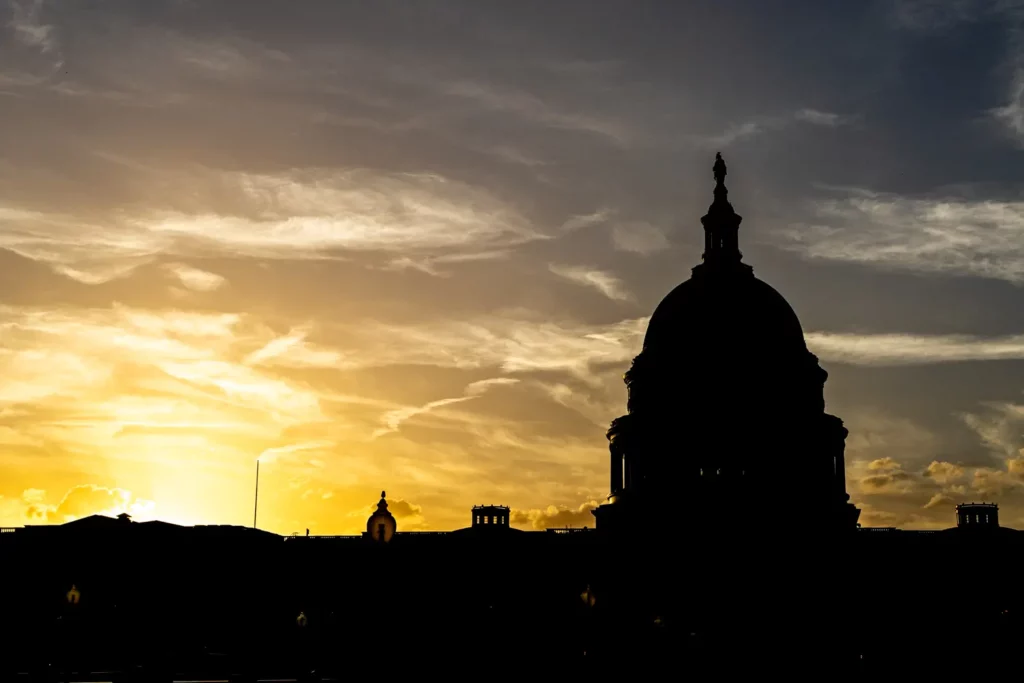
BTW, Dr.T, I found the photo stunning, and the title both stunning AND depressingly accurate as metaphor.
As I’ve commented many times in the last 60 years, history told me the Republic would inevitably fall. I just never expected to be alive to witness it.
@JohnSF:
A rather major distinction. There are no gatekeepers in the US save primary voters.
It was stupid, yes. But the key point for this discussion is that it couldn’t happen in the US. And also that Johnson’s move basically ended those MPs’ political careers, IIRC.
@JohnSF:
I fear you are correct.
And yes, it is “American exceptionalism” in spades
@Flat Earth Luddite: Thanks!
And agreed.