Rolex Protecting its Brand By Selling Secondhand Rolexes
The crazy world of luxury timepieces.
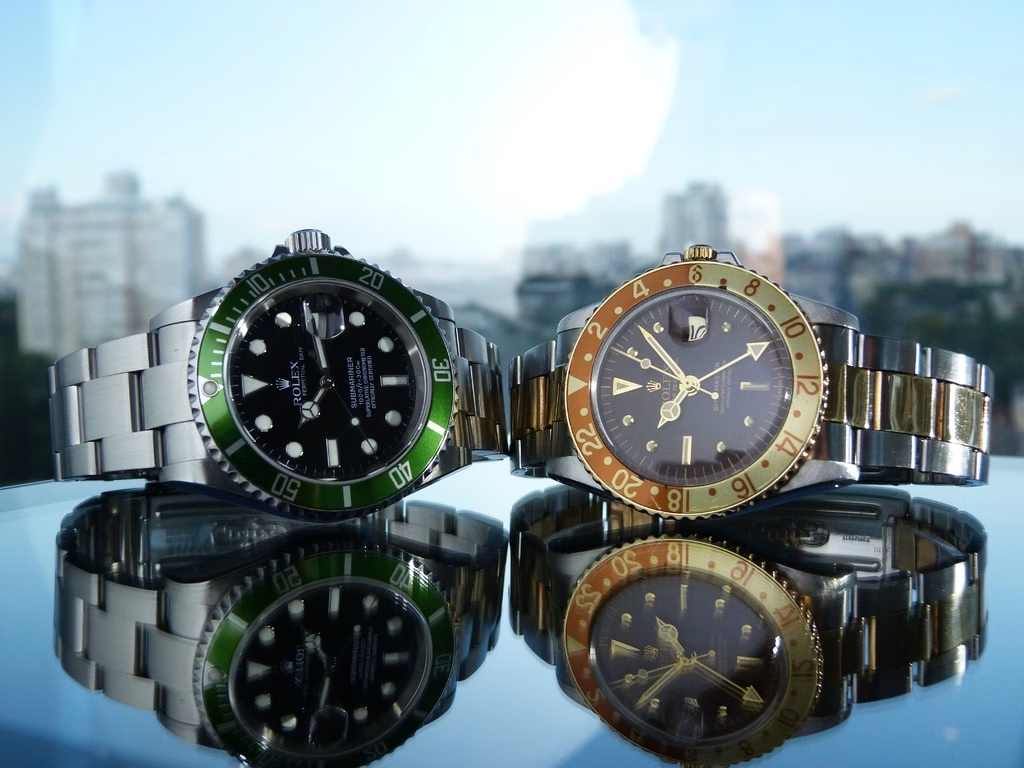
WSJ (“Rolex Tries to Beat Watch Flippers at Their Own Game“):
Rolex is likely only breaking even on its official secondhand watch program. That looks intentional. Leaving profits on the table protects the brand’s reputation while it tries to put flippers out of business.
Rolex looked at the multibillion-dollar annual trade in its secondhand watches, which is rife with counterfeits and speculators, and decided it had to intervene.
Three years ago, the Swiss brand launched an official certified preowned program. The program is expected to do more than $500 million in sales in 2025, based on estimates from data analytics firm WatchCharts. One of Rolex’s main authorized dealers, Watches of Switzerland, told investors this month that certified used Rolexes are now its second-biggest seller.
[…]
An insight from the program is that consumers will pay 28% more on average for a preowned watch that has been certified genuine by Rolex than one that hasn’t, according to Morgan Stanley. Shoppers will spend extra to feel confident they aren’t buying a fake and—importantly for mechanical watches—one that is serviced and working properly.
Certain models of Rolexes are already more expensive to buy used than new. Because demand far outstrips supply, there is a waiting list for the roughly 1.2 million new watches the company sells a year, based on Morgan Stanley’s latest estimate. Collectors pay a premium in the secondhand market to get their hands on a watch immediately.
For example, one specific model of a brand-new Rolex GMT-Master II known as the Pepsi, which features a red and blue bezel, costs $12,150 including average sales tax in stores. The watch costs $22,750 on resale websites, but the median price of one that has been certified authentic by Rolex is $26,750, according to WatchCharts data.
As someone whose most expensive wristwatch was maybe $150, I find all of this rather fascinating. I can’t imagine paying the price of a small car for a timepiece.* But there’s clearly a massive market for signaling affluence.
Even more interesting is this:
Despite that premium, Rolex treats its preowned program as a tool to protect its image rather than a new source of revenue. The plan is set up so that independent retailers such as Watches of Switzerland and the 1916 Company, which are already authorized to sell new Rolex watches, do most of the legwork and get all of the financial reward.
The retailers are responsible for sourcing secondhand Rolexes. They authenticate the watches and service them to the brand’s standards. Rolex then certifies the watches as genuine, and issues a two-year warranty. The retailer, not Rolex, sets the price for the certified watches.
This seems sensible. When luxury watchmaker Audemars Piguet launched a preowned program and set the prices itself, it caused a backlash with consumers. A growing consensus in the industry is that brands should set strict rules for their official preowned programs, but let others run them.
Again, I don’t quite understand the psychology here. I get why people would pay a premium to get a Rolex-certified watch rather than risk getting scammed. But it’s odd to me that people would be upset with Rolex making money selling secondhand Rolexes.
*Indeed, I went several years without wearing a traditional timepiece at all, opting instead for a Fitbit tracker. After Google acquired and enshittified the line, I finally opted not to replace my failing device several months back and dug some watches I hadn’t worn in years out of a drawer.

Rolex is following the lead of some manufacturers of exotic autos, particularly Porsche, Ferrari and Mercedes, those and others have set up “restoration shops” for vintage models. Like Rolex, someone having their car restored at the manufacturer’s shop is paying a premium.
A friend has a 911 with an interesting provenance, plus it has sentimental value for him. The car is original with the expected patina of a 40 yo car that sees 2-3000 miles a year use. A friend convinced him to have Porsche restore it, so he looked into it and was quoted $500,000. Needless to say, the car is still lovingly cared for and in its original condition.
As far as what is it about watches? For me it was seeing one on the wrist of someone that was a boyhood hero, the watch was a Rolex Daytona on the wrist of various racing drivers. Given that the Daytona is an exotic, the interest morphed to Rolexes in general. Seriously considered them and looked maybe a half dozen times, but could never pull the trigger. Finally my wife bought me one for Christmas several years ago and it’s a daily wear. Combination of fulfilling a youthful dream and fond feelings about someone I love.
Everyone is carrying a phone which tracks time. Watches are kind of superfluous for most people. I stopped wearing one 20-30 years ago. These expensive watches are really just jewelry.
Steve
You remind me I should re-read The Theory of the Leisure Class. It seems apt to our new Gilded Age.
@steve222:
Accurate time keeping is hugely important to navigation. Past that, a $5 watch is good enough for most people. Provided the time displayed in their phone, car, TV, computer, oven, microwave oven, coffee maker, stove, office clock, and assorted street clocks isn’t enough to keep track of time.
Once upon a time, when watches, then worn inside a pocket and attached to a chain, were not as accurate, the precision manufacture and use of jewels as working parts that made for best accuracy were expensive. Back then an expensive watch was an accurate one.
We could trace what steps took place afterwards, but the bottom line is quartz watches were accurate and cheap, leaving the need for the above in the dustbin of history.
A Rolex, or any other kind of expensive watch, is a status symbol or display of wealth, or worn as ornamentation like other jewelry. You’d get the same effect with a bracelet, which can also be expensive and serve as a status symbol. Your Rolex need not even tell time to serve this purpose.
In the mid-80’s to erly 90’s, one could go into Chinatown in NYC and buy a fake Rolex that cosmetically looked very good… until you actually picked it up and realized it was 1/3 the weight of any random real watch, much less a Rolex.
Also, I’m certain there are still many tourists from other countries proudly wearing their Bolex (yes, Bolex) watches purchased on street corners in NYC.
I once found a Patek Philippe Aquanaut on the ground in the grass at Ealing Green while arriving at work. Looked it up online. It was a $25K watch at the time. It had a broken clasp. I sent it back to Switzerland to have it repaired. Cost 200GBP. Sold it for 10,000GBP (about $19K at the time). I’ve never worn watches.
@Kathy:..Once upon a time, when watches, then worn inside a pocket and attached to a chain, were not as accurate, the precision manufacture and use of jewels as working parts that made for best accuracy were expensive. Back then an expensive watch was an accurate one.
Gift of the Magi
O Henry
“After funeral services in New York City, he was buried in the Riverside Cemetery in Asheville, North Carolina…
According to the cemetery, as of 2023, people have been leaving $1.87 in change (the amount of Della’s savings at the beginning of “The Gift of the Magi”) on Porter’s grave for at least 30 years. The cemetery says the money is given to area libraries.”
WikiP
What will people do now that pennies are no longer minted?
@steve222:
Totally agree. My iPhone is a watch.
I own a Rolex, it’s in a drawer somewhere. The only jewelry I wear is my platinum wedding ring which I wear because otherwise I just can’t keep the wimmins off me.
I habitually wear a watch when out of the house, perhaps mostly because I don’t habitually carry a phone. I have three, none of which are expensive.
Just two normal, reasonably smart but pretty cheap ones; and a rather ugly but functional and rugged “outdoors” watch/compass for walking.
I’ve never really seen the point of watches as “bling”.
Last watch I bought was a windup analog watch that cost under $10 in 2013 or so. I use it to time the application of depilatory cream in the shower. I never wore it or bothered to set the time. I’m not even sure it’s waterproof, just that it has endured.
This actually seems similar to clothing.
I happen to enjoy Arcteryx shirts.. that brand, as with basically all hi-end outdoor gear, has both a pre-owned and an outlet [1-2 years’ old stock] sections of their website. This is both a way to get started in merino wool [for example] for a low dollar commitment – and to add colors of styles you already know you like.. all while keeping any final profits with the home brand.
Seems like a trend across all industries.
Every electronic device I own with a screen shows the time. I haven’t worn a watch in 20 years. I’m sure for some men they are nothing more than ostentatious jewellery. Just about any battery-powered watch keeps time just as well as a Rolex.
@JohnSF: With the Trump Watch and the Trump Phone, MAGA cultists are doing their best to turn ordinary items into yet another political statement.
@steve222: @Michael Reynolds: @Ken_L: It’s useful not to have to pull the phone out occasionally. I prefer glancing at my wrist to pulling out the phone to keep track of time during seminar, for example. But a $38 Timex will serve that purpose and a $150 dress watch pairs just fine with a suit.
I love that term “Signaling affluence.” Thanks for adding that to my vocabulary. Though I have some affluence, I have never “signaled” it. I rented a car once for a one way trip and because they needed it to be moved to my destination, they asked me if I was willing to take a luxury car for the price of a generic compact car. Sure, fine. But when I stopped for breakfast on the way, the looks I got in the parking lot made me pretty uncomfortable. I was a working class kid who benefited from a 1960s tuition free University of California education, and I did well as an engineer. But the idea of not being able to have a friendly conversation with a cashier in the hardware store as peers because I’m wearing or driving something they can’t afford feels like it would be a huge loss.
BTW I have one watch I have been wearing for 25 years. I did spend a couple of hundred on it mostly because I have small wrists and it was the only men’s watch in the store that fit …