Trump Reverses Course in Minnesota
TACO Tuesday?
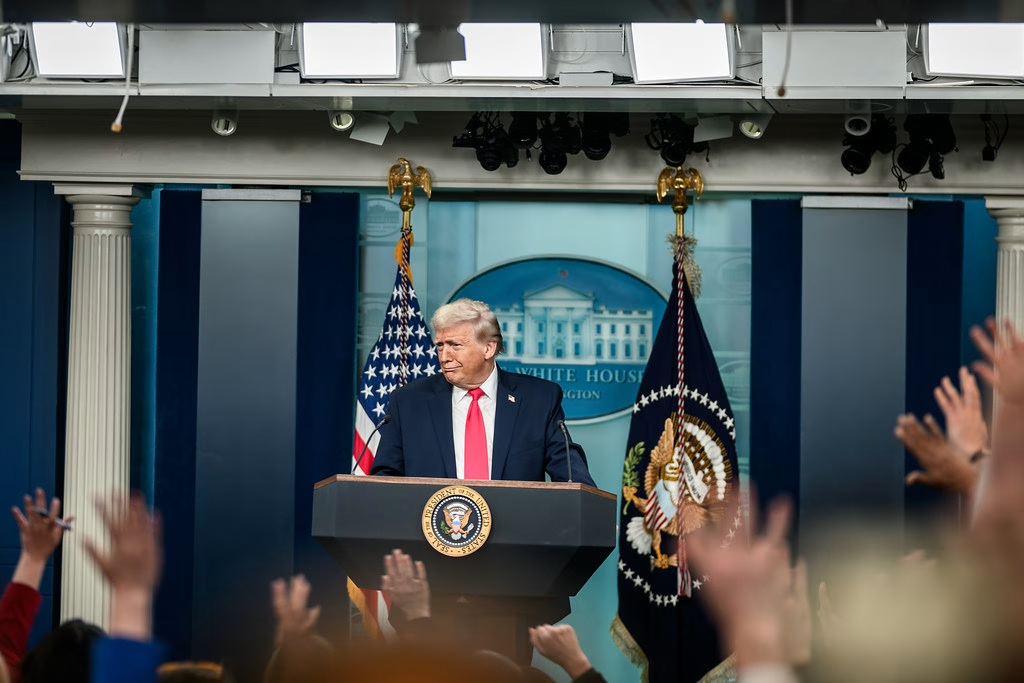
WSJ (“The 48 Hours That Convinced Trump to Change Course in Minnesota“):
The videos were splashed across cable news—and President Trump was paying attention.
Working from the Oval Office as a winter storm barreled toward the nation’s capital, Trump watched as footage of a federal immigration agent shooting Alex Pretti, a 37-year-old intensive-care nurse and U.S. citizen, played on repeat from Minneapolis.
Within hours of the shooting, Homeland Security Secretary Kristi Noem alleged Pretti had attacked officers and was brandishing a gun, labeling the actions domestic terrorism. Border Patrol Commander Gregory Bovino said Pretti wanted to massacre law enforcement. And Stephen Miller, the architect of Trump’s aggressive immigration strategy, called Pretti a “would-be assassin.”
It wasn’t long before that narrative started to fall apart—and Trump started to get frustrated, according to administration officials.
Roughly 48 hours after the shooting, Trump decided to change course, moving to pull back one of his administration’s most high-profile and divisive immigration-enforcement campaigns. By the end of the day Monday, Tom Homan, Trump’s border czar who advocated for a more targeted approach to deportations, was en route to Minneapolis to take charge. Bovino, the face of the hard-edge approach employed in Minnesota, was leaving the state.
Trump’s pivot came after Republican lawmakers and other allies raised concerns that he was squandering public support for his signature campaign issue and senior administration officials increasingly saw the chaotic scenes in Minneapolis as a political liability. Gun rights advocates, normally steadfast allies of Trump, publicly criticized administration officials for criticizing Pretti for carrying a gun during protest activity. State officials said Pretti had a permit to carry the weapon.
In the process, Trump appeared to take sides—for now—in a simmering debate that has been playing out quietly in the administration. Over the past year, Trump’s more hard-line aides, including Noem and her top adviser Corey Lewandowski, have pushed for missions that include roving patrols doing street sweeps in large liberal cities. Homan and others have favored a more methodical but slower approach to go after immigrants with criminal histories or final deportation orders, according to people familiar with the matter.
As Washington was being pummeled by snow and sleet on Sunday and many senior staff stayed home, Trump fielded calls from anxious Republicans, including Sen. Lindsey Graham of South Carolina, who delivered a message that Trump was already starting to internalize: The White House needed to find a way to pivot the narrative away from the shootings.
Graham told the president that the grisly visuals on TV needed to be changed, saying that they were overshadowing the success of other aspects of his immigration agenda, according to a person familiar with the call.
In an interview with The Wall Street Journal on Sunday afternoon, Trump declined to say whether the federal agent who fatally shot Pretti had acted appropriately and said the administration was reviewing the incident. He also signaled that he was considering withdrawing some federal immigration officials from Minnesota.
It was the first time that some senior advisers to the president learned that Trump was considering rethinking the administration’s strategy in Minneapolis, according to administration officials.
On Sunday night, Trump made clear that he was looking to make a deal: In a Truth Social post, he called on Minnesota Gov. Tim Walz and Minneapolis Mayor Jacob Frey to cooperate more closely with federal officials, including providing additional assistance in apprehending people living in the country illegally. Unspoken in the social-media post, but later confirmed by administration officials: If Minnesota leaders agreed to his terms, Trump would pull some U.S. Customs and Border Protection agents out of the state.
The next morning, Trump spoke by phone with Homan, according to administration officials, to discuss giving his longtime adviser a more prominent role. He surprised some aides when he posted a message on social media that he would be sending Homan to Minnesota. “Tom is tough but fair, and will report directly to me,” Trump wrote.
Later, the president talked with Walz and laid out conditions to reduce the number of federal agents in the state. Trump, who has repeatedly lashed out at Walz, characterized the call as productive, adding that they were “on a similar wavelength.” Trump also spoke with Frey.
White House press secretary Karoline Leavitt further sought to cool tensions, distancing Trump from some of his adviser’s rhetoric, even as she continued to blame Democratic leaders for fomenting protesters. “Nobody here at the White House, including the president of the United States, wants to see Americans hurt or killed and losing their lives in American streets,” she told reporters Monday. Trump has made clear that he will continue to focus on fraud in Minnesota even as he rethinks his immigration enforcement strategy.
Reuters (“Trump’s immigration approval drops to record low, Reuters/Ipsos poll finds“):
American approval of U.S. President Donald Trump’s immigration policy fell to its lowest level since his return to the White House in a new Reuters/Ipsos poll, with a majority of Americans saying his crackdown on immigration has gone too far.
The poll, conducted nationwide Friday through Sunday, gathered responses before and after immigration officers on Saturday killed a second U.S. citizen in Minneapolis during confrontations with protesters over Trump’s deployment of immigration agents to cities across the U.S.
Just 39% of Americans approve of the job Trump is doing on immigration, down from 41% earlier this month, while 53% disapprove, the poll found. Immigration was a brighter spot for Trump’s popularity in the weeks following his January inauguration. In February, 50% approved and 41% disapproved.
[…]
Some 58% of poll respondents said U.S. Immigration and Customs Enforcement agents have gone “too far” in their crackdown, while 12% said they had not gone far enough and 26% said the agents’ efforts were “about right.” About nine in 10 Democrats said the agents have gone too far, compared to two in 10 Republicans and six in 10 independents.
Axios (“The dam is breaking on Republicans questioning Trump’s DHS“):
After lockstep unity on immigration for the first year of Trump 2.0, a growing number of Republican lawmakers are calling for investigations and testimony from top Trump officials after the deadly shooting of Alex Pretti.
The dam is breaking, with Republicans more directly questioning the administration — including Homeland Security Secretary Kristi Noem — for its handling of the tragedy in Minnesota. “I disagree with Noem’s premature DHS response, which came before all the facts were known and weakened confidence,” Sen. John Curtis (R-Utah) posted on X on Monday.
Noem is expected to testify for an oversight hearing in front of the Senate Judiciary Committee on March 3, Chair Chuck Grassley’s (R-Iowa) office confirmed. The GOP chairs of Homeland Security committees in both chambers have also called on top DHS officials to testify in upcoming hearings. “Today, I call on the heads of ICE, CBP, and USCIS to testify before the Homeland Security Committee,” Sen. Rand Paul (R-Ky.) posted Monday afternoon, along with screenshots of his requests.
I am deeply troubled by the shootings in Minneapolis involving federal agents,” Sen. Jerry Moran (R-Kan.) posted on Monday. “Our Constitution provides citizens protection from the government. We have a right to free speech, to peaceably assemble and to bear arms,” Moran continued.
“I would encourage the administration to be more measured, to recognize the tragedy, and to say, we don’t want anyone’s lives to be lost,” Sen. Ted Cruz (R-Texas) told reporters.
“I support a full and transparent investigation into the tragic event in Minneapolis,” Sen. Todd. Young (R-Ind.) said in a statement. “Congress has requested testimony from ICE, CBP, and USCIS leaders in an open hearing, and they should testify soon.”
This builds on other GOP statements from over the weekend — such as from Sens. Dave McCormick (R-Pa.), Thom Tillis (R-N.C.) and Bill Cassidy (R-La.), and Reps. Dusty Johnson (R-S.D.), Michael Baumgartner (R-Wash.), Max Miller (R-Ohio) and Michael McCaul (R-Texas).
I must admit to being pleasantly surprised that at least a handful of Republican officials are responding to the outrage and that President Trump is listening and shifting course. Given that the MAGA base continued to cheer on the brutality of the crackdown—despite or because it was happening in a place with one of the lowest rates of illegal immigration in the country—I was not expecting a pivot anytime soon.
While I get the appeal of the “Trump Always Chickens Out” meme, I actually see his willingness to quickly back off harmful policies when faced with backlash as his greatest asset as a leader. Most of his predecessors would stubbornly cling to their decisions lest they look weak. Trump simply declares victory and moves on.
Of course, I would much prefer that the President were surrounded by competent advisors who could warn of the quite predictable outcome of policies like absurdly high tariffs, threatening allies with invasion, or flooding the streets of peaceful cities with poorly trained wannabe soldiers cosplaying as police. The motto of one of his predecessors,* “Don’t do stupid shit,” is good advice. But, if you’re going to unleash bad policies, moving on from them quickly beats the alternative.
“Stop doing stupid shit” is decidedly better than “Keep doing stupid shit.”
*If you prefer, Google’s motto works just as well.

BTW,
Here is what is happening in Congress, according to Punchbowl News, an insidery, gossipy political newsletter. For what’s it worth.
I would modify your point about his backing off to note that he usually doubles down first, once or twice before backing off. With the first killing by ICE in MN Trump supported the wild claims by Noel et al that the driver was trying to kill the agent when she clearly was not. In the more recent case you had, as usual, Noem et al making wild, over the top claims easily disputed by visuals that were so at odds with the claims it was much harder to support. The exception here might be the stock market. That gets a quick response. In short, lose life and you might eventually get a response. Lose some money and that gets a fast response.
As an aside, I cant help but think these killings still get ignored if the people killed were POC. These were nice, normal very white people. Even GOP politicians seem to recognize that’s not so well tolerated.
Steve
Too much made of this supposed pivot from Epstein’s pedophilic bestie. Unprofessional thugs from ICE and BP are still terrorizing Minnesota children. Immigrants charged with no felonies still held in indefinite detention without due process. Noem and Bovino still receiving salary from US taxpayers.
Leavitt’s minimally-softened tone (because some NRA types are mad) doesn’t reach the minimum contrition required to be called a course correction. Not yet.
But this part…
…is notable, worthy of highlighting. Will we get more, on other fronts? Skeptical.
Trump’s Johnny-come-lately micropivots don’t really merit even this unenthusiastic approval. His belated Greenland retreat is not undoing damage done to NATO, US power, and transatlantic relations — which, if not permanent, will take umpteen years to fix. Sending in Homan, a clown, will not undead Renee Good or untraumatize tear gassed children.
It’s no vice on their part that Trump’s predecessors maybe wouldn’t retreat from their imaginary fascism. Prior presidents wouldn’t have to retreat from blowing up NATO or attacking American citizens with paratroopers, because they’d never do these awful things. And it’s not virtue when Trump tepidly unfuks his own unprecedented messes.
A judge just ruled against Trump’s ballroom construction. If Trump were to now abandon the project, we’re still left with a pile of rubble.
Now if MAGA Republicans stop fellating Putin and instead work with Denmark and the EU to ensure Ukraine can force Putin to quit bombing and freezing Kyiv, that’d be a pivot. If Trump stops cutting Americans’ healthcare, fires Miller, redirects the bloated ICE budget to Medicaid and Medicare expansion, yes, let’s golf clap at him for changing course.
Sadly, I don’t expect to receive my long-coveted unicorn pony this year tho. *sobs*
The fact that they did the stupid shit in the first place is eternally damning. They’re going to try to spin this, like how in Iraq they rebranded the same crap over and over. I don’t see it working.
The real struggle is going to be how to treat reality. ICE is taking people who have been in this country for a long time, they’re taking people who are here legally via asylum and the courts are trying to stop it. It’s not like putting in Tom Homan is going to make reality different, unless you hand him 50K in a bag. ~35% of voters want this to continue, and the fact that a noble person was executed by a bunch of ignoble thugs isn’t going to create a change of heart in these people. It’s going to make them worse.
@DK: THIS. Well said.
Greg Sargent at The New Republic interviews Senator Chris Murphy:
“TNR transcript”
…
Italics from the original.
Forcing reforms on ICE is a laudable goal and may be the best Schumer and Jeffries can do. But it will reduce the salience of ICE abuses, even allowing TACO to say he acted against the abuses. Does a good deed and tactical victory today hurt or harm the necessary sole strategic aim of defeating the GOPs in ’28?
@Modulo Myself:
At some point Ds are going to have to stop trying to appeal to everyone. They have to recognize that some of the MAGA simply aren’t gettable. And they need to go further, they need to take a hard look at how GOPs use minorities, and immigrants, and imaginary DEI obsessed school librarians, and be willing to exploit some part of MAGA as an enemy.
I find this quite interesting:
More like changes course.
FBI to investigate Minneapolis activists after far-right claim about Signal chats
Salient claim:
Aside the fact that just about all message apps are encrypted these days, I fail to see anything actionable in the description above, beyond the unsupported claim.
Patel said there’ll be an investigation. How about investigating how war plans wound up on a reporter’s Signal feed first? Also, as noted before, I regard everything anyone in the Taco so-called administration says as a lie until proven otherwise.
This has all the look and feel of more harassment of political opponents.
He hasn’t backed off by much, this is about the illusion of backing off, trying to manipulate opinions. Nothing much has changed, and he is still in Portland also.
I’m thinking Trump is more worried about the bad optics further depressing ticket sales to Melania’s “documentary” than anything else.
Fatso has now changed the 2nd Amendment. Apparently if you don’t support him you can’t carry a legal weapon.
I’m old enough to remember when that fat fuck said he was very pro 2nd.
Top Democrats say that if Trump doesn’t fire Noem, they’ll impeach her. Trump says she’s doing a swell job.
By the by, is Noem still sleeping with Lewandowsky?
@Daryl: Trump pardoned people who brought guns to J6.
@Kathy: There have been many individual stories, some cited here recently, about individuals in Minnesota feeling like they need to go be there when ICE is at work so that they can observe and document what ICE is actually doing. They see themselves as protectors. I think these people are doing God’s work. Can you imagine if they weren’t there and documenting everything? If they weren’t there the official version of the story would have been Noem’s ie that the guy approached brandishing a gun and was trying to kill people. That Good had her car aimed at the ICE guy and was trying to run him over.
Steve
Meta and TikTok are censoring ice reporting, according to Senator Murphy and my daughter.
Trump held a 2-hour meeting with Noem and Lewandowski today.
Excerpt:
The Lincoln Project said something along the lines of the comms team is there but Stephen Miller isn’t, so this wasn’t a policy change meeting, it was a session on how to sell the bullsh!t better.
I think that sounds about right.
@Jen:
Axios suggests a night of the short knives is coming, and the target will be Miller.
I hope so.
There are two reasons why I believe this might happen: 1) someone made El Taco look bad*, which is worse than all deadly sins combined, and everyone is blaming Miller. 2) El Taco can’t even fantasize about f**g Miller.
*I know looking bad is his natural state, but he’s delusional about that as well as just about everything else.
@steve222:
I imagine Trump is asking Stephen Miller “Why aren’t they killing Somalians? You told me the place was crawling with illegal Somalians!“