Robert Duvall, 1931-2026
A great American actor is gone at 95.
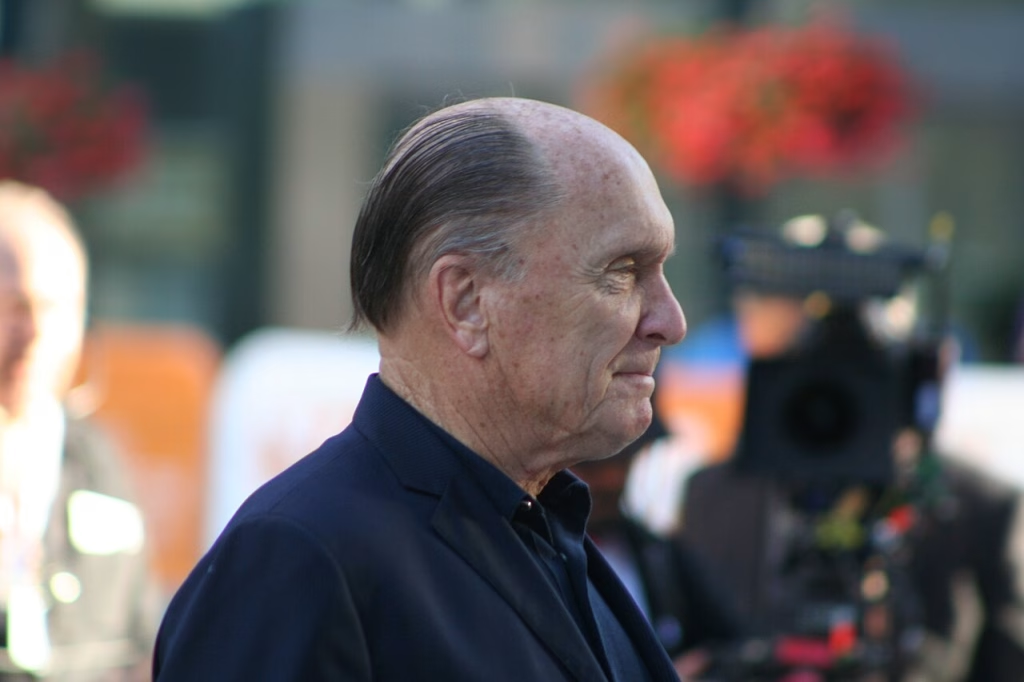
New York Times, “Robert Duvall, a Chameleon of an Actor Onscreen and Onstage, Dies at 95“
Robert Duvall, who drew from a seemingly bottomless reservoir of acting craftsmanship to transform himself into a business-focused Mafia lawyer, a faded country singer, a cynical police detective, a bullying Marine pilot, a surfing-obsessed Vietnam commander, a mysterious Southern recluse and scores of other film, stage and television characters, died on Sunday. He was 95.
His death was announced in a statement by his wife, Luciana Duvall, who said he had died at home. She gave no other details. He had long lived on a sprawling horse farm in The Plains, in Fauquier County, Va., west of Washington.
Mr. Duvall’s singular trait was to immerse himself in roles so deeply that he seemed to almost disappear into them — an ability that was “uncanny, even creepy the first time” it was witnessed, said Bruce Beresford, the Australian who directed him in the 1983 film “Tender Mercies.”
In that film, Mr. Duvall played Mac Sledge, a boozy, washed-up country star who comes to terms with life through marriage to a widow with a young son. The performance earned him an Academy Award for best actor, his sole Oscar in a career that brought him six other nominations in both leading and supporting roles.
“He is the character,” Mr. Beresford said of Sledge. “He’s not Duvall at all.”
Mr. Duvall, though, wasn’t buying it. “What do you mean?” he said in an interview with The New York Times in 1989. “I don’t become the character! It’s still me — doing myself, altered.”
Audiences and reviewers remained unconvinced. For them, Mr. Duvall, with a voice far from silky and features falling more than a few degrees short of movie-star handsome, effectively became someone entirely new, time and again.
Across a film career that took flight in the early 1960s, he stood out for an intense studiousness that shaped his every role. Even as a boy, in a Navy family that moved around the country, he had an ear for people’s speech patterns and an eye for their mannerisms. “I hang around a guy’s memories,” he once said. Insights that he gleaned were routinely tucked away in his head for potential future use.
Variety, “Robert Duvall, Star of ‘The Godfather’ and ‘The Great Santini,’ Dies at 95“
Robert Duvall, who won an Oscar for “Tender Mercies” and was nominated for his roles in films including “The Godfather,” “Apocalypse Now,” and “The Great Santini,” has died. He was 95.
[…]
Duvall’s gruff naturalism came to define the acting style of a generation that included Robert De Niro, Dustin Hoffman and Gene Hackman in such films as “Network” and “The Apostle,” which he also directed.
And while he may never have been as big a star as DeNiro, his unshowy ability to fully embrace the characters he played earned him respect both from his peers and from critics. As Francis Ford Coppola once told the New York Times, at a certain point, it’s “hard to say the difference between leading men and great character actors.”
He was an actor’s actor who drew seven Oscar nominations but also found time to shine in TV vehicles such as “Lonesome Dove” and “Broken Trail,” drawing a total of five Emmy nominations and winning twice.
His first big-screen role, and one of his most memorable, was the scary Boo Radley in 1962’s “To Kill a Mockingbird.” While Duvall’s career took some time to get off the ground despite the strong start, by the early to mid-’70s he had come into his own, combining the abilities for seamless character acting with occasional strong forays into larger roles.
In 1969, he paired with a young director, Francis Ford Coppola, onthe intimate drama “The Rain People,” and the next year got the juicy role of Frank Burns in Robert Altman’s “MASH.” He also starred in George Lucas’ experimental “THX 1138.” And the actor was doing interesting work onstage.
But the movie that turned it all around was 1972’s “The Godfather,” in which he played the patient and sly consigliere Tom Hagen, the role that brought him his first Oscar nomination. He reprised his role as Hagen in “The Godfather: Part II” in 1974. He also appeared in Coppola’s “The Conversation” and as Dr. Watson in Herbert Ross’ “The Seven-Per-Cent Solution.”
In 1976, he had a memorable role as a ruthless television executive in “Network,” and three years later, as Colonel Kilgore, he uttered the memorable “I love the smell of napalm in the morning” line in Coppola’s “Apocalypse Now,” walking off with a second Oscar nomination.
[…]
It was not, however, until “The Great Santini,” in which he played the title character, a blustery, militaristic father, that he established his leading man credentials on film, garnering his first Oscar nomination as best actor in 1980. The following year, he won kudos at the Venice Film Festival opposite Robert De Niro in “True Confessions.”
Then, in 1984, his quiet, detailed performance in “Tender Mercies,” written by Horton Foote and directed by Bruce Beresford, brought him the Oscar as best actor.
Thereafter, however, he often received top billing for secondary or co-lead roles, as in “The Natural,” “Colors,” “Days of Thunder,” “Rambling Rose,” “Geronimo: An American Legend” and “Deep Impact.”
The Hollywood Reporter, “Robert Duvall, All-Purpose Actor With Few Peers, Dies at 95“
Robert Duvall, the steely-eyed actor whose performances in the first two Godfather films, Apocalypse Now, The Great Santini, Lonesome Dove and The Apostle made him one of the finest actors of any generation, has died. He was 95.
[…]
Duvall distinguished himself as an actor of major promise — even though he didn’t have a line of dialogue — when he portrayed the reclusive Boo Radley in To Kill a Mockingbird (1962). Horton Foote, the film’s screenwriter, personally recommended him for the role after seeing Duvall onstage in New York a few years earlier in Foote’s The Midnight Caller.
Foote was a major influence on Duvall; he also wrote the screenplays for Tender Mercies and another excellent Duvall film, Tomorrow (1972), and the actor starred in The Chase (1966), an adaptation of a Foote novel and play.
So too was director Francis Ford Coppola, who first cast Duvall in The Rain People (1969), then hired him to play the trusted family lawyer Tom Hagen in The Godfather (1972) and The Godfather Part II (1974) and the surfing-crazy Lt. Col. Kilgore in Apocalypse Now (1979).
Duvall’s line in Apocalypse Now, “I love the smell of napalm in the morning,” became the stuff of movie legend. With jets flying overhead and shells exploding nearby, the scene, shot in the Philippines, was done, amazingly, in one take.
“There wasn’t any time to think,” Duvall told Roger Ebert in 1983. “I heard over the intercom that we only had the use of the jets for 20 minutes. One flyby and that was it. I just got completely into the character, and if he wouldn’t flinch, I wouldn’t flinch.”
However, in a lifetime of great roles, Duvall’s favorite was playing ex-Texas Ranger Augustus McCrae in the 1989 CBS miniseries Lonesome Dove, based on the Larry McMurtry Pulitzer Prize-winning novel. He got the part when James Garner, the first choice, said he wouldn’t be able to ride a horse for long stretches. (Duvall, on the other hand, was an expert rider, having spent summers as a kid on his uncle’s ranch in Montana.)
“I walked into the wardrobe room one day on Lonesome Dove and said, ‘Boys, we’re making the Godfather of Westerns,’” he told Stephen Colbert in 2021. “They were the two biggest things in the last part of the 20th century, I think.”
David Simms, The Atlantic, “A Different Kind of Leading Man“
Robert Duvall didn’t speak a word in his first film performance. When he was cast as Boo Radley in To Kill a Mockingbird, he was but an up-and-coming theater actor, and his role as the silent, mysterious neighbor to the heroine Scout Finch was small but pivotal. With his shock of blond hair and his haunted, sunken eyes, he somehow looked both childlike and ancient, and although Duvall wouldn’t rise to proper fame for another 10 years, Mockingbird was, for most of the world, an introduction to a man who’d be one of Hollywood’s most versatile and fascinating screen presences for decades to come.
Duvall died yesterday at the age of 95, having never formally retired from acting. His last two roles, in 2022, were in the sports comedy Hustle and the gothic thriller The Pale Blue Eye, and had the same cranky verve and twinkle he’d long brought to movies. Even though he didn’t appear in a movie until he was 31, he made more than 140 of them, receiving an Academy Award (along with six other nominations), an Emmy, and four Golden Globes. He could carry a film thunderously, as in The Apostle or The Great Santini, but won an Oscar for his beautifully melancholic work in the low-key country-music drama Tender Mercies. He could swoop in with a supporting performance like his electrifying Lieutenant Colonel Kilgore in Apocalypse Now, rhapsodizing about the smell of napalm in the morning, but just as easily stand out in subtler roles, like his calming consigliere Tom Hagen in the first two Godfather movies.
Most important to his extraordinary legacy as an actor, Duvall just didn’t stop working, putting in fabulous turns in notable movies, but never phoning it in in the smaller, sillier fill-in roles he took along the way. His filmography tells the story of a changing industry several times over. It includes sturdy ’60s classics such as Mockingbird and True Grit; challenging ’70s movies like George Lucas’s THX 1138 and Robert Altman’s M*A*S*H*; the beloved ’80s TV adaptation of Lonesome Dove; ’90s action hits such as Days of Thunder and Deep Impact; and fantastic 21st-century throwbacks like Open Range and We Own the Night. There are more than a dozen Duvall films you could plausibly pick as your favorite without being laughed out of the room, a truism that some of his best-known peers, such as Al Pacino or Robert De Niro, might struggle to replicate.
It’s interesting that Duvall’s favorite role, retired Texas Ranger Captain Augustus McCrae, was my favorite of his as well. The Lonesome Dove miniseries first aired almost exactly 37 years ago, February 5-8, 1989 while I was a student at the Field Artillery Officer Basic Course at Fort Sill, Oklahoma. My cohort loved it in real time, and I’ve rewatched it many times since.
The sheer breadth of the movies and television programs in which he appeared over six decades is remarkable. He played everyone from Robert E. Lee to Dwight Eisenhower to Joseph Stalin. I’d forgotten he was in Bullitt and M*A*S*H (although, in fairness, it’s been decades since I’ve seen the latter). He was great as Ned Pepper in True Grit—which was almost sixty years ago now. He played so many great characters. And made even silly movies like Days of Thunder watchable.

I was fortunate to work with Mr. Duvall on “Gods and Generals”, one of the worst jobs of my life. I don’t need to ever visit hell because I spent 7 months living in a Ramada Inn in Hagerstown, Maryland. Only upside was that both Baltimore and DC were about an hour away, so I could escape hell every weekend.
Mr. Duvall was professional, classy, very, very nice, and an absolute joy to be around. The man always had a good story to tell. RIP.
Sayonara to Frank Burns
M*A*S*H
My favorite movie starring Robert Duvall is “Tender Mercies.” Also enjoyed the “Lonesome Dove” series.
I thought he was brilliant in “Open Range”.
He often seemed to have an ability to convey a lot with rather few words, and without emoting that much. He could make a pause convey a lot, so to speak.